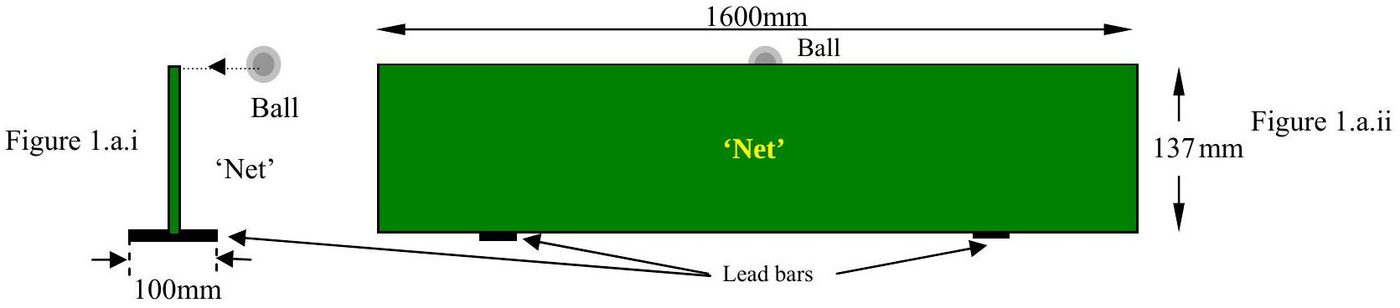
In this question you are asked to make reasoned estimates and assumptions. These must be clearly stated.
a)
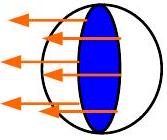
(i) On a really dark moonless night the planet Venus is sufficiently bright to produce shadows of objects on the Earth. Explain why the shadows are different to those produced by the Sun and the Moon.
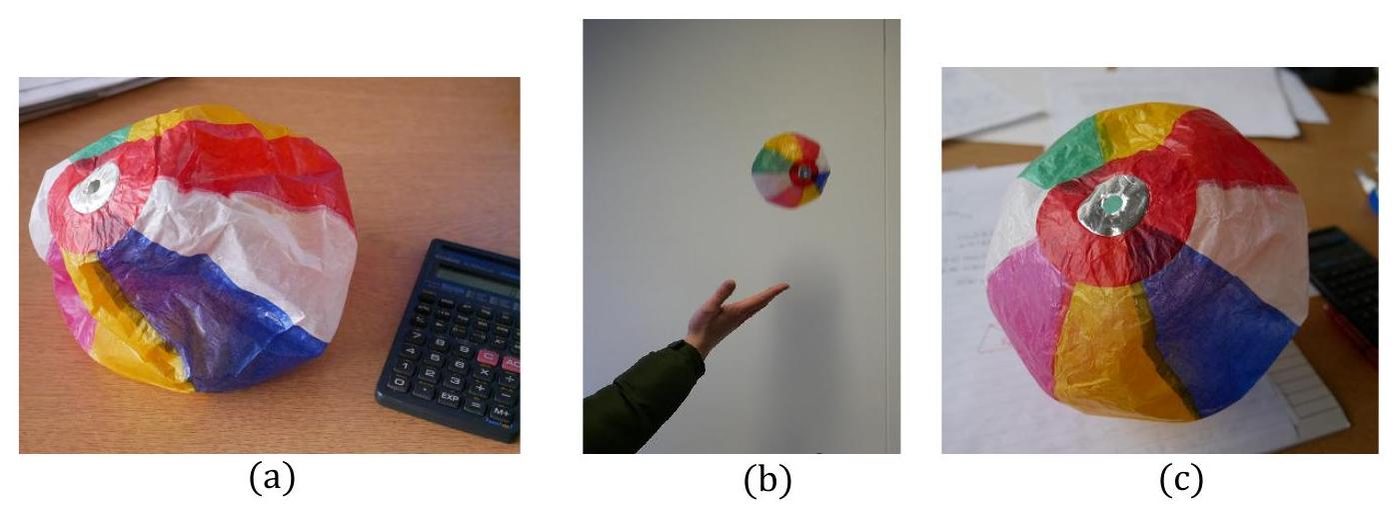
(ii) It is important not to under inflate car tyres - they could overheat and explode. Why is this?
(iii) It is difficult to open small plastic bags for vegetables in the supermarket. A sharp blow along the edge in the plane of the bag usually works. Why?
(iv) How long will it take to hard boil an ostrich egg? Explain how you reached your answer.
(b)
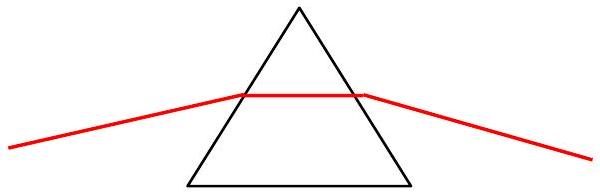
(i) Figure 1.1 shows an equilateral glass prism illuminated by a 100 W laser beam of wavelength $\lambda=600 \mathrm{~nm}$. The refractive index of the glass of the prism is 1.50 at $\lambda=600 \mathrm{~nm}$. The path of the light in the prism is parallel to the base of the prism. The momentum of a photon is $h / \lambda$. Calculate the change in weight of the prism when the beam is switched on.
(ii) Optical tweezers, which are composed of two lasers beams, are able to manipulate small transparent spheres. Explain clearly how this can be done and why at least two beams are needed.
(iii) Small smoke particles in air are seen under a low magnification microscope to move randomly at a speed of $0.10 \mathrm{~mm} \mathrm{~s}^{-1}$. The speed of sound in air is $330 \mathrm{~m} \mathrm{~s}^{-1}$. Estimate the mass of the smoke particles.
(c)
(i) Show that the de Broglie wavelength, $\lambda$, of a particle of mass $m$ moving at a velocity of $v$ where $v \ll c$ is related to the KE of the particle by:
$$\lambda=\frac{h}{\sqrt{2 m \cdot K E}} .$$
(ii) Consider the particle in a small rectangular box with sides of length $a, b$ and $c$. The particle is moving at right angles to the " $b-c$ " plane. Find an expression for the smallest possible energy of the particle.
(Think about the amplitude of the wave at the wall of the box)
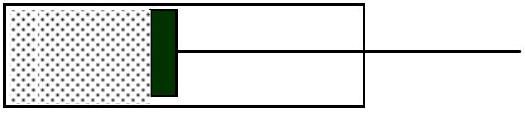
(iii) The box now contains many particles, and one " $b-c$ " plane of the box is replaced by a piston. Show that as the length, $a$, is slowly decreased the resulting change in wavelength ensures that Boyle's Law is obeyed
d)
If an isotope of nitrogen is bombarded by alpha particles, protons are observed. The reaction that occurs is:
$${ }_{7}^{14} N+\alpha \rightarrow{ }_{8}^{17} O+p .$$
Calculate the minimum K E of the alpha particle if this reaction is to occur. Explain your answer.
Data
| Nuclei | Mass $/ 10^{-27} \mathrm{~kg}$ |
|---|---|
| Nitrogen 14 | 23.2466 |
| Oxygen 17 | 28.2209 |
| Alpha particle | 6.6442 |
e) A man is fishing in a boat floating in a small pond. To stop him drifting in the wind he takes a large rock, to which a rope is attached from inside the boat, and lowers the rock to the bottom of the pond, fastening the rope to the boat. Explain what happens to the level of the water in the pond?
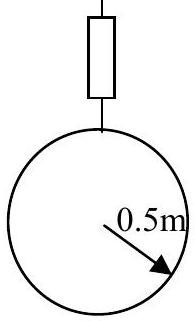
f) Figure 1.2
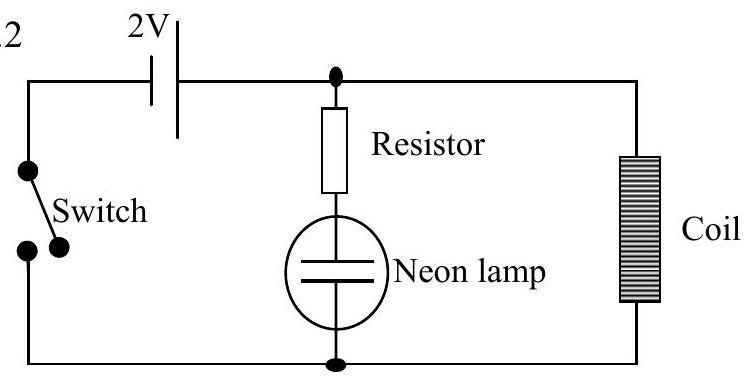
Figure 1.2 shows a circuit containing a resistor, coil, neon lamp, switch and 2 V cell. The bulb needs 80 V to light it and goes out if the PD across it drops below 60 V . The switch is closed and nothing is observed. The switch is opened and the Neon light flashes once. Explain.
Show answer · 显示答案
- (a)(i)See the book for the worked solution.
- (a)(ii)See the book for the worked solution.
- (a)(iii)See the book for the worked solution.
- (a)(iv)$t_{\text{ostrich}} \approx 1.5 \;\text{hours}$
- (b)(i)$\Delta W \approx 2 \times 10^{-7}\;\textrm{N}$
- (b)(ii)See the book for the worked solution.
- (b)(iii)$m_{\textrm{smoke}} \approx 1.1 \times 10^{-12}\;\text{kg}$
- (c)(i)$\lambda = \frac{h}{\sqrt{2m \cdot KE}}$
- (c)(ii)$KE_{\min} = \frac{h^2}{8ma^2}$
- (d)$KE_{\alpha,\min} \approx 1.95\;\text{MeV}$
- (e)See the book for the worked solution.
- (f)When the switch is opened, the inductor generates a very large back-EMF ($\mathcal{E} = -L\,dI/dt$) because the current cannot change instantaneously.
Full worked solutions: BPhO Round 2: Past Questions and Solutions (book)