10 questions — reveal the final answers. Full worked solutions: the book.
2005 Q32005Modern and Nuclear Physics · Spring oscillations, molecular vibration and de Broglie waves
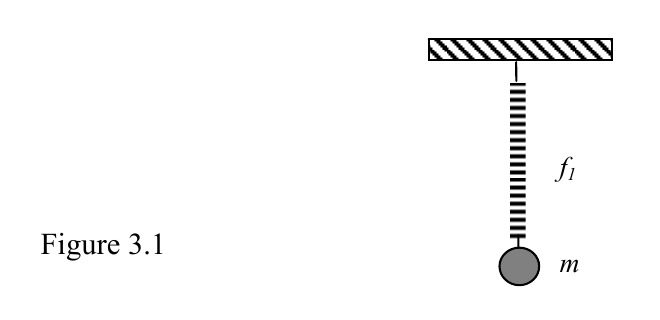
a) Figure 3.1 shows a mass $m$ hanging from a spring of natural length $l$, stiffness $k$, and of negligible mass.
(i) Derive, from first principles, a formula that gives the frequency of longitudinal oscillations, $f_{1}$, in terms of the relevant given parameters.
b)
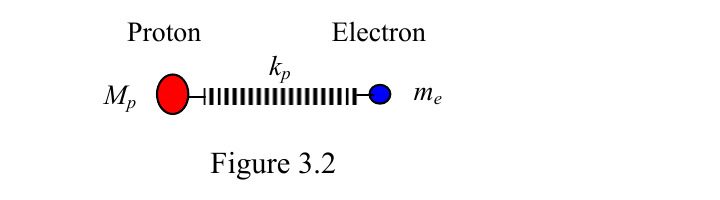
Figure 3.2 illustrates a very simple model of a hydrogen atom. The masses in this case are $M_{p}$ and $m_{e}$. The spring stiffness is $k_{p}$. Ignore the mass of the springs.
(i) Find the position, relative to the proton, of the point on the spring that does not move when the masses are in motion; the unstretched length of the spring being $l$.
(ii) Find a formula, in terms of the given parameters, that gives the fundamental frequency of the hydrogen atom, $f_{p}$.
(iii) Assuming the stiffness, $k_{p}$, of the hydrogen atom is the same as that, $k_{D}$, of the deuterium atom, determine the value of the ratio $\dfrac{f_{p}}{f_{D}}$, where $f_{D}$ is the frequency of the deuterium atom.
c) In the earliest circular planetary model of the atom the electron and proton orbited a common centre. The electrostatic forces alone provided the force field. However an accelerating charged body will send out electromagnetic waves and the orbiting charges would consequently lose energy continuously. The model did not, as it stood, predict the existence of discrete energy levels that were known to be a consequence of the discrete system of spectral lines.
In the wave particle model the de Broglie wavelength, $\lambda$, is related to the momentum $p$ ($p=mv$) by $\lambda=\dfrac{h}{p}$. Assume $v
(i) Use this to find a relationship between the KE of a body and its wavelength.
(ii) How, using the de Broglie result, can a discrete energy level model be constructed?
(iii) A neutron has a KE of 1.0 eV. Calculate its de Broglie wavelength.
(iv) Neutron beams are useful for investigating the nature of certain crystals. Why are neutrons used?
2013 Q12013Modern and Nuclear Physics · Special relativity: light clock, time dilation, current-carrying wires
Observations show that the speed of light in a vacuum is always the same whatever the speed of the source relative to that of the observer.
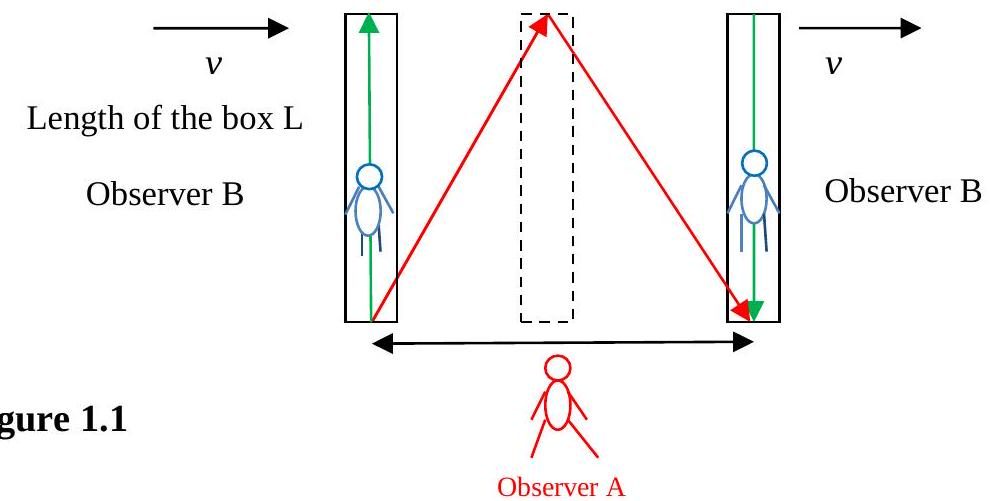
a) Light, illustrated by green arrows, bounces up and down in the box that has perfect mirrors at each end. Observer B is in the box and Observer A is outside the box. The box is observed by A to be moving past at a speed of $v$.
(i) How far does Observer B think the light has travelled?
(ii) How far does Observer A think the light has travelled?
(iii) How long does Observer B think the light takes to travel this distance?
(iv) How long does Observer A think the light takes to travel this distance?
b) Two copper wires carry a current of $I$ amps, Figure 1.2. The wires are 1 mm in diameter and you may assume that there is one free electron per atom.
Find the speed at which the electrons drift down the wire (ignore thermal effects). Use a semi-quantitative argument to show that there will be a force between the wires when a current $I$ flows in each wire - without bringing in the concept of magnetism.
(b)The effect is very small because it is of order $v_{d}^{2}/c^{2}$, but it is non-zero; transforming back to the ion frame gives the same attractive force between the two wires without needing to introduce magnetism.
2013 Q52013Modern and Nuclear Physics · Photon redshift and gravitational frequency shift
a) A particle of electromagnetic radiation is called a photon. A photon has an energy of $h f$ where $h$ is Planck's constant. Write down an expression for the wavelength of the photon if it is emitted from a body moving away from the observer at a speed of $u$ where $u$ is much less than $c$. However, Einstein's theory of general relativity predicts another effect. On leaving the star the photon gains potential energy due to the star's gravitational field.
Derive an expression that gives the change in wavelength due to this gravitational effect when light of frequency $f$ leaves a star of mass $M$, radius $R$. For the purposes of this derivation you can assume that a photon has a fictional mass of $m$ that will (should!) disappear from your final equation.
b) Among the animals that appear in the zoo of the Universe there are black holes and neutron stars. The mass of each of these is often the order of the mass of the Sun. The radius of a neutron star is about 10 km and a certain neutron star rotates at about $100 \pi \mathrm{~s}^{-1}$.
Calculate the ratio of the polar diameter to the equatorial diameter for a typical neutron star. Assume that liquid or solid neutron material is incompressible. How do we know that it is rotating at this frequency?
c) Why are space rockets launched from positions near the equator? In order to launch a space probe out of the solar system, it is decided to send the probe close to Jupiter. Explain why this route reduces the fuel needed.
2017 Q32017Modern and Nuclear Physics · Ionisation chamber and alpha-emitting gas
An ionization chamber is designed to measure the ion current from a radioactive gas. Initially the gas in the chamber is nitrogen. A small amount of Gas A is introduced into the chamber. It contains radioactive atoms which emit alpha particles with energy 6.5 MeV . It takes 15.6 eV to ionize a molecule of nitrogen.
(a) How many alpha particles per second does a current of $17 \times 10^{-9} \mathrm{~A}$ correspond to?
(b) Make an estimate of the expected variation in this current due to random variations in radioactive decay. Why do the current readings not show these variations?
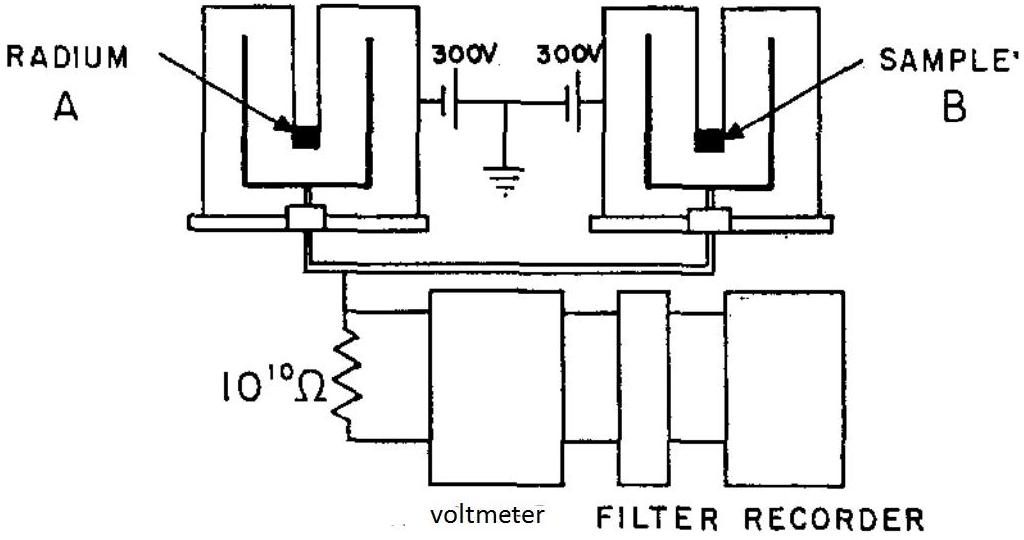
(c) For accurate half-life measurements, a balanced ionization chamber apparatus has been used. This is shown schematically in Figure 3. The liquid sample of radium, whose half life is known accurately, and an unknown sample B are inserted in adjacent chambers. The voltage across a $10^{10} \Omega$ resistor is measured when it is attached to each chamber to measure the difference in current between them. The measurements go to a recorder. What advantages could there be in this experimental method and setup?
(d) After evacuation of the original ionization chamber, Gas B is introduced and the current measured. Gas B contains two radioactive isotopes, both emitting $\alpha$ radiation of the same energy as Gas A.
Plot a graph of $\ln (I / \mathrm{n} A)$ against time (where $I$ is current) and explain its shape in as much detail as you can.
(e) Use your graph to determine the half-life of the longer lived isotope.
(f) Now use the results of these calculations to find the half-life of the shorter lived isotope.
(g) Gas B is removed before Gas C is introduced and the current measured. Gas C is identical to Gas B except that the decay product of the shorter lived isotope is itself unstable, emitting alpha particles of identical energy to Gases A and B . If S is the short-lived component of $\mathrm{C}, \mathrm{L}$ is the long-lived component and X is the decay product of S , sketch graphs of $\ln (I / \mathrm{n} A)$ against time for the following cases. Indicate rough values on your graphs.
(i) The half-life of X is less than the half-life of S .
(ii) The half-life of X is greater than the half-life of L .
Show answer · 显示答案
Final answers · 最终答案
(a)$A = 2.55\times10^{5}\mathrm{~s}^{-1}$
(b)$\delta I = 0.034\mathrm{~nA}$
(c)The $10^{10}\Omega$ resistor converts the very small difference current into a recordable voltage, and continuous recording permits a slope to be measured over days rather than waiting for a time comparable with a long half-life.
(g)(i)The current rises initially only if $I_{\mathrm S0}(k_{\mathrm X}-k_{\mathrm S})>k_{\mathrm L}I_{\mathrm L0}$.
(g)(ii)The crossover depends on the unspecified X half-life; for the representative slow-X curve in the official scheme it is of order $300\mathrm{~min}$.
$$\delta(A, Z):\left\{\begin{array}{l}
\delta(\text { even, even })=-A^{-\frac{1}{2}} \tag{4}\\
\delta(\text { even, even })=+A^{\frac{1}{2}} \\
\delta(\text { odd, even/odd })=0
\end{array}\right.$$
This model is partly based on theory and partly on experiment, with $A$ and $Z$ taken to vary continuously.
(a). (i) Find an expression for the binding energy of the nucleus, $B E(A, Z)$. The $\delta(A, Z)$ term captures the tendency of nucleons to form pairs in the nucleus so is often referred to as the 'pairing' term. Suggest, with reasoning, the physical origins of the other terms in your expression, giving as much detail as you can. It may help to know that the electrostatic energy of a spherical distribution of charge $Q$ with radius $r$ is $E=\frac{3}{5} \frac{Q^{2}}{4 \pi \varepsilon_{0} r}$.
(ii) The term in equation (2) which is accompanied by the constant $a_{3}$ is often written alternatively as $a_{3} Z(Z-1) A^{-\frac{1}{3}}$. Suggest why this might be.
(b). (i) Represent the binding energy graphically as a function of $Z$ for a given mass number, justifying your reasoning. How many protons does it predict for the most stable nuclei? Show that $Z \approx \frac{A}{2}$ is a decent approximate value.
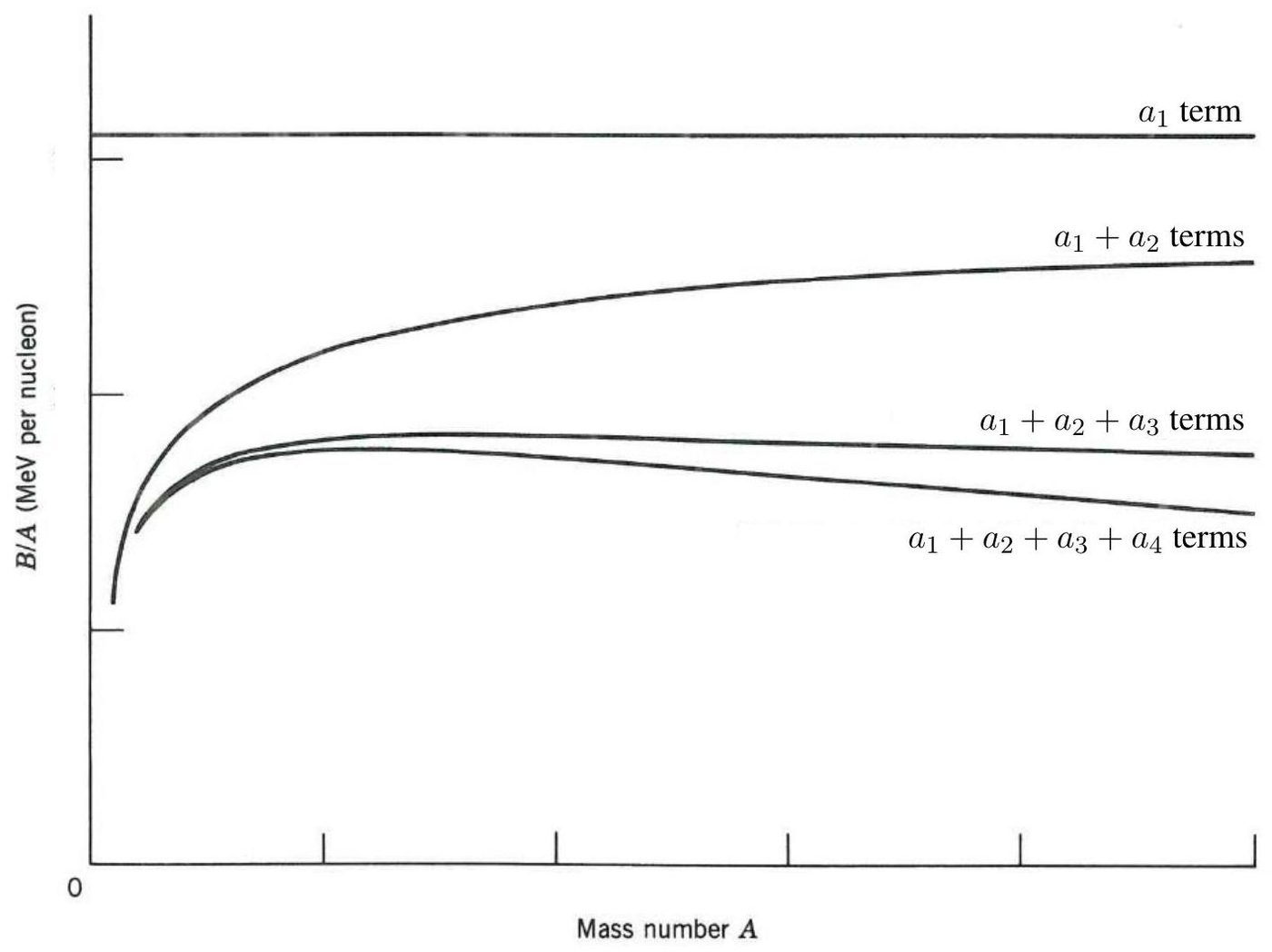
(ii) Figure 5, on the next page, shows the contributions of the various terms, with the exception of the pairing term, to the binding energy per nucleon as a function of mass number. Considering nuclei with an odd number of nucleons, predict the mass number of the most stable nuclei showing your method clearly.
(c). By analogy with the electrostatic energy of a spherical distribution of charge, $E=\frac{3}{5} \frac{Q^{2}}{4 \pi \varepsilon_{0} r}$, include a term for the gravitational energy in your expression for the binding energy per nucleon. Continuing to assume that the number of nucleons is odd, use your new expression to estimate the minimum mass for which a neutron star can be stable.
(d). Returning to (b), make a less basic approximation of the value of $Z$ for which nuclei are stable, and hence a less basic prediction for the mass number of the most stable nuclei.
Hint: Halley's method is a root-finding algorithm which rapidly converges on the root of an equation $f(x)=0$. If $x=x_{n}$ is an approximation to a root of $f(x)=0$, then
is a better approximation. Here, $f^{\prime}\left(x_{n}\right)$ refers to the first derivative of $f(x)$ with respect to $x$, evaluated at $x=x_{n}$. Likewise $f^{\prime \prime}\left(x_{n}\right)$ is the second derivative of $f(x)$ with respect to $x$, evaluated at $x=x_{n}$
Show answer · 显示答案
Final answers · 最终答案
(a)(i)$E_{\mathrm e}=\frac35\frac{(Ze)^2}{4\pi\varepsilon_0r_0A^{1/3}}$, whose coefficient is about $0.72\,\mathrm{MeV}$, consistent with $a_3$.
(a)(ii)The electrostatic energy should count pairs of distinct protons, so the number dependence is $Z(Z-1)$ rather than $Z^2$.
2020 Q42020Modern and Nuclear Physics · Free-electron model of conduction; Fermi energy of sodium
Write you answer starting on a new page for this question.
This question is about conduction in a metal. Data on the metal sodium can be found at the end of the question. (Sodium has one free electron per atom for conduction.) Conduction in metals can be usefully discussed in terms of the free electron model. We can consider "free" electrons that move with complete freedom throughout a metallic solid, subject only to reflection at the inside surface of the conducting body. Classically the electron has a large random thermal motion with a superimposed systematic drift due to an electric or thermal gradient in the metal.
(a) If we consider the electron gas to have a classical gas distribution of velocities, using the kinetic interpretation of temperature, evaluate the RMS velocity of an electron at room temperature $(300 \mathrm{~K})$. This is equivalent to the thermal speed, $v_{\text {th }}$.
(b) If an electric field $E$ is applied to the conductor the electrons will drift in the opposite direction to $E$. This drift velocity $v_{\mathrm{d}}$ is lost due to random collisions of the electrons with the ion lattice, so that the average drift velocity is zero immediately after any scattering collision.
(i) Sketch a schematic graph of $v_{\mathrm{d}}$ against $t$ for an electron in the field $E$.
(ii) Calculate the average drift velocity of an electron in a sodium wire of cross sectional area $1 \mathrm{~mm}^{2}$ with a current of 1 A flowing.
(iii) Sketch a path of such a conduction electron as it travels along the wire
(iv) Calculate a value for the distance travelled parallel to the field, $x_{\mathrm{d}}$ in time $\tau_{m}$.
(c) The resistivity of a metal, $\rho$ is also often cited in terms of the electron mean free path, the distance $\lambda=v_{\text {th }} \tau_{m}$ that any electron moves by virtue of its thermal speed during the mean free time between collisions with the lattice ions, $\tau_{m}$. Derive an expression for the resistivity of a metal, in terms of $e, \lambda, n, k_{\mathrm{B}}, m_{e}, T$.
(d) The temperature dependence of the resistivity of a metal is obtained in this result. How does this dependence compare with the typical temperature dependence of $\rho$ for metals at room temperature?
(e) Using the conductivity $\sigma=1 / \rho$ for sodium, and the data given at the end of the question, calculate the mean free path of an electron in sodium at room temperature.
It is clear that this model of conduction gives the wrong temperature dependence, and including a distribution of electron velocities as for a gas does not correct the difficulty.
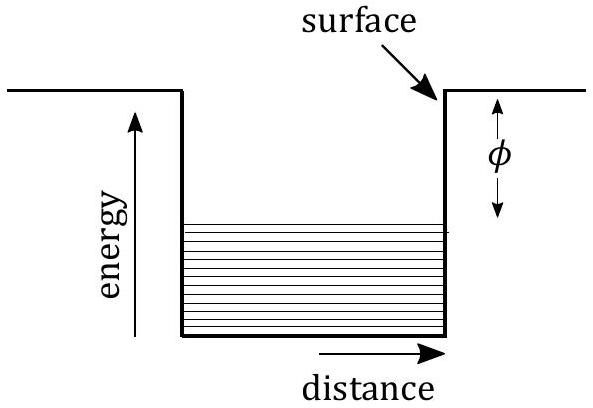
To glimpse an approach to a quantum model, we treat the electron as a standing wave with a de Broglie wavelength in a closed container (analogous to sound waves in a closed pipe). An electron is trapped in the metal conductor in a state represented by a standing wave with nodes at the faces. The states form energy levels in the solid (like energy levels in an atom), as illustrated in Figure 7. Due to a quantum mechanical effect (the Pauli Exclusion Principle) at most two electrons can occupy a single energy level: the next two electrons fill the next energy level, etc.
(f) If we take energy levels as determined by de Broglie waves with nodes at the surface of the metal, sketch the waves corresponding to the lowest three energy levels for six electrons trapped in a one dimensional potential well of width $\ell$.
(g) In a 3-D cube of metal of side $\ell$, the energy levels are filled up to an energy $E_{\mathrm{F}}$ by $N$ electrons. Show that the number of energy levels filled up by $N$ electrons is given by $E_{\mathrm{F}}=\frac{h^{2}}{8 \ell^{2} m_{e}}\left(n_{x}^{2}+n_{y}^{2}+n_{z}^{2}\right)$, where $n_{x}, n_{y}, n_{z}$ are the labels of levels below filled by electrons.
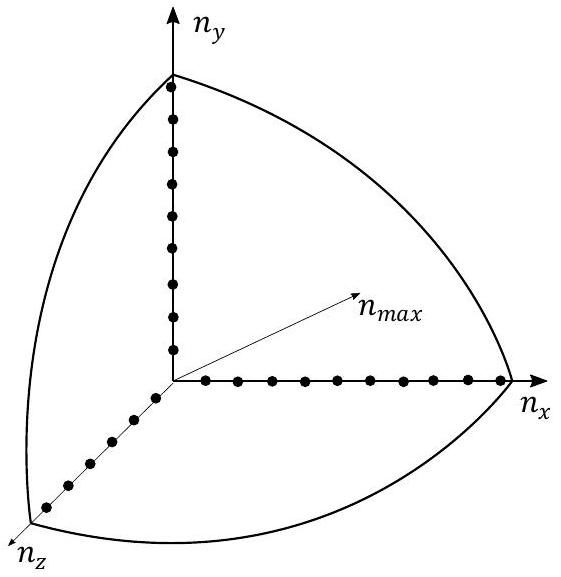
If we let $\left(n_{x}^{2}+n_{y}^{2}+n_{z}^{2}\right)=n_{\text {max }}^{2}$ then all of the levels are filled up to $n_{\text {max }}$, which corresponds to a radius in an octant of a sphere in a space of radius $n_{\text {max }}$ (the $n$ 's are only positive values), as shown in Figure 8. Thus at temperature $T=0 \mathrm{~K}$ all $N$ conduction electrons in a cube of side $\ell$ occupy $L$ levels, given by
(h) Derive an expression for $E_{\mathrm{F}}$ in terms of $h, m_{\mathrm{e}}, N$ and volume $V=\ell^{3}$.
(i) Hence obtain a numerical value for $E_{\mathrm{F}}$ for sodium in units of eV .
At a temperature $T>0 \mathrm{~K}$ only the states near $E_{\mathrm{F}}$ can supply conduction electrons, electrons in the lower states being fixed in their energy levels by the electrons above. (There are no empty states for these lower electrons to scatter into). This leads to a disconnect between the temperature and the classical thermal energy of the electrons.
(j) The Fermi speed, $v_{\mathrm{F}}$ is defined by $\frac{1}{2} m v_{\mathrm{F}}^{2}=E_{\mathrm{F}}$, and the mean free path is now given by $\lambda=v_{\mathrm{F}} \tau_{m}$.
(i) Calculate the value of $\lambda$ for these scattered conduction electrons at the Fermi energy.
(ii) How many atomic sodium diameters does this length correspond to? (assume a simple cubic packing structure for sodium to calculate a diameter).
(k) Calculate the derivative $\left(\frac{\mathrm{d} n}{\mathrm{~d} E}\right)$ at $E_{\mathrm{F}}$. Hence calculate the energy separation of two states at $E=E_{\mathrm{F}}$. It may be concluded that we may consider the energy to be virtually continuous for these conduction electrons.
Sodium has one free electron per atom for conduction.
$$\begin{aligned}
\text { conductivity } & \sigma=8.7 \times 10^{7} \mathrm{~m} \Omega^{-1} \\
\text { electron ion number density } & n=2.9 \times 10^{28} \mathrm{~m}^{-3} \\
\text { density } & \rho_{m}=0.971 \times 10^{3} \mathrm{~kg} \mathrm{~m}^{-3} \\
\text { molar mass } & M=23.0 \mathrm{~g} \mathrm{~mol}^{-1}
\end{aligned}$$
2021 Q22021Modern and Nuclear Physics · Proton decay and pion kinematics
Proton decay is a hypothetical form of particle decay in which the proton decays into lighter subatomic particles. One possible decay mode, common to many models (including Grand unified Theories and String Theories), is into a positron and a neutral pion: $p \rightarrow e^{+}+\pi^{0}$. The masses of these particles, expressed in units of $\mathrm{MeV} / c^{2}$ where $c$ is the speed of light in vacuo, are: $m_{p}=938 \mathrm{MeV} / c^{2}, m_{e}=0.511 \mathrm{MeV} / c^{2}$ and $m_{\pi}=135 \mathrm{MeV} / c^{2}$. As with radioactive decay the rate of decay is presumed to be proportional to the number of undecayed protons in a given sample.
(a) Show that $N=N_{0} e^{-\lambda t}$, where $N$ is the number of undecayed protons at time $t, N_{0}$ is the number at time $t=0$ and $\lambda$ is a constant called the decay constant.
(b) By considering the number of protons, $\mathrm{d} N$, that decay in time $\mathrm{d} t$ :
(i) Show that the probability, $\mathrm{d} P$ for a proton to decay in this time can be expressed as
\begin{equation*}
\mathrm{d} P=\lambda e^{-\lambda t} \mathrm{~d} t \tag{2}
\end{equation*}
(ii) Show that all the probabilities (from $t=0$ to $t=\infty$ ) sum to 1 as expected.
(iii) Show that the probability that a proton remains undecayed after time $t$ is given by
You may assume, without proof, the standard integral
$$\int_{0}^{\infty} x e^{-x} \mathrm{~d} x=1$$
(c) The average heat outflux through the surface of the Earth is $Q=92 \mathrm{mWm}^{-2}$.
(i) Assuming that this outflux is produced entirely by proton decay, estimate a lower bound for the proton's mean lifetime.
(ii) Why is this a considerable underestimate?
(d) The Super-Kamiokande detector in Japan is currently the largest detector for the observation of proton decay. It consists of a tank containing 50,000 tons of ultrapure water with about 13,000 photomultiplier tubes, covering about $40 \%$ of the area around the tank that detect Cherenkov radiation produced by the movement of charged particles through the water.
(i) Assuming the detectors are $100 \%$ efficient, how long would you have to wait, on average, to observe one proton decay.
(ii) How many decays would you expect to observe per year, on average?
(iii) The detection process for such decays can be modelled using Poisson statistics where the probability of observing $k$ decays per year, $p(k)$, is given by
$$p(k)=\frac{\mu^{k} e^{-\mu}}{k!}$$
with $\mu$ the average number of decays per year. So far, no convincing proton decays have been observed. What would be the probability of not observing any decays in a year and what would this mean for the lifetime you calculated in (c) (i)?
[0pt]
[3]
(e) Assuming that any proton decay occurs via the process $p \rightarrow e^{+}+\pi^{0}$, with the proton decaying while at rest, determine the energies and speeds of the positron and neutral pion produced. Hint: The energy, $E$, of a particle of rest mass $m$ and momentum $p$ (velocity $v$ ) is given by $E^{2}=p^{2} c^{2}+m^{2} c^{4}$ with $p=\gamma m v$ and $\gamma=1 / \sqrt{1-\frac{v^{2}}{c^{2}}}$.
2022 Q22022Modern and Nuclear Physics · Nuclear fusion, Coulomb barrier and stellar interiors
This question explores nuclear fusion and the interior structure of stars.
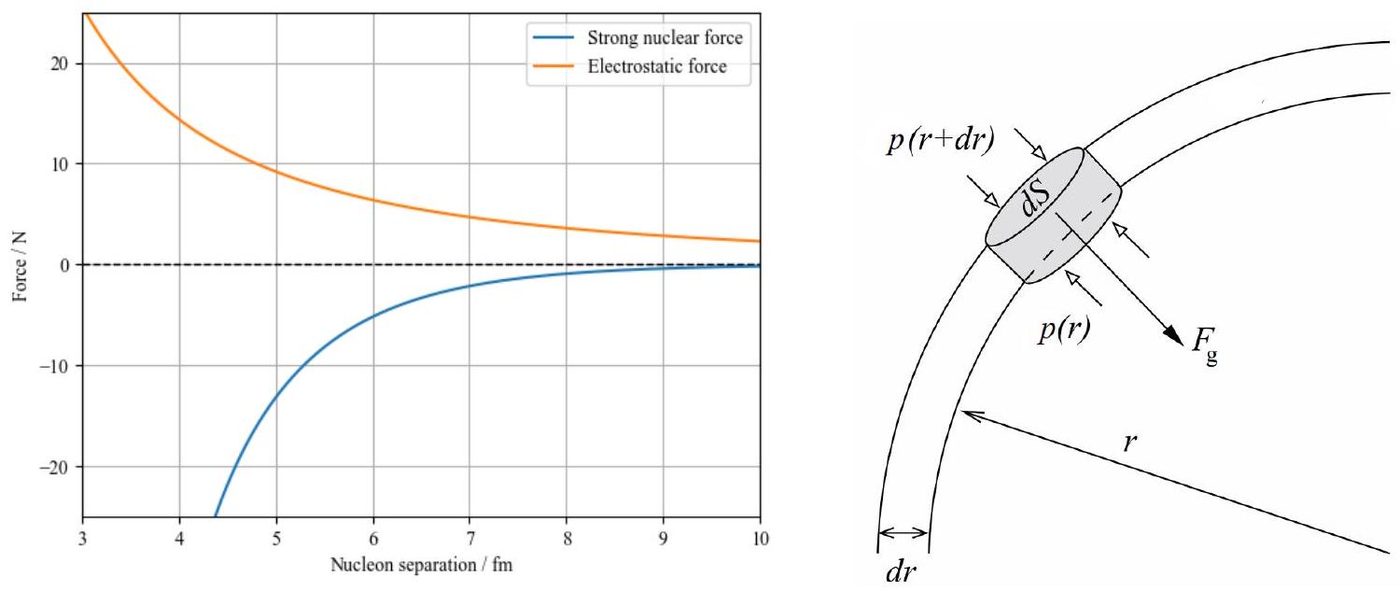
(a) As shown in Figure 3, two protons separated by 7 fm experience a mutual electrostatic repulsion of about 5 N . Verify this fact by calculation.
(b) Make a rough copy of the graph of Figure 3 and add your own sketch to it to show the resultant force between two protons, as a function of their separation. Explain why very high temperatures are required for fusion to occur. Hence estimate the minimum temperature for proton-proton fusion to occur.
(c) Suggest why your answer to part (b) is likely to be an overestimate.
(d) The gravitational field strength within a star is given by $g(r)=-G m(r) / r^{2}$, where $m(r)= \int_{0}^{r} 4 \pi r^{\prime 2} \rho\left(r^{\prime}\right) d r^{\prime}$ is the mass enclosed at radius $r$ and $\rho(r)$ is the gas density, i.e. the force of attraction at radius $r$ is only due to the mass of the sphere that lies within radius $r$. By considering the forces on the fluid parcel indicated in the right-hand panel of Figure 3, show that the pressure gradient within a star in hydrostatic equilibrium is given by
and thereby argue that the pressure decreases with increasing radius throughout the star.
(e) The Sun has mass $M=2 \times 10^{30} \mathrm{~kg}$ and radius $R=7 \times 10^{5} \mathrm{~km}$. By taking crude averages (across the whole star) for each of the quantities in Eq. 1, estimate the pressure and temperature of the Sun's core. Is it plausible that the Sun is powered by nuclear fusion? Do protons move relativistically in the Sun's core?
(f) Modelling the Sun with the following density profile, determine more careful estimates for the pressure and temperature at the Sun's core:
where $\rho_{0}$ is the density at the Sun's core.
(g) Almost all stars we observe have a mass $M$ in the range $0.1 M_{\odot}
Show answer · 显示答案
Final answers · 最终答案
(a)$F \simeq 4.7\ \mathrm N$
(b)$T_{\min}\sim10^9\ \mathrm K$
(c)See the book for the worked solution.
(d)$g(r)=-\frac{Gm(r)}{r^2}<0$
(e)$v_{\mathrm{rms}} \simeq 2.5\times10^{-3}c$
(f)$T_c \simeq 1.2\times10^7\ \mathrm K$
(g)Below about $0.1M_{\odot}$, gravity cannot produce a central temperature and pressure high enough for sustained hydrogen fusion; such objects are brown dwarfs rather than main-sequence stars.
2023 Q22023Modern and Nuclear Physics · Bohr-de Broglie model of hydrogen and energy levels
This question explores energy levels in atoms. The model is interesting both from a historical perspective and as an example of where classical physics meets quantum physics.
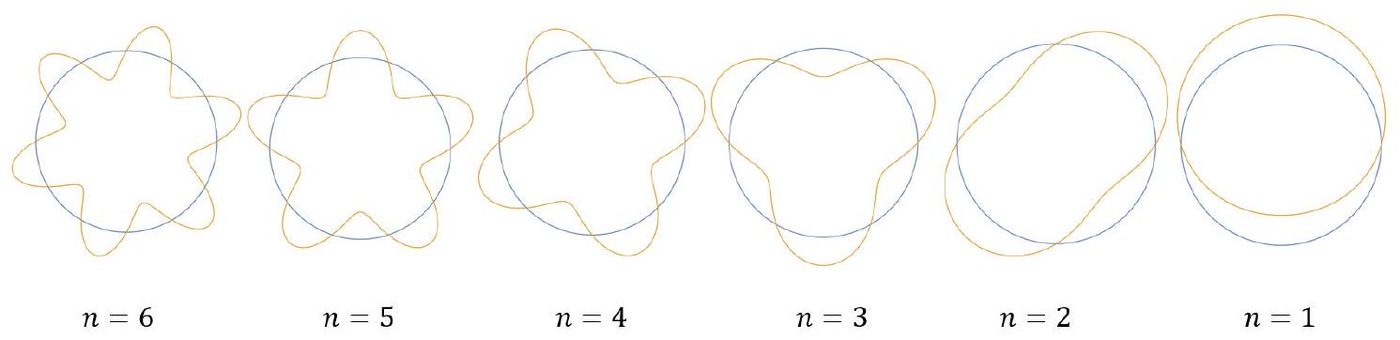
(a). In a simple model of the hydrogen atom due to Bohr and de Broglie, electrons are assumed to follow circular orbits around the nucleus with the wave-like nature of electrons manifest as resonant states or standing waves around a closed orbit, with the number of half-wavelengths given by the integer, n. This model of the orbits is illustrated in Fig. 8.
(i) Sketch the $n=3$ example shown and referring to your sketch, comment on what determines the value of $n$.
(ii) By considering the electron simply as a particle of mass $m$ and charge $e$ orbiting the nucleus, derive an expression for the total energy of the system, $E$, in terms of the radius of the orbit of the electron around the nucleus, $r$
The energy of the electron in its orbit is dependent upon $r$, but there is no restriction on the value of $r$ or of $E$. Now, if we consider the electron as a de Broglie wave,
(iii) show that the wave-like nature illustrated in Fig. 8 leads to the quantisation condition
$$r p=n \frac{h}{2 \pi}$$
where $p$ is the momentum of the electron.
(iv) Determine the radius of the hydrogen atom that this predicts when $n=1$. Does it seem sensible?
(v) Determine the energy levels of atomic hydrogen, $E_{n}$, in this model. Calculate the ground state energy in eV .
(b). In a slightly improved model, the electron and nucleus orbit their common centre of mass.
(i) Show that the electron and nucleus orbit with a common angular velocity, $\omega$, and find an expression for $\omega$ in terms of $r$, the separation of the electron from the nucleus, and $\mu$, the so-called 'reduced mass'
$$\mu=\frac{m M}{m+M}$$
with $m$ the mass of the electron and $M$ the mass of the nucleus.
(ii) The quantity $r p$ in (a).(iii) is the angular momentum of the electron. This is the 'moment of momentum' about the orbital centre. A generalisation of the quantisation condition arrived at previously has the total (sum of) angular momentum of the electron and nucleus quantised in units of $\frac{h}{2 \pi}$. Calculate the lowest two energy levels of both atomic hydrogen and atomic tritium in this model.
(iii) Which of hydrogen and tritium would absorb a shorter wavelength of light for a given atomic transition? What is the difference between the two wavelengths?
2024 Q42024Modern and Nuclear Physics · Fluorescence, photon counting and lifetimes
This question explores light bulbs and fluorescence.
(a). A fluorescent material absorbs photons and re-emits photons of a longer wavelength. One of its most common applications is in fluorescent lamps, where a UV photon leads to the emission of a visible light photon.
(i) Estimate the efficiency of a fluorescent light bulb. Why will this value necessarily be a maximum?
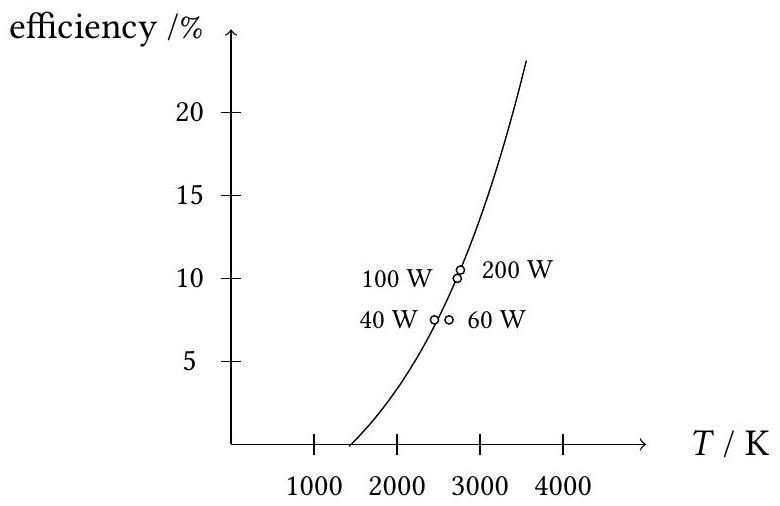
(ii) The graph below shows the estimated efficiency of incandescent light bulbs as the temperature of the filament varies. The estimation is based on a model where the filament is treated as a non-ideal black body emitting across the visible spectrum.
Figure 9: Estimated efficiency vs temperature $T$ of incandescent light bulbs. The open circles show data for 40, 60, 100, and 200 W bulbs.
Compare the efficiency of incandescent bulbs with fluorescent bulbs, commenting on your answer in light of the processes involved.
(b). Electrical conductivity in semiconductors is determined by the susceptibility of electrons to be excited from the valence states ('valence band') to the conduction band ('conduction band'). The difference in energy between these two bands is called the band gap. In an LED, electrons in the conduction band fall to the valence band and emit photons in the process.
(i) Gallium arsenide (GaAs) is a semiconductor with a band gap of 1.42 eV . Fluorescein is a liquid that absorbs light of a wavelength around 494 nm and fluoresces at around 512 nm . Determine whether a GaAs LED will stimulate fluorescence in fluorescein.
(ii) A laser diode is made from a gallium arsenide-phosphide alloy ( $\operatorname{GaAs}_{1-x} \mathrm{P}_{x}$ ) with a band gap of $E_{g}=2.50 \mathrm{eV}$. This provides a collimated light source which is used to illuminate a dilute sample of fluorescein that absorbs a proportion $\varepsilon$ of the incident photons. The proportion of photons emitted (assumed isotropically) to photons absorbed by a fluorescent material is called its quantum yield, denoted by $\Phi$. A detector of area $A$ connected to a photomultiplier tube is situated at a distance $r$ from the sample, detecting emitted photons and generating a measurable electrical signal. The detector generates electrons via the photoelectric effect which are then amplified by a factor $f$ by the photomultiplier.
If the power of the laser is $P_{l}$, find an expression for rate of detection of photons $\frac{\Delta n}{\Delta t}$, explaining your reasoning carefully. You may find that a diagram of the setup is helpful.
(iii) In a particular experiment, the laser has a power of 4 mW , the dilution of fluorescein (whose quantum yield is 0.9 ) is $1 \%$, the detector diameter is 1 cm , and the signal is amplified by a
factor of $10^{6}$ to give a current of 3 mA . Calculate the distance between the sample and the detector. Why is this likely an overestimate?
(iv) If the uncertainty in the detector area diameter of $\pm 5 \%$ dominates, estimate the uncertainty in the sample-detector distance.
(c). Fluorescein is an example of a fluorophore, a chemical compound that can re-emit light upon excitation. The rate at which a population of $N$ excited fluorophores decays is proportional (with constant of proportionality $k$ ) to the number of excited fluorophores present. The fluorescence lifetime $\tau$ is the time taken for a population of $N$ excited fluorophores to decrease to $N / e$ via the loss of energy through fluorescing.
(i) Find an expression for the number of excited fluorophores as a function of time after pulsed excitation, and determine the fluorescence lifetime. What are the units of $k$ and what are the units of $\tau$ ? Show your working and explain your reasoning.
(ii) A short pulse of laser light is directed towards the sample in described in (b). Following this, the detector current changes from 3 mA to 0.25 mA in 10 ns . Calculate the lifetime of fluorescein.
(a)(ii)The graph gives an efficiency of only about $7$--$10\%$ for ordinary filament temperatures near $2500$--$3000\;\text{K}$, well below the roughly $50\%$ upper bound estimated for fluorescence.
(b)(i)$\text{a GaAs LED will not stimulate appreciable fluorescein fluorescence}$