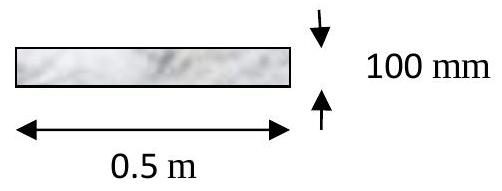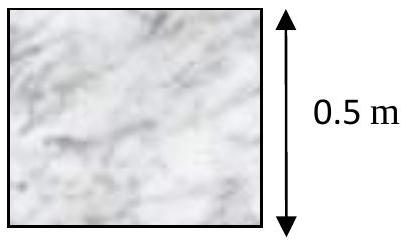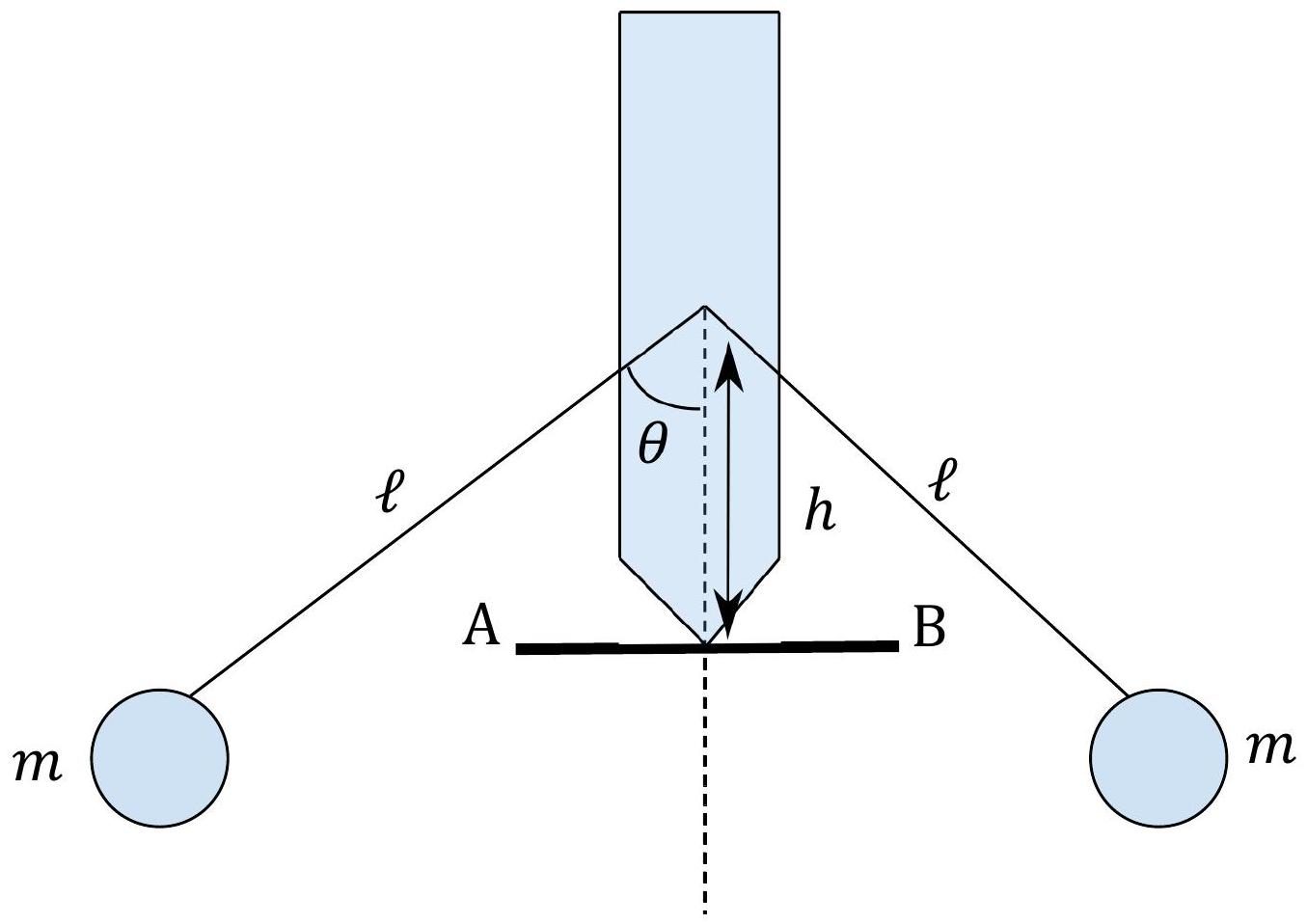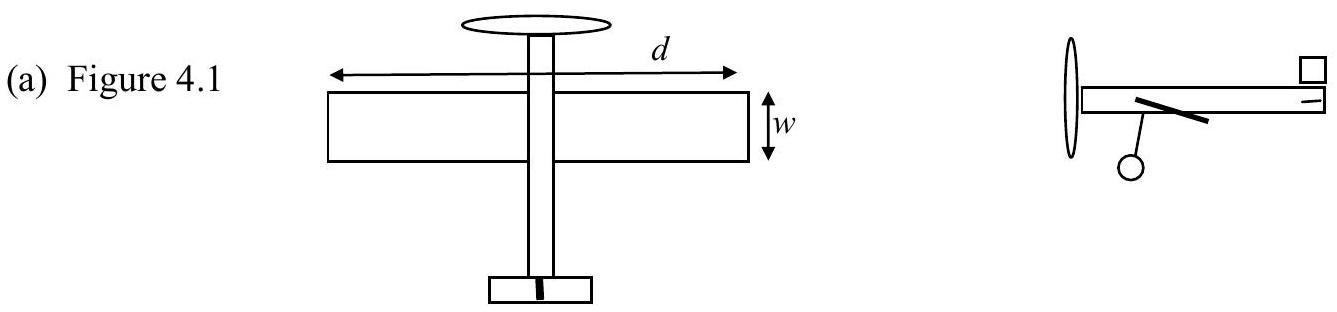
Figure 4.1 shows a diagram of a model aeroplane. The wing may be regarded as a thin rigid sheet; lift is obtained by the air hitting the angled wing. When the aeroplane is flying horizontally the wing is angled at $10^{\circ}$ to the horizontal. The mass of the aeroplane is $m$ and the density of air is $\rho_{\text {air }}$.
(i) Find an expression for $v$ the speed of the aircraft, relative to the air, if it is to maintain horizontal flight.
(ii) Find the minimum power needed to maintain this speed if $m=1 \mathrm{~kg}, \rho_{\text {air }}=1.2 \mathrm{kg} \mathrm{m}^{-2}, d=2 \mathrm{~m}$ and $w=0.2 \mathrm{~m}$.
(iii) Solar panels produce about $60 \mathrm{~W} \mathrm{~m}^{-2}$. Comment on the wing area if the plane is to be driven by solar power alone.
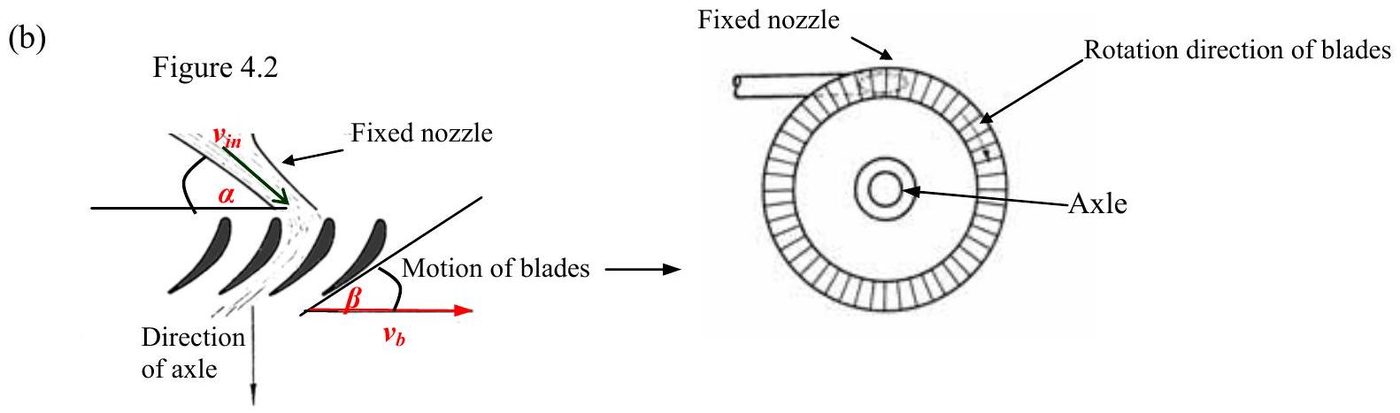
Figure 4.2 shows two views of a water turbine. The blades move at a mean tangential velocity $v_{b}$. The water from the fixed nozzle, velocity $v_{\text {in }}$ makes an angle of $\alpha$ with the direction of the blades and the angle at which the water leaves the blades relative to the blades is $\beta$, Figure 4.3.
Figure 4.3
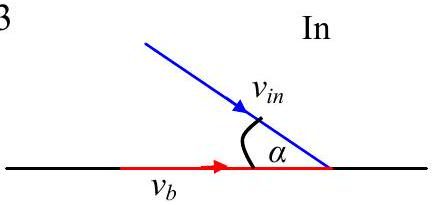
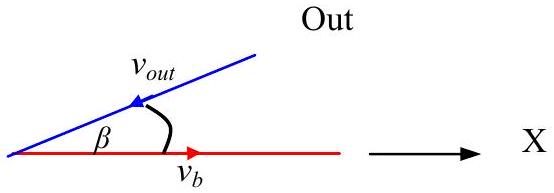
Copy the two vector diagrams in Figure 4.3 and complete the triangle of vectors. Explain the added vectors and their effects.
(c)
Assume that the magnitude of the velocity of the water in the passage between the blades does not change. Write down an expression for the change in momentum of the water in the direction X in terms of $v_{\text {out }}, v_{\text {in }}, \alpha, \beta$ and the mass flow per second $\mu$. Show that this leads to the expression:
\begin{equation*} F v_{b}=\mu\left(\frac{v_{\text {in }}^{2}-v_{\text {out }}^{2}}{2}\right) \end{equation*}
where $F$ is the force on a blade. Explain the significance of this equation.
Show answer · 显示答案
- (i)$v = \frac{1}{\sin\theta}\sqrt{\frac{mg}{\rho_{\mathrm{air}} \, d \, w}}$
- (ii)$P \approx 45\;\mathrm{W}$
- (iii)The wing area $A = d \times w = 0.4\;\mathrm{m^2}$ generates about 24 W from solar panels.
- (c)$F v_b = \mu\left(\frac{v_{\text{in}}^2 - v_{\text{out}}^2}{2}\right)$
Full worked solutions: BPhO Round 2: Past Questions and Solutions (book)