BPhO · Round 2 · Long answer

Gravitation and Astrophysics

16 questions — reveal the final answers. Full worked solutions: the book.

2003 Q22003Gravitation and Astrophysics · Missing mass: fields inside shells, galaxy rotation curves, MOND
Question 2 - Missing Mass

Figure 2.1

figure
figure

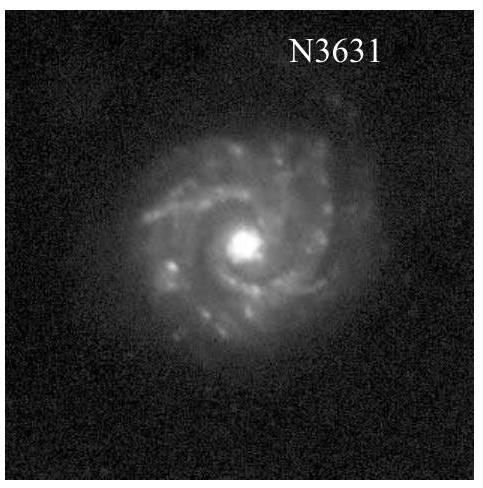
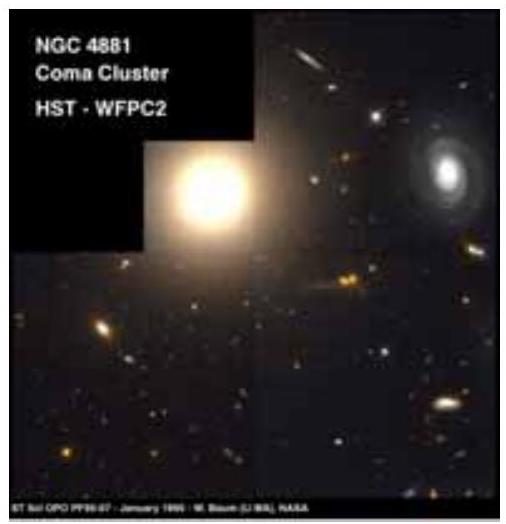
Figure 2.1 shows a photograph of the galaxy N 3631 . The axis of rotation of this disc-like galaxy is at right angles to the plane of the photograph. The velocity of stars in similar galaxies, that are seen edge on, can be determined from the Doppler shift of the spectral lines of the constituent stars. The rotation rates are slow and the speeds of the stars are very much smaller than the speed of light. Figure 2.2 shows a photo of the Coma cluster of galaxies. This contains at least one roughly spherical galaxy. The magnification of the Coma cluster is less than that of N3631.
a) A thin uniform density spherical shell is of mass $M$, radius $R$. Show that there is no gravitational field due to the shell inside the volume enclosed by the shell.
b) In the case of a spherically symmetrical body of uniform density and of radius $R$ show that the gravitational field inside the body at a radius of $r$ depends only on the mass of the body contained within radius $r$ for $r \leq R$. Sketch graphs showing how you would expect (i) the gravitational field (ii) the gravitational potential to vary from the centre to a distance of $3 R$ from the centre.
c) A ring of material has radius $x$. Explain why the gravitational field is not generally zero inside the plane of the ring and hence that the orbit of a star in the galaxy N3631 will be affected by the extent of the galaxy outside the orbit of the star.
d) An estimate of the mass of the Coma cluster can be made from the velocity of the galaxies relative to the centre of mass of the cluster; the velocities are around $2000 \mathrm{~km} \mathrm{~s}^{-1}$. The stars that form the cluster have been together for a long time. Show that a simple model will predict a mass of the cluster of the order of $2 \times 10^{43} \mathrm{~kg}$. The radius of the Coma cluster is about $10^{21} \mathrm{~m}$.
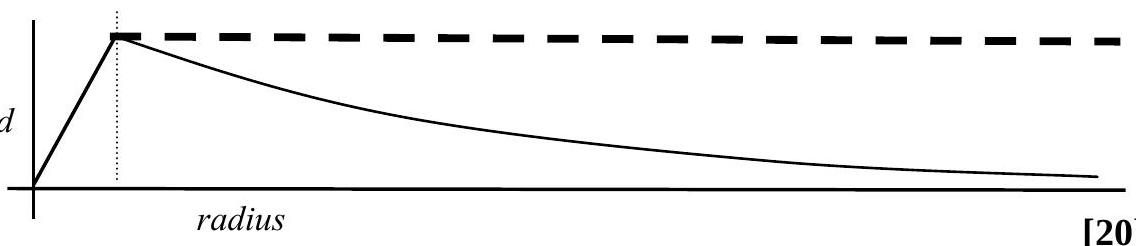
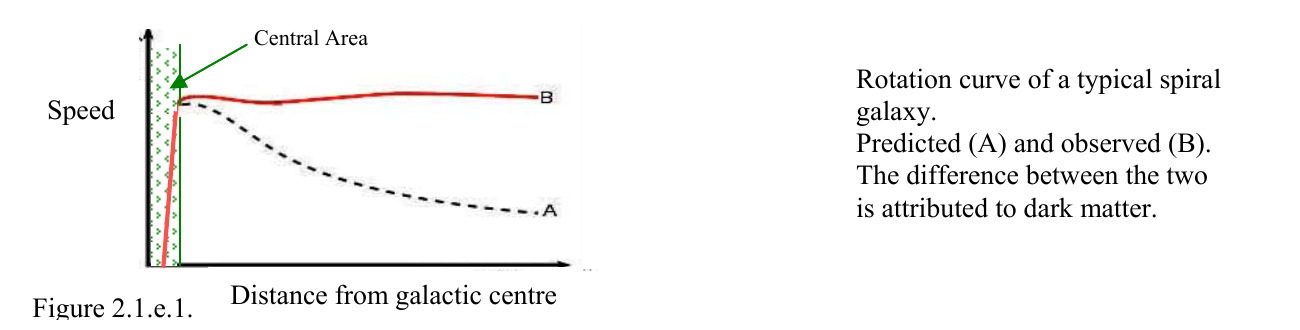
e) Measurements can be made of the luminosity of the Coma cluster and compared with that of the Sun. The observed luminosity of the cluster divided by its mass is of the order of a hundred times less than that of the Sun. The implication is that most of the mass in the cluster is dark i.e. too cold to emit detectable radiation - hence the term missing mass. It has been suggested that another solution to the problem is a modification of Newton's Laws of motion for very small accelerations, such as the Sun's acceleration towards the centre of the Galaxy $\left(\approx 10^{-10} \mathrm{~m} \mathrm{~s}^{-2}\right)$. For a spherical, constant density, galaxy show that the tangential speed/distance graph from the centre point should be a curve like that in Figure 2.3. How would you modify Newton's second law so that the dashed line in Figure 2.3 is obtained for orbits of stars outside the main, visible, mass of the galaxy?
figure
Show answer · 显示答案
Final answers · 最终答案
  • (a)$g = 0 \text{ inside the shell}$
  • (b)(ii)The potential is therefore $-3GM/(2R)$ at the centre, rises quadratically to $-GM/R$ at the surface, and then approaches zero as $-GM/r$, reaching $-GM/(3R)$ at $r=3R$.
  • (c)See the book for the worked solution.
  • (d)$M_c \sim 3 \times 10^{43} \text{ kg}$
  • (e)$\frac{GM}{r^2} = \text{constant}$

Full worked solutions: BPhO Round 2: Past Questions and Solutions (book)
2004 Q32004Gravitation and Astrophysics · Satellite navigation: polar orbits, Doppler shift, time dilation

This question concerns a proposed satellite navigation system.
(a) A satellite orbits the Earth, radius $R_{E}$, in a circular polar orbit with a period, $T$, and a height, $h$, above the Earth's surface. Find $h$ in terms of $T$.
(b) Sketch an orbit of the satellite on a rough Mercator projection map of the Earth, and a subsequent orbit at a time $\tau$ later. $T<24 \mathrm{hrs}$ and $\tau>T$.

figure

(c) The satellite sends out a radio frequency $f_{o}$. This frequency is monitored by an atomic clock.
Show from first principles that this frequency will be observed by an observer on the Earth as $f$ where

$$f=f_{o} \pm f_{o} \frac{v}{c} \cos \theta$$

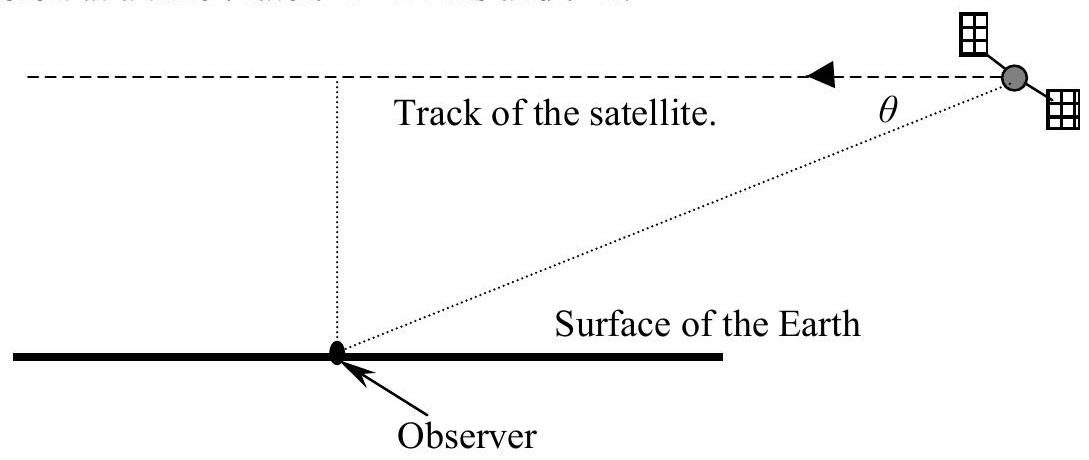
$\boldsymbol{v}$ is the velocity of the satellite and $\theta$ is the angle between the satellite's instantaneous direction and the observer, Figure 3.1. Assume $v \ll c$ where $c$ is the speed of light.
(d) A satellite in low orbit is monitored by an observer at latitude of $0^{\circ}$ and longitude of $0^{\mathrm{o}}$. Sketch a graph of $\Delta f$, where $\Delta f=f_{o} \frac{v}{c} \cos \theta$, against time, $t$, as the satellite
(i) approaches (ii) passes overhead and (iii) disappears from the observer.
(e) Find expressions for asymptotes and turning points on your graph.
(f) The observer moves $1^{\circ}$ East. The height of the satellite is 200 km . What is the effect on the frequency of the observed signals as the satellite approaches and recedes next time the satellite passes over the position latitude $0^{\circ}$ and longitude $0^{\circ}$ ?
(g) The special theory of relativity predicts that in addition to any of the above effects moving clocks appear to run slow i.e. " $\Delta \Xi_{\text {observed }}=\frac{\Delta \Xi}{\left(1-\frac{v^{2}}{c^{2}}\right)^{1 / 2}}$ " where $\Xi$ is the time variable, $\Delta \Xi$ is a time interval in the inertial frame of the clock and $v$ is the relative velocity of the clock with respect to the observer. What error will have occurred if non relativistic equations are assumed?

Show answer · 显示答案
Final answers · 最终答案
  • (a)$h = \left(\frac{gR_E^2 T^2}{4\pi^2}\right)^{1/3} - R_E$
  • (b)During each orbital period $T$, Earth rotates by $\Delta\lambda = 360° \cdot T/24$ hrs, so the ground track shifts westward.
  • (c)$f = f_0 \pm f_0 \frac{v}{c}\cos\theta$
  • (d)See the book for the worked solution.
  • (e)See the book for the worked solution.
  • (f)See the book for the worked solution.
  • (g)$\frac{\Delta f_{\text{rel}}}{f_0} \approx 3.4 \times 10^{-10}$

Full worked solutions: BPhO Round 2: Past Questions and Solutions (book)
2005 Q42005Gravitation and Astrophysics · Emission and absorption in a glowing gas shell; planetary nebula image
figure

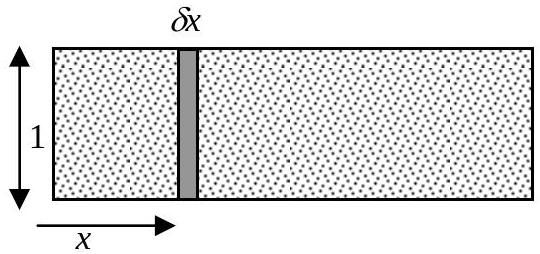
a) Figure 4.1 shows a glowing gas in a rectangular glass box. The square cross section, perpendicular to the plane of the diagram, of the ends of the box is $1 \mathrm{~m}^{2}$. The intensity of the light emitted in the $x$ direction due to the glowing atoms in a volume (Figure 4.1) of thickness $\delta x$ is $k \delta x$, where $k$ is a constant. The absorption of the light due to this same volume is $\sigma_{x} \delta x$, where $\sigma$ is a constant and $I_{x}$ is the incident intensity, in the direction of increasing $x$, normally on the element of thickness $\delta x$. Show that this leads to the differential equation

$$\frac{d I_{x}}{d x}=-\sigma I_{x}+k$$

(i) Use this equation to find an explicit relation between $x$ and $I_{x}$. (Mathematical integrals are listed on page1. The units of intensity areWm ${ }^{-2}$ ).
(ii) Find an expression for the intensity $I_{m}$ when $x$ is very large and an expression for $x$ in terms of $I_{0.5}$ where $I_{0.5}=0.5 I_{m}$.

figure

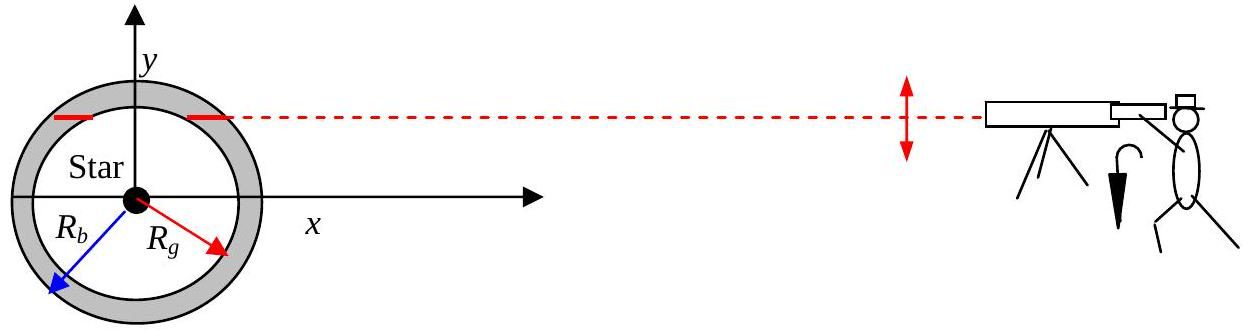
Figure 4.2 shows an observer looking at a luminous cloud around a central star, in the form of a spherical shell, between the radii $R_{b}$ and $R_{g}$. His distance from the star is very much greater than the radius of the cloud. The thickness of the cloud is much less than the radius of the cloud. In the position shown on the diagram the thickness of the cloud in the line of sight is the sum of the lengths of the two full red lines shown in Figure 4.2. The star forms the origin of a Cartesian coordinate system with the $x$-axis parallel to the line of sight and the y -axis at right angles to it.
(i) Find expression/expressions that give the total length of this path through the cloud in terms of $y$ and the other relevant parameters.
(ii) Hence find an expression that gives the variation of the intensity of the light, $I_{x}$, with $y$.
(iii) Sketch a graph of $I_{x}$ against $y$.
c)

figure

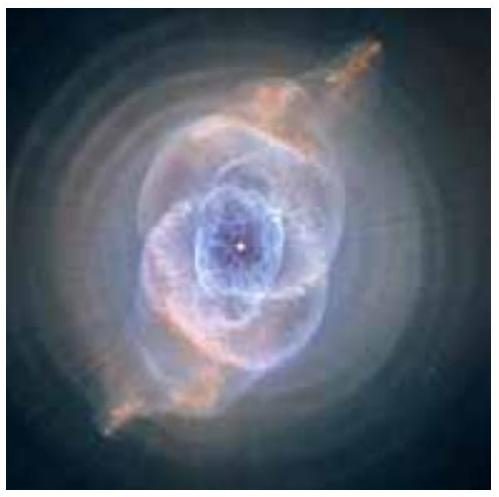
Figure 4.3 shows a picture taken by the Hubble Telescope. A star is seen in the centre of the picture.
(i) Describe qualitatively the main features of Figure 4.3.
(ii) Suggest, with reference to part b , how these features may be explained.

Show answer · 显示答案
Final answers · 最终答案
  • (a)$\frac{dI_x}{dx}=-\sigma I_x+k$
  • (a)(i)$I_x(x)=\frac{k}{\sigma}\left(1-e^{-\sigma x}\right)$
  • (a)(ii)$I_m = \frac{k}{\sigma}$
  • (a)(ii)$x_{0.5}=\frac{\ln2}{\sigma}$
  • (b)(i)$L(y)= \begin{cases} 2\left(\sqrt{R_g^2-y^2}-\sqrt{R_b^2-y^2}\right), 0\leq |y|
  • (b)(ii)$I_x(y)=\frac{k}{\sigma} \left[1-e^{-\sigma L(y)}\right]$
  • (b)(iii)$I_x(0)=\frac{k}{\sigma} \left[1-e^{-2\sigma(R_g-R_b)}\right]$
  • (c)(i)See the book for the worked solution.
  • (c)(ii)See the book for the worked solution.

Full worked solutions: BPhO Round 2: Past Questions and Solutions (book)
2006 Q52006Gravitation and Astrophysics · X-ray binary: neutron star and companion orbit
figure

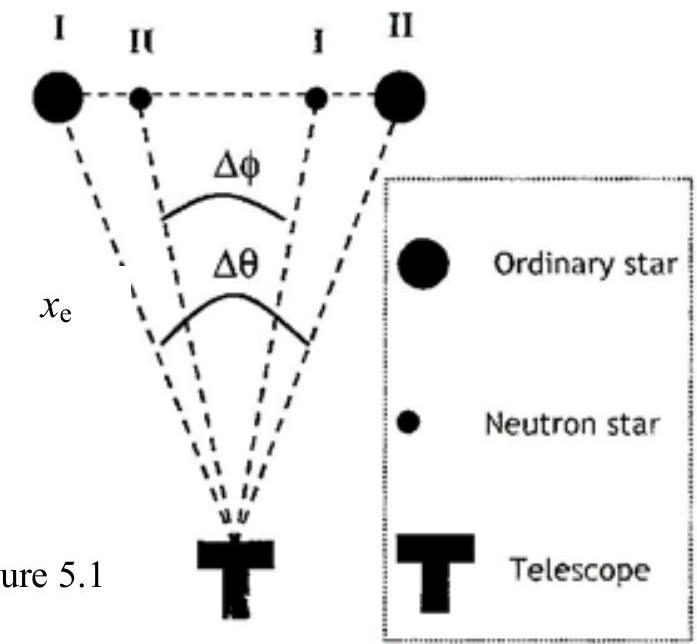
It is well known that most stars form binary systems. One type of binary system consists of an ordinary star with mass $m_{o}$ and radius $R$, and a more massive, compact, neutron star with mass $M$, rotating around each other. In all the following ignore the motion of the Earth. Observations of such a binary system reveal the following information:
(i) The maximum angular displacement of the ordinary star is $\Delta \theta$, whereas that of the neutron star is $\Delta \varphi$ (see Figure 5.1).
(ii) The time it takes for these maximum displacements is $\tau$.
(iii) The radiation characteristics of the ordinary star indicate that its surface absolute temperature is $T$ and the radiated energy incident on a unit area on Earth's surface per unit time is $E$.
(iv) A calcium line in this radiation differs from its normal wavelength $\lambda_{o}$ by an amount $\delta \lambda$, due only to the gravitational field of the ordinary star. For this calculation the photon can be considered to have an effective mass of $h / \lambda c$.

Find an expression for the distance $x_{\mathrm{e}}$ from Earth to this system in terms of the observed quantities and the universal constants.

Show answer · 显示答案
Final answers · 最终答案
  • Final result$x_{\mathrm{e}}= \left[ \frac{8c^2\tau^2}{ \pi^2\Delta\varphi(\Delta\theta+\Delta\varphi)^2} \frac{\delta\lambda}{\lambda_o+\delta\lambda} \left(\frac{E}{\sigma T^4}\right)^{1/2} \right]^{1/2}$

Full worked solutions: BPhO Round 2: Past Questions and Solutions (book)
2008 Q42008Gravitation and Astrophysics · Exoplanet detection: Doppler wobble, thermal broadening, transits

(a) Light from a sodium gas discharge lamp is incident on a gas flame into which common salt crystals are thrown. On a screen behind the flame a dark shadow of the flame is seen. Explain this observation.
(b) In recent years many planets have been spotted orbiting stars. The first ones were spotted by the movement of a star round the common centre of mass of the star-planet system.
(i) Show that when a light source, wavelength $\lambda$, is moving away from an observer at a speed $v$ the displacement of the line, $\delta \lambda$, due to orbital motion, will be given by

$$\frac{\delta \lambda}{\lambda} \approx \frac{v}{c}$$

$v \ll \mathrm{c}$.
(ii) Find the maximum speed at which the Sun appears to approach the centre of mass of the solar system as viewed from a planet on a distant star. Ignore the effect of all the planets except Jupiter. Then the equation above to determine $\delta \lambda$ for a sodium absorption line of wavelength $\lambda=569.0 \mathrm{~nm}$.
(iii) Assume the Sun's atmosphere is at a temperature of 6400 K and it is a perfect gas. Find the rms speed of an atom of $F e_{26}^{56}$ and an atom of $H_{1}^{1}$ in the Sun's atmosphere. How do these speeds compare with the speeds found in (ii)? Comment.
c) Another very recent method of detecting planets round other stars is the reduction in light due to the planet passing across the star. Find the fractional reduction in the intensity of light due to the passage of Jupiter across the face of the Sun as seen by a very distant observer at a distance of the order of about $10^{17} \mathrm{~m}$. Assume that Jupiter is totally opaque.
d)
(i) It is of interest to know whether water is present on these remote planets. The water vapour in the atmosphere of the earth, and possibly the remote planet will absorb certain wavelengths. However in practice we can distinguish between these two effects. How?
(ii) Assume that the atmosphere of the Earth is 20 km thick and is sufficiently optically thick to remove all the light from the relevant water vapour spectral lines. Imagine that a very distant observer records the intensity reduction in these water vapour lines due to the passage of the earth across the face of the Sun. Calculate the relative reduction in the intensity of a spectral line due to transit of the atmosphere of the Earth across the line of sight to a distant observer of the Sun who is on a planet orbiting a distant star.

Show answer · 显示答案
Final answers · 最终答案
  • (a)See the book for the worked solution.
  • (b)(i)$\frac{\delta\lambda}{\lambda}\approx\frac{v}{c}$
  • (b)(ii)$v_{\mathrm{Sun}}\approx13.0\ \mathrm{m\,s^{-1}}$
  • (b)(ii)$\delta\lambda\approx2.47\times10^{-5}\ \mathrm{nm}$
  • (b)(iii)$v_{\mathrm{rms,H}}\approx1.26\times10^4\ \mathrm{m\,s^{-1}}$
  • (b)(iii)$v_{\mathrm{rms,Fe}}\approx1.68\times10^3\ \mathrm{m\,s^{-1}}$
  • (c)$\frac{\delta I}{I}\approx0.0104$
  • (d)(i)See the book for the worked solution.
  • (d)(ii)$\frac{\delta I_{\mathrm{line}}}{I}\approx5.3\times10^{-7}$

Full worked solutions: BPhO Round 2: Past Questions and Solutions (book)
2010 Q22010Gravitation and Astrophysics · Cold dark matter: light deflection, galactic rotation curves
This question is about cold dark matter.

Cold dark matter only affects ordinary matter by gravitational interaction. It will deflect light by gravitational interaction. Electromagnetic quanta are thought to rarely interact with cold dark matter, therefore ``physical collisions'' occur very infrequently. No verified direct detection appears to have yet been recorded and its existence is inferred through indirect observations. These include the deflection of light by invisible bodies and optical effects such as gravitational lensing; double images caused by the gravitational fields and the inferred mass of a group of galaxies rotating about a common centre. In the last case the total mass of the visible galaxies is far less than the total mass needed to produce stable orbits given the observed orbital speeds and orbital parameters. Part (a) illustrates the bending of light rays by mass.
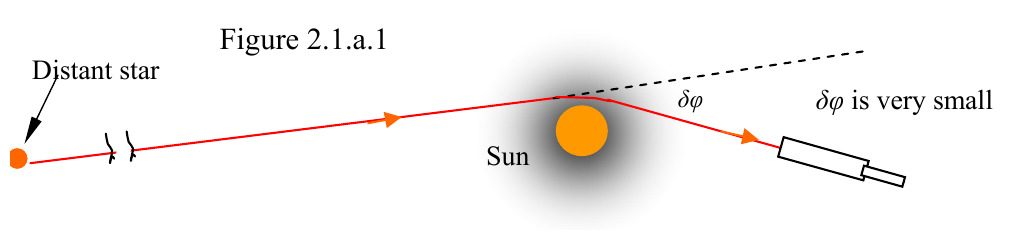
(a) According to the General Theory of Relativity the gravitational field of the Sun alters the effective refractive index, $n$, of outer space so that: $$n^{2}\approx 1+\frac{4a}{r},$$ where $a$ is a constant which, for the Sun, takes a value of $1.48\times10^{3}\ \mathrm{m}$ and $r$ is the distance to the centre of the Sun.

figure

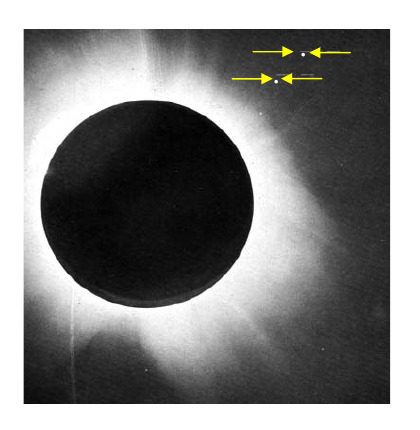
Figure 2.1.a.1 shows the Sun with the surrounding space shaded illustrating the increasing effective refractive index, $n$, as the distance from the centre of the Sun is decreased. As the Sun passes across the sky, the skylight of stars closest to the Sun should appear to shift position in the sky due to the effective change in refractive index of the space surrounding the Sun. However due to the intense light emanating from the Sun the only possible way to measure the position of stars close to the Sun is to observe it during a total solar eclipse. Figure 2.1.a.2 shows a photograph taken during the 1919 solar eclipse. Measurements of the position of stars from this photo showed an apparent shift in their position from their positions taken during the night. This shift agreed with Einstein's predicted value.

Find the value of the effective refractive index, $n$, close to the surface of the Sun. Using a simple model, or otherwise, find the angular deflection of the light from a distant star as it passes very close to the Sun. Draw a clear diagram of your model.

figure

Figure 2.1.a.2

(b)

figure

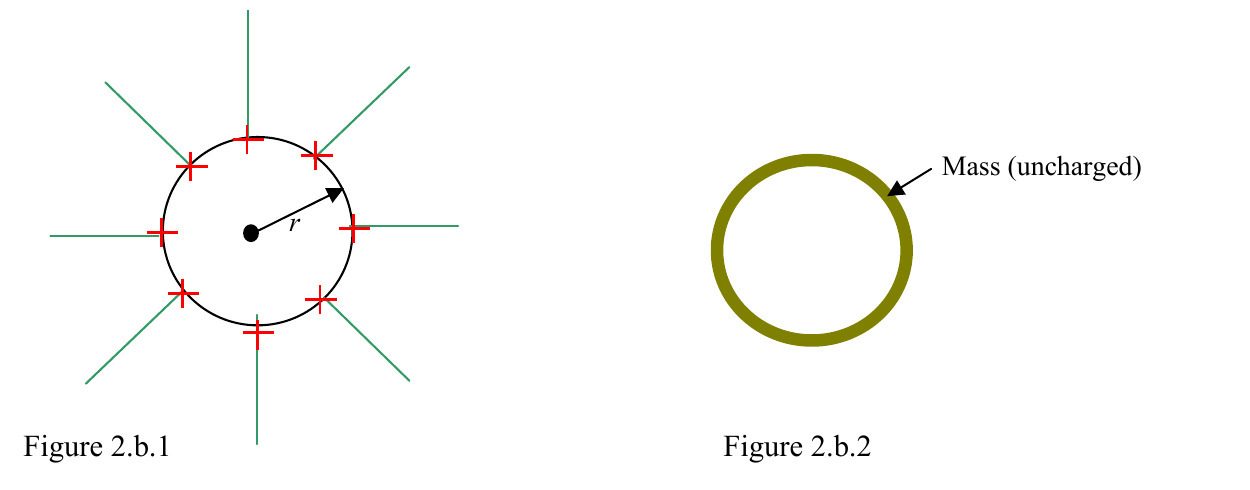
Figure 2.b.1 shows a hollow metal sphere that is positively charged. The lines of electric field are connected to negative charges that are a long way away. Show that if the electric field $E$ from a very small charge $q$ is given by $E=\dfrac{q}{4\pi r^{2}\varepsilon_{0}}$, where $\varepsilon_{0}$ is the dielectric constant of free space, then the electric field inside the sphere is zero. Figure 2.b.2 shows an uncharged massive spherical shell. Show that the gravitational field inside the sphere due to the uniform massive shell is also zero.
(c) Show that, according to Newton's theory of gravitation, the numerical values of the mass of the Sun and radius of the orbit of the Earth, given on page 1 --- the data page, are consistent.
(d)

figure

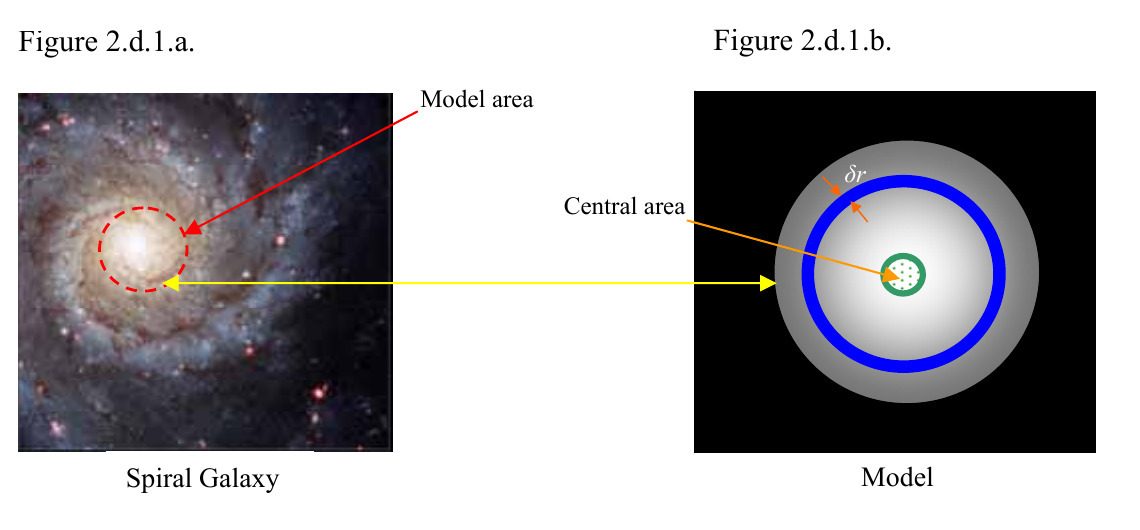
To perform a mathematical analysis of the distribution of stars and their angular velocity in a galaxy it is expedient to make a simple mathematical model of the galaxy. The model illustrated in Figure 2.d.1.b consists of a thin disc of stars inside the dotted circle in Figure 2.d.1.a. The density of the stars is roughly constant in the central area within the green dotted circle, Figure 2.d.1.b.

Determine a formula that relates the speeds of the stars with their distance, $r$, from the centre of the galaxy given that the mass of stars per unit volume, $\rho(r)$, is given by $\rho(r)=k/r$ (except in the central area). $k$ is a constant. Is your formula consistent with Figure 2.1.e.1?

figure
Show answer · 显示答案
Final answers · 最终答案
  • (a)$n(R_{\mathrm{Sun}})\approx1.0000043$
  • (a)$\delta\phi \approx 1.75\text{ arc seconds}$
  • (b)$E=0$
  • (b)$g=0$
  • (c)$M_{\mathrm{Sun}}\approx1.99\times10^{30}\ \mathrm{kg}$
  • (d)$v^2(r)=G\left\{\frac{M_c}{r} +2\pi kh\left(1-\frac{r_c}{r}\right)\right\}$
  • (d)$v(r)\longrightarrow\sqrt{2\pi Gkh}$

Full worked solutions: BPhO Round 2: Past Questions and Solutions (book)
2012 Q22012Gravitation and Astrophysics · Cosmological expansion and redshift; excited-level populations

(a) In cosmology it is thought that the Universe is expanding and this results in an apparent velocity of recession $V_{H}$. This velocity is related to the distance from the observer $R_{0}$ by the equation:

$$V_{H}=H R_{0}$$

$H$ is Hubble's constant. A very distant galaxy at present (time $t_{0}$ ) is observed to be $R_{0}$ away. How would you expect the distance of the galaxy to change with time?
(b) It can be shown that in the case of a number of atoms with one electronic energy level E , of value $\varepsilon$ above the ground state, the number of electrons, $n_{1}$ in E is related to the number in the ground state $n_{0}$ by the equation:

$$\frac{n_{1}}{n_{0}} \approx e^{-\frac{\varepsilon}{k T}}$$

Where $T$ is the absolute temperature and $k$ is the Boltzman constant. Show that if the atom has two electronic levels E1 and E2 of energy $\varepsilon_{1}$ and $\varepsilon_{2}$ above the ground state then if $n_{1} \ll n_{0}$ and $n_{2} \ll n_{0}$ then:

$$\frac{n_{2}}{n_{1}} \approx e^{-\frac{\varepsilon_{2}-\varepsilon_{1}}{k T}} .$$

Show answer · 显示答案
Final answers · 最终答案
  • (a)$H^{-1} \simeq 1.3\times10^{10}\text{ yr}$
  • (b)$\frac{n_2}{n_1} = e^{-(\varepsilon_2-\varepsilon_1)/(kT)}$

Full worked solutions: BPhO Round 2: Past Questions and Solutions (book)
2012 Q32012Gravitation and Astrophysics · Tides, Roche limit, dark-matter detector
figure

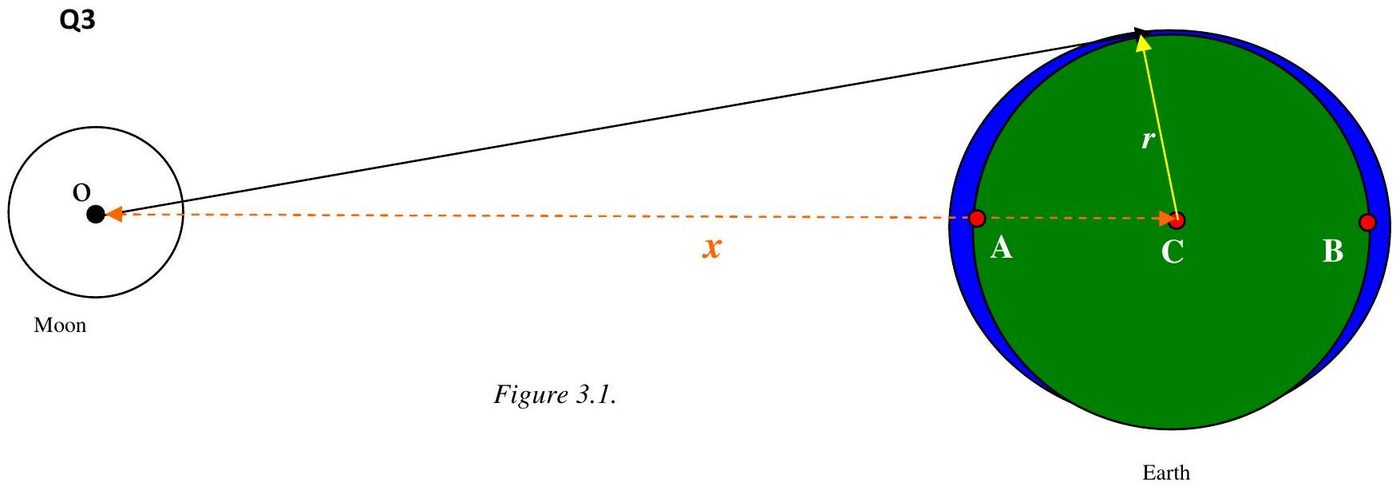
(a) Figure 3.1 shows a diagram of the Earth and the Moon. Assume a very simple model that the whole smooth Earth is covered with a layer of water depth 750 m . Find an expression that relates the gravitational field due to the Moon at A and B (assume $r \ll x$ ). Hence give a reasoned estimate of the height of the tides at the equator. Ignore the effects of continents, ocean currents etc. Comment on your estimate and the assumptions you make.
(b) The Moon is slowly coming towards the Earth. The gravitational tidal effect on the Moon will become greater. The Roche limit is the value of the radius of an orbit at which the tidal effect on a body, in this case the Moon, will disrupt the body if it has no internal tensile strength, eg composed of sand or loose rock. What would be the Roche limit for a neutron star radius 10 km and mass about the mass of the Sun?
(c) The year is 3500 AD. Captain Amabo is steering his space ship Enterprise X11. He is searching for Dark Matter Asteroid VII which could be a hazard to space navigation. Dark matter interacts with ordinary matter through the exchange of gravitons that are the quanta of gravity. Gravitons were first detected in 2035 AD. The normal electromagnetic interaction does not react with dark matter. Enterprise X11 photon rocket engines are switched off. Design a very simple apparatus that he could carry that would warn him of the possible hazard. What is the nature of the hazard?
Show answer · 显示答案
Final answers · 最终答案
  • (a)This is much smaller than the assumed $750\text{ m}$ ocean depth, so treating the displacement as a small perturbation is consistent.
  • (b)This force-balance calculation fixes only the order and gives $d_R\sim10^9\text{ m}$.
  • (c)See the book for the worked solution.

Full worked solutions: BPhO Round 2: Past Questions and Solutions (book)
2014 Q52014Gravitation and Astrophysics · Solar wobble from orbiting planets

Imagine that you are an observer on a planet of a nearby star such as Proximae Centauri (if it has one). You might notice that our Sun seems to wobble slightly with a somewhat complex wobble. This observed wobble has been used to detect planets round other stars.
i) What is the wobble due to?
ii) Using the data provided find the maximum speed of the wobble.
iii) What other method might be used to detect a planet orbiting a distant star?

Show answer · 显示答案
Final answers · 最终答案
  • (i)See the book for the worked solution.
  • (ii)Thus the maximum solar wobble speed is approximately $12.4\text{ m s}^{-1}$, dominated by Jupiter.
  • (iii)See the book for the worked solution.

Full worked solutions: BPhO Round 2: Past Questions and Solutions (book)
2014 Q62014Gravitation and Astrophysics · Energy of orbits in a funnel-shaped horn as a solar-system model
figure
figure

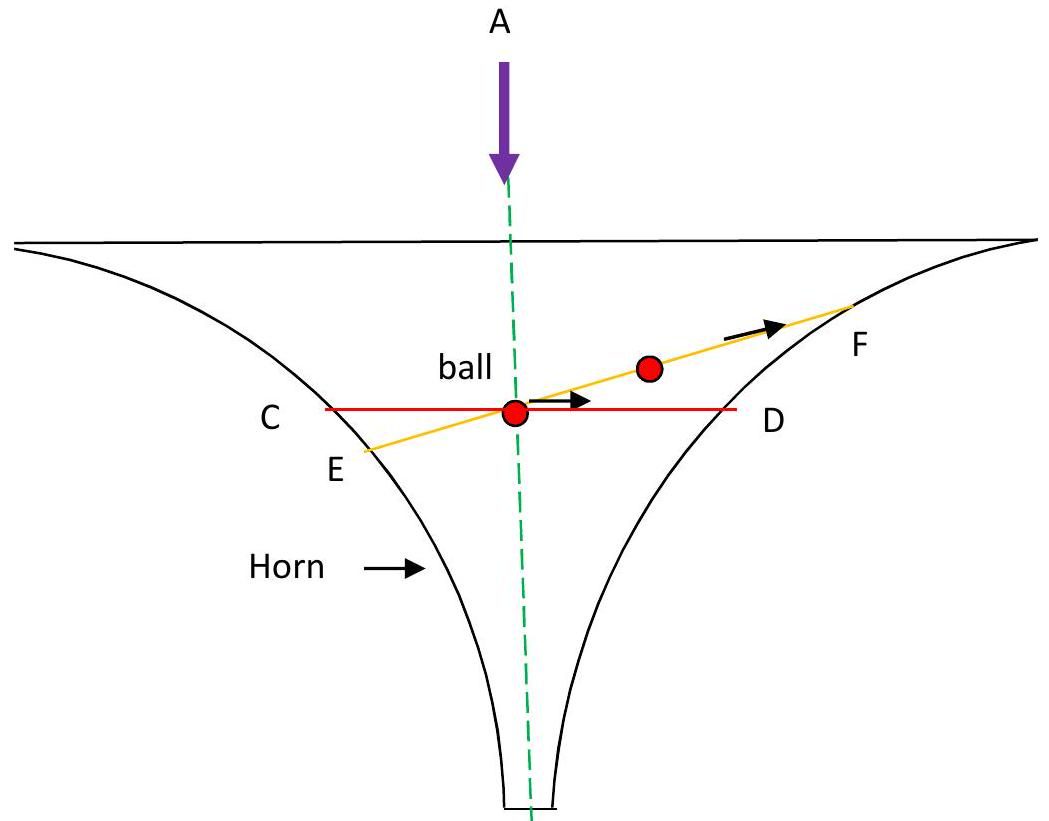
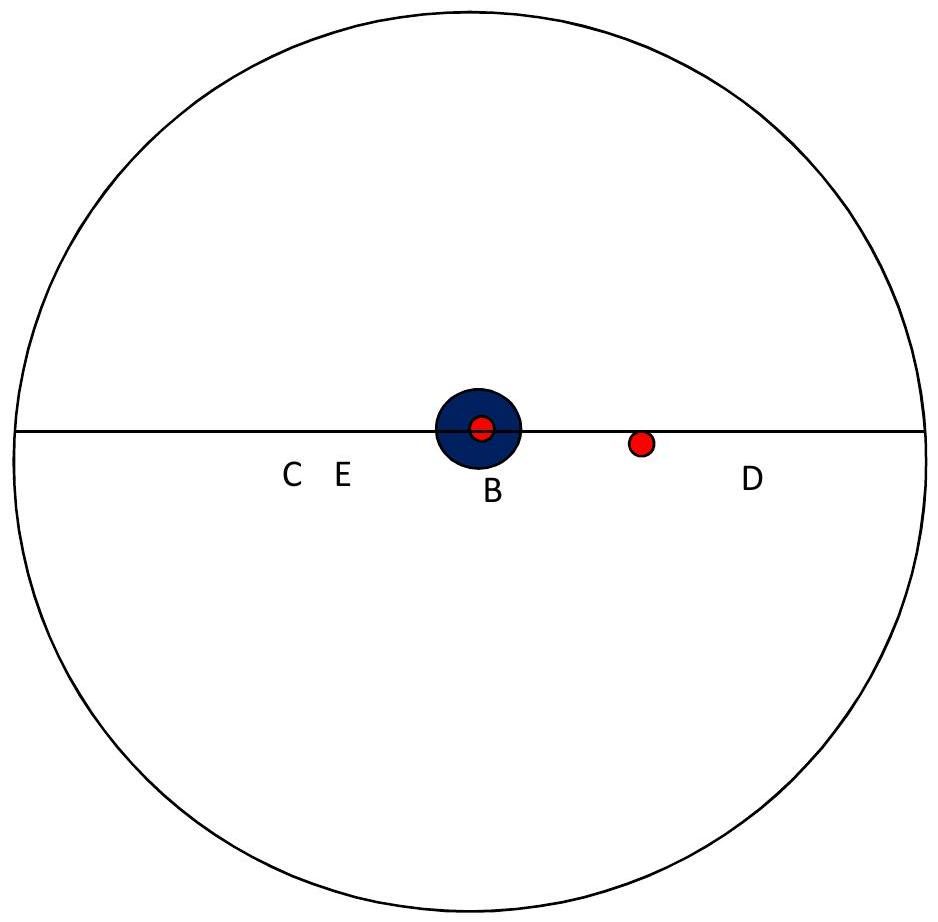
Figure 6.1 shows a vertical cross section of a metal horn. A small red ball moves along a line that is horizontal and circular, C, D. However the ball could take the track E, F.

Discuss, using appropriate algebra where possible, the relative energies of the two tracks.
How good a model is this of the solar system?

Show answer · 显示答案
Final answers · 最终答案
  • Final resultAn inclined section of a $1/r$ horn is not exactly a Kepler ellipse except in a shallow-slope approximation, so precession may occur.

Full worked solutions: BPhO Round 2: Past Questions and Solutions (book)
2015 Q52015Gravitation and Astrophysics · Lunar eclipse geometry and the Earth's shadow

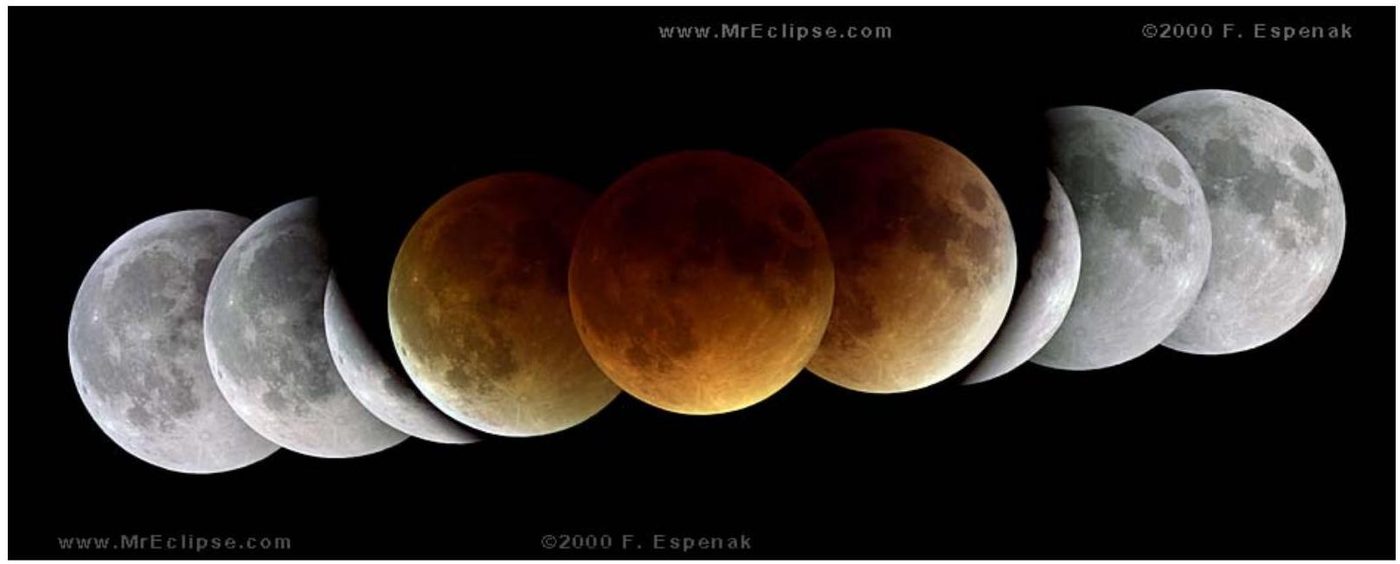
A lunar eclipse from the year 2000 is shown in Figure 5a below. The composite image is a set of nine separate images taken as a sequence over a period of three to four hours, and has been processed in Adobe Photoshop so that the moon's image is shown relative to the Earth's shadow. It shows various stages of the total lunar eclipse of Jan 20-21 2000, observed from Maryland in the United States. The three images of the moon at the centre of the composite are some 10000 times fainter than the surrounding images of the moon, and have been enhanced in this composite image. The reddening of the image is due to the scattering effect of light in the earth's atmosphere.
The angular diameter of the moon subtended at the earth is about $0.52^{\circ}$, whilst the angle subtended by the sun at the earth is on average about $0.53^{\circ}$.

figure

The diameter of the earth is 6370 km and the sun is much larger, but at a very great distance away compared to the Earth-Moon distance. Using the information provided, estimate the distance from the Earth to the Moon.
Use sketch diagrams to show your method.

Show answer · 显示答案
Final answers · 最终答案
  • Final result$3.7\times10^5\text{ km}$

Full worked solutions: BPhO Round 2: Past Questions and Solutions (book)
2016 Q22016Gravitation and Astrophysics · Measuring G: Cavendish balance, binary pulsars

(a) The gravitational force of attraction, $F$, between two spherical masses $M_{1}$ and $M_{2}$ is given by

$$F=\frac{G M_{1} M_{2}}{R^{2}}$$

Measuring $G$ is difficult. Explain why.
(b) One of the earliest methods of measuring $G$ was devised by Henry Cavendish, and a modern version of the sort of setup he used is illustrated below.

figure

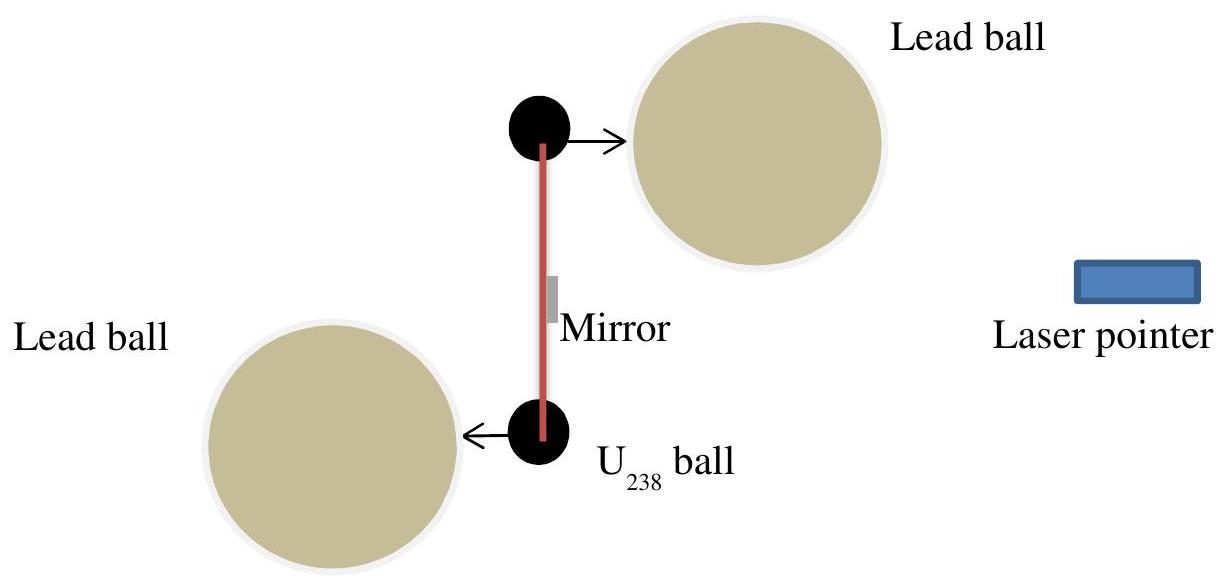
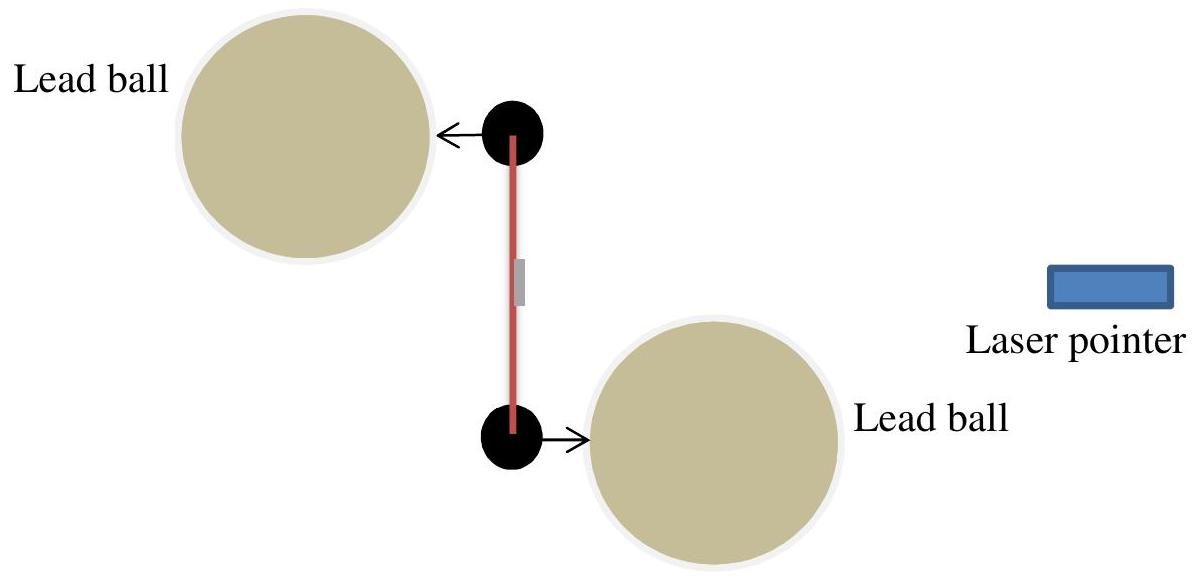
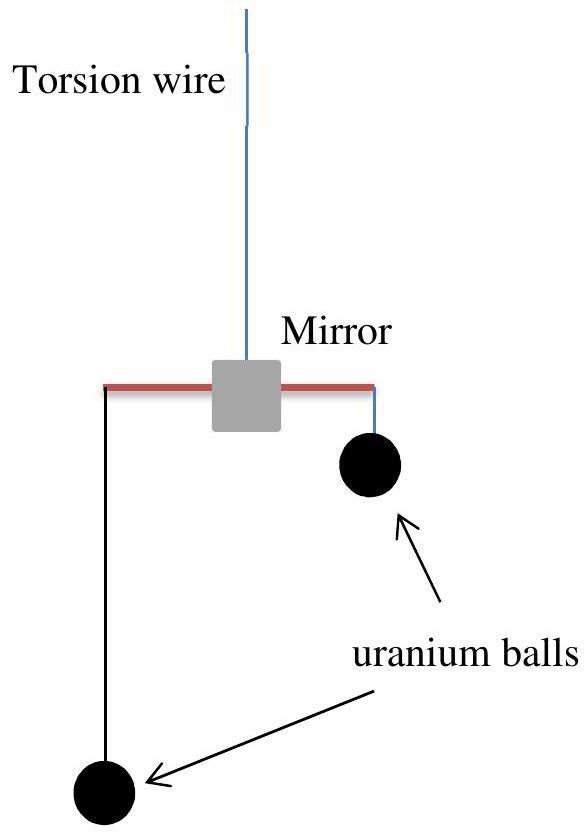
Two identical uranium spheres each of mass 60 g , made of depleted uranium-238, are suspended from a short, light, beam with a mirror attached. This is suspended from a thin torsion wire attached to a rigid support. The two small uranium spheres are hanging at different heights from the beam. Two massive lead balls (not shown) are placed on supports close to each of the uranium spheres, with about 1 cm separation between them. The uranium and lead spheres will not make contact when the beam is released. The lead spheres have a diameter of 7.6 cm and the length of the beam is 8.5 cm .

In Figure 2.2 the layout is now seen from above. This also shows the two large (grey) lead balls viewed from above. The pair of lead balls can be swung from position A as shown Figure 2.2, to position B as in Figure 2.3. The torsion wire supporting the mirror beam will resist twisting with a torque proportional to the angle of the twist, with the constant of proportionality being the torsion constant.

Explain how you could get the value of $G$ from this apparatus. Your answer should contain quantitative values as well as comments about the layout of the apparatus and a procedure for determining $G$. Consider estimating the torsion constant of the wire and the period of oscillation.

figure
figure

(c) If one of the large balls was moved, then the force on a small ball would change. It might be expected that the force, by similarity to light would propagate at the speed of light and like light photons, would be quantised (gravitons!).

Some years ago a flashing radio wave emitting source was observed by Jocelyn Bell, a PhD student at Cambridge, later Professor Bell and Chair of the BPhO. The team leader, Professor Anthony Hewish received the Nobel Prize in Physics for this discovery of pulsars. Sometime later the mass of the star was determined (the mass is about the same as the Sun but with a diameter of about 25 km ), but since the star's surface could not be measured it was difficult to tell what exactly was happening. Binary pulsars have also been found (pulsars that rotate round a common centre of mass) and it is they that are likely to produce detectable changing gravitational fields.

Why would you think that binary pulsars might be a strong source of gravitational waves?

Show answer · 显示答案
Final answers · 最终答案
  • (a)The value of $G$ is very small, $G\simeq6.67\times10^{-11}\mathrm{\ N\,m^2\,kg^{-2}}$, so the attraction between laboratory masses is only a few nanonewtons.
  • (b)$G = \frac{\kappa\Delta x R^2}{4S mML}$
  • (c)Each star has a mass of order the Sun's mass, but its radius is only about $12.5\mathrm{\ km}$, so a binary can be very close and can orbit rapidly.

Full worked solutions: BPhO Round 2: Past Questions and Solutions (book)
2017 Q42017Gravitation and Astrophysics · Elliptical orbits: Kepler's laws and orbital energy

This question concerns elliptical orbits.
(a) The equation of an ellipse of eccentricity $\varepsilon=\sqrt{1-\frac{b^{2}}{a^{2}}}$ and centre ( $x_{0}, y_{0}$ ) in Cartesian co-ordinates is

$$\frac{\left(x-x_{0}\right)^{2}}{a^{2}}+\frac{\left(y-y_{0}\right)^{2}}{b^{2}}=1$$

where $a$ is the semi-major axis (i.e. along its longest diameter) and $b$ is the semi-minor axis (i.e. along its shortest diameter).

Show that the polar equation

$$r=\frac{\alpha}{1+\varepsilon \cos \theta}$$

describes an ellipse in the $x-y$ plane with the following features:

$$\text { centre }\left(x_{0}, y_{0}\right)=\left(-\frac{\alpha \varepsilon}{1-\varepsilon^{2}}, 0\right)$$

and

$$\text { semi-major axis } a=\frac{\alpha}{1-\varepsilon^{2}}$$

and

$$\text { semi-minor axis } b=\frac{\alpha}{\sqrt{1-\varepsilon^{2}}}$$

Sketch the ellipse, noting the aforementioned features as well as the locations of the foci which are at a distance $f=\sqrt{a^{2}-b^{2}}$ either side of the centre along the semi-major axis. What constraints are there on the eccentricity? You may find it useful to consider the relationship between cartesian coordinates and polar coordinates: $x=r \cos \theta, y=r \sin \theta$, noting that $x^{2}+y^{2}=r^{2}$.
(b) A Sun-planet system has total energy $E$ and angular momentum $L . M_{S}$ is the mass of the Sun and $m_{p}$ the mass of the planet.
(i) Angular momentum is like a 'moment' of momentum. So, for an object undergoing rotational motion, its angular momentum at a distance $r$ from an axis of rotation with a linear speed $v$ (the component perpendicular to $r$ ) at that point, will have angular momentum equal to $m v r$. Furthermore, Newton's second law applies to angular momentum just as it does to momentum if you replace 'resultant force' with 'resultant moment/torque' and 'momentum' with 'angular momentum'.

Why must $L$ be a constant? Show that the rate at which an imaginary line drawn between the orbital axis and the planet sweeps out area is given by

$$\frac{\mathrm{d} A}{\mathrm{~d} t}=\frac{L}{2 m_{p}}$$

What relevance does this have for Kepler's second law?
(ii) Show that

$$E=\frac{1}{2} m_{p} \dot{r}^{2}+\frac{L^{2}}{2 m_{p} r^{2}}-\frac{k}{r}$$

where $\dot{r}=\left(\frac{\mathrm{d} r}{\mathrm{~d} t}\right)$ and $k$ is a constant to be determined.

If time, $t$, is re-parametrised in terms of angle, $\theta$, the solution to this differential equation is $r=\alpha /(1+\varepsilon \cos \theta)$ with $\alpha=L^{2} / \mu k$ and $\varepsilon^{2}=1+\frac{2 E L^{2}}{\mu k^{2}}$.
(iii) Find a formula for the time period of the planet in terms of the semi-major axis of its orbit. The total area of an ellipse is $\pi a b$.
(c) A satellite in low earth orbit at an altitude of 320 km is to be transferred to a geosynchronous orbit using an elliptical orbit which is tangential to both the initial and final orbits at its periapsis and apoapsis (the smallest and largest distances from a focus) respectively. How elliptical is the transfer orbit, what is the total velocity change, $\Delta v$, required to achieve the transfer and how long will it take? State any assumptions you make.
(d) A significant part of a manned mission to Mars involves transfer from a low earth orbit of altitude about 300 km to a low orbit around Mars of altitude about 250 km . What is the $\Delta v$ budget needed to make the trip using a similar transfer to that in (c), and what is the shortest length of time for a return trip using this method? What are your assumptions and how good are they in this context? To three significant figures, the eccentricites of Earth and Mars are 0.0167 and 0.0934 respectively, while Mars takes 1.88 Earth years to orbit the Sun.

Show answer · 显示答案
Final answers · 最终答案
  • (a)A non-circular ellipse has $0<\varepsilon<1$; $\varepsilon=0$ is the circular limiting case and $\varepsilon=1$ gives a parabola.
  • (b)(i)$\frac{\mathrm dA}{\mathrm dt} = \frac{L}{2m_p}$
  • (b)(ii)$E=-\frac{k}{2a}$
  • (b)(iii)$T^{2}=\frac{4\pi^{2}a^{3}}{GM_S}$
  • (c)$t_{\mathrm t} = 5.29\mathrm{~h}$
  • (d)$t_{\mathrm{round}} = 2.7\mathrm{~years}$

Full worked solutions: BPhO Round 2: Past Questions and Solutions (book)
2018 Q22018Gravitation and Astrophysics · Gravitational waves from binary black holes

Gravitational waves were first detected on the 14th September 2015 by the LIGO collaboration using two sets of large detectors based on the interference of waves. In this question we investigate some of the physics involved, using a combination of approximating the relativistic physics classically and dimensional analysis. The observed event, called GW150914, occurred as a result of a binary black hole pair merging to form a single black hole whilst simultaneously releasing a lot of energy in the form of gravitational waves.
(a). Before the two black holes merge, they can be modelled as two point masses $M$ and $m$ that rotate about their common centre of mass with radii $R$ and $r$, respectively. Assume that the binary black holes obey Newtonian mechanics and gravity. Show that the angular frequency $\omega$ of the motion satisfies

$$\omega^{2}=\frac{G(M+m)}{(R+r)^{3}}$$

where $G$ is Newton's universal gravitational constant.
(b). Find the total energy of the black hole system and express this in terms of the masses of the black holes and the angular frequency of the motion.

Unlike Newtonian gravity, Einstein's general relativity predicts that accelerating objects will radiate gravitational waves and thus the binary black hole system will lose energy and the black holes will spiral into each other. The rate of radiation depends on the quadruple moment of the system. For our purposes, the quadruple moment can be considered as the same as the moment of inertia $I$ of the system about its centre of mass. The radiated power $P$ is proportional to $I^{2}$ and also depends on the angular frequency $\omega$, and on the fundamental constants $G$ and $c$, the speed of light. We shall use dimensional analysis to determine the rate of loss in terms of these quantities.
(c). Find the moment of inertia $I$ of the black hole system about its centre of mass.
(d). The radiated power loss $P$ can be written as

$$P=\alpha I^{2} G^{\beta} \omega^{\gamma} c^{\delta}$$

Find the exponents $\beta, \gamma$ and $\delta$. More detailed analysis shows that $\alpha=32 / 5$.
(e). Find the rate of change in the angular frequency $\frac{\mathrm{d} \omega}{\mathrm{d} t}$ in terms of constants, $\omega$ and the chirp mass

$$\mathcal{M}=\frac{(m M)^{3 / 5}}{(m+M)^{1 / 5}}$$

The quadruple moment is symmetric under rotations by $\pi$ and so the frequency of the gravitational waves $f$ is twice that of the orbital frequency.
(f). By integrating your answer to (e), show that over any interval of time $\tau$ the observed frequencies, $f_{1}$ and $f_{2}$ satisfy

$$\frac{1}{f_{1}^{8 / 3}}-\frac{1}{f_{2}^{8 / 3}}=8 \alpha \pi^{8 / 3} \frac{(G \mathcal{M})^{5 / 3}}{c^{5}} \tau .$$

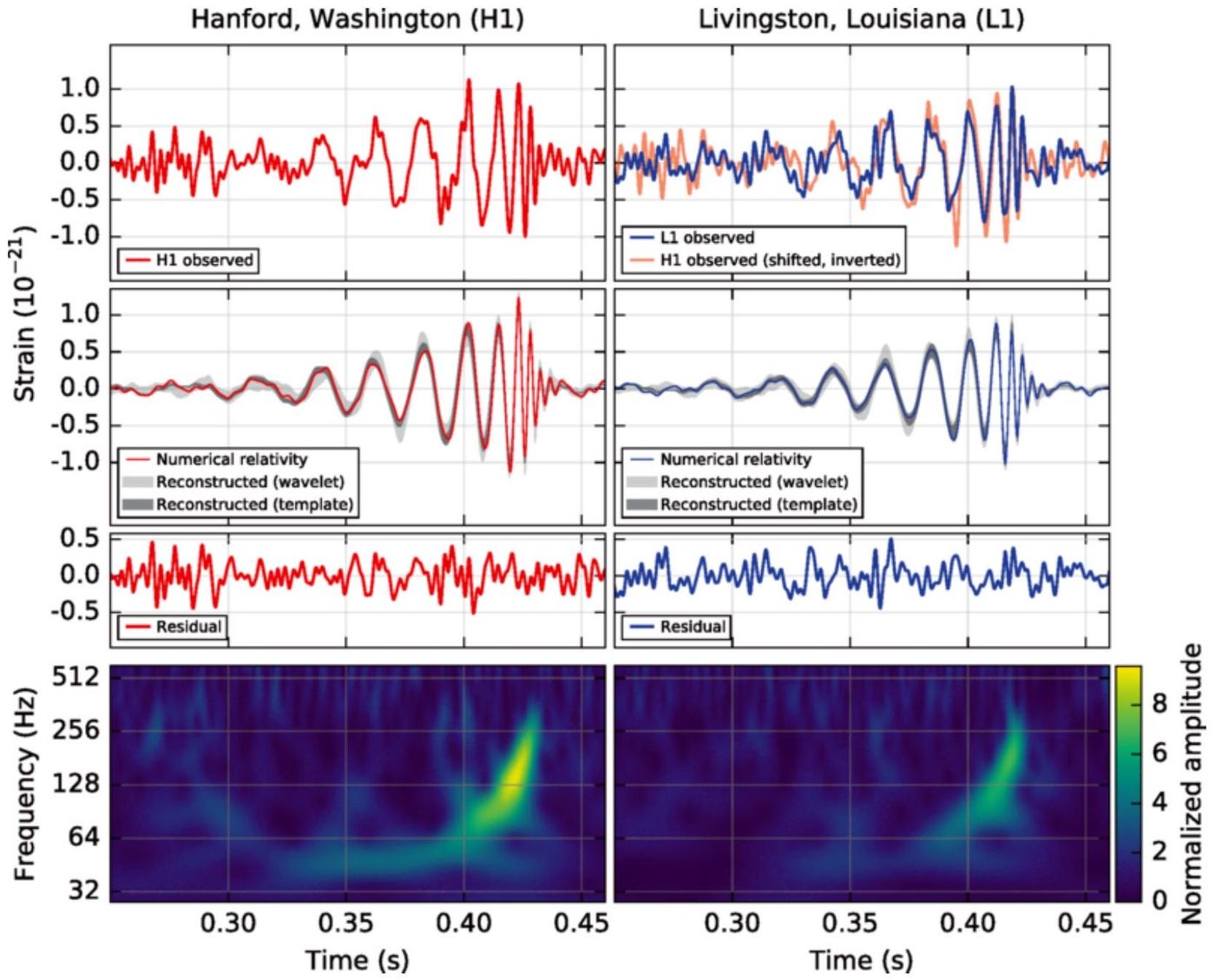
(g). Using the data from LIGO, given in Figure 5, estimate the chirp mass $\mathcal{M}$, expressing your answer in terms of Solar masses $M_{\odot}=1.989 \times 10^{30} \mathrm{~kg}$.
(h). Deduce the lower bound on the total mass $m+M$ of the black holes before coalescence using your estimate of $\mathcal{M}$.

figure

Figure 5: Data from Abbott et al., Observation of gravitational waves from a binary black hole merger, PRL 116, 061102 (2016). The left hand side panels refer to measurements made by the Hanford detector and the right hand side from Livingston. The top two rows show measurements and simulations of the strain on the detectors as a function of time. The third row details the differences between the simulation and measurements. The fourth row provides the relative amplitudes of the strain signal of the component frequencies as a function of time. In particular for part (g), note the signal frequency increasing in time.

In order to obtain better estimates of the total mass as well as the individual masses, we need to know something about the sizes of black holes. The radius of a black hole, where light itself cannot escape, is called the Schwarzschild radius $R_{S}$ and is given by

$$R_{S}=\frac{2 G M}{c^{2}}$$

for a black hole of mass $M$.
(i). Assume that the two black holes begin to merge when the separation of their centres is equal to the sum of their Schwarzschild radii. Show that the highest frequency attained by the chirp is

$$f_{c}=\frac{\omega_{c}}{\pi}=\frac{c^{3}}{2 \sqrt{2} \pi G(M+m)}$$

Using the data from Figure 5 estimate the individual masses $M, m$ of the black holes and their sum $M+m$ in terms of Solar masses.
(j). Finally, estimate the total energy radiated during the collision, stating any necessary assumptions, expressed in terms of mass equivalent to Solar masses.

Show answer · 显示答案
Final answers · 最终答案
  • (a)$\omega^2=\frac{G(M+m)}{(R+r)^3}$
  • (b)$E=-\frac12G^{2/3}\mathcal{M}^{5/3}\omega^{2/3}$
  • (c)$I = G^{2/3}\mathcal{M}^{5/3}\omega^{-4/3}$
  • (d)$P=\alpha\frac{GI^2\omega^6}{c^5}$
  • (e)$\frac{\mathrm{d}\omega}{\mathrm{d}t} =3\alpha\frac{(G\mathcal{M})^{5/3}}{c^5}\omega^{11/3}$
  • (f)$\frac{1}{f_1^{8/3}}-\frac{1}{f_2^{8/3}} =8\alpha\pi^{8/3}\frac{(G\mathcal{M})^{5/3}}{c^5}\tau$
  • (g)$\mathcal{M} \approx 30M_{\odot}$
  • (h)$M+m\geq4^{3/5}\mathcal{M} \approx69M_{\odot}$
  • (i)$M+m\approx76M_{\odot}$
  • (j)$\frac{E_{\rm rad}}{c^2} \approx 4M_{\odot}$

Full worked solutions: BPhO Round 2: Past Questions and Solutions (book)
2021 Q32021Gravitation and Astrophysics · Circular and elliptical orbits: perigee, apogee and energy

This question is about the mechanics of circular and elliptical orbits. Consider a satellite of mass $m$ in orbit around a planet of mass $M$ such that it is in free fall and sufficiently far from the planet to be able to ignore atmospheric effects. The point of closest approach (perigee) is at a distance $r_{\mathrm{p}}$ from the centre of the planet and the highest point in the orbit (apogee) is at a distance $r_{\mathrm{a}}$ from the centre of the planet.
(a) As the orbit is not circular, the equation $F=m v^{2} / r$ does not apply at any point in the orbit. However, at the apogee and perigee the velocity vector is perpendicular to the gravitational force. Hence the angular momentum ( $=m r \omega$ where $\omega$ is the angular velocity) is constant and at those two points is simply equal to $m v_{\mathrm{a}} r_{\mathrm{a}}=m v_{\mathrm{b}} r_{\mathrm{b}}$.

Use this with the conservation of energy (kinetic + gravitational potential) to derive Newton's vis viva equation (eq. 1) to find the velocity at any given radius of orbit on the ellipse:

\begin{equation*} v^{2}=G M\left(\frac{2}{r}-\frac{1}{a}\right) \tag{eq.1} \end{equation*}

where $a=\left(r_{\mathrm{a}}+r_{\mathrm{p}}\right) / 2$, the semi-major axis of the ellipse, $r_{\mathrm{a}}=a(1+e)$ and $r_{\mathrm{p}}=a(1-e)$, where $e$ is the eccentricity. Note: the largest diameter of an ellipse has a length $2 a$ so that $a$ is the length of the semi major axis.
(b) In order to escape from orbit, the satellite undergoes a single short burn at a specific point in the orbit which gives it a new orbit with infinite semi-major axis. That burn creates a velocity change $\Delta v$ which is a figure of interest to engineers as it is essentially proportional to the amount of fuel burnt in a given manoeuvre.
(i) Find expressions for the necessary $\Delta v$ to reach escape velocity from apogee ( $\Delta v_{\mathrm{a}}$ ) and perigee ( $\Delta v_{\mathrm{p}}$ ).
(ii) Hence show that the ratio:

\begin{equation*} \frac{\Delta v_{\mathrm{a}}}{\Delta v_{\mathrm{p}}}=\frac{\sqrt{2(1-e)}-(1-e)}{\sqrt{2(1+e)}-(1+e)} \tag{2} \end{equation*}

(iii) Recalling that, for an ellipse, $0

In order to change from one circular orbital radius $\left(r_{1}\right)$ to another $\left(r_{2}\right)$ in the same orbital plane, a very efficient way is to use the two-burn Hohmann transfer. A brief burn is applied at one point in the orbit which makes the orbit elliptical. The first burn point is the perigee of the ellipse. On reaching the apogee, a second burn is applied to give the necessary velocity to make a circular orbit at the new height.
(c) Show that the velocity changes at perigee and apogee are given by:

$$\Delta v_{\mathrm{p}}=\sqrt{\frac{G M}{r_{1}}}\left(\sqrt{\frac{2 r_{2}}{r_{1}+r_{2}}}-1\right)$$

and

$$\Delta v_{\mathrm{a}}=\sqrt{\frac{G M}{r_{2}}}\left(1-\sqrt{\frac{2 r_{1}}{r_{1}+r_{2}}}\right)$$

(d) For a given initial orbit $r_{1}$, the total $\Delta v=\Delta v_{\mathrm{a}}+\Delta v_{\mathrm{p}}$ will vary with $r_{2}$.

By differentiation with respect to $r_{2}$, keeping $r_{1}$ fixed, show that the maximum value of $\Delta v$ occurs for the positive root of the equation

$$x^{3}-15 x^{2}-9 x-1=0$$

Where $x=r_{2} / r_{1}$. This root has the approximate value of 15.6 .
In other words, it requires more energy to place the satellite in a higher orbit than it does to remove it to escape velocity, another counter-intuitive result!
[0pt] [4]
[0pt] [22 marks]

Show answer · 显示答案
Final answers · 最终答案
  • (a)$v^2=GM\left(\frac{2}{r}-\frac{1}{a}\right)$
  • (b)(i)$\Delta v_{\mathrm p} =\left(\frac{GM}{a(1-e)}\right)^{1/2} \left(\sqrt{2}-\sqrt{1+e}\right)$
  • (b)(ii)$\frac{\Delta v_{\mathrm a}}{\Delta v_{\mathrm p}} = \frac{\sqrt{2(1-e)}-(1-e)} {\sqrt{2(1+e)}-(1+e)}$
  • (b)(iii)$\Delta v_{\mathrm a}>\Delta v_{\mathrm p}$
  • (c)$\Delta v_{\mathrm a} = \sqrt{\frac{GM}{r_2}} \left(1-\sqrt{\frac{2r_1}{r_1+r_2}}\right)$
  • (d)$x \approx 15.6$

Full worked solutions: BPhO Round 2: Past Questions and Solutions (book)
2023 Q42023Gravitation and Astrophysics · Space elevator in a rotating frame

This question explores the idea of a space elevator for reaching a high altitude orbit such as a geostationary one.

When considering the physics of rotating objects, a helpful way to analyse the motion can be to transform to a frame of reference which is rotating with the object, and in which the object is therefore (in the simplest case) at rest. When an object of mass $m$ is at rest in this frame of reference, and the reference frame is rotating uniformly with angular velocity $\omega$, the transformation to this frame gives rise to a fictitious 'centrifugal' force equal to $m r \omega^{2}$, where $r$ is the distance of the mass from the axis of rotation. The force is centrifugal in that it is directed away from the axis of rotation rather than towards it. To handle the laws of motion in such a rotating frame, simply treat the fictitious forces like real forces and go about things as usual!
(a). Find an expression for the orbital time period for a satellite of mass $m_{\mathrm{s}}$ orbiting at a distance $r_{\mathrm{g}}$ from the centre of the earth. Calculate the radius of the orbit of a geostationary satellite.
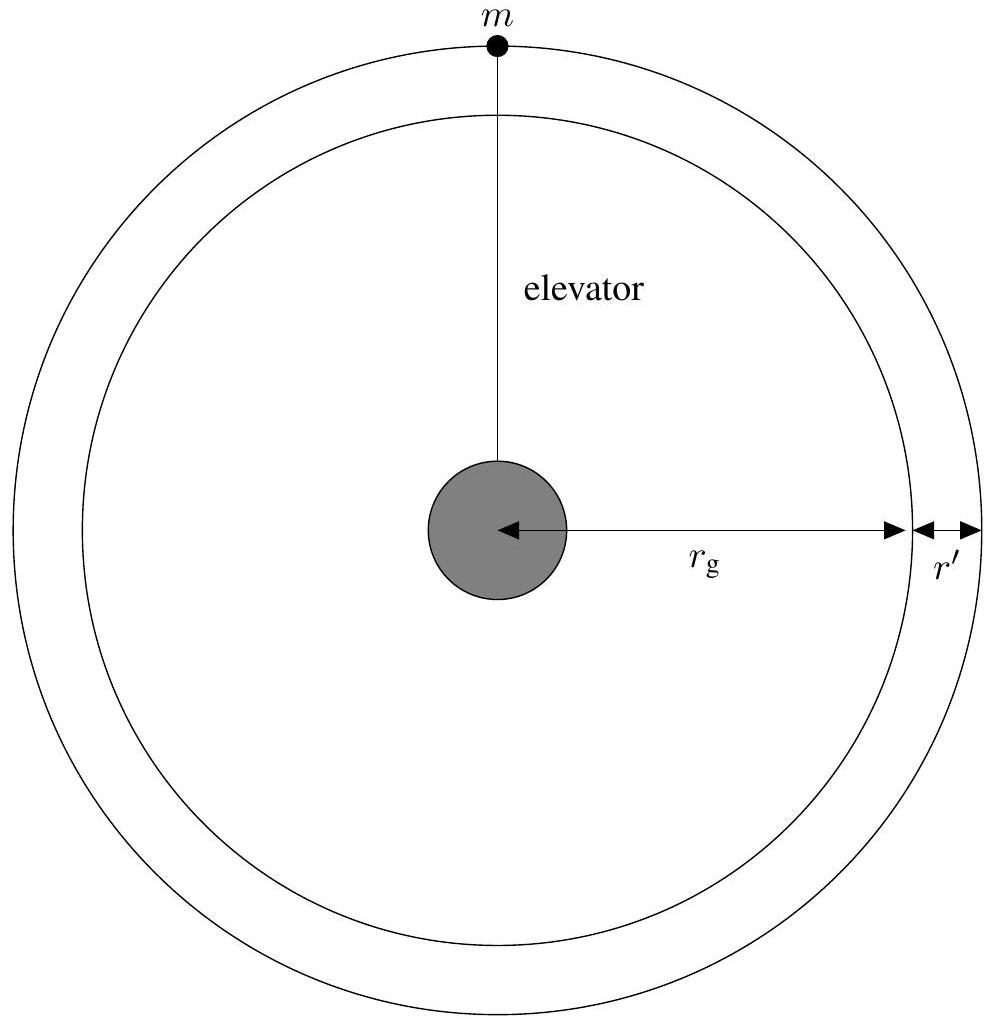
(b). A mass $m$ is to be kept in orbit at a radius $r_{\mathrm{g}}+r^{\prime}\left(r^{\prime} \ll r_{\mathrm{g}}\right)$ as shown in the diagram below. What extra force is required to do this over and above the gravitational force. Determine both its magnitude and direction.

figure


(c). An elevator is hung from the mass $m$ as shown in the diagram above and reaches all the way down to the surface of the earth. Modelling the elevator as a thin rod with mass per unit length $\mu$, show that for the elevator plus mass to maintain the same geostationary orbital period then the mass must (taking the radius of a geostationary orbit to be very much bigger than the radius of the earth) be given by

$$m=\frac{\mu r_{\mathrm{g}}^{3}}{3 r_{\mathrm{e}} r^{\prime}}$$

where $r_{\mathrm{e}}$ is the radius of the earth.
(d). Using reasonable estimates for $\mu$ and $r^{\prime}$, comment on the viability of this proposal using standard materials.
(e). Contemplate instead a 'free-standing' elevator without a counterweight, modelled as a uniform cable whose ends require no restraint. Again the cable rotates with the earth. Consider the net stress $\mathrm{d} \sigma$ on an element of cable $\mathrm{d} r$ with cross-sectional area $A$ at a distance $r$ from the centre of the earth. Show that

$$\frac{\mathrm{d} \sigma}{\mathrm{~d} r}=G m_{\mathrm{e}} \rho\left(\frac{1}{r^{2}}-\frac{r}{r_{\mathrm{g}}^{3}}\right)$$

where $\rho$ is the mass density (by volume) of the cable and $m_{\mathrm{e}}$ is the mass of the earth.
(f). What is the largest tensile stress in the cable and at what radius does it occur? Compare this for the three different materials in the table below and comment on your findings.

  • Safe practice typically dictates that materials are not subject to stresses of more than half their maximum.
    (g). A different design of elevator is one where the stress is held fixed (at a safe value) and instead the cross-sectional area varies. Show that in this setup the cross-sectional area is given by

$$A(r)=A_{\mathrm{b}} \exp \left[\frac{r_{\mathrm{e}}^{2}}{L_{\mathrm{c}}}\left(-\frac{1}{r}-\frac{r^{2}}{2 r_{\mathrm{g}}^{3}}+k\right)\right]$$

where $k$ is a constant to be determined, $A_{\mathrm{b}}$ is the area at the base of the elevator and $L_{c}=\frac{\sigma}{\rho g}$ (with $g$ the acceleration due to gravity at the surface of the earth) is the 'characteristic length' of the elevator material. What is the maximum area and at what radius does it occur?
(h). For a realistic construction, the ratio between the area at ground level and the maximum area should not be too large. Determine this ratio (known as the 'taper ratio') for the materials given above (for a suitable stress) and comment on your findings.
(i). Assuming a symmetrical construction of the variable area elevator, calculate its height and compare the value you obtain with the height of the setup in (e).

END OF PAPER
Questions proposed by:
Rupert Allison (Harrow School)
James Bedford (Harrow School)
Robin Hughes (Isaac Physics & BPhO)
Show answer · 显示答案
Final answers · 最终答案
  • (a)$r_{\mathrm g}-r_{\mathrm e} \approx3.58\times10^7\ \mathrm m$
  • (b)$F = 3m\omega^2r'$
  • (c)$m=\frac{\mu r_{\mathrm g}^3}{3r_{\mathrm e}r'}$
  • (d)$m \approx 3.9\times10^9\ \mathrm{kg}$
  • (e)$\frac{d\sigma}{dr} =Gm_{\mathrm e}\rho \left(\frac{1}{r^2}-\frac{r}{r_{\mathrm g}^3}\right)$
  • (f)Carbon nanotubes are the only listed material strong enough in principle; the safe working stress is about $130/2=65\ \mathrm{GPa}$, only just above the required $62.9\ \mathrm{GPa}$.
  • (g)$A_{\max}=A_{\mathrm b}\exp\left\{ \frac{r_{\mathrm e}^2}{L_c}\left[ \frac{1}{r_{\mathrm e}}-\frac{3}{2r_{\mathrm g}} +\frac{r_{\mathrm e}^2}{2r_{\mathrm g}^3} \right]\right\}$
  • (h)$$\begin{array}{c|c|c|c} \text{material} & \sigma\text{ used} & L_c=\sigma/(\rho g) & A_{\max}/A_{\mathrm b}\cr \hline \text{steel} &2.5\ \mathrm{GPa}&3.23\times10^4\ \mathrm m &2.4\times10^{66}\cr \text{Kevlar} &1.8\ \mathrm{GPa}&1.31\times10^5\ \mathrm m &2.2\times10^{16}\cr \text{carbon nanotubes} &65\ \mathrm{GPa}&5.11\times10^6\ \mathrm m &2.63 \end{array}$$
  • (i)$H = 1.44\times10^5\ \mathrm{km}$

Full worked solutions: BPhO Round 2: Past Questions and Solutions (book)