BPhO R1 S2 · Section 2

Waves & Optics

6 questions — reveal each final answer.

2017 · Q4Waves & OpticsRay Optics

a) [5] Calculate the smallest angle of incidence for light incident on the face of a $60^{\circ}$ prism of refractive index $1.5$, such that all of the light on the second face is totally reflected.

Draw a large diagram to show the path of the light and the angles.

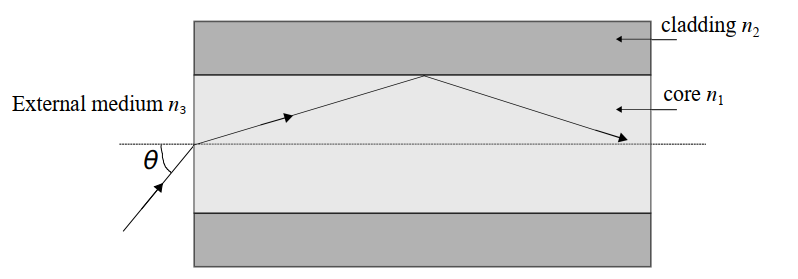
b) [12] Consider the step index optical fibre shown in Figure $\boldsymbol{4}$.
figure

Figure 4

The core, cladding and external medium have refractive indices $n_{1}, n_{2}$, and $n_{3}$, respectively. The acceptance angle $\theta$ for light entering the core of the fibre will allow transmission without loss providing the angle $\theta$ between the incident ray and the axis is smaller than the maximum acceptance angle $\theta_{m}$.

(i) Obtain an expression for $\sin \theta_{m}$ in terms of $n_{1}, n_{2}$, and $n_{3}$.

Hint: $\cos ^{2} \theta=1-\sin ^{2} \theta$

(ii) Light enters the fibre optic at angles between $\theta=0^{\circ}$ and $\theta_{m}$. Given a step index fibre with a core refractive index of $1.48585$, and a cladding refractive index of $1.45641$, determine the time broadening of the leading edge of a square pulse over a distance of $100 \mathrm{~km}$.

(iii) If multiple, very brief, square pulses of light are sent down the cable at frequency $f_{\mathrm{p}}$, calculate the maximum possible pulse frequency over this $100 \mathrm{~km}$ distance, such that the pulses do not overlap.

(iv) Show that in general the time spread of a pulse $\Delta t$, in a fibre of length $L$, is given by $\Delta t=\frac{L}{c^{\prime} n_{2}} \Delta n$, with $\Delta n$ the difference in refractive indices between core and cladding, and $c^{\prime}$ the speed of light in the optical fibre.

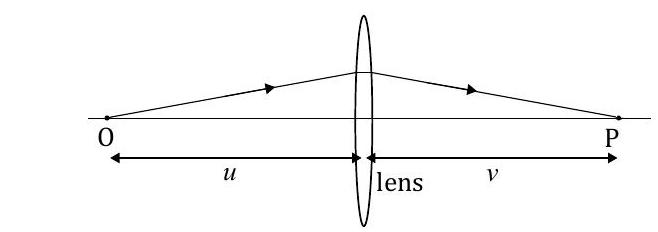
c) [2] A ray of light from a point source $\mathbf{O}$ on the principal axis of a thin converging lens, passing through the lens, is brought to a focus at the image point $\mathbf{P}$ also on the principal axis, and shown in Figure 5 .
figure

Figure 5

One form of an equation for a thin lens, relating object and image distances, $u, v$ to the focal length $f$ is

$$ \frac{1}{u}+\frac{1}{v}=\frac{1}{f} $$

By taking the limit $u \rightarrow \infty$, explain what the length $f$ represents for a lens.

d) [6] Rays of light from a point source on the principal axis, passing through a converging lens by different paths and reaching a focus point on the principal axis, can be considered to do so by following paths which all have an equal time of travel. (This is a simplified form of a more general principle - Fermat's Principle of Least Time).

A flat, thin, circular disc of transparent material is made so that its refractive index $n$ varies with the distance $r$ from the principal axis normal to the centre of the disc, according to the equation $n=n_{\mathrm{o}}\left(1-k r^{2}\right)$, where $n_{\mathrm{o}}$ and $k$ are constant.

(i) By considering the times taken by light travelling by different paths (take a path not on the principal axis), show for rays travelling very close to the principal axis that the thin disc can behave as a lens. i.e. obtain an expression for $\frac{1}{u}+\frac{1}{v}$, if the thickness of the disc is $d$, with $d \ll u, v$.

(ii) Derive an expression for its focal length in terms of $d, k$ and $n_{\mathrm{o}}$.

Show answer · 显示答案
Answers
  • (a)$\displaystyle 27.92^{\circ}$
  • (b)(i)$\displaystyle \sin \theta_m = \frac{\sqrt{n_1^2 - n_2^2}}{n_3}$
  • (b)(ii)$\displaystyle 10 \, \mu \mathrm{s}$
  • (b)(iii)$\displaystyle 100 \, \mathrm{kHz}$
  • (b)(iv)$\displaystyle \Delta t = \frac{L}{c'} \frac{\Delta n}{n_2}$
  • (d)(i)$\displaystyle \frac{1}{u} + \frac{1}{v} = 2 d n_0 k$
  • (d)(ii)$\displaystyle f = \frac{1}{2 d n_0 k}$

Worked solutions are in the book.
2017 · Q6Waves & OpticsGravitation & AstrophysicsDoppler Effect

a) [4] Sea waves of frequency $f$ are moving North with velocity $c$. A small boat moves South with a velocity $u$, both velocities being measured with respect to the land. By counting the number of waves moving past the boat in a time $\Delta t$ or otherwise, show that the boat will be moving up and down with a frequency $f^{\prime}$ given by

$$ f^{\prime}=\frac{(u+c) f}{c} $$

b) [6] (i) A source of sound, emitting a single note of frequency $f$ is moving towards a stationary observer with speed $v_{s}$. Show that if the air is stationary, the frequency $f^{\prime}$ detected by the observer is given by

$$ f^{\prime}=\frac{f}{\left(1-\frac{v_{\mathrm{S}}}{c}\right)} $$

where $c$ is the speed of sound in air. You may wish to consider a time $\Delta t$, and how many waves are emitted by the source, how far the waves and the source each move in this time, the wavelength the observer then detects, or any other approach.

(ii) What would be the value of $\Delta f=f^{\prime}-f$ if the source is moving away from the observer at a speed $v_{\mathrm{s}}=c / 2$ ?

(iii) If $v_{\mathrm{s}} \ll c$, show that $\frac{\Delta f}{f} \approx \frac{v_{\mathrm{s}}}{c}$

c) [5] The above formula can be applied to electromagnetic waves.

(i) Show that the observed frequency of an absorption line of emitted frequency $f$ in the spectrum of the Sun should vary between $f+\delta f$ and $f-\delta f$ where

$$ \delta f=\frac{2 \pi R f}{T c} $$

in which $R$ is the radius of the Sun, and $T$ the period of rotation.

(ii) Given that the density of the Sun is $1.4 \times 10^{3} \mathrm{~kg} \mathrm{~m}^{-3}$, the mass is $2.0 \times 10^{30} \mathrm{~kg}$ and the equatorial rotation period is $24.5$ days, estimate the fractional frequency shift, $\frac{\delta f}{f}$, for the peak in the visible spectrum at $550 \mathrm{~nm}$.

d) [10] Two stars labelled $\mathrm{A}$ and $\mathrm{B}$ separated by a distance $a=19.8 \mathrm{AU}$ form a binary pair, gravitationally bound, orbiting a common centre of mass with a period $T=50.1 \mathrm{y}$. Star $\mathrm{A}$, with mass $m_{\mathrm{A}}$ is at radius $R_{\mathrm{A}}$ from the centre of mass, and star $\mathrm{B}$, a very faint white dwarf, of mass $m_{\mathrm{B}}$ orbits at radius $R_{\mathrm{B}}$. The stars have circular orbits with the plane of the orbit lying along the line of sight from the Earth. Only the brightest of the two stars can be observed through a telescope, and it is found that a spectral line of $656.3 \mathrm{~nm}$ in the lab varies by $\pm 0.0235 \mathrm{~nm}$ when observed in the bright star.

(i) Show that $T^{2}=\frac{4 \pi^{2}}{G M} a^{3}$ where $M=m_{\mathrm{A}}+m_{\mathrm{B}}$ is the total mass of the binary pair.

(ii) From the figures given, calculate a value for the total mass of the system.

(iii) Show that $v_{\mathrm{A}}=\frac{G T}{2 \pi a^{2}} m_{\mathrm{B}}$ where $v_{\mathrm{A}}$ is the orbital velocity of star A.

(iv) From the spectral line shift, calculate mass $m_{\mathrm{B}}$ and hence the mass of star $\mathrm{A}, m_{\mathrm{A}}$.

(v) Hence calculate the ratio of the orbital radii, $\frac{R_{\mathrm{A}}}{R_{\mathrm{B}}}$.

$$ 1 \mathrm{AU}=1.50 \times 10^{11} \mathrm{~m} $$

Show answer · 显示答案
Answers
  • (a)$\displaystyle f' = \frac{(u + c) f}{c}$
  • (b)(i)$\displaystyle f' = \frac{f}{1 - \frac{v_s}{c}}$
  • (b)(ii)$\displaystyle \Delta f = -\frac{f}{3}$
  • (b)(iii)$\displaystyle \frac{\Delta f}{f} \approx \frac{v_s}{c}$
  • (c)(i)$\displaystyle \delta f = \frac{2 \pi R f}{T c}$
  • (c)(ii)$\displaystyle \frac{\delta f}{f} \approx 7 \times 10^{-6}$
  • (d)(ii)$\displaystyle M \approx 6.2 \times 10^{30} \, \text{kg}$
  • (d)(iii)$\displaystyle v_A = \frac{G m_B}{2 \pi a^2} T$
  • (d)(iv)$\displaystyle 5.65 \times 10^{30} \, \text{kg}$$\displaystyle 5.6 \times 10^{29} \, \text{kg}$
  • (d)(v)$\displaystyle \frac{R_A}{R_B} = 10$

Worked solutions are in the book.

2019 · Q6Waves & OpticsWave Interference

This question explores different applications of wave interference.

a) [2] State the necessary conditions to be able to observe stable wave interference patterns.

b) [10] (i) Consider a ship that carries a radio receiver a height $h$ above the sea, which is anchored (stationary) a large distance $D$ away from the bottom of a cliff. Suppose on top of the cliff there is a radio transmitter at a height of $H$ above the sea and transmitting waves of wavelength $\lambda$. Assuming that the sea acts as a flat, perfectly reflecting surface, show that the signal strength received by the ship is a maximum when

$$ h=\frac{\lambda D}{4 H} . $$

State any assumptions you make. Note that there is a phase change of $\pi\left(180^{\circ}\right)$ when waves reflect at an interface going from a less dense to a denser medium. [4]

(ii) At high tide, the ship is $1.5 \mathrm{~km}$ away from the cliff and its receiver is at $20 \mathrm{~m}$ above the sea with the height of the transmitter above the sea at $80 \mathrm{~m}$. The frequency of the radio waves is $70 \mathrm{MHz}$.

i. By how much would the tide need to fall for the signal received by the ship to become a minimum?

ii. The normal maximum tidal range (twice the amplitude) is $5 \mathrm{~m}$. Would the signal strength change appreciably between low and high tides, and why?

iii. What if the receiver height was just above sea level at $0.5 \mathrm{~m}$ ? [6]

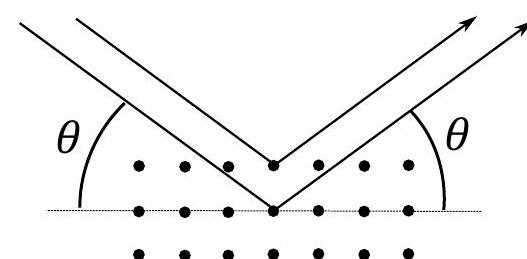
c) [8] A simplified model of sodium chloride (salt) consists of a cubic arrangement of alternating sodium and chloride ions separated by distance $d$. When a plane wave of X-rays is incident on the ions, each ion can be considered as a new source of spherically scattered new waves.

(i) Show that for plane waves of wavelength $\lambda$ and incident at angle $\theta$ to be reflected from the crystal constructively they must satisfy

$$ 2 d \sin \theta=n \lambda, $$

where $n$ is a positive integer and $\theta$ is specified as the angle given in Figure $\mathbf{1 5}$. This is called the Bragg condition.[3]

(ii) The density of salt is $2.17 \mathrm{~g} \mathrm{~cm}^{-3}$ with a molar mass of $58.4 \mathrm{~g} \mathrm{~mol}^{-1}$. Calculate the value of $d$ for salt. [3]

figure

Figure 15: Bragg reflection (an interference condition) with angle $\theta$ specified.

The dots denote the atomic layers.

(iii) In an X-ray diffraction experiment, waves that are incident at a minimum angle of $25^{\circ}$ are strongly reflected from a salt crystal. Calculate the wavelength of the Xrays. [2]

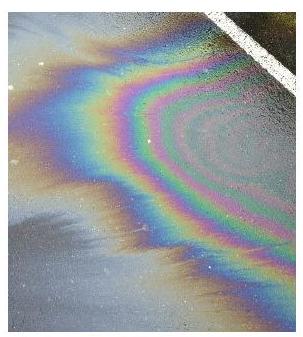
d) [7] An oil film on water produces colourful interference effects, as shown in Figure $16 .$

(i) Sketch a diagram showing the path of a ray of light entering and leaving the oil film. Mark on two paths that are going to account for the interference effect observed.

(ii) Calculate the minimum thickness of film needed to observe a strong reflection of violet light with a wavelength of $410 \mathrm{~nm}$, at an angle of reflection of $50^{\circ}$. The refractive index of oil is $1.5$, and that of water is $1.33$.

figure

Figure 16: Oil on water.

(image credit: E. Wiebe, http://climate.uvic.ca)

Show answer · 显示答案
Answers
  • (b)(i)$\displaystyle h = \frac{\lambda D}{4H}$
  • (b)(ii)Tide fall $\approx+80.7\,\mathrm{m}$ (far-field approximation; $81.7\,\mathrm{m}$ with exact path lengths). Corrected — the printed −81 m has the wrong sign; see the interactive walkthrough.Path difference increases by about $6.25\%$; the signal remains near its maximum (intensity falls by about $0.8\%$ for equal amplitudes). Clarified — the printed 6% describes a path-difference change, not the intensity change; see the interactive walkthrough.Very weak signal: $I/I_{\max}\approx0.00153$ ($0.153\%$, equal-amplitude model). Corrected — the printed “no signal” is not exactly true; see the interactive walkthrough.
  • (c)(ii)$\displaystyle 2.82 \times 10^{-10} \, \text{m}$
  • (c)(iii)$\displaystyle 2.4 \times 10^{-10}\, \text{m}$
  • (d)(ii)$t\approx7.948\times10^{-8}\,\mathrm{m}=79.48\,\mathrm{nm}$. Corrected — the printed 79.3 nm includes a square-root arithmetic error; see the interactive walkthrough.

Worked solutions are in the book.

2020 · Q4Waves & OpticsWave in Medium and Ray Optics

The change in speed of a wave in a medium has many important aspects, some of which are illustrated in this question.

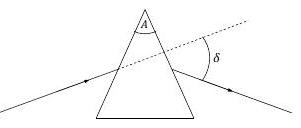
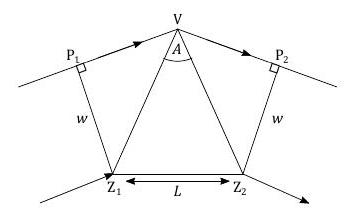
a) [10] A prism of apex angle $A$ and refractive index $n$ has a monochromatic beam of light incident on a face as shown in Figure 6 .

(i) Sketch a large diagram of the prism and draw the path of a ray passing through the prism. Mark on the angles of incidence for each face and the angles of refraction for each face for the ray, following the path of the ray with the angles in

figure

Figure 6 path order, $\theta_{1}, \theta_{2}, \theta_{3}$ and $\theta_{4}$.

(ii) Obtain an expression for the angle of deviation, $\delta$, between the incident ray and the emerging refracted ray in terms of the incident angle of refraction $\theta_{1}$, the angle of refraction of the ray emerging from the second face, $\theta_{4}$ and $A$.

The minimum angle of deviation, $\delta_{\min }$, occurs when the ray passes through the prism symmetrically. Then $\theta_{1}=\theta_{4}$ and $\theta_{2}=\theta_{3}$.

(iii) By considering a symmetric ray passing through the prism, obtain an expression for the the refractive index of the prism in terms of $\delta_{\min }$ and $A$.

(iv) For a prism with apex angle $A=60^{\circ}$, what is the difference in the angle of deviation for red and blue light, for which the refractive indices are respectively $n_{r}=1.604$ and $n_{b}=1.620$ ? Assume each ray passes through the prism with minimum deviation.

(v) If the emerging rays are focused on to a screen by a lens with a focal length of $30 \mathrm{~cm}$, what will be the linear separation of the images on the screen? [parallel rays passing through the centre of a lens are undeviated in direction but will be focused on the screen a focal length away]

(vi) Show that when the apex angle of the prism $A$ is small, then the refractive index can be given by $\delta=A(n-1)$.

(vii) A glass prism of apex angle $6.0^{\circ}$ and of refractive index $n_{1}=1.50$ is held with its apex downwards alongside another prism of apex angle $4.0^{\circ}$ which has its apex upwards. A parallel beam of monochromatic light is at normal incidence to the first prism and emerges from the second, parallel to the original beam, but displaced. Calculate the refractive index of the second prism.

The thin prism approximation of (vi) can be used for both prisms.

b) [3] In Figure 7, a parallel beam with a wavefront of width $w$ passes symmetrically through the isosceles prism. If $t_{1}$ is the time taken for the light to travel the path $\mathbf{P}_{1} \mathbf{V P}_{2}$, and $t_{2}$ is the time taken to travel $\mathbf{Z}_{1} \mathbf{Z}_{2}(=L)$, obtain an expression for the ratio of the times $\frac{t_{1}}{t_{2}}$ in terms of the incident angle $\theta_{1}, A$ and $n$.

figure

Figure 7

c) A thin lens has the characteristics of a thin prism. Using the result quoted earlier for a thin prism, $\delta=A(n-1)$, and the lengths $u$ and $v$ with corresponding small angles $\alpha$ and $\beta$ shown in Figure 8, in which the top half of the lens is shown,

(i) obtain an expression relating $u, v, A, n$ and the radius of the lens $d$.

(ii) If a thin lens has a diameter of $5.0 \mathrm{~cm}$, and $n=1.5$, what is the value of the apex angle $A$ for the lens with a focal length of $40 \mathrm{~cm}$ ?

(The focal length is the distance from the lens where a set of parallel rays entering the lens would cross the axis.)

figure

Figure 8

d) [3] A $60 \mathrm{~m}$ tank of water has a stroboscope at one end producing white light in equal time on/off flashes at a frequency $f_{0}$. The refractive index of water for red light is $1.33$ and for blue light it is $1.35$.

Estimate the maximum flash frequency at which light pulses can enter the tank and emerge from the far end as separate flashes.

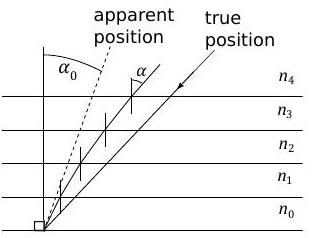
e) [6] From the Earth's surface, a star can be observed through a telescope. However, the

From the Earth's surface, a star can be observed through a telescope. However, the angle of the star measured from the vertical is shifted due to refraction by the Earth's atmosphere, as indicated in the model in Figure 9. The true position of the star is at angle $\alpha$ to the vertical, and the observed angle is at $\alpha_{0}$ to the vertical, with the small difference in angle being given by $r$, such that $\alpha=\alpha_{0}+r$. It should be assumed that $r$ is a small angle.

(i) Obtain an expression relating $\alpha$ and $\alpha_{0}$ for the refracted light.

(ii) Hence find an expression for $r$ in terms of $\tan \alpha_{0}$ and $n_{0}$, the refractive index of the atmosphere at the Earth's surface.

figure

Figure 9: The atmosphere is treated as distinct horizontal layers of refractive index from $n_{0}, n_{1}, \ldots$ to $n_{n}$ at the top.

Show answer · 显示答案
Answers
  • (a)(ii)$\displaystyle \delta = \theta_1 + \theta_4 - A$
  • (a)(iii)$\displaystyle n = \frac{\sin \left(\frac{\delta_{\min} + A}{2}\right)}{\sin \left(\frac{A}{2}\right)}$
  • (a)(iv)$\displaystyle 1.54^{\circ}$
  • (a)(v)$\displaystyle 0.81 \, \text{cm}$
  • (a)(vi)$\delta\approx A(n-1)$. Corrected — the reference mislabels (vi) as (iv) and boxes the earlier general index formula instead of the requested thin-prism result; see the interactive walkthrough.
  • (a)(vii)$\displaystyle 1.75$
  • (b)$\displaystyle \frac{1}{n} \cdot \frac{\sin \theta_1}{\sin \left(\frac{A}{2}\right)}$
  • (c)(i)$\displaystyle \frac{1}{u} + \frac{1}{v} = \frac{A}{d}(n-1)$
  • (c)(ii)$A=0.125\,\mathrm{rad}\approx7.162^\circ$. Corrected — the reference mis-evaluates 1/8 rad and prints 7.14°; see the interactive walkthrough.
  • (d)$\displaystyle 1.25 \times 10^8 \, \text{Hz}$
  • (e)$\displaystyle \sin \alpha = n_0 \sin \alpha_0$$\displaystyle r = (n_0 - 1) \tan \alpha_0$

Worked solutions are in the book.

2021 · Q2Waves & OpticsWave Propagation and Standing Wave

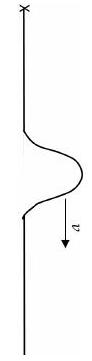
a) [6] A uniform wire of length $\ell$ and mass per unit length, $\mu$, is stretched between two fixed points $\times$. A point close to one end is plucked and a pulse travels along the wire at speed $v$, as shown in Fig. 1, to reflect off the right hand fixed end.

figure

Figure 1: Pulse travelling at speed $v$ along a wire under tension.

(i) Sketch a diagram of the reflected pulse.

(ii) After a second reflection from the left hand end, the pulse would be passing the initial point and travelling in the same direction. At that moment the wire could be plucked again to reinforce the pulse. What is the period of plucking, $t(\ell, v)$ which would accomplish this?

(iii) Calculate the corresponding frequency of plucking the wire, $f_{1}$, in terms of $v$ and $\ell$.

(iv) If a mechanical vibrator is attached to the wire to produce oscillations of frequency $f_{n}=n f_{1}$ (which are the harmonics or multiples of the $1^{\text {st }}$ harmonic, $f_{1}$ ) what resonant frequencies of the wire will be sustained, in terms of integer $n, v$ and $\ell$.

(v) The wire is now plucked near one end whilst a finger is lightly touching the wire at a point $40 \%$ of length from one end. Sketch the resultant amplitude of vibration along the wire, and determine the two lowest frequencies heard in terms of $f_{1}$.

(vi) The speed of transverse waves along a stretched wire wave is given by $v=\sqrt{\frac{T}{\mu}}$, with $T$ the tension in the wire. What would be the tension required in order to sustain the fifth harmonic, $f_{5}$, of frequency 162 Hz in the wire if its length is 2.3 m and mass is 42 g .

b) [8] In this example we hang the cable vertically and use its own weight to provide the tension. A massive, uniform cable of length $L$ and mass $M$ hangs with its upper end fixed to a support and the lower end free. The extension is negligible.

(i) What is the tension at a distance $x$ below the support?

(ii) The cable is shaken slightly at the bottom end. Using the information in part (a) (vi), calculate the ratio of the speeds of the pulse on the cable at points $1 / 4$ of its length from the top end and $1 / 4$ of its length from the bottom end.

(iii) The cable is now plucked at the top end as in Fig. 2 and the pulse travels down the cable. Write an expression for the speed of a pulse travelling down the cable in terms of $x, L$ and $g$.
(iv) Now obtain an expression for the time taken, $t_{\text {top }}$ for a pulse to travel a distance $x$ down the cable from the support at the top end.

(v) At the same moment that the cable is plucked at the top end, a ball is dropped from rest from the same starting height. At what value of $x$ in terms of $L$ will the ball overtake the pulse traveling down?

figure

Figure 2: Pulse travelling down a vertical hanging cable.

c) [2] The timing of pulses can be used in GPS systems.

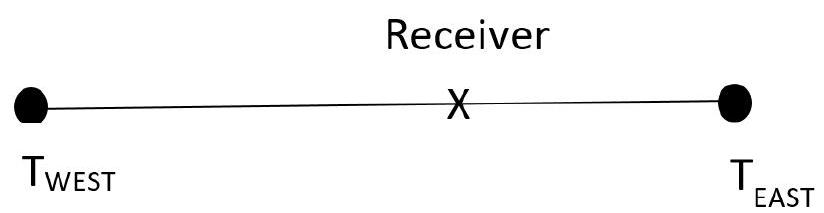
A stationary receiver is at a point on the line between two radio transmitters which lie on a West-East line, as in Fig. 3. Each transmitter contains a highly accurate clock and broadcasts a precise 1 MHz electromagnetic wave in pulses. After each pulse, a signal is sent with the exact time at which that signal was sent. The radio transmitters are 600 km apart. At the receiver, pulses are received from both transmitters. The pulse from the Western transmitter is received 1542 cycles of the 1 MHz wave before the pulse from the Eastern transmitter is received. The pulse from the Western transmitter was sent 0.000484 s before the pulse from the Eastern transmitter.

How far is the receiver from the Western transmitter?

figure

Figure 3: Two transmitters and a receiver lying along a W-E line

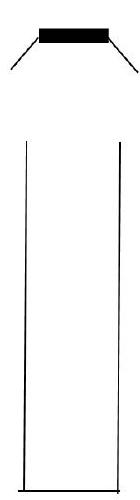
d) 2 A resonant tube of length $\ell$ is closed at one end and has a small loudspeaker close to the open end as in Fig. 4. An a.c. signal of frequency $f$ is supplied to the speaker, and adjusted so the tube resonates at its lowest frequency, $f_{1}$. This longitudinal sound wave has a displacement node at the closed end and an antinode at the open end.

(i) Sketch three graphs of the amplitude of the standing wave along the tube, for the lowest three harmonics that can be heard, as the speaker frequency $f$ is steadily increased.

(ii) Now in dotted lines but on the same axes as already drawn in part (i), sketch three graphs of the corresponding pressure variation of the air with position along the tube.

figure

Figure 4: Speaker above the open end of a closed tube.

e) [7] The speed of sound in air is given by the equation $v_{\text {gas }}=\sqrt{\frac{\gamma P}{\rho}}$ where $\gamma$ is a numeric constant, $P$ is the pressure and $\rho$ is the density of the air.

(i) In a 20 m tall vertical tube closed at one end, by how much is the pressure of air greater at the bottom of the tube relative to the top?

(ii) Why is it that the speed of sound does not vary with the depth of the air in the tube?

(iii) However, the speed does depend upon the absolute temperature of the air. Obtain an expression for the dependence on the speed of sound in terms of the constant $\gamma$, the gas constant $R$, the absolute temperature $T$ and the kg molar mass $M_{\mathrm{u}}$ in $\mathrm{kg} \mathrm{mol}^{-1}$.

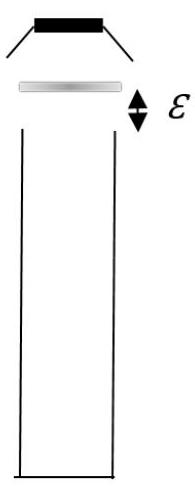
(iv) In a tube closed at one end, the antinode at resonance is located a (small) fixed distance $\varepsilon$ beyond the open end of the tube. This length is known as the end correction and is illustrated in Fig. 5.

A tube closed at one end, of length 52.0 cm , and filled with air at $20.0^{\circ} \mathrm{C}$, resonates at its first harmonic at 156 Hz . A second, shorter tube alongside, which has the same end correction, $\varepsilon$, is filled with warm air at $35^{\circ} \mathrm{C}$ and resonates at a slightly different frequency, producing beats with the first tube at 4.8 Hz . What is the length of the second tube?

figure

Figure 5: The end

At $20^{\circ} \mathrm{C}$ the speed of sound in air is $343 \mathrm{~m} \mathrm{~s}^{-1}$.

Atmospheric pressure is $1.01 \times 10^{5} \mathrm{~Pa}$.

Density of air at atmospheric pressure and $15^{\circ} \mathrm{C}$ is correction, $\varepsilon$ for an antinode located above the open end of the tube.

Show answer · 显示答案
Answers
  • (a)(ii)$\displaystyle \frac{2\ell}{v}$
  • (a)(iii)$\displaystyle \frac{v}{2\ell}$
  • (a)(iv)$\displaystyle n \frac{v}{2\ell}$
  • (a)(v)$5f_1$ Corrected — the printed 1.67f₁ is not an allowed full-string mode; see the interactive walkthrough.$10f_1$ Corrected — the printed 2.5f₁ is not an allowed full-string mode; see the interactive walkthrough.
  • (a)(vi)$\displaystyle 406 \text{ N}$
  • (b)(i)$\displaystyle \frac{M}{L} g (L - x)$
  • (b)(ii)$\displaystyle \sqrt{3}$
  • (b)(iii)$\displaystyle \sqrt{g (L - x)}$
  • (b)(iv)$\displaystyle 2 \sqrt{\frac{L}{g}} \left( 1-\sqrt{1-\frac{x}{L}} \right)$
  • (b)(v)$\displaystyle \frac{8}{9} L$
  • (c)$\displaystyle 140 \text{ km}$
  • (e)(i)$\displaystyle 240.345 \text{Pa}$
  • (e)(ii)$\displaystyle \text{both pressure and density change proportionally}$
  • (e)(iii)$\displaystyle v_{\text{gas}} = \sqrt{\frac{\gamma R_{\text{univ}} T}{M_u}}$

Worked solutions are in the book.
2022 · Q3Waves & OpticsModern & Nuclear PhysicsRay Optics and Diffraction

This question is about investigating materials with $X$ rays and electrons.

An accelerated charge radiates electromagnetic radiation. A synchrotron electron storage ring uses this idea to produce a continuous spectrum of electromagnetic radiation as the electrons are accelerated in a circular trajectory.

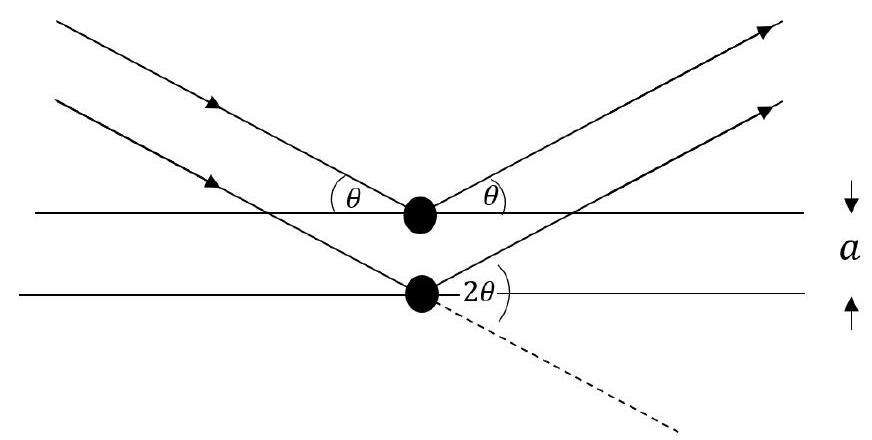
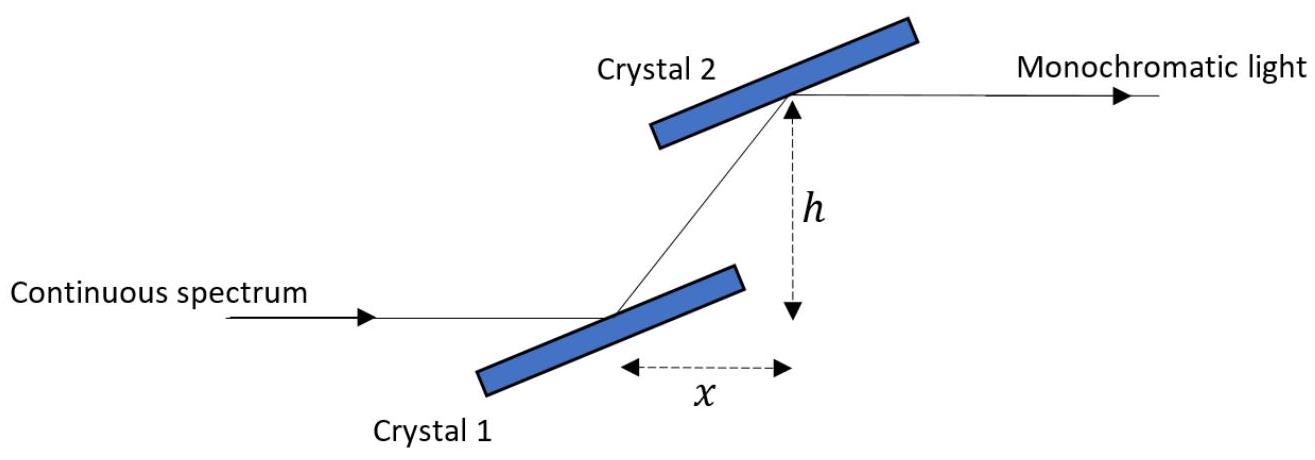
a) [5] Particular wavelengths of light can be selected using a monochromator, some of which make use of diffraction and interference from crystals. The diagram shows two rays from the continuous spectrum striking two adjacent crystal planes separated by a distance $a$. The crystal planes act as partially reflecting mirrors. For certain angles $\theta$, measured to the reflecting plane, the emerging rays are monochromatic.

figure

Figure 4: Reflection from two atomic surfaces in a crystal.

(i) What is the path difference between the two rays shown, in terms of $a$?

(ii) Determine the wavelength in terms of $\theta$ and $a$.

(iii) If $a=0.31 \mathrm{~nm}$, calculate the first order wavelength of light strongly scattered at an angle of $\theta=15^{\circ}$, and

(iv) the direction and magnitude of the change in momentum of the photons of this wavelength. You may use a diagram.

b) [3] In practice two crystals are used such that the light enters and leaves the monochromator in the same direction. The height, $h$ between the incoming and outgoing beams is fixed. Using a suitable approximation to first order, obtain a formula for $x$ in terms of the wavelength $\lambda$, the crystal lattice spacing $a$, and the height $h$.

figure

Figure 5

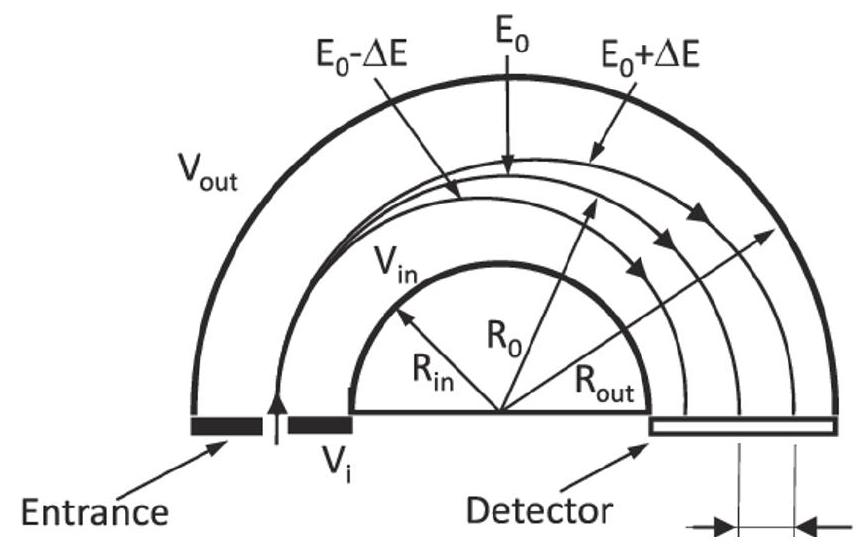
c) [7] Monochromatic light of part (b) is incident on a sample of copper so that electrons are emitted via the photoelectric effect. The energy of the emitted electrons are investigated using a hemispherical electron energy analyser, shown in Fig. 6.

$E_{0}$, referred to as the pass energy, is the energy of the electron travelling from the analyser entrance to the exit slit of the electron detector along the equipotential path defined by, $R_{0}=\frac{R_{\text {out }}+R_{\text {in }}}{2}$, in which $R_{\text {in }}$ and $R_{\text {out }}$ are the inner and outer hemisphere radii, respectively.

These charged spheres produce a radial electric field between them. Only electrons of the particular energy $E_{0}$, describe a perfectly semi circular path and are detected. The inner sphere is at a potential $V_{\text {in }}$ and the outer one is at a potential $V_{\text {out }}$ so as to make the electric field radial.

figure

Figure 6: Hemispherical electron energy analyser.

Figure published in Progress in Materials Science 2020 X-ray photoelectron spectroscopy: Towards reliable binding energy referencing G. Greczynski, L. Hultman

(i) Draw a sketch of the electric field lines between the hemispheres.

(ii) Write down the potential $V_{\text {in }}$ of the inner hemisphere in terms of the charge $Q$ on the hemisphere and its radius $R_{\mathrm{in}}$.

(iii) In the simplest form possible, determine an expression for the pass energy, $E_{0}$ in terms of the radii of the hemispheres $R_{\mathrm{in}}$ and $R_{\text {out }}$, the difference in the potentials (i.e. $\Delta V=V_{\text {in }}-V_{\text {out }}$ ), and the electronic charge $e$.

(iv) If the mean radius of the hemispheres is 50 mm with a separation of 10 mm , what potential difference between the plates gives a pass energy of 5.0 eV ?

d) [5] In a solid such as copper, the electrons exist in very closely spaced energy levels, which can be investigated. A 5.0 eV free electron is produced, for example, when an electron is in an energy level 4.0 eV below the top level in the solid and is released without collision in photoelectric emission. The workfunction of copper is 4.6 eV .

(i) What was the photon energy used?
(ii) what wavelength is this and which part of the electromagnetic spectrum does it correspond to? [3]

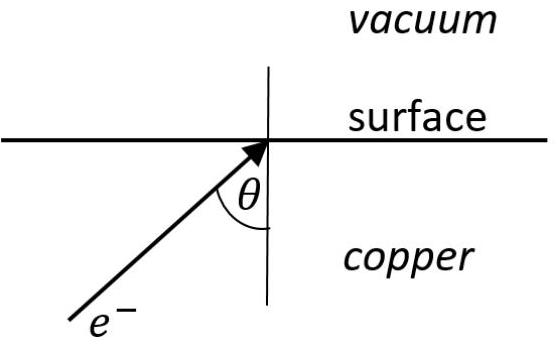
(iii) When an electron travels from the solid into the vacuum, it changes speed, similar to the behaviour of light crossing a boundary. Whilst inside the material the electron was travelling in the direction shown in Fig. 7, at $\theta=50^{\circ}$ to the surface normal.

i. Calculate a value for the (relative) refractive index $\mu>1$, corresponding to the electron going from the vacuum into the copper.

ii. For the the electron leaving the copper at $\theta=50^{\circ}$, at what angle does it emerge into the vacuum? [2]

figure

Figure 7: An electron crossing a surface from the vacuum.

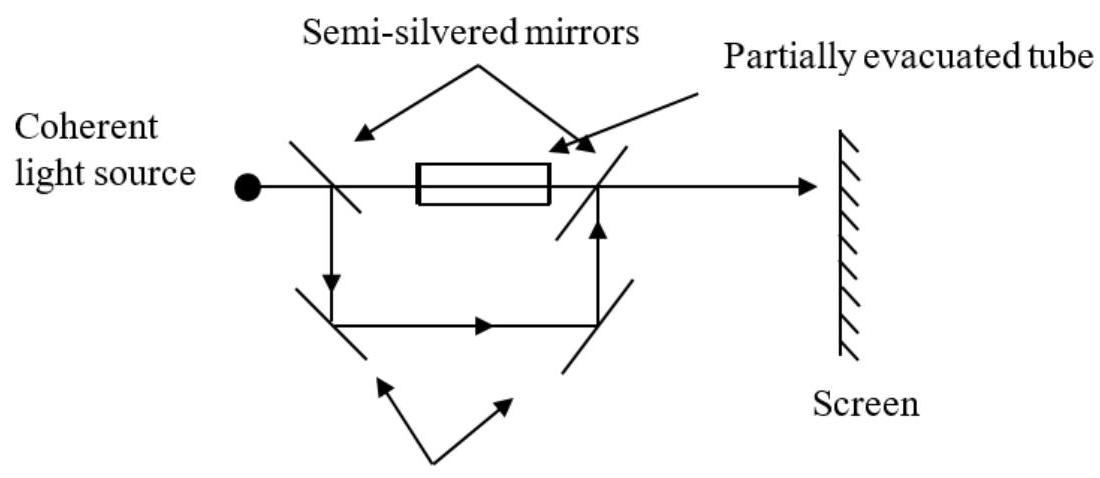
e) [2] Light of wavelength $\lambda=640 \mathrm{~nm}$ passes through an evacuated tube of length $\ell=8.0 \mathrm{~cm}$ with thin glass ends. The beam interferes with a second coherent beam of light on a screen, causing destructive interference, as shown in Fig. 8. Air has a refractive index given by $\mu_{\text {air }}=1+0.00029 \frac{P}{P_{0}}$ where $P_{0}=1.0 \times 10^{5} \mathrm{~Pa}$. What minimum pressure of air in the tube would cause the interference pattern to become constructive interference at the screen?

figure

Figure 8: Interference between two beams from a coherent source of light. One beam passes through a partially evacuated tube.

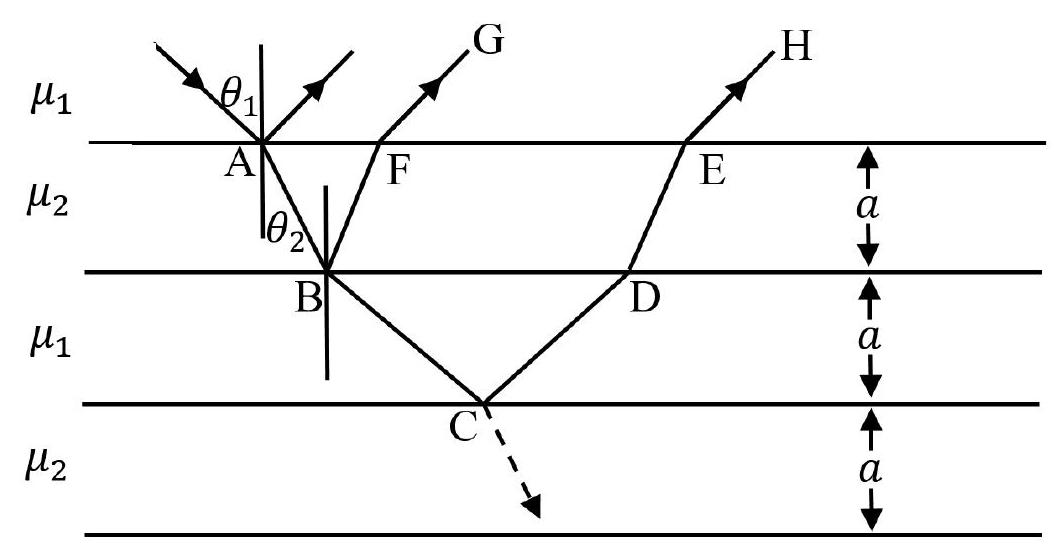
f) [3] The refractive index of a material for electrons depends upon the wavelength of the electron. So if we instead consider X rays reflecting off adjacent layers of a crystal, we can take into account the effect of refraction within the material.

figure

Figure 9: X ray interference between layers of atoms.

An example is illustrated in Fig. 9 in which adjacent layers of atoms are laid down on a substrate. X rays are incident at angle $\theta_{1}$ and refracted in the second layer at angle $\theta_{r}$. If there are multiple layers and reflections, then these will dominate intensity of the reflection at the first surface from the vacuum. So we we can look at the path difference between the emerging rays G and H . In this very simplified model, the layers have been given the same thickness $a$.

(i) Determine the path length BCD.

(ii) What is the optical path difference between rays G and H?

Show answer · 显示答案
Answers
  • (a)(i)$\displaystyle \Delta = 2a \sin(\theta)$
  • (a)(ii)$\displaystyle \lambda = \frac{2a \sin(\theta)}{n}$
  • (a)(iii)$\displaystyle 0.1605 \text{ nm}\text{ or } 1.6 \times 10^{-10} \text{m}$
  • (a)(iv)$\displaystyle \Delta p \approx 2.1 \times 10^{-22} \mathrm{kg} \cdot \mathrm{ms}^{-1}$
  • (b)$\displaystyle \frac{x}{h} \approx \frac{\lambda}{2a}$
  • (c)(ii)$\displaystyle V_{\text{in}} = \frac{Q}{4 \pi \epsilon_0 R_{\text{in}}} = \frac{kQ}{R_{in}}$
  • (c)(iii)$\displaystyle E_0 = e \Delta V \left[\frac{R_{\text{in}} R_{\text{out}}}{(R_{\text{out}}^2 - R_{\text{in}}^2)} \right]$
  • (c)(iv)$\displaystyle \Delta V \approx 2.02 \text{ V}$
  • (d)(i)$\displaystyle 13.6 \text{ eV}$
  • (d)(ii)$\displaystyle \lambda \approx 0.912 \times 10^{-7} \text{ m} = 91.2 \text{ nm}$$\displaystyle \text{ultraviolet part of the electromagnetic spectrum}$
  • (d)(iii)$\displaystyle n \approx 1.30$$\displaystyle \theta_{\text{vac}} \approx 84.8^\circ$
  • (e)$\displaystyle 1.379 \times 10^2 \text{ Pa} \approx 137.9 \text{ Pa}$
  • (f)(ii)$\displaystyle 2 \mu_1 a \cos \theta_1$

Worked solutions are in the book.