This question is about hot air balloons.
A hot air balloon floats because the air sealed inside its envelope is less dense than the colder air outside, so the surrounding atmosphere pushes up on the balloon harder than gravity pulls it down. The problem begins with the simple buoyancy condition for a balloon to lift, recreates the pioneering 1783 Montgolfier and Charles flights using the ideal gas law, and then builds up the barometric (exponential atmosphere) model to follow the balloon's hydrogen as it expands and cools on the way up.
a) [3] A hot air balloon rises when the upthrust is greater than its total weight. Calculate the volume of hot air required to lift a balloon with a combined mass of $200\,\mathrm{kg}$ for the balloon and basket. You should include the mass of the hot air, which has a density of $0.95\,\mathrm{kg\,m^{-3}}$ in the total weight of the balloon. The density of the cold air surrounding the balloon is $1.23\,\mathrm{kg\,m^{-3}}$.
b) [4] In 1783, the Montgolfier brothers' hot air balloon freely ascended, but remained at a low height. The balloon had a volume of about $2000\,\mathrm{m^3}$, and a lifting capacity including its own weight of $830\,\mathrm{kg}$. The air inside the balloon was heated by a fire in a basket below. Estimate the temperature of the air in the balloon. Air density at ground level is $1.23\,\mathrm{kg\,m^{-3}}$. Surface atmospheric pressure is $1.01 \times 10^{5}\,\mathrm{Pa}$. The molar mass of air $0.029\,\mathrm{kg\,mol^{-1}}$.
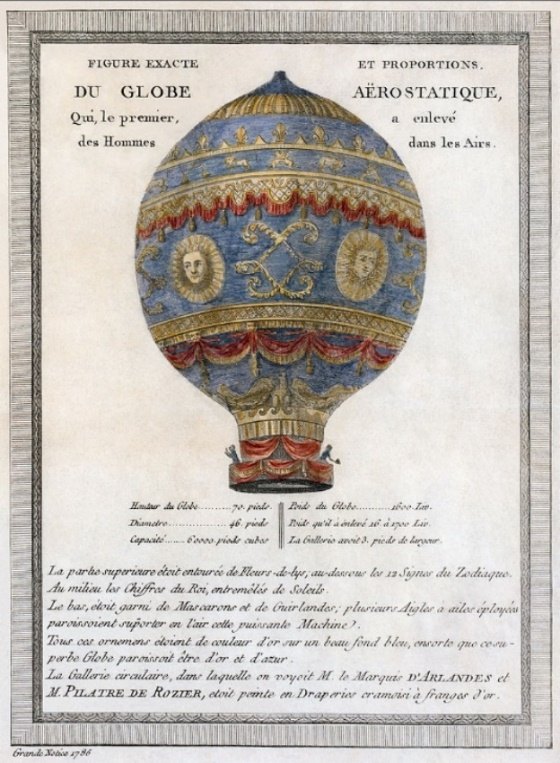
Figure 6: The Montgolfier brothers' hot air balloon of 1783, heated by a fire in the basket below.
c) [9] Charles' and the Robert brothers' balloon flew not long after but was filled with hydrogen. The balloon had a capacity of $380\,\mathrm{m^3}$ and was filled on the ground at a sea level pressure of $1.01 \times 10^{5}\,\mathrm{Pa}$, and temperature of $288\,\mathrm{K}$.
- (i) Calculate the mass of hydrogen in the balloon.
- (ii) The balloon was constructed of a single lamina of rubberised silk with a thickness $0.43\,\mathrm{mm}$. The silk cloth has a mass per unit area of $66.5\,\mathrm{g\,m^{-2}}$ and a density of $1.30\,\mathrm{g\,cm^{-3}}$. Rubber has a density of $1.34\,\mathrm{g\,cm^{-3}}$. Assuming the balloon is spherical, calculate the mass of the balloon to three significant figures.
- (iii) Taking the mass of the two passengers, gondola and rigging to be $270\,\mathrm{kg}$, calculate the initial acceleration of the balloon at sea level.
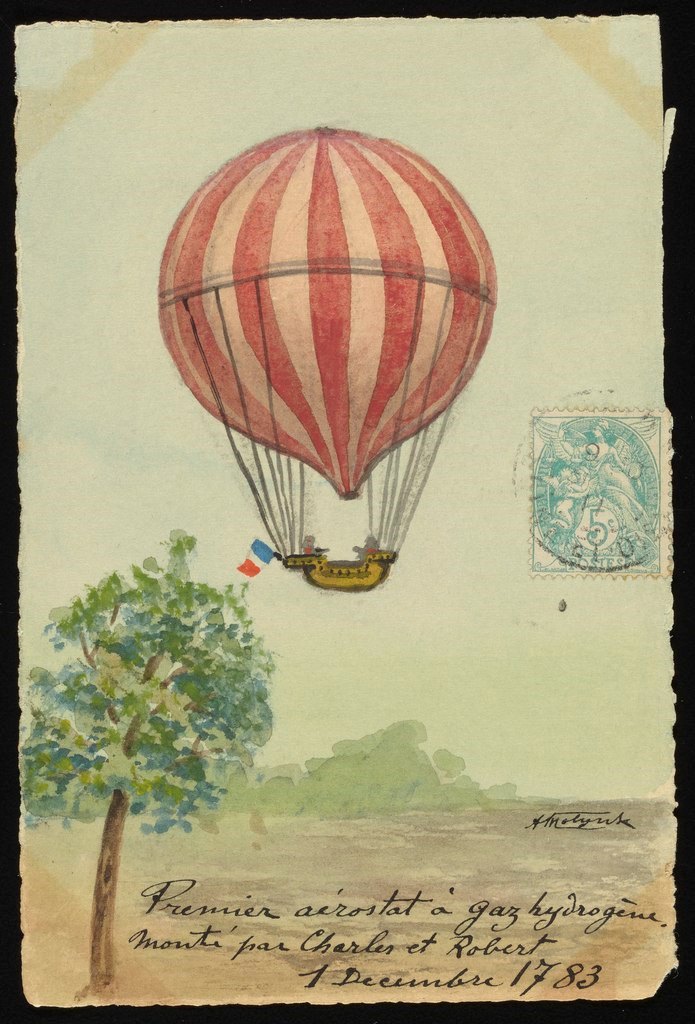
Figure 7: Charles and the Robert brothers' hydrogen-filled balloon.
The density of air at sea level is $1.23\,\mathrm{kg\,m^{-3}}$.
d) [3] In an unrelated example, a balloon of mass $m_1$ with a small amount of ballast $m_2$ descends with constant velocity $v$ due to a drag force $F_\mathrm{d}$ acting on the balloon. The drag force is proportional to the speed of the balloon through the air. What is the mass of ballast $m_2$, expressed in terms of $F_\mathrm{d}$, that must be jettisoned from the balloon so that it rises with the same velocity $v$?
e) [6]
- (i) Atmospheric pressure is due to the weight of air above.
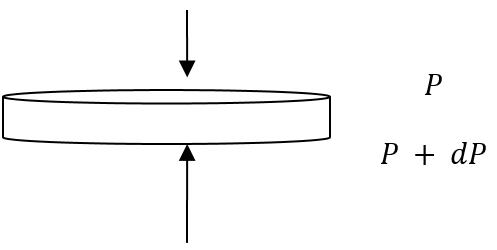
Figure 9: A thin slab of atmosphere of thickness $\Delta h$, used to derive how pressure varies with altitude.
- i. From the hydrostatic equation, $p = \rho g h$ we can trivially write down an expression for $\Delta p$. This contains both $p$ and $\rho$ so you need another equation to eliminate $\rho$.
- ii. From the ideal gas equation, obtain a relation between $p$ and $\rho$, $R$, $T$ and $M$, the molar mass.
- iii. Now using the hydrostatic equation, obtain an expression for $\dfrac{\mathrm{d}p}{p}$ in terms of $M$, $g$, $h$, $R$ and $T$.
- iv. The temperature decreases linearly with height, in the form $T = T_0 - \alpha h$. Use this with the previous result to produce an expression for atmospheric pressure as a function of altitude $p(h)$, in terms of sea level pressure $p_0$, $g$, the molar mass of air $M$, the molar gas constant $R$, the air temperature at sea level $T_0$, the rate of decrease of temperature with altitude $\alpha$ and altitude $h$. Humidity should not be considered.
- (ii) In a second flight, Charles ascended to $3000\,\mathrm{m}$. Calculate the ambient temperature and pressure at this altitude. Take the molar mass of air to be $0.0290\,\mathrm{kg\,mol^{-1}}$, and the molar gas constant to be $8.31\,\mathrm{J\,mol^{-1}\,K^{-1}}$. The rate of decrease of temperature with height is $0.00976\,\mathrm{K\,m^{-1}}$, the reference sea level temperature $T_0 = 288\,\mathrm{K}$ and the reference sea level pressure $p_0 = 1.01 \times 10^{5}\,\mathrm{Pa}$.
- (iii) The balloon expands in volume by $30\,\%$ at a height of $3000\,\mathrm{m}$.
- i. Calculate the pressure inside the balloon, assuming no hydrogen has been lost.
- ii. Determine the stress in the skin of the balloon.
- iii. Estimate the Young's Modulus of the composite skin material.
[25 marks]
Show answer · 显示答案
- (a)$\displaystyle V = 714\,\mathrm{m^3}$
- (b)$\displaystyle T = 430\,\mathrm{K} = 160\,^\circ\mathrm{C}$
- (c)(i)$\displaystyle m_{\mathrm{H_2}} = 32\,\mathrm{kg}$
- (c)(ii)$\displaystyle m_\mathrm{balloon} = 146\,\mathrm{kg}$
- (c)(iii)$\displaystyle a = 0.42\,\mathrm{m\,s^{-2}}$
- (d)$\displaystyle m_2 = \frac{2F_\mathrm{d}}{g}$
- (e)(i)$\displaystyle \Delta p = -\rho g\,\Delta h$$\displaystyle \rho = \frac{pM}{RT}$$\displaystyle \frac{\mathrm{d}p}{p} = -\frac{Mg}{RT}\,\mathrm{d}h$$\displaystyle p(h) = p_0\left(\frac{T_0 - \alpha h}{T_0}\right)^{\!\frac{Mg}{R\alpha}}$
- (e)(ii)$\displaystyle T = 259\,\mathrm{K}, \qquad p(3000) = 7.0 \times 10^{4}\,\mathrm{Pa}$
- (e)(iii)$\displaystyle p_2 = 70\,\mathrm{kPa}$$\displaystyle \sigma = 4 \times 10^{8}\,\mathrm{Pa}$$\displaystyle E = 4 \times 10^{9}\,\mathrm{Pa}$
Worked solutions are in the book.