This question is on the photoelectric effect and radioactive decay.
a) [5] When UV light is shone on a metal surface electrons are emitted.
(i) Write down an equation which illustrates conservation of energy for this situation, relating the work function $W$, to the kinetic energy of the emitted electrons and the wavelength, $\lambda$, of the monochromatic light incident on the metal.
Two plane, large area, parallel conducting plates are placed $2.0 \mathrm{~cm}$ apart in a vacuum. The plates form part of a circuit containing a very sensitive ammeter (and amplifier) such that a current as low as $0.1 \mathrm{pA}$ can be measured. One of the metal plates is illuminated with UV light of wavelength $280 \mathrm{~nm}$, causing photoelectrons to be emitted. The current flow is reduced to zero by an applied potential of $-0.82 \mathrm{~V}$ relative to the emitting plate.
(ii) How many electrons per second can the ammeter detect?
(iii) Calculate the work function of the metal plate.
(iv) Determine the speed of the most energetic photoelectrons emitted from the plate.
(v) If one of the photoelectrons with the maximum kinetic energy is emitted at an angle of $20^{\circ}$ to the normal to the surface, calculate how far from its starting point it returns to the plate.
b) [8] A $300 \mathrm{~m}$ long evacuated pipe has a parallel beam of very low intensity monochromatic light from a laser of wavelength $585 \mathrm{~nm}$ directed along its axis from one end. A laser has a power of $1.2 \mathrm{~mW}$ and the power reaching the far end is required to be less than $6.6 \times 10^{-11} \mathrm{~W}$.
This can be achieved by a set of absorbing filters, each filter reducing the light intensity by a factor of $4.5$.
(i) Calculate the minimum number of filters required to reduce the power to that required value.
(ii) State the resulting power of the light obtained.
(iii) Calculate the average number of photons reaching the far end each second.
(iv) Determine the average distance between photons travelling down the pipe.
(v) If a Young's double slit arrangement was placed at the end of the tube and illuminated with this low intensity light, and the intensity pattern was recorded on a sensitive camera placed behind the slits, what would be the appearance of the pattern recorded on the camera?
(vi) How would your answer to part (iv) differ if the pipe was filled with a transparent medium of refractive index $n=1.2$ ?
c) [4] An uncharged copper sphere of radius $8.0 \mathrm{~cm}$ hangs from a thin, insulating thread in a vacuum. It is illuminated with light covering a range of wavelengths from $600 \mathrm{~nm}$ down to $150 \mathrm{~nm}$ and becomes charged.
The work function of copper is $4.7 \mathrm{eV}$.
(i) What is the value of the final potential of the sphere?
(ii) Calculate the number of electrons that have been lost from the sphere.
(iii) If the light illuminating the sphere is reduced to a very low intensity, it is calculated that an electron might be emitted every $0.1 \mathrm{~s}$ on average. However, measurements show that an electron may be emitted a few nanoseconds after the illumination is switched on. Explain this observation.
(iv) The illumination is switched off and it is observed that the sphere discharges by a small current flowing through the supporting thread, which is not a perfect insulator. What is the value of its resistance if the sphere loses half of its charge in $20 \mathrm{~s}$ ?
d) [8] The half-life of the long lived isotope Radium- 226 was originally measured by allowing it to charge an insulated metal plate and measuring the time taken to reach a known potential, repeatedly, over a long period of time. Such an apparatus is shown schematically to the right in Figure 1. The apparatus is supported on insulating rods and contained in a vacuum.
The $\mathrm{Ra}-226$ is contained in the thin walled glass container in the form of $3.62 \mathrm{mg}$ of newly prepared radium bromide $(\mathrm{RaBr})$. As it beta decays, the metal plate that it sits on charges up and the flexible golf leaf rises until it reaches $220 \mathrm{~V}$, when it touches the earthed electrode and is discharged. Assume that all beta particles escape through the glass and away from the apparatus. Measurements on the apparatus show that the potential on the gold leaf is proportional to the charge, with the constant of proportionality being $6.40 \mathrm{pC} \mathrm{V}^{-1}$. The relative atomic masses of radium and bromine atoms are 226 and 80 respectively. The gold leaf rises and falls every 85 seconds.
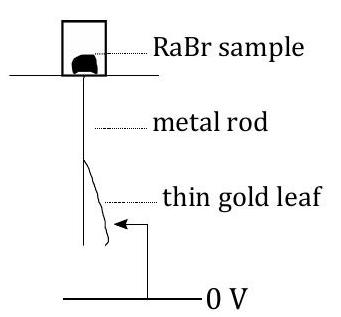
Figure 1
(i) Calculate the number of beta decays which occur for the flexible gold leaf to rise and make contact with the electrode.
(ii) Calculate the activity of the sample.
(iii) Hence determine the half-life of Ra-226.
(iv) What is the average current flow along the contact to earth during the first day?
(v) Comment on whether a similar gold leaf apparatus could be used to measure the initial current flow from the sphere used in part (c).
(vi) What would be the effect on the rise and fall of the gold leaf of replacing the radium bromide sample with a sample having the same initial activity but made from the isotope $\mathrm{Ra}-223$ with a half life of $11.4$ days? Sketch a graph of the rise and fall time, $T$, of the gold leaf over a period of 50 days.
(vii) If this apparatus with the original Ra-226 sample was used as a clock, how long would it take for the clock to have slowed by one hour in a correctly measured 24 hour period?
Show answer · 显示答案
- (a)(i)$\displaystyle h \frac{c}{\lambda} = W + \frac{1}{2} m_e v^2$
- (a)(ii)$\displaystyle 6.25 \times 10^5 \text{ electrons per second}$
- (a)(iii)$\displaystyle 3.63 \mathrm{~eV}$
- (a)(iv)$\displaystyle 5.36 \times 10^5 \mathrm{~m/s}$
- (a)(v)$\displaystyle 2.6 \mathrm{~cm}$
- (b)(i)$\displaystyle 12$
- (b)(ii)$\displaystyle 1.74 \times 10^{-11} \mathrm{~W}$
- (b)(iii)$\displaystyle 5.1 \times 10^7 \text{ photons per second}$
- (b)(iv)$\displaystyle 5.88 \mathrm{~m}$
- (b)(vi)$\displaystyle 4.9\mathrm{~m}$
- (c)(i)$\displaystyle 3.58 \mathrm{~eV}$$\displaystyle 3.58 \mathrm{~V}$
- (c)(ii)$\displaystyle 2 \times 10^8$
- (c)(iv)$\displaystyle 3.25 \times 10^{12} \mathrm{~\Omega}$
- (d)(i)$\displaystyle 8.8 \times 10^9 \text{ electrons}$
- (d)(ii)$\displaystyle 1.035 \times 10^8 \text{ Bq }$
- (d)(iii)$\displaystyle 1.53 \times 10^3 \text{ years}$
- (d)(iv)$\displaystyle 1.656 \times 10^{-11} \text{ A}$
- (d)(v)$\displaystyle \text{No.}$
- (d)(vii)$\displaystyle 90 \text{ years}$
Worked solutions are in the book.