a) (i) [8] A tall cylinder of circular cross sectional area $A$ and height $h$ is filled with a liquid of uniform density $\rho$.
i. Derive an expression for the pressure $P$ at the bottom of the liquid in terms of the variables $\rho, g$ and $h$. Ignore atmospheric pressure.
ii. Show that the units for each side of your derived equation are the same.
iii. What would your result be if the liquid changed in density linearly from $\rho_{t}$ at the top to $\rho_{b}$ at the bottom of the cylinder?
iv. If you used your formula for the pressure at ground level, at the bottom of the Earth's atmosphere, which has a height of about $200 \mathrm{~km}$, it would give an answer which is very far from correct. Explain why.
(ii) A water tank which sits on the ground is kept full of water to a depth of $h$. Water is issuing horizontally from a hole which is in the sidewall of the tank, a distance $h^{\prime}$ below the surface. Determine the maximum horizontal distance $H$ from the hole in the can where the jet of water strikes the floor, by using arguments which assume only
i. conservation of mechanical energy, assuming the water falls down through height $h^{\prime}$,
ii. conservation of momentum (using the pressure at depth $h^{\prime}$ ).
b) [7] An empty, hollow cuboid container of mass $M$ and height $h$, width $a$, depth $b$, is suspended upright from a thin cable in a liquid of density $\rho_{\ell}$, as shown in Figures $3 \mathbf{a}$ and $\mathbf{3 b}$.
(i) Find an expression for the tension, $T$, in the cable by considering the force due to the pressure of the liquid on the top of the container, and the force due to the pressure of the liquid on the bottom of the container.
(ii) The cuboid container now has a small hole pierced in the bottom surface and the liquid leaks in until the air now confined to the top part of the container, occupying a fraction $f$ of the volume, with a fraction $(1-f)$ of the volume inside now being filled with liquid. The pressure of the atmosphere at the surface of the liquid is $P_{0}$ and the density of the liquid is $\rho_{\ell}$. Obtain an expression for the depth, $h^{\prime}$ of the bottom surface of the container in terms of $P_{0}, \rho_{\ell}, g$ and $h$.
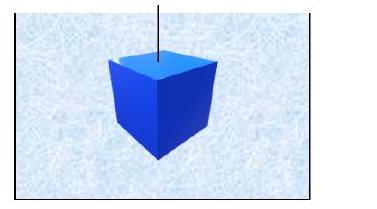
Figure 3 (a)
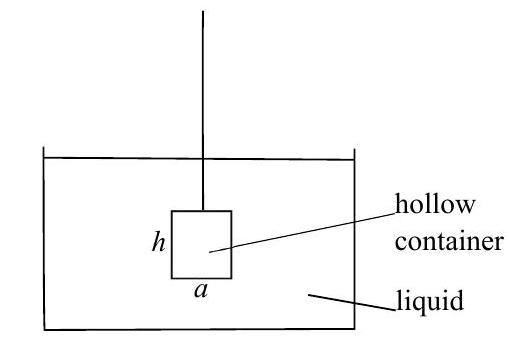
Figure 3 (b)
c) [5] A rod of length $\lambda$ and material density $\rho_{r}$ is pivoted by a hinge at a point on the wall of a container which has liquid of density $\rho_{\ell}$, below the level of the pivot point. The rod floats without touching the bottom of the container. If a fraction $\lambda / n$ of the rod is above the surface, determine $n$ in terms of $\rho_{r}$ and $\rho_{\ell}$.
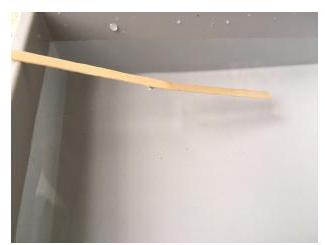
Figure 4 (a)
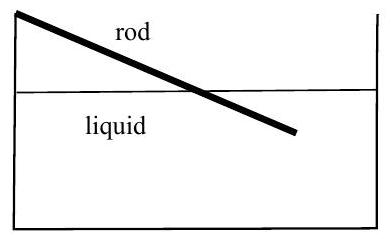
Figure 4 (b)
d) A solid circular cone of height $h$, mass $m$, radius of base, $r$, is floating in a liquid of density $\rho_{\ell}$ with its axis vertical and vertex downwards, as shown in Figure $\mathbf{5}$. In the liquid, a height $h / n$ is submerged below the surface of the liquid.
(i) Obtain an expression relating the mass of the cone to the fraction submerged, $\frac{h}{n}$, in terms of $r, h, n$ and $\rho_{\ell}$
The volume of a circular cone is given by $V=\frac{1}{3} \pi r^{2} h$.
(ii) A weight equal to the weight of the cone is placed on the base whilst it is floating, and it sinks until the base is just level with the liquid, and then it rises again. For this condition, show that
$$ n^{3}+n^{2}+n=7 $$
You may neglect any effects of the inertia and viscosity of the liquid. Energy considerations may be helpful.
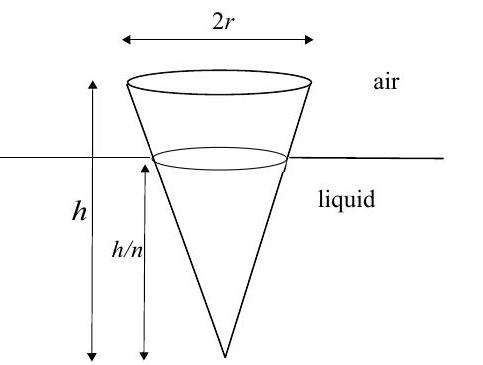
Figure 5
Show answer · 显示答案
- (a)(i)$P=\frac{gh(\rho_t+\rho_b)}{2}$. Corrected — the printed pressure has an extra density factor; see the interactive walkthrough.
- (a)(ii)$\displaystyle H = 2 \sqrt{h' (h - h')}$$\displaystyle 2 \sqrt{h' (h - h')}$
- (b)(i)$\displaystyle M g - \rho_{\ell} g a b h$
- (b)(ii)$\displaystyle h' = \left( \frac{P_0}{\rho g f} + h \right)(1 - f)$
- (c)$\displaystyle \sqrt{\frac{\rho_l}{\rho_l-\rho_r}}$
- (d)(i)$\displaystyle \frac{\pi}{3} \rho_\ell \frac{r^2 h}{n^3}$
Worked solutions are in the book.