A typical cheap handheld telescope has a diameter of 10 cm, whilst ones for keen amateurs can have diameters of 40 cm. How much greater light gathering power does the larger telescope have?
A. 2
B. 4
C. 8
D. 16
On September 5th 2016, the Rosetta mission found the Philae lander on Comet 67P/Churyumov-Gerasimenko. Philae ($1 \times 1 \times 1$ m) appeared as $25 \times 25$ pixels in a high-resolution camera with $2048 \times 2048$ pixels and field of view $2.2^{\circ} \times 2.2^{\circ}$. From what distance did Rosetta image Philae?
A. 1.1 km
B. 2.1 km
C. 12.2 km
D. 26.8 km
Show answer · 显示答案
Two light sources, A and B, emitting their light isotropically (i.e. equally in all directions) are placed at distance $r$ and $2r$ respectively from a detector, which shows they have the same apparent brightness (i.e. $b_A/b_B = 1$). If A is moved to $2r$ and B is moved to $3r$, what is the new ratio of apparent brightness $b'_A/b'_B$?
A. $2/3$
B. $4/9$
C. $3/4$
D. $9/16$
Show answer · 显示答案
Light source A from the previous question is returned to a distance of $r$ from the detector. How far away should it now be moved to appear 5 magnitudes fainter?
A. $5r$
B. $10r$
C. $50r$
D. $100r$
Show answer · 显示答案
The three stars that make up Orion's belt are Alnitak, Alnilam and Mintaka, with apparent magnitudes, $m$, of $1.77, 1.69$ and $2.23$ respectively. What is the ratio of the apparent brightnesses of the two brightest stars?

A. 0.655
B. 1.076
C. 1.528
D. 1.644
Show answer · 显示答案
The Chandra X-ray Observatory celebrates 20 years of operation this year, and was 100 times more sensitive than previous X-ray telescopes when it was launched. All X-ray telescopes have either been space-borne or operate in near-space environments. This is because:
A. X-rays cannot penetrate the Earth's atmosphere all the way to the ground
B. On the ground there is too much interference from medical X-rays
C. It is dangerous to be close to an X-ray telescope so it must be highly remote from human life
D. The resolution of the telescope would be too poor for astronomical observations from the ground
Show answer · 显示答案
On 1st January 2019 New Horizons had an encounter with Ultima Thule at 43.4 au from the Sun. Given the apparent magnitude of the Sun from Earth is -26.74, what is the apparent magnitude of the Sun from Ultima Thule?
A. -18.25
B. -18.35
C. -18.45
D. -18.55
Show answer · 显示答案
The Ring Nebula, M57, has shells with angular diameter 230 arcseconds. Given the nebula is 787 pc from Earth, estimate its radius.
A. 0.44 pc
B. 0.88 pc
C. 25 pc
D. 50 pc
Show answer · 显示答案
After many delays, the James Webb Space Telescope (JWST) is due to be launched in December 2021. This will be the successor to the Hubble Space Telescope (HST) and has a much bigger primary mirror (6.5 m in diameter against 2.4 m for the HST) so will be able to study the Universe in unprecedented detail. Given the faintest objects the HST can see have a magnitude of $\sim 31$ (known as the limiting magnitude), what limiting magnitude might we expect for JWST?
A. $\sim 29$
B. $\sim 31$
C. $\sim 33$
D. $\sim 36$
Show answer · 显示答案
Estimate the number of photons incident on a human pupil (of radius 2 mm) from the Sun per second when it is at the zenith on a clear day.
A. $\sim 10^{10}$
B. $\sim 10^{13}$
C. $\sim 10^{16}$
D. $\sim 10^{19}$
Show answer · 显示答案
A telescope with a focal length of 750 mm is used with an eyepiece. Which eyepiece focal length would give the greatest overall magnification?
A. 25 mm
B. 20 mm
C. 15 mm
D. 10 mm
Show answer · 显示答案
The Gaia spacecraft, launched in 2013, is designed to map the sky with unprecedented precision. Its third data release (from June 2022) had $1.8 \times 10^{9}$ objects detected of which $1.9 \times 10^{6}$ were highly likely to be quasars (distant galaxies with an actively feeding black hole responsible for their light output). Assuming the quasars are evenly distributed across the whole sky, what is the approximate average angular separation between them?
A. $\sim 0.001^{\circ}$
B. $\sim 0.01^{\circ}$
C. $\sim 0.1^{\circ}$
D. $\sim 1.0^{\circ}$
Show answer · 显示答案
Jupiter's apparent magnitude at opposition in 2022 of $m = -2.94$ is the brightest for $\sim 70$ years due to it happening close to Jupiter's perihelion. What is the difference in apparent magnitude between Jupiter's brightest and faintest possible oppositions? Jupiter has a semi-major axis of 5.20 au and an eccentricity of 0.0489. Assume the Earth's orbit is circular.
A. 0.38
B. 0.43
C. 0.48
D. 0.53
Show answer · 显示答案
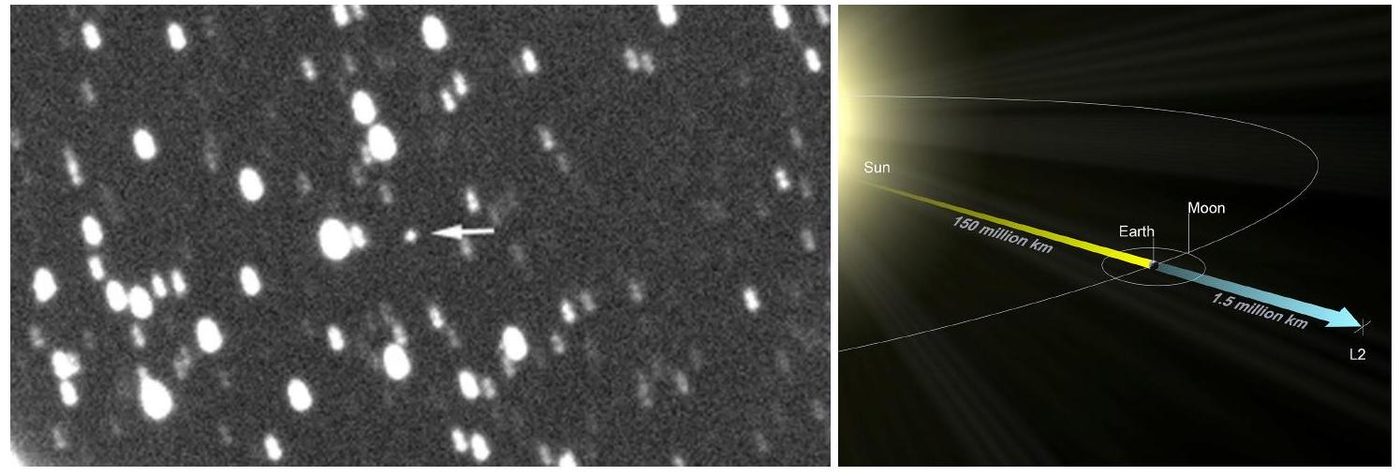
The James Webb Space Telescope (JWST) is an exciting new space-based observatory which is capable of detecting incredibly faint objects that have never been seen before, but it is also possible to be seen from Earth if you have a large enough telescope. It has now entered a halo orbit around the second Lagrangian point, $L_{2}$, of the Sun-Earth system at a distance of about 1.5 million km from Earth, directly along the Sun-Earth line.

The rectangular sunshield is rather large (measuring 21 m by 14 m, roughly the same as a tennis court), very reflective (reflecting $\sim 90\%$ of the incident light), and always points directly towards the Sun to protect the other parts of the telescope, especially to keep it cool enough to do infrared astronomy.
(a) Calculate the apparent magnitude of the JWST at $L_{2}$ due to the light reflected off its sunshield, given the apparent magnitude of the Sun is $m_{\odot} = -26.832$ as viewed from Earth. [Hint: you may wish to calculate the intensity of light that corresponds to an apparent magnitude of zero.]
(b) On a very dark night, your eye's pupil opens up to about 6 mm in diameter and you are able to see stars as faint as $m = +6$. Estimate what diameter of telescope you would need to look through in order to see the JWST in similarly dark conditions.
Show answer · 显示答案
- (a)$m_{\mathrm{JWST}} \approx +15.8$
- (b)$D_{\mathrm{tel}} \approx 21\ \text{inches}$
Full worked solutions: BAAO Astro Challenge: Complete Solutions (book)
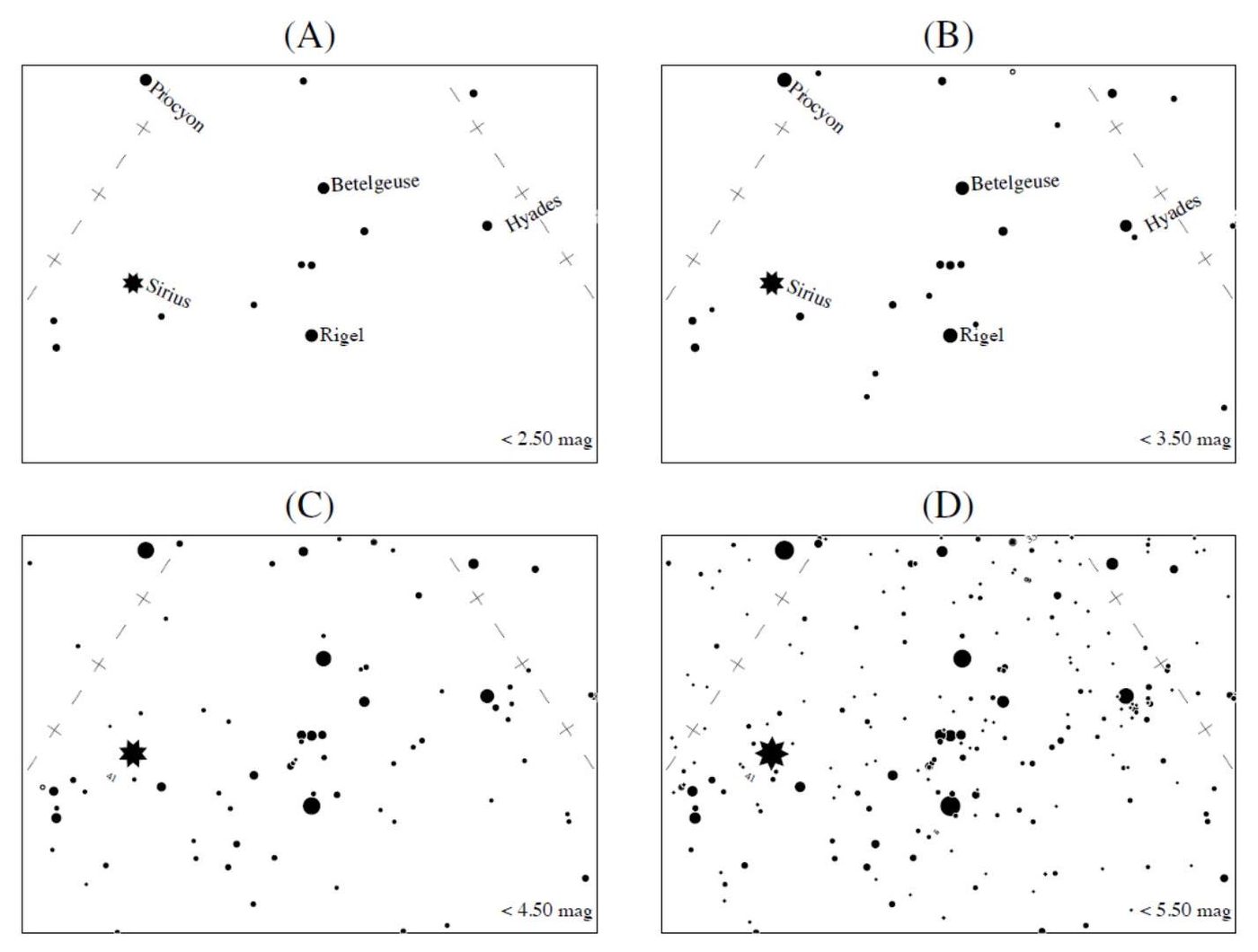
A study by Kyba et al. (2023) found that between 2011-2022 the night sky has brightened by a global average of $9.60\%$ per year, brightening the limiting apparent magnitude and hence greatly reducing the number of stars that people can see (with much of this change attributed to a vast uptake in LED lighting over that period). Figure 1 shows the effect of changing the naked eye limiting magnitude from 5.50 to 2.50 looking in the direction of the constellation of Orion.

Figure 1: Four panels showing how the night sky near Orion looks for four different values of naked eye limiting magnitude, going from magnitude 2.50 (top left, very few stars) to magnitude 5.50 (bottom right, many stars). The change in limiting magnitude makes a vast difference to the number of stars visible at a site, and the increase in light pollution means this is happening well within human lifetimes. Credit: Kyba et al. (2023).
(a) Assuming you were in a place with a limiting apparent magnitude of $m = 5.0$ in 2011 and an increasing sky brightness equal to the global average, what would it now be in 2024?
(b) If the trend continues, in what year will even the brightest star in the sky, Sirius ($m = -1.46$), no longer be visible at your location?
Show answer · 显示答案
- (a)$m_1 = \mathbf{3.7}$
- (b)$2011 + 65 = \mathbf{2076}$
Full worked solutions: BAAO Astro Challenge: Complete Solutions (book)