BAAO · Astro Challenge · Sections A–C

Space Missions and Current Events

7 questions — reveal the final answers. Full worked solutions: the book.

2020 Q12020Section A · Multiple choiceSpace Missions and Current Events · Astronomy anniversaries of 1990

The year 1990 held many exciting events in astronomy. Which of the following did not celebrate its 30th anniversary this year?

figure

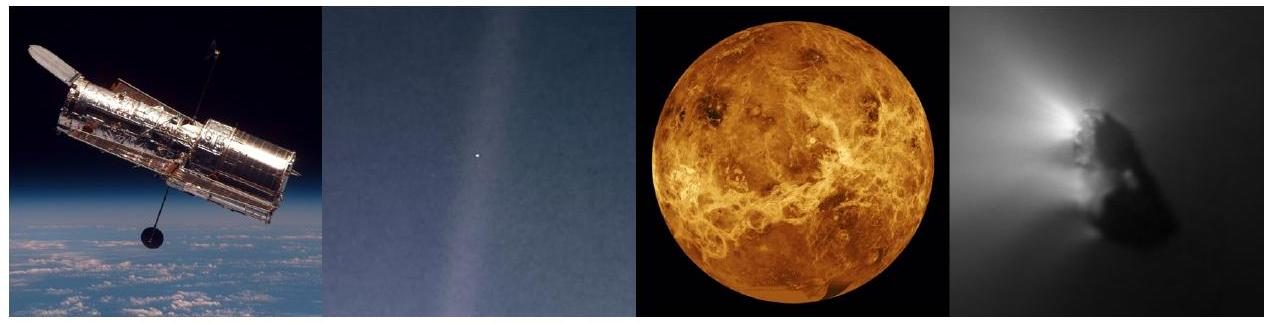
A. The launch of the Hubble Space Telescope, part of NASA's 'Great Observatories' programme
B. The most distant photo ever taken of the Earth by Voyager 1 from 40.5 au, nicknamed the 'Pale Blue Dot'
C. The arrival at Venus of the Magellan probe, where it used radar to create the highest resolution maps we have of the surface
D. ESA's Giotto probe passing within 600 km of the nucleus of Halley's Comet

Show answer · 显示答案
Answer · 答案
D

Full worked solutions: BAAO Astro Challenge: Complete Solutions (book)

2021 Q12021Section A · Multiple choiceSpace Missions and Current Events · Billionaire spaceflights

As of September 2021, which of the following billionaires has not been into space (defined as at least 80 km above the surface of the Earth)?

figure

A. Jeff Bezos with the company Blue Origin
B. Richard Branson with the company Virgin Galactic
C. Elon Musk with the company SpaceX
D. Dennis Tito with the company Space Adventures

Show answer · 显示答案
Answer · 答案
C

Full worked solutions: BAAO Astro Challenge: Complete Solutions (book)

2022 Q12022Section A · Multiple choiceSpace Missions and Current Events · First JWST images

Below is one of the first images taken with the James Webb Space Telescope (JWST) released to the public on $12^{\mathrm{th}}$ July 2022. Which object is it from?

figure

A. Carina Nebula
B. Stephan's Quintet
C. Southern Ring Nebula
D. WASP-96 b

Show answer · 显示答案
Answer · 答案
A

Full worked solutions: BAAO Astro Challenge: Complete Solutions (book)

2022 Q22022Section A · Multiple choiceSpace Missions and Current Events · The Artemis programme

In Autumn 2022, NASA plans to launch a practice mission in preparation for sending humans back to the Moon. What is the name of the programme this is part of?
A. Artemis
B. Athena
C. Diana
D. Orion

Show answer · 显示答案
Answer · 答案
A

Full worked solutions: BAAO Astro Challenge: Complete Solutions (book)

2023 Q12023Section A · Multiple choiceSpace Missions and Current Events · UK spaceports

SaxaVord is due to be one of the UK's newest spaceports, with first launches planned in late 2023. Where is it based?
A. Cornwall, England
B. Llanbedr, Wales
C. Sutherland, Scotland
D. Unst, Shetland Islands

Show answer · 显示答案
Answer · 答案
D

Full worked solutions: BAAO Astro Challenge: Complete Solutions (book)

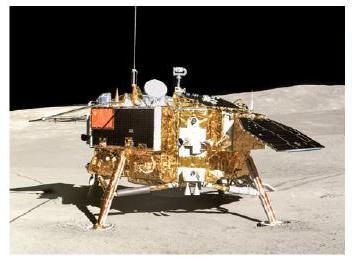
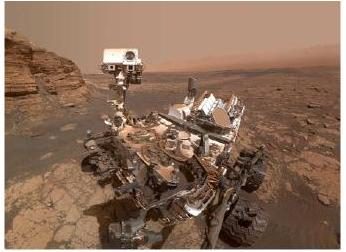
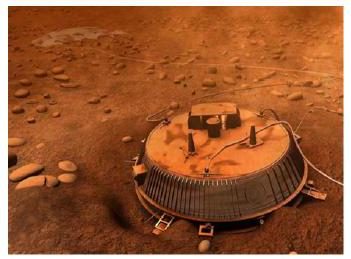
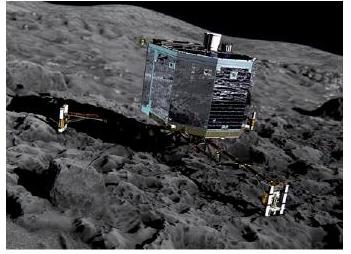
2024 Q12024Section A · Multiple choiceSpace Missions and Current Events · Planetary landing anniversaries

The year 2024 marks the $10^{\mathrm{th}}$ anniversary of the landing by which of the following spacecraft?

A.B.C.D.
figurefigurefigurefigure

A. Chang'e 4 (landed on the Moon)
B. Curiosity (landed on Mars)
C. Huygens (landed on Titan)
D. Philae (landed on comet 67P/Churyumov-Gerasimenko)

Show answer · 显示答案
Answer · 答案
D

Full worked solutions: BAAO Astro Challenge: Complete Solutions (book)

2024 Q132024Section C · Long answerSpace Missions and Current Events · Starship re-entry
SpaceX Starship

In June 2024, the upper stage of SpaceX's experimental Starship rocket successfully performed a controlled re-entry into the earth's atmosphere for the first time during a test flight. This is a significant milestone, as Starship is intended to be the world's first fully reusable rocket, and successfully recovering the upper stage is an essential part of this. At a mass of 85 tonnes, the Starship upper stage is one of the largest and heaviest man-made objects ever to re-enter the atmosphere.

figure

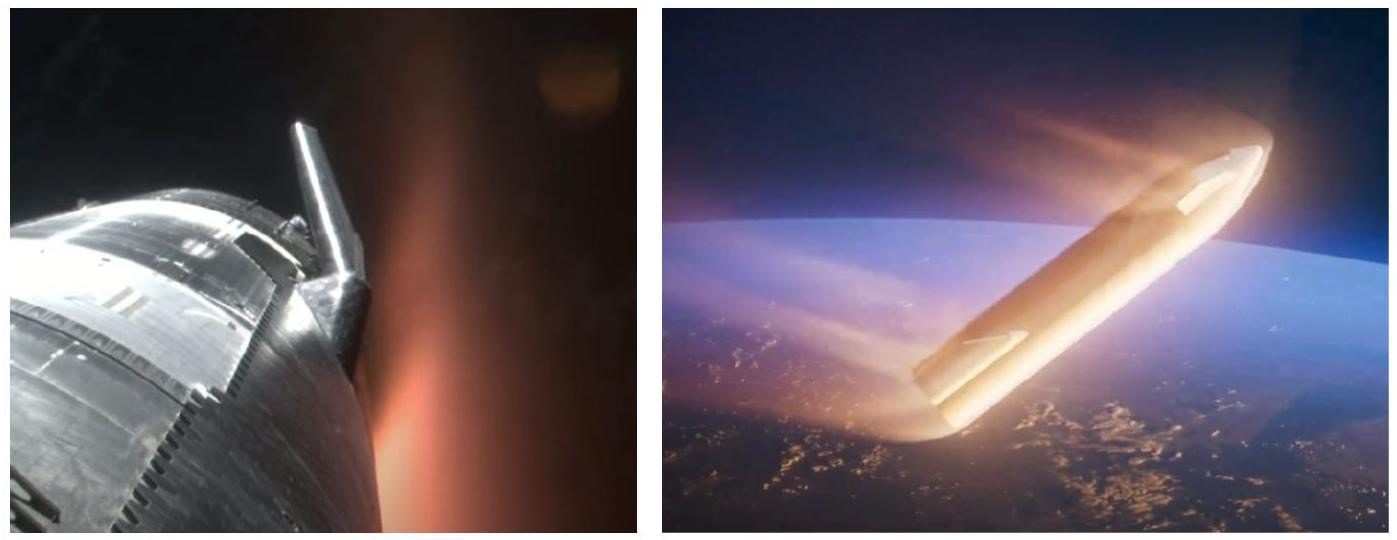
Figure 3: Left: Plasma build-up on Starship during re-entry, as captured by an onboard camera. The black silica tiles for the thermal protection system are visible on the bottom right of the spacecraft. Credit: SpaceX Right: A computer rendering of starship entering the atmosphere. The direction of travel is down and to the right. Credit: SpaceX.

Due to the extremely high speeds involved, the vehicle experiences extreme heating effects during its re-entry, which must be appropriately managed to prevent destruction of the vehicle. For this reason, the forwards-facing side of Starship is covered in a thermal protection system comprised of thousands of hexagonal silica tiles.

(a) Before entering the atmosphere, Starship is on a sub-orbital trajectory which reaches a maximum altitude above the Earth's surface of 213 km. Since the test is designed to simulate re-entering from orbit, at this point Starship is travelling at $94\%$ of the circular orbit velocity for that height --- just slow enough to re-enter the atmosphere instead of orbiting the Earth. Determine the total energy of Starship at this point.

(b) Starship is decelerated by atmospheric drag forces until it reaches negligible speed and altitude. Determine the work done by the atmosphere during re-entry.

Starship is 50 m tall, has a diameter of 9 m, and the nose cone takes up the top 14 m. Its outer skin is made of 4 mm thick stainless steel, which has a specific heat capacity of $500$ J kg$^{-1}$ K$^{-1}$, a density of $8000$ kg m$^{-3}$ and a maximum operational temperature of $900^{\circ}$C. To maximise the amount it is slowed down by atmospheric forces, Starship travels through the atmosphere pointing perpendicular to its direction of travel, as shown in Figure 3.

(c) Given that it initially has a temperature of approximately $0^{\circ}$C, calculate the maximum thermal energy which can be safely transferred to the steel during re-entry. Assume all heating occurs uniformly on the forwards facing side of the spacecraft body, and that conduction to the rest of the spacecraft is negligible.

(d) Show that this means the thermal protection system has to be good enough that $<1\%$ of the thermal energy generated by the deceleration of the Starship by the atmosphere is transferred to the steel body of the spacecraft.

Show answer · 显示答案
Final answers · 最终答案
  • (a)$E = -2.87\times10^{11}\ \mathrm{J}$
  • (b)$W = 2.87\times10^{11}\ \mathrm{J}$
  • (c)$Q = 7.3\times10^9\ \mathrm{J}$
  • (d)For the steel skin not to exceed $900^{\circ}$C, the thermal protection system must therefore ensure that well under $1\%$ of the re-entry energy actually reaches the steel --- the tiles must reflect or ablate the overwhelming majority of the heat.

Full worked solutions: BAAO Astro Challenge: Complete Solutions (book)