2017 Q32017Section A · Multiple choiceSolar System · Thickness of Saturn's rings
What is the approximate average thickness of Saturn's rings?
A. $10 \mu \mathrm{~m}$
B. 10 mm
C. 10 m
D. 10 km
12 questions — reveal the final answers. Full worked solutions: the book.
What is the approximate average thickness of Saturn's rings?
A. $10 \mu \mathrm{~m}$
B. 10 mm
C. 10 m
D. 10 km
Pluto has roughly the same surface area as which country?
A. Australia
B. China
C. USA
D. Russia
The tail of a comet
A. is gas and dust pulled off the comet by the Sun's gravity
B. always points towards the Sun
C. is a trail behind the comet, pointing away from the Sun as the comet approaches it, and toward the Sun as the comet moves out of the inner Solar System
D. is gas and dust expelled from the comet's nucleus and blown outward by radiation pressure and solar wind
Meteor showers are caused by
A. the breakup of asteroids that hit our atmosphere at predictable times
B. the Earth passing through the debris left behind by a comet as it moves through the inner Solar System
C. passing asteroids triggering auroral displays
D. nuclear reactions triggered by an abnormally large meteoritic particle entering the upper atmosphere
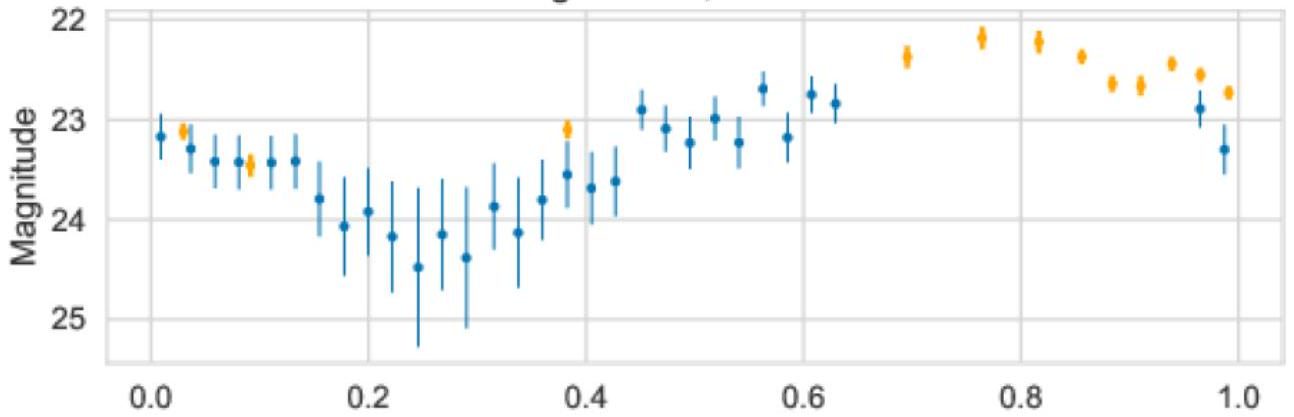
'Oumuamua is an elongated interstellar comet. During an observation with a ground-based telescope whilst close to the Sun, the light curve displayed a sinusoidal variation in magnitude as shown below. If the comet is modelled as an ellipsoid with a shortest visible axis of 30 m, use the light curve to determine the approximate size of the longest visible axis.
A. $\sim 60$ m
B. $\sim 240$ m
C. $\sim 960$ m
D. $\sim 3840$ m
Where on the Moon did astronauts walk in July 1969?
A. Mare Serenitatis
B. Mare Tranquillitatis
C. Mare Imbrium
D. Mare Nubium
NASA's Mars 2020 mission includes the Ingenuity helicopter drone.
NASA’s Mars 2020 mission involves a large rover called Perseverance, and an audacious experiment to see if motor driven flight is possible on the red planet. The helicopter drone is called Ingenuity, and is the first attempt to fly on another world.
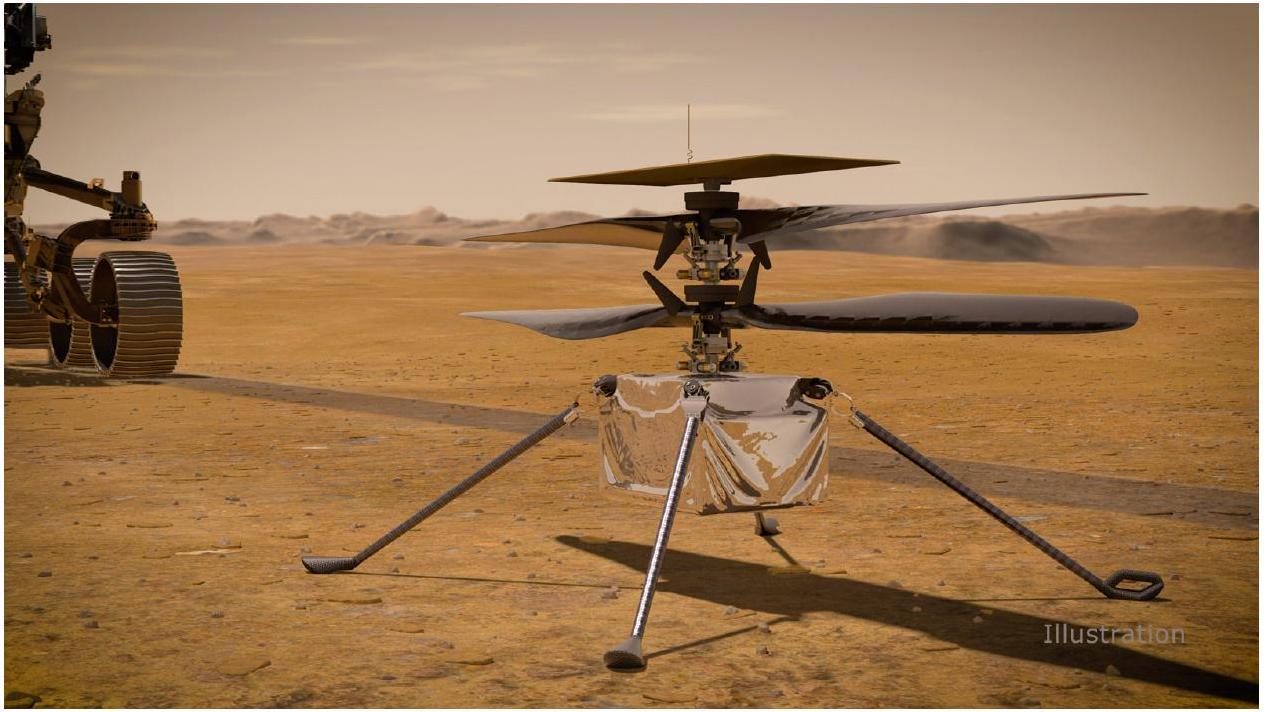
Although gravity is weaker on Mars, the Martian atmosphere is only about $1 \%$ the density of that on Earth, which makes it very hard to get lift. To overcome this, the probe has two counterrotating blades (directly above each other) with a tip-to-tip length of 1.2 m that will spin at 2400 rpm (about 5 times faster than helicopters on Earth), and is incredibly light with a mass of 1.8 kg . A consequence of the weight restriction is that the battery is small (and charged by a solar panel on top of the drone, above the blades). Since flying in such a thin atmosphere is a very high power activity the maximum flight duration is therefore short, and given the time needed to recharge, they will be limited to only one flight per day.
(a) The energy stored in the battery available for flight is 10 Wh out of a 35 Wh capacity (the rest is mainly used to keep the drone warm on the cold Martian surface). During flight the drone uses an average of 390 W . Determine the maximum duration (in seconds) of one flight.
(b) If the active region of the solar panel has an area of $544 \mathrm{~cm}^2$ and Mars takes 687 days to orbit the Sun, determine the minimum amount of time (in minutes) the battery needs to charge for between flights. Assume the panel is $30 \%$ efficient and the Sun is directly overhead throughout.
Full worked solutions: BAAO Astro Challenge: Complete Solutions (book)
C/2020 F3 NEOWISE was discovered on 27th March 2020 and became visible to the naked eye.
The NEOWISE telescope discovered a new comet on 27th March 2020, later given the official designation C/2020 F3 NEOWISE. Although when first discovered it only had an apparent magnitude of 18.0, it would become sufficiently bright that it could be seen with the naked eye by observers throughout the northern hemisphere, and was one of the brightest comets since Hale-Bopp in 1997.
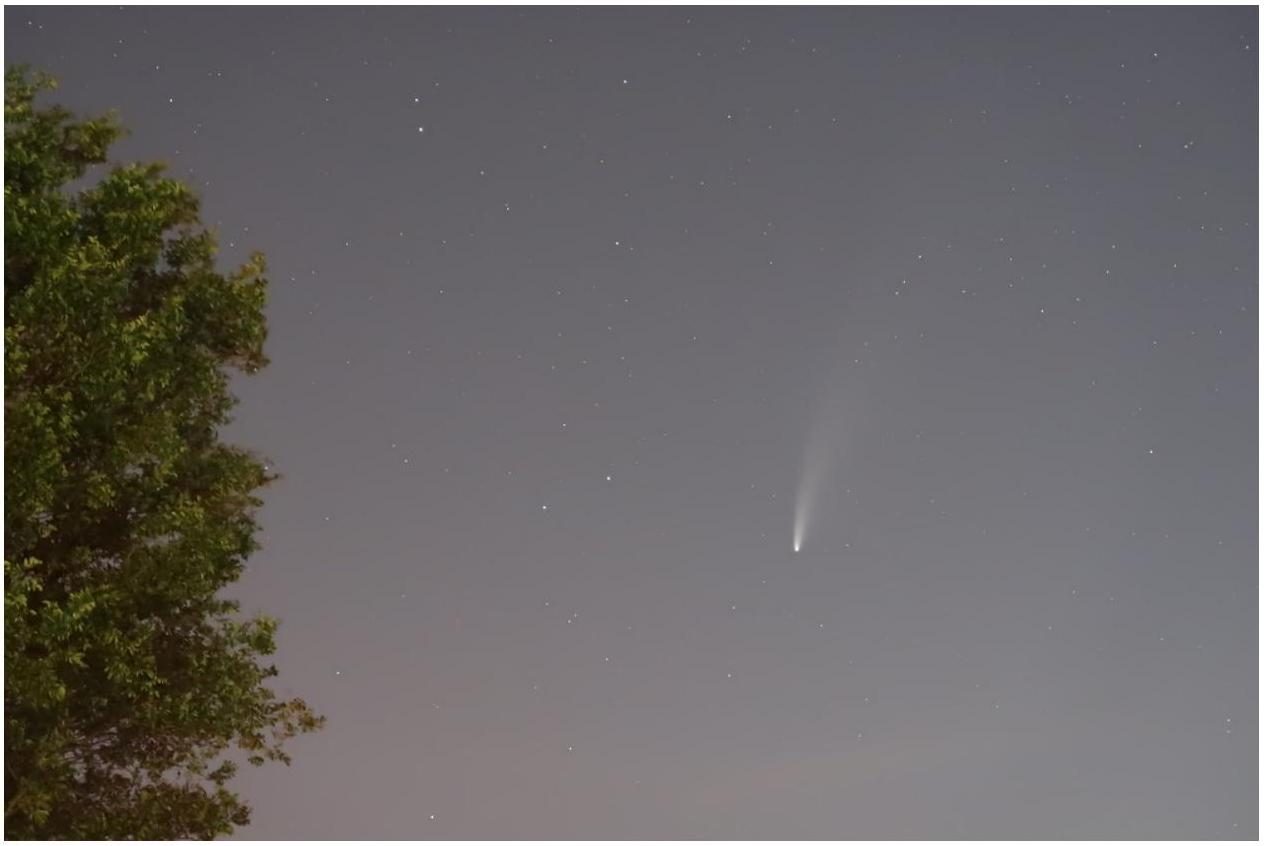
On its discovery date the comet was 1.702 au from the Earth and 2.089 au from the Sun, and at perihelion (when it was closest to the Sun) on $3^{\text {rd }}$ July 2020 it was only 0.294649 au from the Sun. (a) Given the comet's orbit has an eccentricity of 0.999188 , estimate the year of its next perihelion.
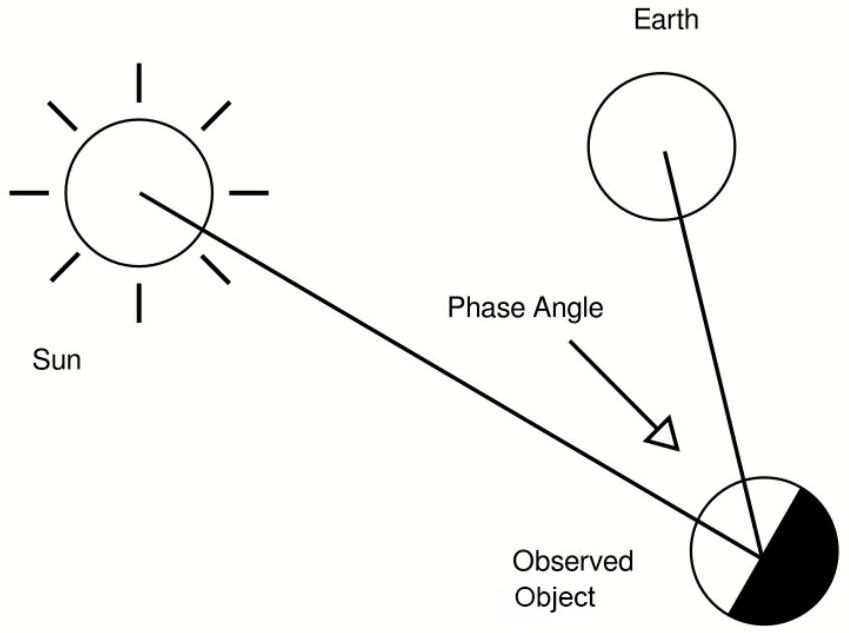
For a spherical object, the luminosity of the reflected light is a function of how much of the lit surface of the object we can see, known as the phase (for example crescent and gibbous phases of the moon).
This correction is known as the phase factor, $p(\theta)$, such that the total power reflected is related to the total power incident as $P_{\text {ref }}=P_{\text {inc }} \times p(\theta)$. You are given that
$$ p(\theta)=B\left[\left(1-\frac{\theta}{\pi}\right) \cos \theta+\frac{1}{\pi} \sin \theta\right], $$
where $B$ is a constant and $\theta$ is the phase angle, as defined in Fig 5, and is measured in radians (a measure of angle such that $2 \pi$ radians $=360^{\circ}$ ).
(b) Treating the comet nucleus as a sphere of fixed radius as it orbits, estimate the comet's apparent magnitude when it is at aphelion (when it is furthest from the Sun), assuming the phase angle is zero when it is observed from the Earth. Comment on whether the Hubble Space Telescope (limiting magnitude $\sim 30$ ) would be able to see it.
Full worked solutions: BAAO Astro Challenge: Complete Solutions (book)
In August 2023, India became the fourth country to successfully land a spacecraft on the Moon. The Chandrayaan 3 mission also involved the Pragyan rover, which was fully dependent on its small solar panel to provide it with the 50 W necessary to move around the lunar surface and do experiments. Assuming it was pointing at the Sun the whole time, what was the minimum solar panel area needed?
A. $29$ cm$^2$
B. $370$ cm$^2$
C. $1160$ cm$^2$
D. $4640$ cm$^2$
Quaoar is a trans-Neptunian object (TNO), one of the largest members of the Kuiper belt, and likely to be recognised as a dwarf planet in the near future. Despite its small size, in 2023 it was discovered to be one of only three minor planets that has a ring system.
Rings have always been associated with the Roche limit of an object, which is the distance from an object where the difference in gravitational forces on the near and far side of any orbiting satellite would exceed the internal forces of the material, tearing it apart and generating the material for the ring. The rings of Quaoar break this convention as they are much further out; simulations show that such a ring would coalesce into a satellite within a century, so they must be being constrained by some other process. The most likely explanations are that these rings are kept from coalescing due to resonances with the period of the particles in the ring and either the period of rotation of Quaoar or the period of its largest moon, Weywot.
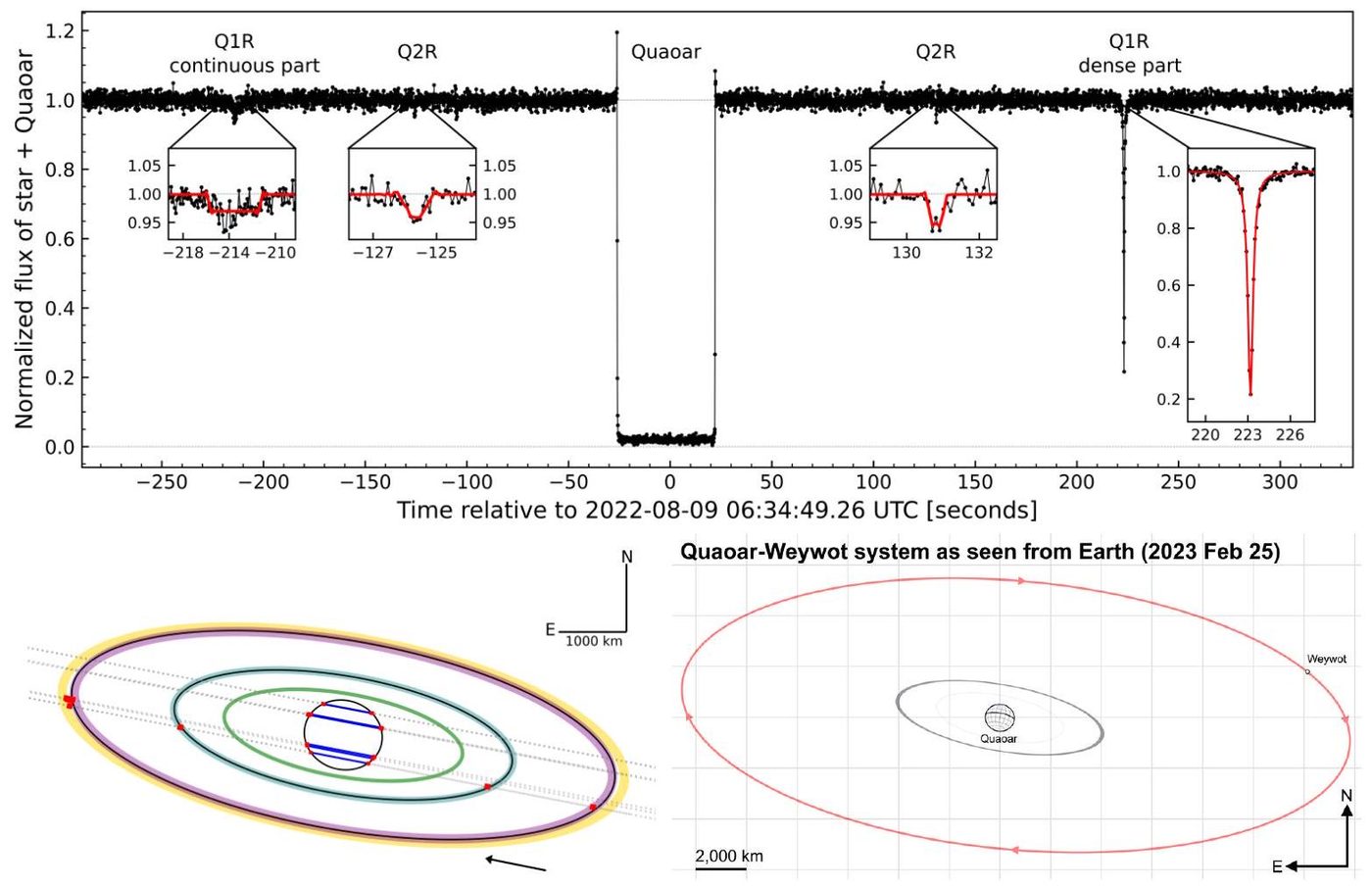
The two types of resonance involved are spin-orbit resonance (SOR), where the particles in a ring complete an integer number of orbits in the same time as an integer number of rotations of Quaoar, and mean-motion resonance (MMR), where the particles in a ring complete an integer number of orbits in the same time as an integer number of orbits of Weywot.
The Q1R ring is found at an orbital radius of 4057 km from the centre of Quaoar, shepherded between the $1:3$ SOR at 4200 km (meaning Quaoar spins 3 times in every orbit by a particle at that distance) and the $6:1$ MMR at 4020 km (meaning particles at that distance orbit 6 times whilst Weywot orbits once).
(a) Given Weywot has a period of 12.4311 days, calculate the rotational period of Quaoar, giving your answer in hours.
(b) Q2R has a radius of 2520 km, which is very close to another SOR of the form $a:b$. Determine $a$ and $b$, given that they are single digit integers with $a < b$.
Classically, the Roche limit of this system is given by the formula $$d = \alpha\,R_Q\!\left(\frac{\rho_Q}{\rho_{\mathrm{ring}}}\right)^{1/3},$$ where $R_Q$ is the radius of Quaoar, $\rho_Q$ is the density of Quaoar, and $\rho_{\mathrm{ring}}$ is the density of the material that makes up the ring. The parameter $\alpha$ can vary from $2^{1/3} \approx 1.26$ for very rigid solids up to 2.44 for fluids. Tiscareno et al.\ (2013) found that for rings around minor planets they are best modelled as $$\alpha = \left(\frac{4\pi}{\gamma}\right)^{1/3},$$ where $\gamma$ is a factor describing particle shape, and that for rings like these $\gamma = 1.6$ is most appropriate (so $\alpha \approx 2.0$).
(c) Taking the density of the ring material to be $\rho_{\mathrm{ring}} = 0.40$ g cm$^{-3}$, similar to the smallest inner Saturnian moons, calculate the Roche limit for the Quaoar system and hence verify that Q1R and Q2R are outside it.
Note: you do not need to take any measurements from the figure.
Full worked solutions: BAAO Astro Challenge: Complete Solutions (book)
On 12 October 2024, comet C/2023 A3 (Tsuchinshan-ATLAS) is expected to have its closest approach with the Earth. When it does, the angular distance between it and the sun will be around $14.3^{\circ}$ and it has the possibility to be one of the brightest comets for over a decade, easily visible to the naked eye even in towns and cities just before sunrise in the constellation of Virgo (see Figure 2).
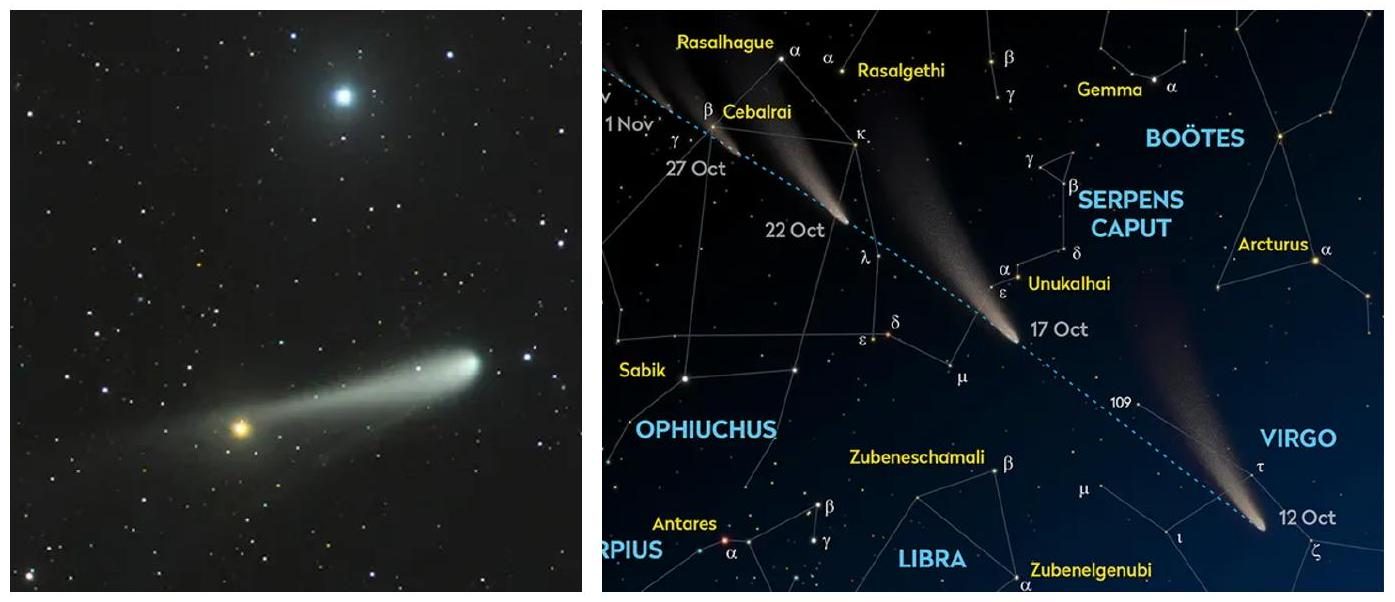
Figure 2: Left: C/2023 A3 (Tsuchinshan-ATLAS) from the Southern Hemisphere, captured 1 August 2024. Credit: José J. Chambó. (www.cometografia.es) Right: Chart showing the location of Comet C/2023 A3 (Tsuchinshan-ATLAS) in October 2024. It will be best observed just before dawn. Credit: Pete Lawrence / BBC Sky at Night Magazine.
Because the luminosity of a comet is affected by its distance from the sun, an extra factor is added to the conversion between cometary apparent and absolute magnitudes:
$$m = \mathcal{M} + \frac{5}{2} K \log_{10}\left(\frac{d_{\mathrm{Comet-Sun}}}{1~\mathrm{au}}\right) + 5 \log_{10}\left(\frac{d_{\mathrm{Comet-Earth}}}{1~\mathrm{au}}\right)$$
$K$ is a parameter relating to the activity of the comet and in this case can be taken to be 4.0 for the remainder of the question. The absolute magnitude of C/2023 A3 is 4.3.
Astronomers have also predicted that the comet may be ejected from the solar system after its perihelion. This is due to the very high eccentricity of its orbit, which means that interactions with the planets may significantly affect its orbit. The acceleration experienced by the comet due to the Earth's gravity, however, will not exceed $8.0 \times 10^{-8}$ m s$^{-2}$.
(a) What will be the apparent magnitude of the comet at closest approach to Earth?
(b) The comet was first reported by the Purple Mountain Observatory, and then later reported by the Asteroid Terrestrial-impact Last Alert System (ATLAS), with an apparent magnitude of 18.1. Given that at the time of its discovery the comet was a long distance from the Sun, estimate $d_{\mathrm{Comet-Sun}}$ when it was first announced. Give your answer in au.
Full worked solutions: BAAO Astro Challenge: Complete Solutions (book)
The atmosphere of Mars is carbon dioxide rich, very low pressure and rather cold - this makes it an interesting place to consider the acoustics should any future humans live on Mars as sound waves behave rather differently than what we are used to on Earth.
The conditions of the Martian atmosphere mean that it is well modelled as an ideal gas, and so the speed of sound is given as:
$$c = \sqrt{\frac{\gamma R T}{M}}$$
where $\gamma$ is the adiabatic index (derived from thermodynamics), $R = 8.314$ J K$^{-1}$ mol$^{-1}$ is known as the molar gas constant, $T$ is the absolute temperature, and $M$ is the molar mass in kg mol$^{-1}$.
For a stiff molecule like $\mathrm{CO}_2$, the value of $\gamma$ changes with frequency, as at low frequencies any vibrational excitation (alongside rotational excitation) can relax again before the next wave hits, whilst at high frequencies only the rotational excitation is able to relax, and so there are fewer degrees of freedom. The relaxation frequency when this transition occurs is called $f_R$. This means that for sound waves travelling through $\mathrm{CO}_2$, there are two regimes with separate speeds:
$$\begin{array}{lll} f < f_R & \text{then} & \gamma = \dfrac{9}{7} \\[6pt] f > f_R & \text{then} & \gamma = \dfrac{7}{5} \end{array}$$
For $\mathrm{CO}_2$ on Earth, $f_R \approx 40$ kHz so is outside the range of human hearing, but in the low-pressure environment on Mars that is no longer true, and humans would experience the effect of high and low frequencies travelling at different speeds when listening to everyday sounds.
(a) Given that $f_R$ is directly proportional to atmospheric pressure and Mars has a surface atmospheric pressure of about 0.6 kPa, show that $f_R$ is within the human hearing range.
(b) Taking a typical temperature on the surface of Mars to be 230 K and the molar mass of the Martian atmosphere to be 43.34 g mol$^{-1}$, show that high frequencies travel about 10 m s$^{-1}$ quicker than low frequencies.
As well as having a much lower pressure than on Earth, the Martian atmosphere is also much less dense, with a density of only $\rho = 0.02$ kg m$^{-3}$ and so has a much smaller acoustic impedance, given by the formula $Z = \rho c$. The consequence of this is that a given source of sound will be much quieter on Mars than on Earth, with the difference measured in decibels as $$10 \log_{10}\!\left(\frac{Z_{\mathrm{Earth}}}{Z_{\mathrm{Mars}}}\right)$$
(c) Given the density of Earth's atmosphere (at sea level) is $1.217$ kg m$^{-3}$ with a typical sound speed of 340 m s$^{-1}$ (at room temperature) whilst in the $f < f_R$ regime, calculate how much quieter a sound on Mars will be to human ears compared to Earth, giving your answer in decibels.
The speed of sound on Mars has long been derived from temperature measurements. However, the Perseverance rover, which landed on Mars in 2021, had a microphone on board that was able to make in-situ recordings and test some of these models.
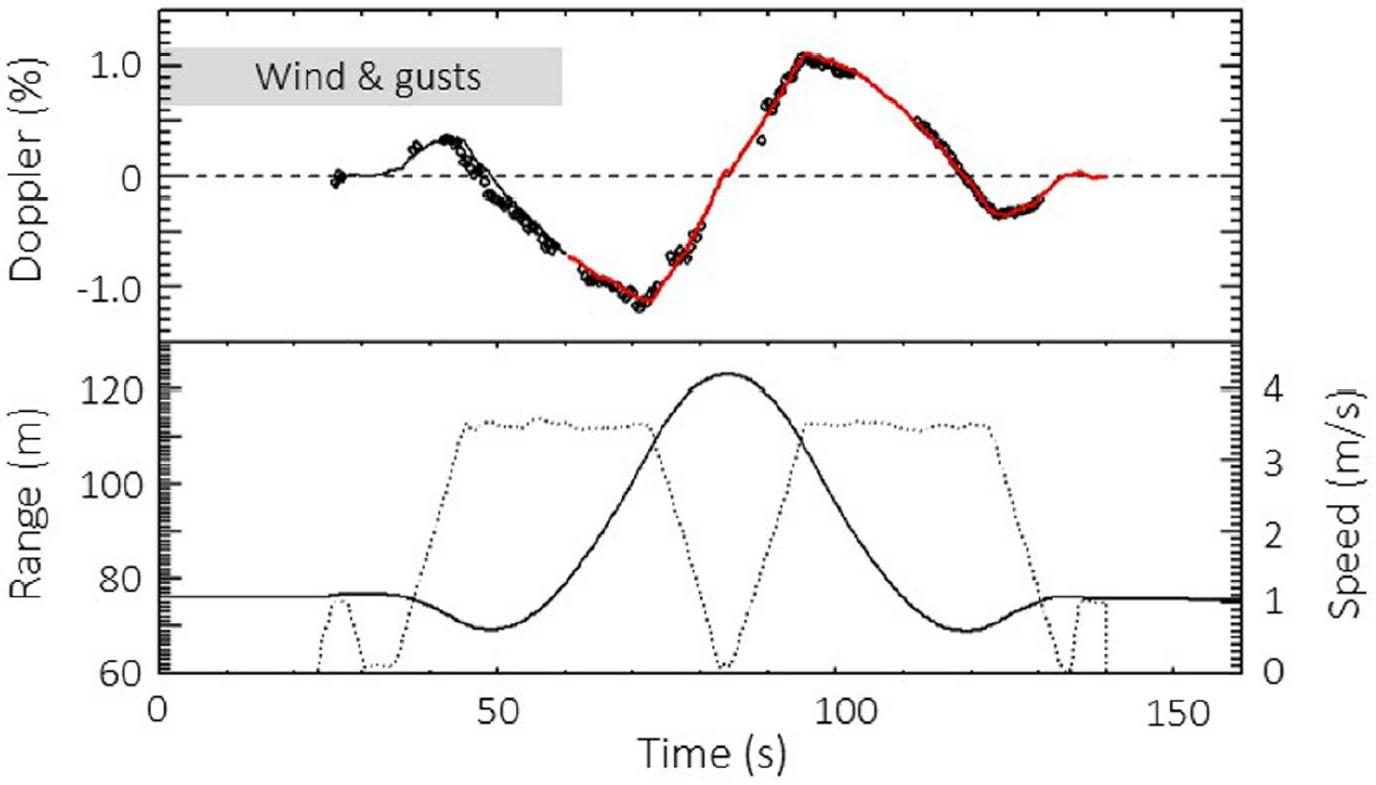
One experiment involved laser-induced sparks (with $3 < f < 15$ kHz and so $f > f_R$) used as the sound source, but perhaps the most creative was to use the small helicopter the probe had brought with it (called Ingenuity) as a low frequency source (and so $f < f_R$) where they could use the Doppler effect on the recorded frequency of the noise made by its blades (with emitted sound frequency of 84.44 Hz) as it flew past Perseverance in order to calculate the speed of sound directly.
Data from the fourth flight of Ingenuity is shown in Figure 4, where it takes off 76 m from Perseverance, and travels in a straight line coming as close as 69 m and ending its flight 123 m from the microphone before stopping and coming back the way it came. Data for the first 60 s was not reliable due to interference from wind and gusts, but from 60 s onwards the recording was clean and allowed a good determination of the speed of sound in this regime.
Figure 4: Top: Variations of the received frequency along the trajectory of the flight (diamond symbol) along with the best fitting model (solid line). During the first 60 s, the recording is perturbed by high winds so the data is less reliable. Credit: Maurice et al. (2022). Bottom: Range between the rover and Ingenuity (solid line, left $y$-axis) and the speed of Ingenuity at the time (dotted line, right $y$-axis). Credit: Maurice et al. (2022).
(d) Take measurements from Figure 4 to determine the speed of sound on Mars. Compare your value to the low frequency sound speed calculated in part (b) and comment on your answer.
Full worked solutions: BAAO Astro Challenge: Complete Solutions (book)