GPS and Relativity
Special Relativity (SR) tells us that two observers will disagree about the duration of a time interval measured by each one's clock if one is moving at speed $v$ relative to the other, a phenomenon called time dilation. General Relativity (GR) tells us that gravitational fields dilate time too. This has an impact on satellites, since they travel at high orbital speeds (slowing down their clocks relative to the surface) but due to their altitude they are in a weaker gravitational field (speeding up their clocks relative to the surface). Which effect is dominant varies with orbital radius. Global Positioning System (GPS) satellites must compensate for this effect, since the satellites rely on accurate measurements of the time between sending and receiving a radio signal.
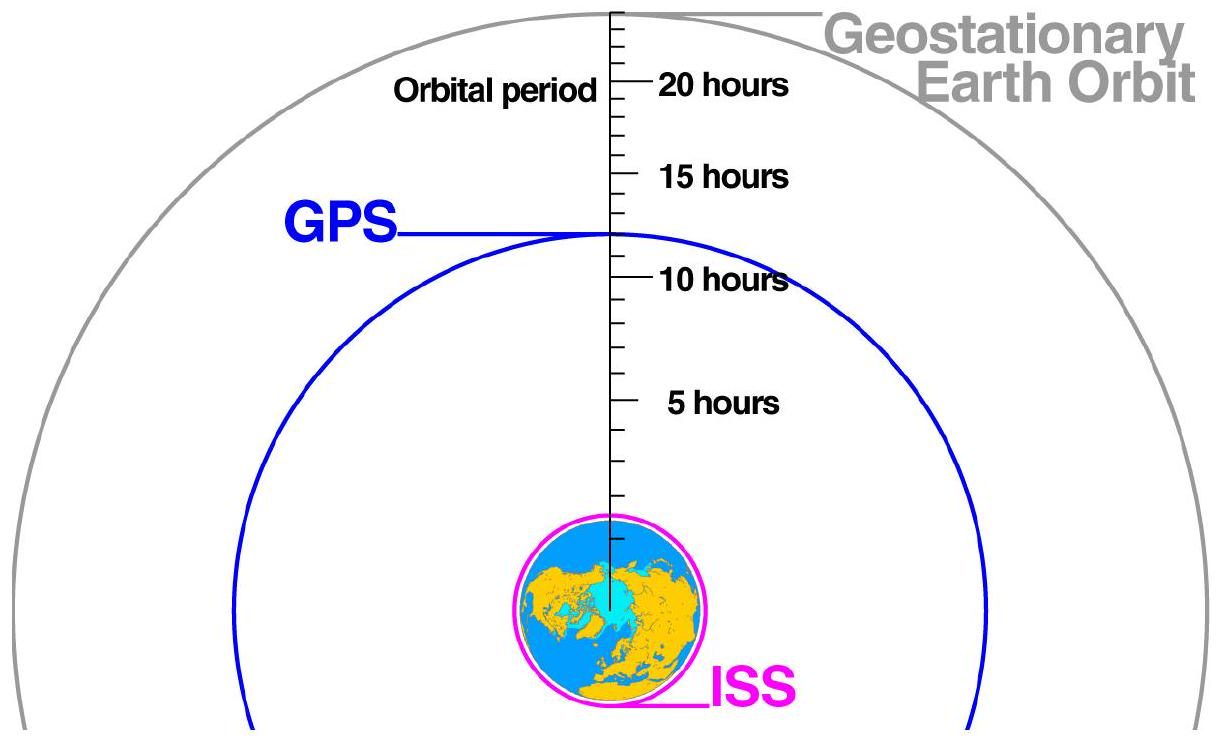
Figure 4: A scale diagram of the positions of the orbits for the International Space Station (ISS), GPS satellites and geostationary satellites, along with their orbital periods.
In SR, time dilation can be calculated with
$$t' = \gamma t_0 \quad \text{where} \quad \gamma = \frac{1}{\sqrt{1 - \dfrac{v^2}{c^2}}} \quad \text{so} \quad \Delta t_{\mathrm{SR}} = t_0 - t' = (1 - \gamma)t_0,$$
where $t_0$ is the time measured by the moving clock, $t'$ is the time measured by the observer, $c$ is the speed of light and $v$ is the speed of the object. A negative $\Delta t$ indicates that the clocks are passing time slower relative to the observer, whilst a positive indicates they are passing quicker.
(a) GPS satellites have a period of exactly half a day. Use this to determine their orbital speed and hence show that for them $\Delta t_{\mathrm{SR}} \approx -7\,\mu$s when $t_0 = 1$ day.
In GR, the overall effect (taking into account both the orbital motion and changing gravitational field strength) can be calculated by considering the measurements of time passing on the surface of the Earth and on the satellite as taken by an observer infinitely far away from Earth (so outside the gravitational field). It can be shown that
$$\Delta t_{\mathrm{overall}} = (\Gamma_{\mathrm{GPS}} - \Gamma_{\mathrm{E}})\,t_0 \quad \text{where} \quad \Gamma_{\mathrm{GPS}} = \sqrt{1 - \frac{3GM_E}{a_{\mathrm{GPS}}c^2}} \quad \text{and} \quad \Gamma_{\mathrm{E}} = \sqrt{1 - \frac{2GM_E}{R_E c^2}}.$$
(b) Given $a_{\mathrm{GPS}}$ is the radius of the GPS satellite's orbit, calculate $\Delta t_{\mathrm{overall}}$ when $t_0 = 1$ day. Give your answer in $\mu$s and state the significance of the sign.
(c) Hence calculate the daily offset in GPS positions if relativity was not taken into account.
(d) Sketch how $\Delta t_{\mathrm{overall}}$ varies with orbital radius, $r$, from $r = R_E$ (near the ISS) to $r = 7R_E$ (near geostationary satellites), clearly indicating any important points.
[Hint: You may find the binomial approximation useful: $(1+x)^n \approx 1 + nx$ when $|x| \ll 1$]