Why do hurricanes rotate anti-clockwise in the northern hemisphere and clockwise in the southern hemisphere?
A. Due to the Earth rotating from East to West
B. Due to the different ratios of land to water area between the two hemispheres
C. Due to the Moon's orbit being inclined by $5^{\circ}$ above the ecliptic giving it more influence on the northern hemisphere
D. Due to the Coriolis Effect causing paths of particles to curve as they travel over the Earth's surface
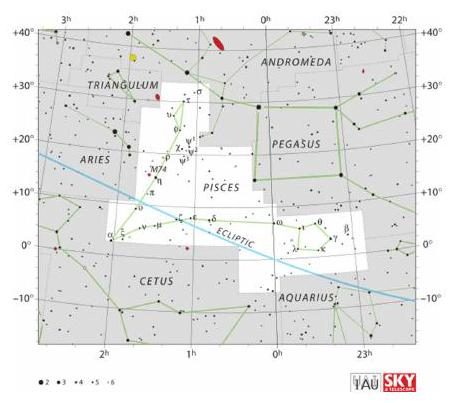
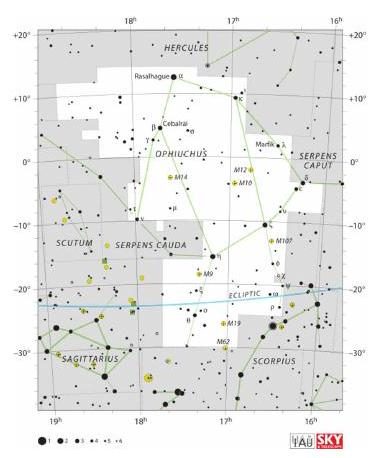
Which of the following is not a zodiacal constellation, according to the astronomical definition?
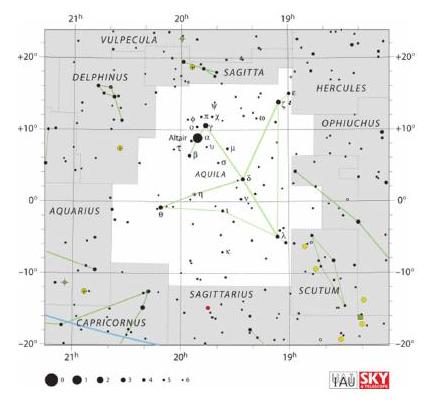
A. Aquila
B. Aquarius
C. Ophiuchus
D. Pisces


Show answer · 显示答案
When observing from the UK, during which season is the Full Moon visible highest in the sky?
A. Spring
B. Summer
C. Autumn
D. Winter
Show answer · 显示答案
At a latitude of $52^{\circ}$ N what is the altitude of Polaris above the horizon?
A. $38^{\circ}$
B. $48^{\circ}$
C. $52^{\circ}$
D. $90^{\circ}$
Show answer · 显示答案
``Manhattanhenge'' is when the Sun aligns with the east-west streets of the New York grid system. One setting date was July 11th. Which of these is another likely Manhattanhenge sunset date?
A. May 30th
B. June 30th
C. December 11th
D. January 11th
Show answer · 显示答案
You travel 100 miles South, 100 miles East and 100 miles North and arrive back where you started. You are NOT at the North Pole. Where are you?
A. South Pole
B. 100 miles from the North Pole
C. 116 miles from the South Pole
D. 200 miles from the South Pole
Show answer · 显示答案
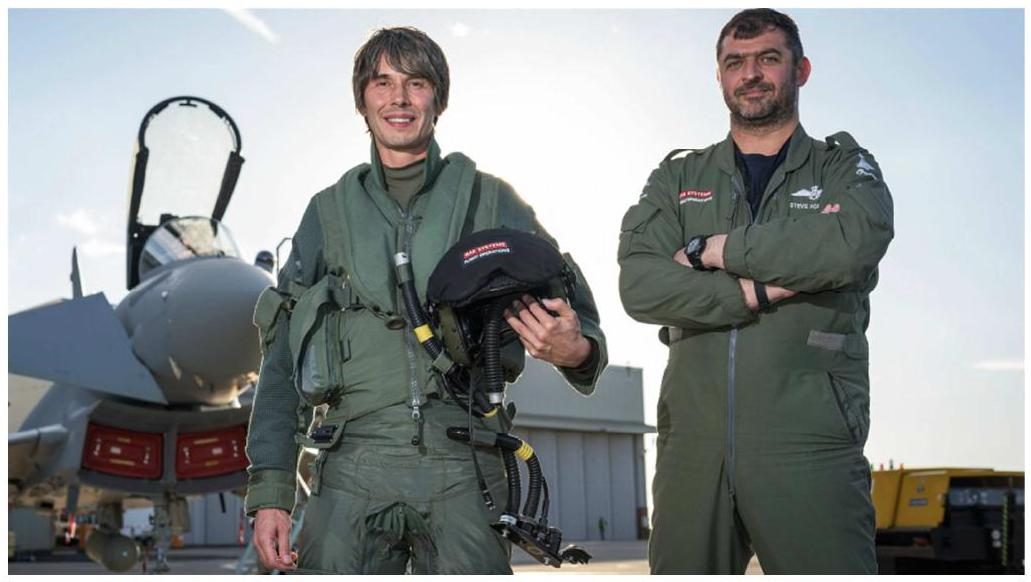
In the BBC programme Forces of Nature, Brian Cox uses a Eurofighter Typhoon to try and overtake the spin of the Earth such that the setting Sun appears to rise instead.

- The equator
- Oxford (which has a latitude of about $52^{\circ}$)
Show answer · 显示答案
- (a)(i)$v_{\text{eq}} \approx 463 \text{ m s}^{-1}$
- (a)(ii)$v_{\text{Ox}} \approx 285 \text{ m s}^{-1}$
- (b)$t\approx25.26\,\mathrm{min}$ Corrected — the printed 25.0 min rounds the equatorial speed too early; see the interactive walkthrough.
Full worked solutions: BAAO Astro Challenge: Complete Solutions (book)
In which constellation would you find the centre of the Milky Way?
A. Ophiucus
B. Coma Berenices
C. Sagittarius
D. Scorpius
Show answer · 显示答案
What is the declination of the Sun on the Winter solstice?
A. $+45^{\circ}$
B. $+23.5^{\circ}$
C. $0^{\circ}$
D. $-23.5^{\circ}$
Show answer · 显示答案
Which of the following cities will experience the longest day during June?
A. Edinburgh (longitude $=3.2^{\circ}\mathrm{W}$, latitude $=56.0^{\circ}\mathrm{N}$)
B. Rome (longitude $=12.5^{\circ}\mathrm{E}$, latitude $=41.9^{\circ}\mathrm{N}$)
C. Nairobi (longitude $=36.8^{\circ}\mathrm{E}$, latitude $=1.3^{\circ}\mathrm{S}$)
D. Sydney (longitude $=58.4^{\circ}\mathrm{W}$, latitude $=34.6^{\circ}\mathrm{S}$)
Show answer · 显示答案
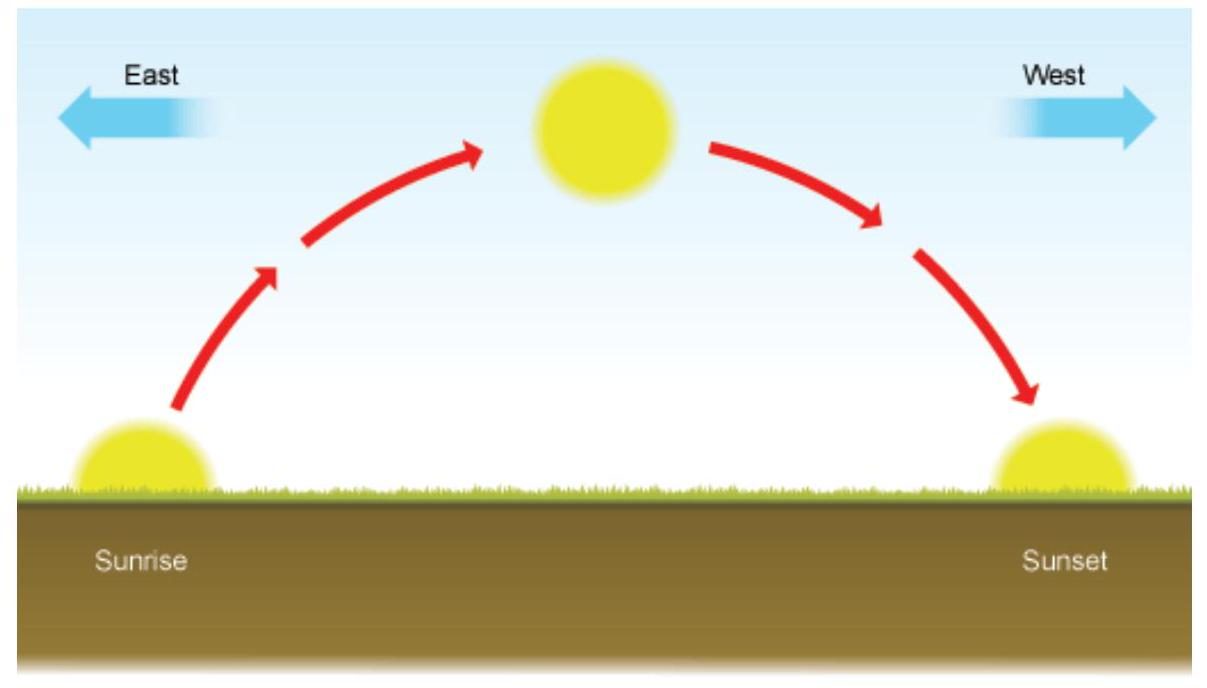
The word 'equinox' comes from the Latin for ``equal night'', and typically people assume it's the time of year when day and night are equal in length (i.e. 12 hours each), but that's not strictly true -- in fact the centre of the solar disc spends 12 hours above the horizon (see Fig 1), but sunrise and sunset times are measured from when the very top of the Sun first appears, and when it finally disappears respectively.

(a) By working out the angular radius of the Sun as seen from the Earth, work out how many extra minutes of daylight you get from this effect.
(b) Since the atmosphere has a refractive index just slightly greater than 1, this has an influence too, meaning that when the centre of the solar disc appears to be just at the horizon, it is in fact $0.6^{\circ}$ below the horizon. Combining this with the previous effect, calculate the total number of minutes longer than 12 hours a day is on an equinox.
Show answer · 显示答案
- (a)$\Delta t_{\text{disc}} = 2.13 \text{ min}$
- (b)$\Delta t_{\text{total}} = 6.93 \text{ min}$
Full worked solutions: BAAO Astro Challenge: Complete Solutions (book)
Looking up into the UK sky at 10 pm in late September, which of the following bright stars is NOT visible?
A. Deneb (Right ascension $=20^{\mathrm{h}}41^{\mathrm{m}}$, declination $=+45.28^{\circ}$)
B. Vega (Right ascension $=18^{\mathrm{h}}37^{\mathrm{m}}$, declination $=+38.78^{\circ}$)
C. Capella (Right ascension $=05^{\mathrm{h}}17^{\mathrm{m}}$, declination $=+46.00^{\circ}$)
D. Sirius (Right ascension $=06^{\mathrm{h}}45^{\mathrm{m}}$, declination $=-16.72^{\circ}$)
Show answer · 显示答案
On the evening of 27th July 2018, there was a total lunar eclipse. As viewed from Oxford, totality began whilst the Moon was below the horizon. Interestingly, moonrise was at $8:55$ pm, yet sunset was only at $9:01$ pm, so for 6 minutes both the fully eclipsed Moon and setting Sun were visible above the horizon. This very rare event is known as a selenelion. What is the explanation behind this seemingly impossible observation?
A. The Moon is in an orbit with a non-zero eccentricity
B. Prominences on the Sun at the time of the eclipse
C. The non-zero light travel time to cover the large distance between the Moon and the Earth
D. The effect of atmospheric refraction meaning the Sun and Moon only appear to be above the horizon
Show answer · 显示答案
Looking up into the UK night sky in late September, which of the following bright stars rises first?
A. Aldebaran (Right ascension $=04^{\mathrm{h}}36^{\mathrm{m}}$, declination $=+16.51^{\circ}$)
B. Rigel (Right ascension $=05^{\mathrm{h}}15^{\mathrm{m}}$, declination $=-8.20^{\circ}$)
C. Procyon (Right ascension $=07^{\mathrm{h}}39^{\mathrm{m}}$, declination $=+5.23^{\circ}$)
D. Sirius (Right ascension $=06^{\mathrm{h}}45^{\mathrm{m}}$, declination $=-16.72^{\circ}$)
Show answer · 显示答案
An observer in the UK sees a full moon in the constellation of Capricorn. What time of year is it?
A. Spring
B. Summer
C. Autumn
D. Winter
Show answer · 显示答案
The One-Mile Telescope has three dishes spread up to 1.6 km apart. Two dishes are fixed, whilst one can move along 800 m of railway tracks. In order for the tracks to be perfectly flat, how much did they need to raise one end to compensate for the curvature of the Earth?
A. 5 cm
B. 10 cm
C. 15 cm
D. 20 cm
Show answer · 显示答案
Which of these constellations is entirely south of the ecliptic?
A. Orion
B. Andromeda
C. Aquila
D. Ophiuchus
Show answer · 显示答案
For an observer at latitude $52^{\circ}$, which star culminates with the highest altitude?
A. Kochab (declination $=74^{\circ}$)
B. Capella (declination $=46^{\circ}$)
C. Vega (declination $=38^{\circ}$)
D. Pollux (declination $=28^{\circ}$)
Show answer · 显示答案
On 21st March the Sun is in Pisces. Which constellation could Venus be in? Venus has a circular orbit of radius 0.723 au.
A. Aries
B. Leo
C. Libra
D. Gemini
Show answer · 显示答案
The website what3words splits up the Earth's surface into $3~\mathrm{m} \times 3~\mathrm{m}$ squares and gives a coordinate of three randomly chosen words (for example the entrance to the Oxford University Physics Department is engage.proud.police). If each of the words is taken from the same list of $n$ words, what value of $n$ is needed?
A. $\sim 10000$
B. $\sim 20000$
C. $\sim 30000$
D. $\sim 40000$
Show answer · 显示答案
For which of these lines of latitude will a vertical stick in the ground have no shadow at local midday on $21^{\mathrm{st}}$ December 2021?
A. Tropic of Cancer
B. Equator
C. Tropic of Capricorn
D. Antarctic Circle
Show answer · 显示答案
When Mars has its opposition in 2022, an observer in the UK will see it in Taurus. In roughly which month will this opposition take place? [Mars' opposition corresponds to when it is closest in its orbit to the Earth.]
A. March
B. June
C. September
D. December
Show answer · 显示答案
In which constellation is Saturn visible during Autumn 2021? [Hint: it is close to Jupiter, which spent most of Summer 2021 in Aquarius]
A. Capricorn
B. Gemini
C. Leo
D. Libra
Show answer · 显示答案
Which of these stars are closest to the Sun in October 2021?
A. Rigel (Right ascension $=05^{\mathrm{h}}15^{\mathrm{m}}$, declination $=-8.20^{\circ}$)
B. Regulus (Right ascension $=10^{\mathrm{h}}08^{\mathrm{m}}$, declination $=+11.97^{\circ}$)
C. Spica (Right ascension $=13^{\mathrm{h}}25^{\mathrm{m}}$, declination $=-11.16^{\circ}$)
D. Vega (Right ascension $=18^{\mathrm{h}}37^{\mathrm{m}}$, declination $=+38.78^{\circ}$)
Show answer · 显示答案
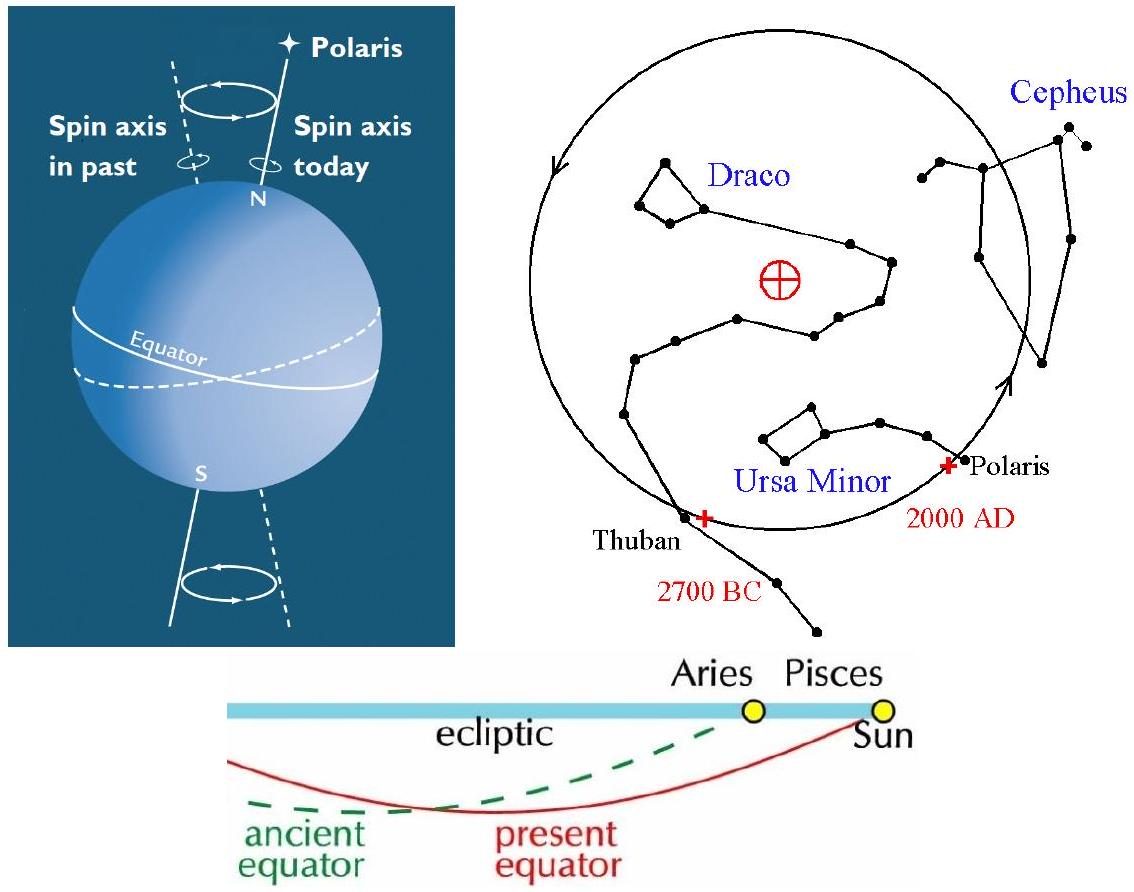
Currently, Polaris is very close to the north celestial pole (the projection of the Earth's rotational axis on the sky) and so all other stars appear to rotate around it. However, this axis is drawing out a large circle in the sky with an angular radius of $23.44^{\circ}$ so Polaris will only temporarily be the pole star (see Figure 2). This precession of the rotational axis is mainly driven by the gravitational pull of the Moon and the Sun.

Another consequence is that the position of the Sun at the equinoxes varies slightly, moving slowly westwards. This gives rise to two definitions of a year:
- a sidereal year (the time taken for the Earth to orbit the Sun once with respect to the background stars) $= 365.256363$ days
- a tropical year (the time taken for the Sun to return to the same position in the cycle of the seasons) $= 365.242190$ days
The Gregorian calendar is a 400-year cycle with a system of leap years. The rule is: ``every year that is exactly divisible by four is a leap year, except for years that are exactly divisible by 100, but these centurial years are leap years if they are exactly divisible by 400.''
(a) By working out the average length of a year in the Gregorian calendar, is it closer to the sidereal or the tropical year?
(b) Taking one day to be exactly 24 hours, what is the difference (in minutes and seconds) between a sidereal year and a tropical year?
(c) Assuming the rate of axial precession remains constant, work out the time (in sidereal years) to complete a whole precessional cycle.
Show answer · 显示答案
- (a)$\bar{Y}_\mathrm{Greg} = 365.2425~\mathrm{days}$
- (b)$\Delta Y\approx20\,\mathrm{min}\ 25\,\mathrm{s}$ Corrected — the bank extraction dropped the minute and second units; the reference value itself is correct; see the interactive walkthrough.
- (c)$N \approx 25770~\mathrm{sidereal~years}$
Full worked solutions: BAAO Astro Challenge: Complete Solutions (book)
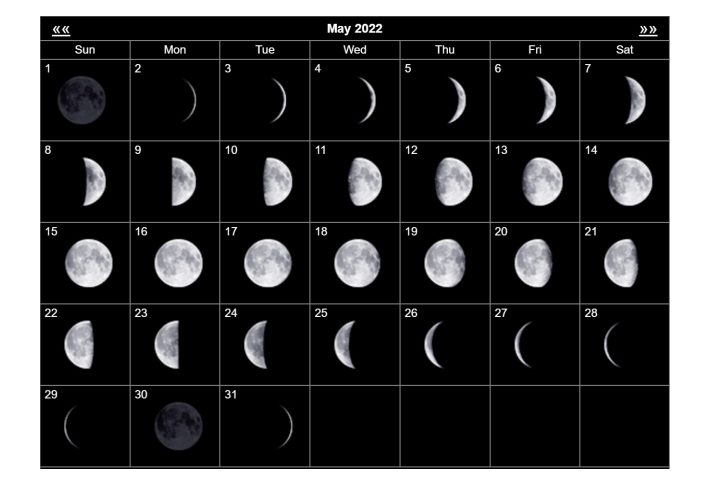
In the UK we use the Gregorian calendar; it is a solar calendar so that a year corresponds to the time to orbit the Sun once, where 1 solar year is $\approx 365.25$ days. Several cultures use a lunar calendar, where each month is determined by the time it takes to go from New Moon to New Moon, and have a lunar year that is exactly 12 lunar months. An example of this is the Islamic calendar. Since the length of a lunar month (29.53 days) is a little shorter than the average month length in our solar calendar (see Figure 3), it means the start date of each month in the Islamic calendar is not tied to the seasons and gradually moves earlier in the solar year.

(a) Calculate (to the nearest day) how much earlier in the Gregorian calendar (on average) a given month in the Islamic calendar will start compared to the previous year.
(b) Given that the Islamic year 1429 AH fell completely within the Gregorian year 2008 CE, calculate the Gregorian year in which the Islamic calendar started, and predict the Gregorian year when (at least in part of it) they will both have the same numerical value of year.
(c) In some Islamic countries, odd-numbered months have 30 days and even-numbered months have 29 days. How often will leap years be in this system (where the twelfth month is also 30 days)? [This is analogous to the Gregorian system where there is a leap year roughly once every 4 years.]
(d) In other Islamic countries, the start of a new month is determined through direct telescopic observations of the Moon, looking for a very thin crescent. This is a very hard measurement to make and the human eye struggles to recognise the presence of a crescent until about $0.6\%$ of the lunar disc is illuminated. Calculate how many hours this is after the end of the astronomical New Moon. Assume the lunar orbit is circular.
Show answer · 显示答案
- (a)$\Delta \approx \mathbf{11}~\textbf{days earlier each year}$
- (b)$\Rightarrow \text{year of coincidence} \approx \mathbf{20849}~\mathrm{CE}$
- (c)$n \approx 2.78~\mathrm{years}$
- (d)$t \approx \mathbf{17.5}~\textbf{hours}$
Full worked solutions: BAAO Astro Challenge: Complete Solutions (book)
In September 2022, Jupiter reached opposition a few days after the autumnal equinox. Which constellation was it in at the time? [Jupiter's opposition corresponds to when it is closest in its orbit to the Earth.]
A. Cancer
B. Pisces
C. Scorpio
D. Virgo
Show answer · 显示答案
An observer on the equator sees the Moon rise at 22:00. Ignoring the inclination and eccentricity of the Moon's orbit, when will it rise the next night? The Moon's orbital period is 27.3 days.
A. $21:07$
B. $21:47$
C. $22:13$
D. $22:53$
Show answer · 显示答案
Which of these stars will culminate at the highest altitude as seen by an observer in Oxford (latitude $51.75^{\circ}$ N, longitude $1.26^{\circ}$ W)?
A. Aldebaran (Right ascension $=04^{\mathrm{h}}36^{\mathrm{m}}$, declination $=+16.51^{\circ}$)
B. Altair (Right ascension $=19^{\mathrm{h}}51^{\mathrm{m}}$, declination $=+8.87^{\circ}$)
C. Capella (Right ascension $=05^{\mathrm{h}}17^{\mathrm{m}}$, declination $=+46.00^{\circ}$)
D. Procyon (Right ascension $=07^{\mathrm{h}}39^{\mathrm{m}}$, declination $=+5.22^{\circ}$)
Show answer · 显示答案
From which of these settlements can a geostationary satellite not be seen?
A. Longyearbyen, Svalbard, Norway (latitude $= 78.20^{\circ}$ N)
B. Nagurskoye, Franz Josef Land, Russia (latitude $= 80.80^{\circ}$ N)
C. Alert, Ellesmere Island, Canada (latitude $= 82.47^{\circ}$ N)
D. Geostationary satellites are visible from all of these latitudes
Show answer · 显示答案
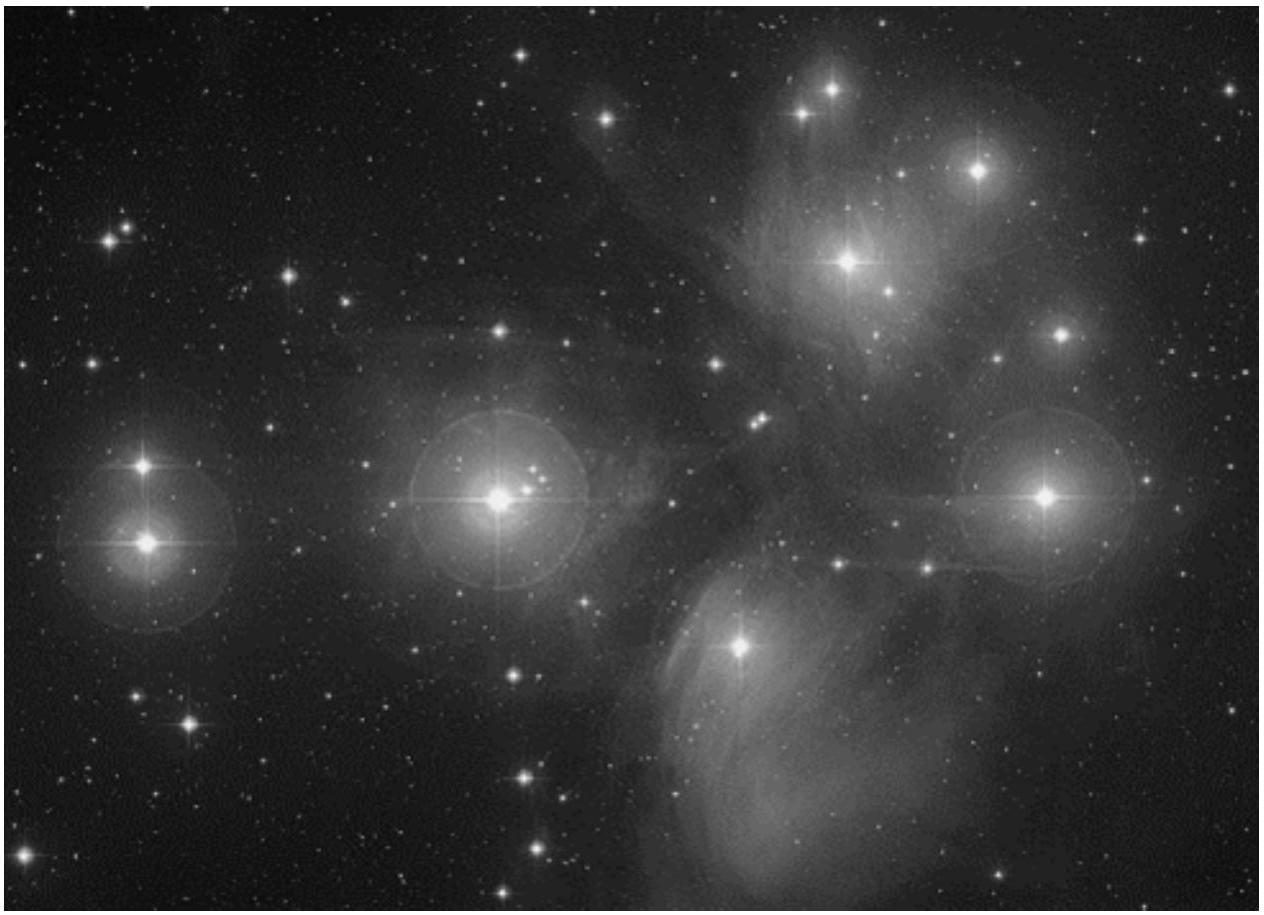
What is the Messier number of this object?

A. M42
B. M43
C. M44
D. M45
Show answer · 显示答案
Which of the following stars is in the constellation Taurus?
A. Aldebaran
B. Castor
C. Rigel
D. Sirius
Show answer · 显示答案
An observer in the UK sees a third quarter moon in the constellation Capricornus. What is the month?
A. January
B. April
C. July
D. October
Show answer · 显示答案
On the $21^{\mathrm{st}}$ June the Sun sets in Guernsey ($49.45^{\circ}$ N, $2.59^{\circ}$ W) at 21:00 BST (British Summer Time, BST = UT+1). At what time UT (approximately) did the Sun set as observed from Antananarivo, Madagascar ($18.88^{\circ}$ S, $47.51^{\circ}$ E) on the same day?
A. 12:40
B. $14:20$
C. 14:40
D. 16:40
Show answer · 显示答案
An observer is lost at sea and sees that Polaris is $33^{\circ}$ above the horizon. What is their latitude?
A. $57^{\circ}$ N
B. $33^{\circ}$ N
C. $33^{\circ}$ S
D. $57^{\circ}$ S
Show answer · 显示答案
Which of the following constellations is south of the celestial equator?
A. Andromeda
B. Canis Major
C. Gemini
D. Perseus
Show answer · 显示答案
Which of the following Messier objects is a nebula that can be found in the same constellation as the star Aldebaran?
A. M1
B. M31
C. M42
D. M45
Show answer · 显示答案
Which of these stars will culminate at the highest altitude, as seen by an observer in Rio de Janeiro ($22.91^{\circ}$ S, $43.17^{\circ}$ W)?
A. Castor (RA: $07^{\mathrm{h}}35^{\mathrm{m}}$, Dec: $+31.89^{\circ}$)
B. Rigel (RA: $05^{\mathrm{h}}15^{\mathrm{m}}$, Dec: $-8.20^{\circ}$)
C. Nunki (RA: $18^{\mathrm{h}}55^{\mathrm{m}}$, Dec: $-26.30^{\circ}$)
D. Hadar (RA: $14^{\mathrm{h}}04^{\mathrm{m}}$, Dec: $-60.37^{\circ}$)
Show answer · 显示答案
Between September 2024 and January 2025, Mars, Saturn, Uranus, and Neptune will all be in opposition: Mars in Gemini, Saturn in Aquarius, Uranus in Taurus, and Neptune in Pisces. In what order will their oppositions occur?
A. Mars, Uranus, Neptune, Saturn
B. Neptune, Uranus, Mars, Saturn
C. Saturn, Neptune, Uranus, Mars
D. Saturn, Uranus, Neptune, Mars