History of the Universe
The Universe consists of radiation, matter, and dark energy, with three different epochs in its history.
The Universe consists of three main components: radiation (including neutrinos), matter (both
atoms and dark matter), and dark energy. The overall density of the universe has been dominated by the density of each of those in turn at different times in its history, leading to three different epochs.
The scale factor, $a$, describes how the Universe has expanded (i.e. a measure of the relative radius of the Universe), and the current value is defined as $a_0 \equiv 1$ where the subscript ' 0 ' indicates it is as measured today. At earlier times $a<1$ and at the Big Bang $a=0$.
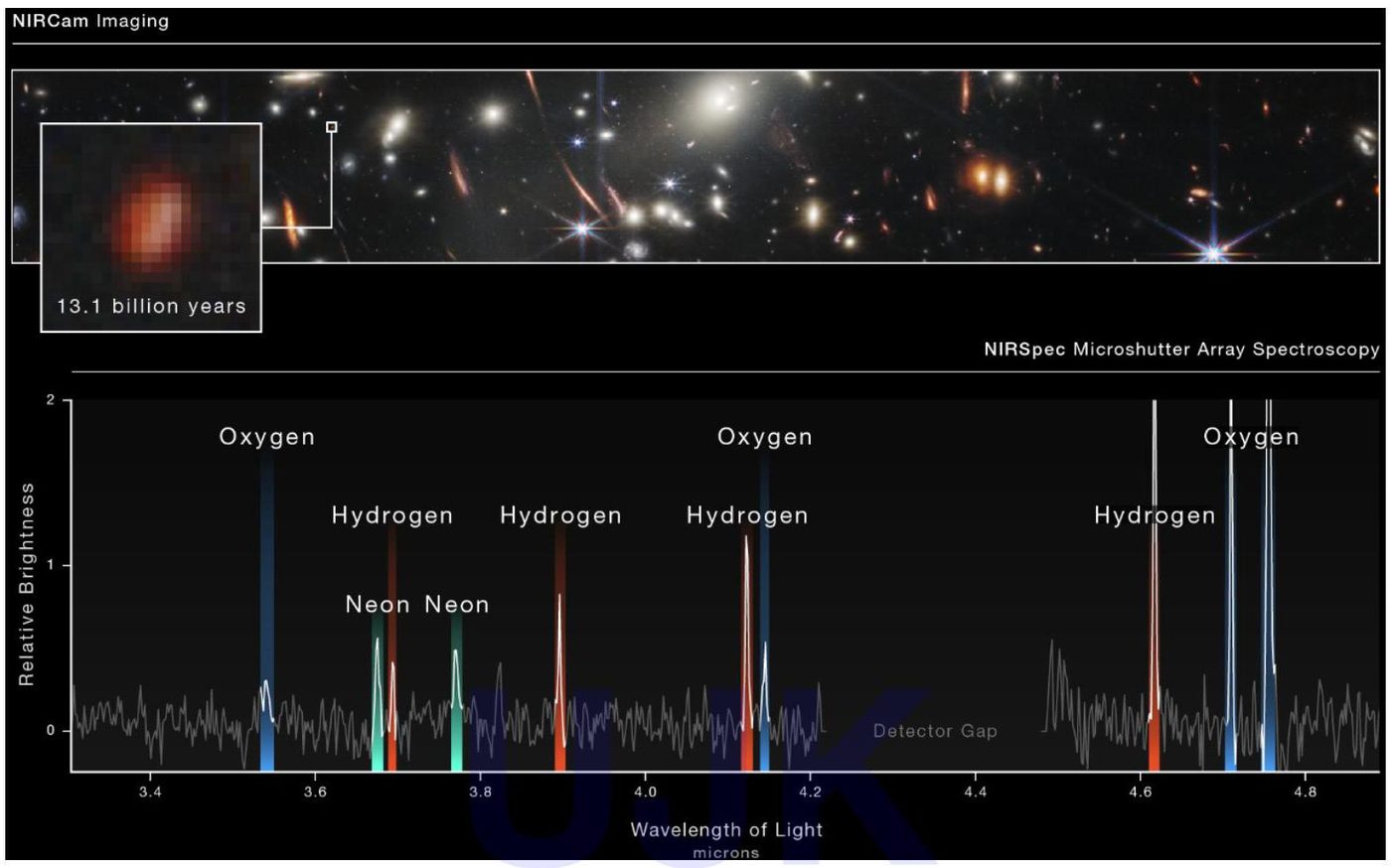
The redshift of an object, $z$, is related to the scale factor as $a=(1+z)^{-1}$ and so the redshift corresponding to now is $z=0$, and far away objects have higher redshift $(z>0)$ since we observe them as they were long ago when the scale factor was smaller.
For a Universe to be flat (i.e. zero curvature), its average density must be equal to the critical density,
$$
\rho_{\text {crit }, 0}=\frac{3 H_0^2}{8 \pi G},
$$
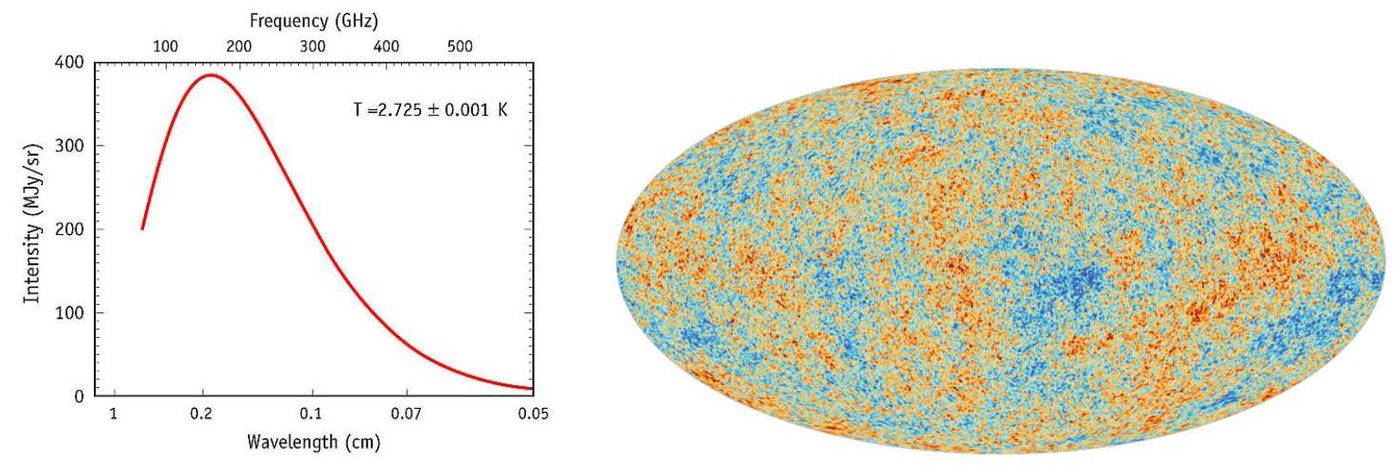
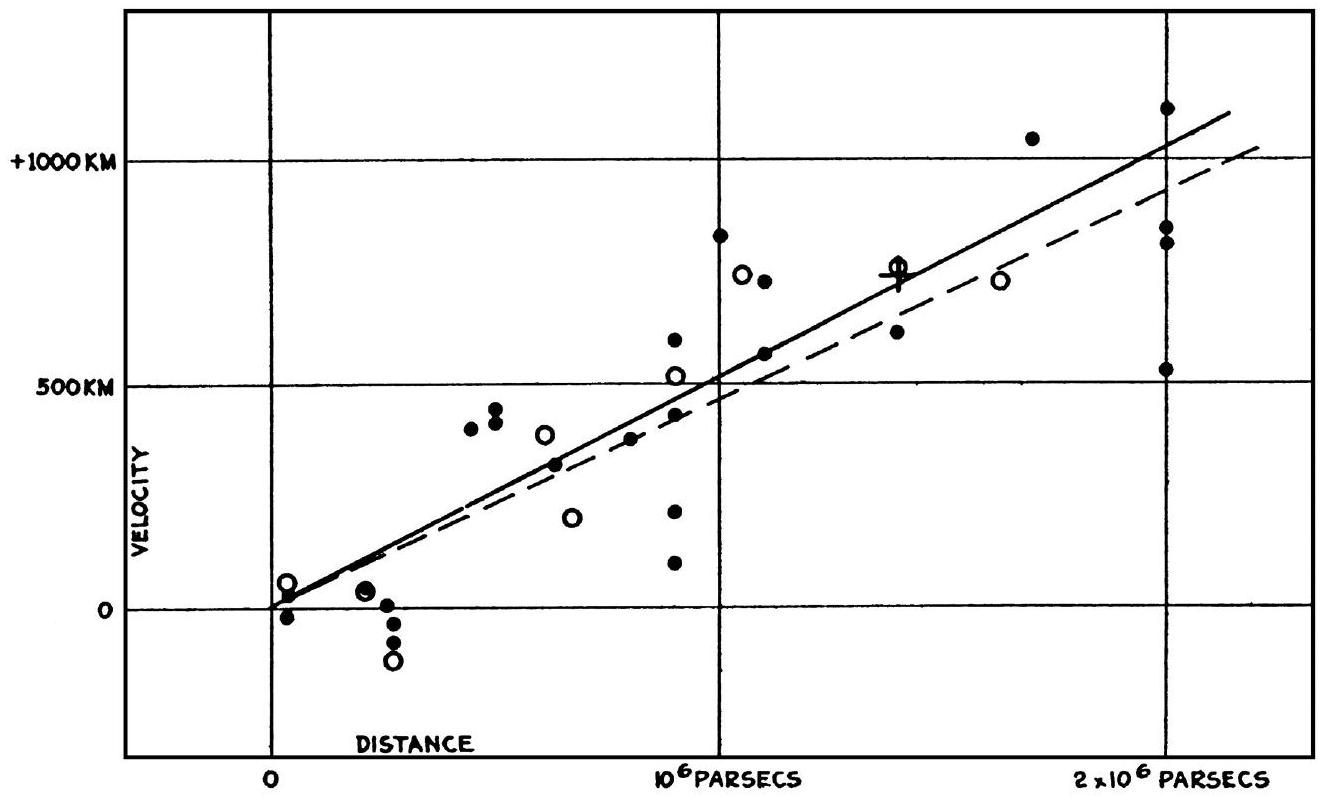
where $H_0$ is the Hubble constant, measured in 2018 from the cosmic microwave background by the Planck spacecraft to be $67.36 \mathrm{~km} \mathrm{~s}^{-1} \mathrm{Mpc}^{-1}$.
The density of the $i^{\text {th }}$ component of the Universe can be expressed relative to the critical density as the density parameter,
$$
\Omega_i=\frac{\rho_i}{\rho_{\text {crit }}}
$$
Planck measured the current density parameters of dark energy and matter as $\Omega_{\Lambda, 0}=0.6847$ and $\Omega_{m, 0}=0.3153$ respectively.
In each epoch, the scale factor increases at a different rate with time, $t$, as the density also varies differently with scale factor.
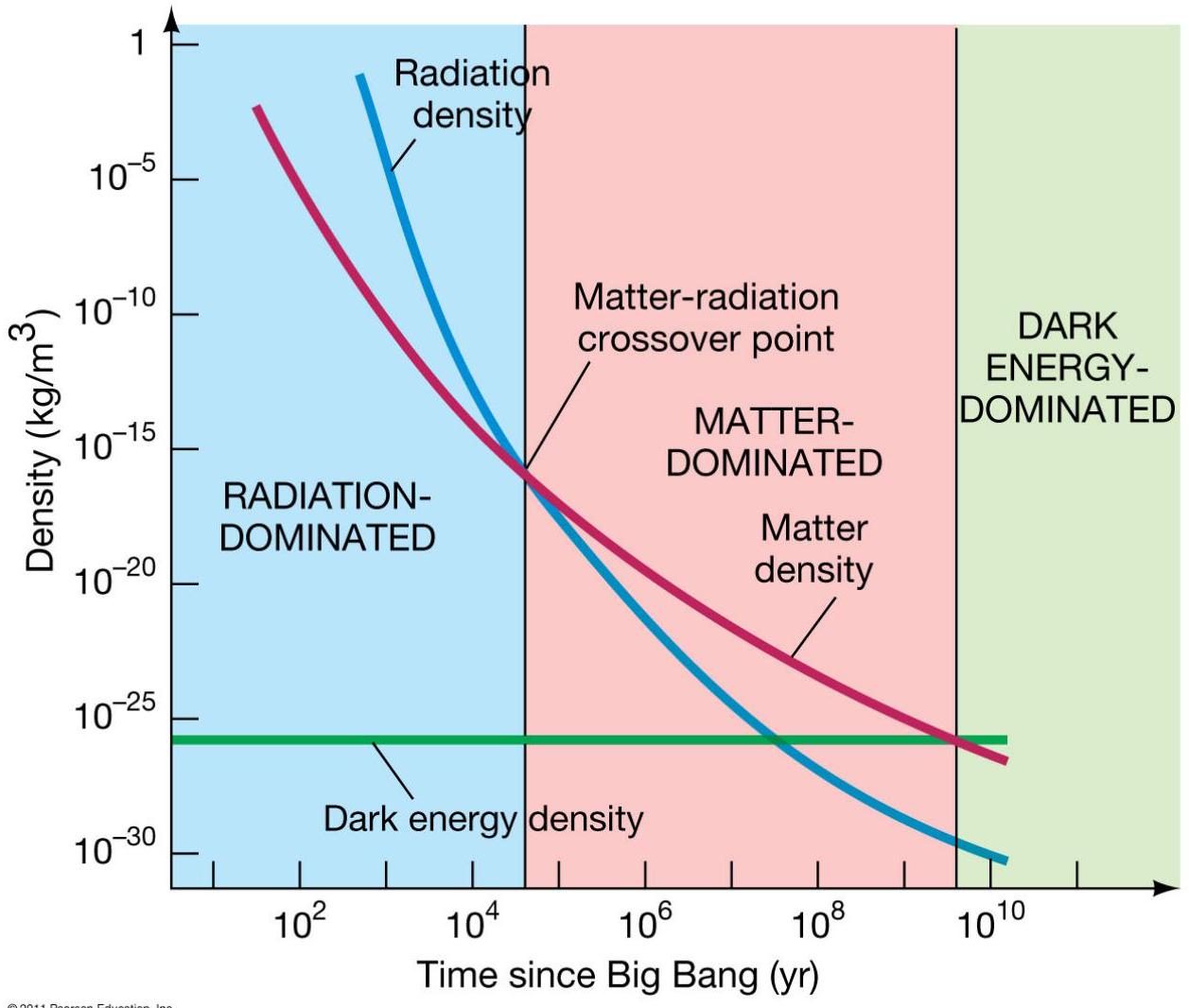
- Radiation-dominated epoch: The Universe's early history, where $\rho \propto a^{-4}$ and so $a \propto t^{1 / 2}$
- Matter-dominated epoch: This represents much of the history of the Universe, where $\rho \propto a^{-3}$ and so $a \propto t^{2 / 3}$
- Dark-energy-dominated epoch: This is an era we have recently entered and will remain in for the rest of time, where $\rho$ doesn't vary with scale factor (i.e. is a constant) and so $a \propto e^{H_0 t}$
(a) Assuming our Universe is flat, calculate the current average density of the Universe.
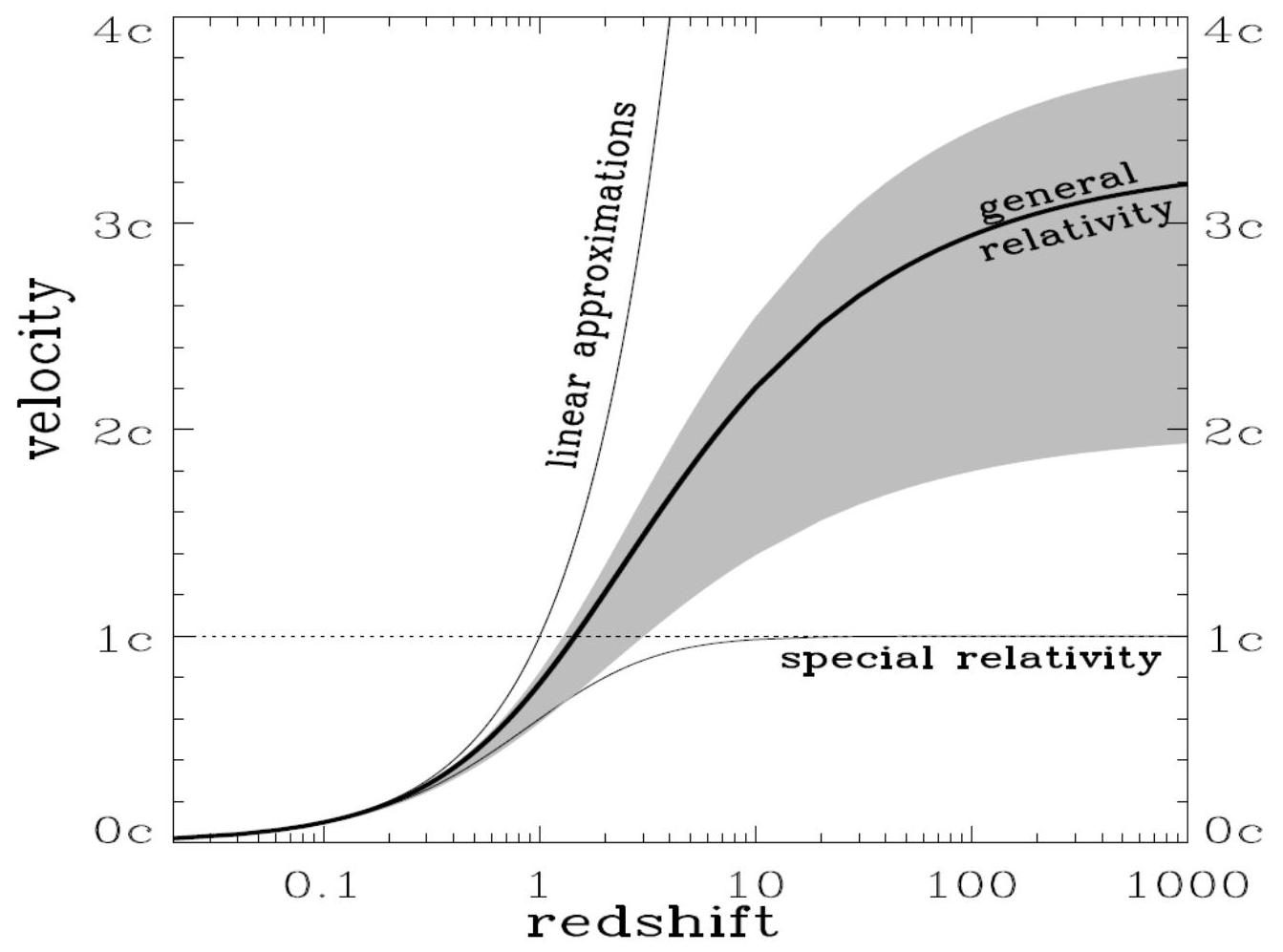
(b) Find the time, $t_{D E}$, when the current epoch began (i.e. when the densities of dark energy and matter were equal), given that the age of the Universe today is $t_0=13.80 \mathrm{Gyr}$ (where 1 Gyr $=10^9$ years). Give you answer in Gyr. You do not need to read anything off the graph.
(c) Assuming the Universe has always been flat, find the time $t_{\text {eq }}$, corresponding to when the densities of matter and radiation were equal, given that data from Planck has allowed us to calculate the redshift of this to be $z_{e q}=3402$, and find the average density of the Universe at $t_{e q}$. Again, do not try and read any data off the graph.