BAAO · Astro Challenge · Sections A–C

Exoplanets

5 questions — reveal the final answers. Full worked solutions: the book.

2016 Q142016Section C · Long answerExoplanets · Proxima Centauri b: habitable-zone exoplanet
Proxima Centauri B

On 24th August 2016, astronomers discovered a planet orbiting the closest star to the Sun, Proxima Centauri, situated 4.22 light years away, which fulfils a long-standing dream of science-fiction writers: a world that is close enough for humans to send their first interstellar spacecraft.

Astronomers have noted how the motion of Proxima Centauri changed in the first months of 2016, with the star moving towards and away from the Earth, as seen in the figure below. Sometimes Proxima Centauri is approaching Earth at 5 km hour$^{-1}$ --- normal human walking pace --- and at times receding at the same speed. This regular pattern of changing radial velocities caused by an unseen planet, which they named Proxima Centauri B, repeats and results in tiny Doppler shifts in the star's light, making the light appear slightly redder, then bluer.
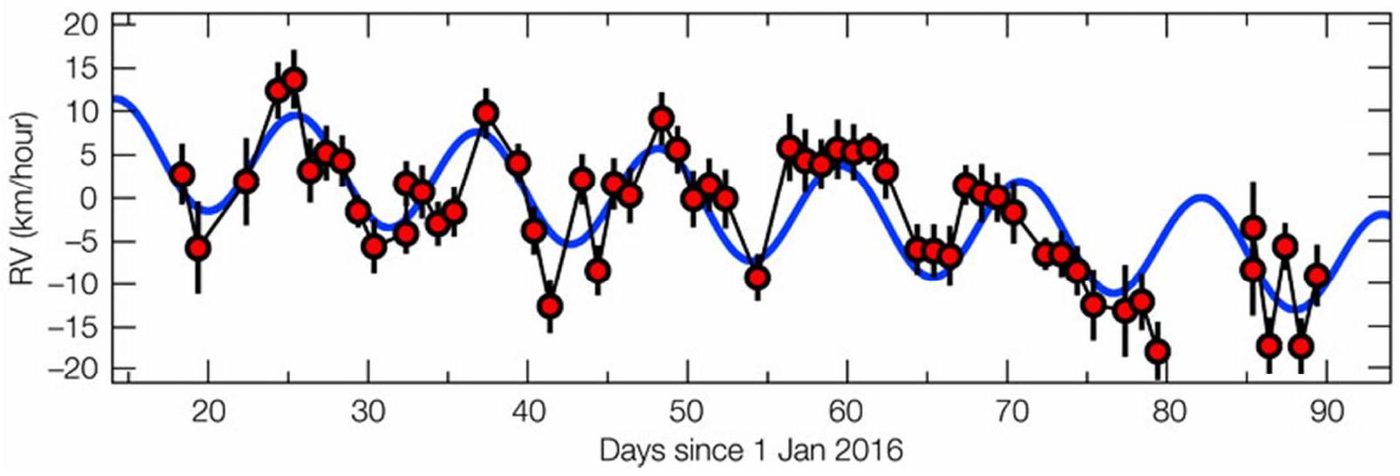
figure
a. From the radial velocity curve above, determine the period of the planet around Proxima Centauri. b. Proxima Centauri is a red dwarf star, unlike our Sun, with a mass of only $0.12 M_{\odot}$. What is the semi-major axis of the planet's orbit in AU? c. Assuming a circular orbit, what is the planet's orbital velocity? d. By considering that the total linear momentum of the star-planet system in the centre of mass frame is zero, estimate the minimum mass of the planet in terms of Earth masses. Why is this a minimum for the mass of the planet? e. Using a simple approximation, the equilibrium temperature of a planet can be calculated as: $$T_{\text{Planet}} = T_{\text{Star}}\sqrt{\frac{R_{\text{Star}}}{2d}}$$ where $d$ is the distance between the star and the planet. Given that the astronomers discovered that the orbit of the planet is in fact an ellipse with an eccentricity of 0.35, and that the star has a surface temperature of 3000 K and a radius of $0.14 R_{\odot}$, what are the minimum and maximum equilibrium temperatures of Proxima Centauri B?

Comment on whether or not the planet is in the habitable zone of Proxima Centauri.

[The habitable zone is the band around a star where a planet can have water on its surface in liquid form, at normal pressure.] f. Comment on the prospects of studying the planet directly with robotic space probes.
Show answer · 显示答案
Final answers · 最终答案
  • (a)$T \approx 11.2 \text{ days}$
  • (b)$a = 0.0483 \text{ AU}$
  • (c)$v_p = 4.694 \times 10^4 \text{ m s}^{-1}$
  • (d)$m_p = 1.18\, M_\oplus$
  • (e)$T_{\min} = 212 \text{ K}$
  • (f)$d \approx 4.0 \times 10^{13} \text{ km}$

Full worked solutions: BAAO Astro Challenge: Complete Solutions (book)
2018 Q132018Section C · Long answerExoplanets · Density and composition of an iron exoplanet
Iron Planet

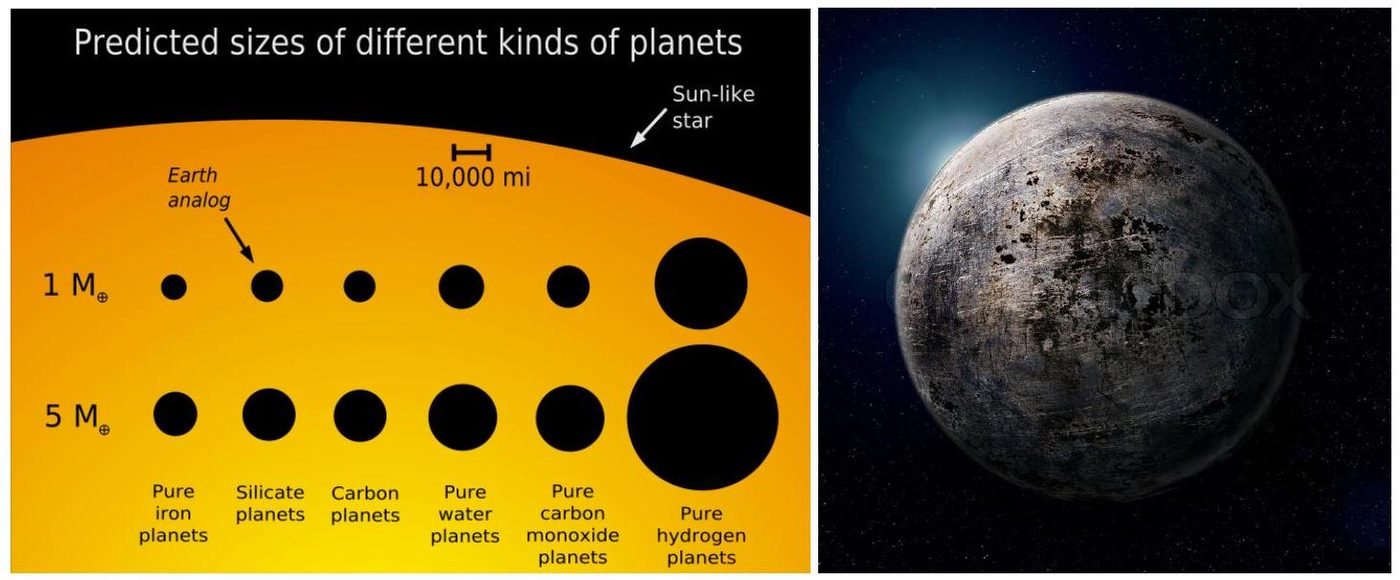
Given the mass and radius of an exoplanet we can determine its likely composition, since the denser the material the smaller the planet will be for a given mass (see Figure 3). At a minimum orbital distance, called the Roche limit, tidal forces will cause a planet to break up, so very short period exoplanets place meaningful constraints on their composition as they must be very dense to survive in that orbit. The most extreme variant is called an `iron planet', as it is made of iron with little or no rocky mantle ($\gtrsim 80\%$ iron by mass). The exoplanet KOI 1843.03 has the shortest known orbital period of a little over 4 hours, so is a potential candidate to be an iron planet.

figure
Figure 3: Left: Comparisons of sizes of planets with different compositions [Marc Kuchner / NASA GSFC]. Right: An artist's impression of what an extreme iron planet (almost $\sim 100\%$ iron) might look like.

The Roche limiting distance, $a_{\mathrm{min}}$, for a body comprised of an incompressible fluid with negligible bulk tensile strength in a circular orbit about its parent star is $$a_{\mathrm{min}} = 2.44\, R_{\star}\left(\frac{\rho_{\star}}{\rho_{p}}\right)^{1/3},$$ where $R_{\star}$ is the radius of the star, $\rho_{\star}$ is the density of the star and $\rho_{p}$ is the density of the planet. Over the mass range $0.1\,M_E$--$1.0\,M_E$ the mass-radius relation for pure silicate and pure iron planets is approximately a power law and can be described as $$\log_{10}\!\left(\frac{R}{R_E}\right) = 0.295\log_{10}\!\left(\frac{M}{M_E}\right) + \alpha,$$ where $\alpha = 0.0286$ in the pure silicate case and $\alpha = -0.1090$ in the pure iron case.

(a) Derive a formula for the period of an exoplanet orbiting at the Roche limit, and hence show it is dependent only on the variable $\rho_{p}$ (i.e.\ independent of the properties of the parent star).

(b) The exoplanet KOI 1843.03 is measured (from transit lightcurves) to have a radius of $0.61\,R_E$. Calculate the minimum period for the exoplanet in the pure silicate and pure iron cases. Give your answer in hours.

(c) The measured period is 0.1768913 days. If it is only made of iron and silicate, estimate the minimum percentage of iron, and hence conclude if it is an example of an iron planet.

Show answer · 显示答案
Final answers · 最终答案
  • (a)$T_\text{min} = \sqrt{\frac{3\pi\,(2.44)^3}{G\,\rho_p}}$
  • (b)$T_\text{min,iron} \approx 3.86\,\text{hours}$
  • (c)Conclusion. This minimum iron content of $\sim 89\%$ by mass comfortably exceeds the $\gtrsim 80\%$-by-mass threshold stated in the question.

Full worked solutions: BAAO Astro Challenge: Complete Solutions (book)
2019 Q142019Section C · Long answerExoplanets · TRAPPIST-1 planets: orbits and temperatures
Life in the TRAPPIST-1 System

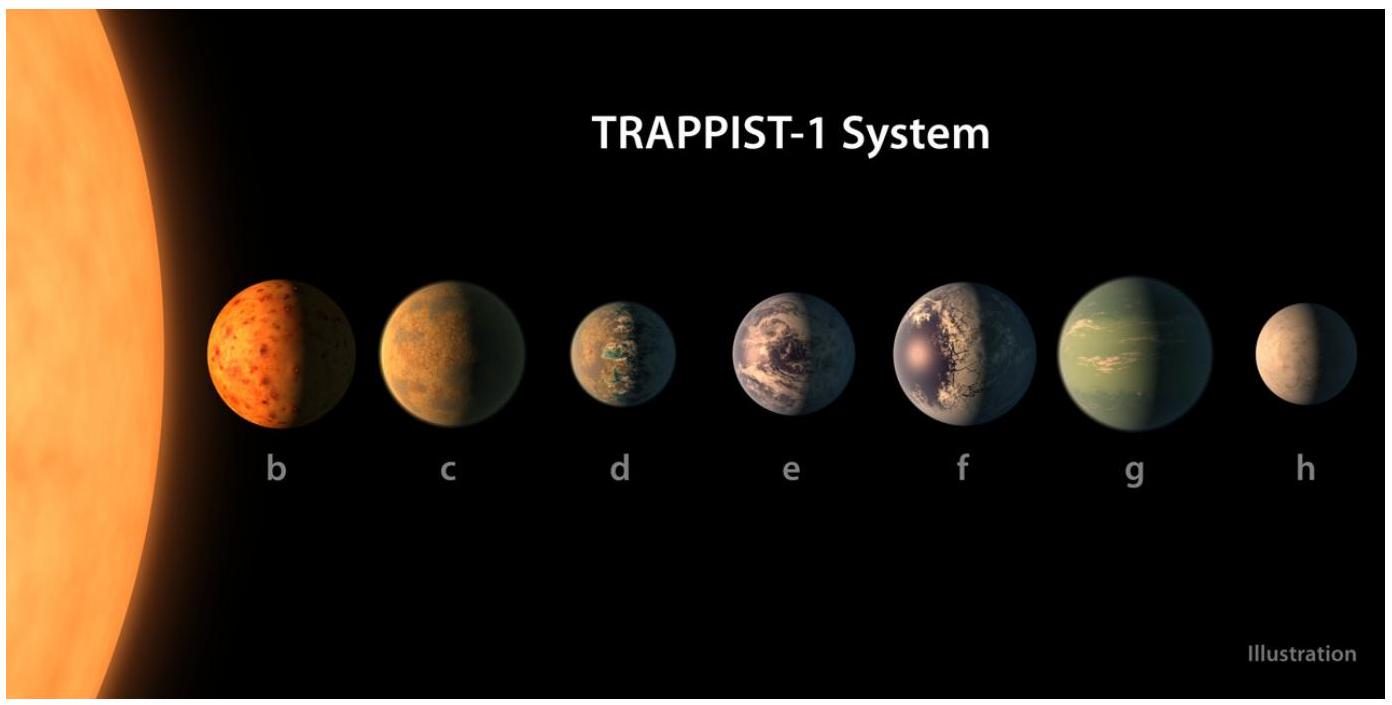
In February 2017 the astronomical world was very excited by the announcement of the discovery of seven exoplanets similar in size to Earth orbiting around the ultra-cool red dwarf star TRAPPIST-1, found only 12.14 pc away. Whilst they are much closer to their star than Mercury is to the Sun, since the star is considerably cooler it means that three of them (planets d, e and f) are in the habitable zone of the star (defined as where liquid water could exist on the surface).

figure
Figure 4: A size comparison of the planets of the TRAPPIST-1 system, lined up in order of increasing distance from their host star. The planetary surfaces are portrayed with an artist's impression of their potential surface features, including water, ice, and atmospheres. Credit: NASA/R. Hurt/T. Pyle

Data about the system is below:

Mass / $M_{E}$Radius / $R_{E}$Orbital Period / Earth days
TRAPPIST-1b1.021.1271.511
TRAPPIST-1c1.161.1002.422
TRAPPIST-1d0.300.7884.050
TRAPPIST-1e0.770.9156.099
TRAPPIST-1f0.931.0529.206
TRAPPIST-1g1.151.15412.354
TRAPPIST-1h0.330.77718.768

The star has a mass of $0.089\,M_{\odot}$, radius $0.121\,R_{\odot}$, luminosity $5.22 \times 10^{-4}\,L_{\odot}$ and effective surface temperature of 2511 K. Assume the planets orbit in circular, coplanar orbits.

For black-body radiation (which is a good approximation for a stellar spectrum), the modal wavelength in the spectrum (in terms of intensity), $\lambda_{\max}$, is related to the effective temperature, $T$, through Wien's displacement law, $$ \lambda_{\max} T = 2.90 \times 10^{-3}~\mathrm{m~K}. $$

The smallest angular width, $\theta_{\min}$, in radians that a telescope can resolve is limited by diffraction (ignoring the effects of the atmosphere). For a telescope of aperture diameter $D$, operating at wavelength $\lambda$, it can be shown that $$ \theta_{\min} = \frac{1.22\lambda}{D}. $$

(a) Verify that the central star, as viewed from planet d, is of comparable brightness (i.e. intensity, measured in $\mathrm{W~m^{-2}}$) to the Sun as viewed from Earth, and hence determine the apparent magnitude of the star. [The apparent magnitude of the Sun as viewed from Earth is $-26.74$]

(b) Assuming life developed on both planets d and f, calculate the size of telescope an alien on planet f would need to be able to resolve a city 20 km across on planet d when they are at their closest in their orbits. Is such a telescope feasible? [Assume their eyes have evolved to operate around the modal wavelength of the star.]

[Hint: You may find the small angle approximation useful: $\tan x \approx x$ when $|x| \ll 1$ and in radians. A radian is a measure of angle, and there are $2\pi$ radians in a circle (i.e. $2\pi$ radians $= 360^{\circ}$).]

Show answer · 显示答案
Final answers · 最终答案
  • (a)$m_d \approx -26.81$
  • (b)$D \approx 0.17 \text{ m}$

Full worked solutions: BAAO Astro Challenge: Complete Solutions (book)
2020 Q82020Section A · Multiple choiceExoplanets · Transit depth and planet-to-star radius ratio

When an exoplanet transits a star, the brightness dims by 0.0557 magnitudes. What is $R_P/R_S$?
A. 0.00250
B. 0.224
C. 0.776
D. 0.998

Show answer · 显示答案
Answer · 答案
B

Full worked solutions: BAAO Astro Challenge: Complete Solutions (book)

2020 Q112020Section B · Short answerExoplanets · Equilibrium temperature of TOI 700 d
Temperature on an Exoplanet

NASA's TESS discovered TOI 700 d, an Earth-sized exoplanet in the habitable zone.

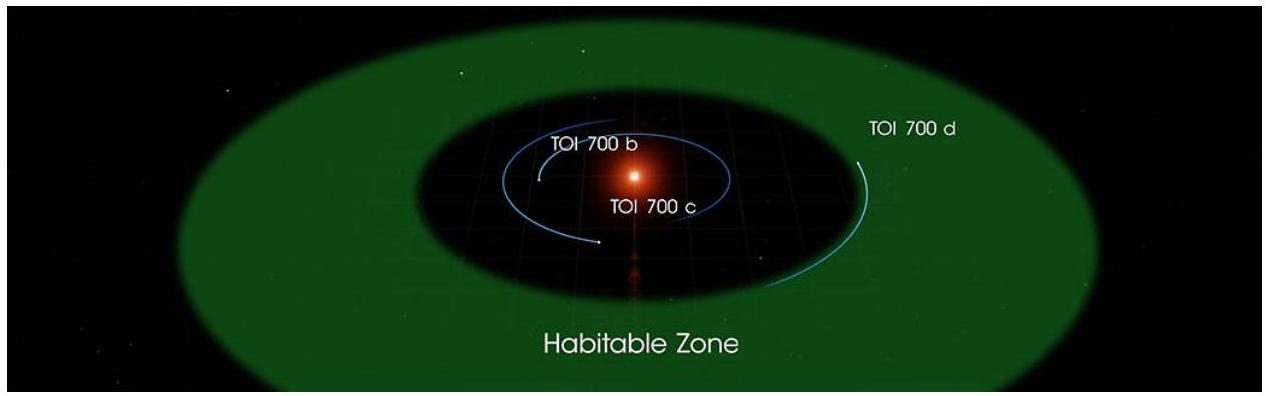
In January 2020, NASA’s Transiting Exoplanet Survey Satellite (TESS) discovered an Earth-sized exoplanet, called TOI 700 d, in its star’s habitable zone. This is the range of distances a planet can orbit a star so that liquid water can exist on the surface, given sufficient atmospheric pressure. It was discovered using the transit method, where the planet passes directly between the observer and the star, causing a drop in brightness.

figure

TOI 700 d has $R_P = 1.19 R_E$ orbiting a star with $L = 0.0233 L_{\odot}$ at 0.163 au. Assume that the planet absorbs all the light that hits the surface, and that the orbit is circular.

(a) Determine the total power incident on the planet's surface, $L_{\mathrm{incident}}$.

Assuming the planet is in thermal equilibrium and a perfect blackbody emitter with temperature $T_P$, the total amount of energy emitted is given by the Stefan-Boltzmann Law,

$$ L_{\mathrm{emitted}}=4 \pi R_P^2 \sigma T_P^4, $$

where $\sigma=5.67 \times 10^{-8} \mathrm{~W} \mathrm{~m}^{-2} \mathrm{~K}^{-4}$.

(b) Find the value of $T_P$. Give your answer in ${ }^{\circ} \mathrm{C}$. [Hint: you may find it is colder than expected.]

(c) Suggest one reason to still justify the claim that the exoplanet is in the habitable zone.

Show answer · 显示答案
Final answers · 最终答案
  • (a)$L_{\mathrm{incident}} = 2.16\times10^{17}\ \text{W}$
  • (b)$T_P \approx -4^{\circ}\text{C}$
  • (c)See the book for the worked solution.

Full worked solutions: BAAO Astro Challenge: Complete Solutions (book)