BAAO · Astro Challenge · Sections A–C

Celestial Mechanics and Orbits

25 questions — reveal the final answers. Full worked solutions: the book.

2016 Q22016Section A · Multiple choiceCelestial Mechanics and Orbits · Tides and the Earth-Moon centre of mass

Why are there two tides every day?
A. The Moon causes the one at night and the Sun causes the one during the day
B. The Earth and Moon orbit a common centre of mass
C. The Moon is tidally locked to the Earth
D. Water waves can only travel around the Earth in 12 hours

Show answer · 显示答案
Answer · 答案
B

Full worked solutions: BAAO Astro Challenge: Complete Solutions (book)

2016 Q62016Section A · Multiple choiceCelestial Mechanics and Orbits · Orders of magnitude: folding paper to the Moon

Given an overwhelmingly large piece of paper, with a thickness of $10~\mu\mathrm{m}$, approximately how many times do you need to fold it in half for the thickness of the final stack to reach from Earth to the Sun (1 AU)?
A. 40
B. 50
C. 60
D. 70

Show answer · 显示答案
Answer · 答案
B

Full worked solutions: BAAO Astro Challenge: Complete Solutions (book)

2016 Q122016Section B · Short answerCelestial Mechanics and Orbits · Eclipse geometry and orbits (Death Star)
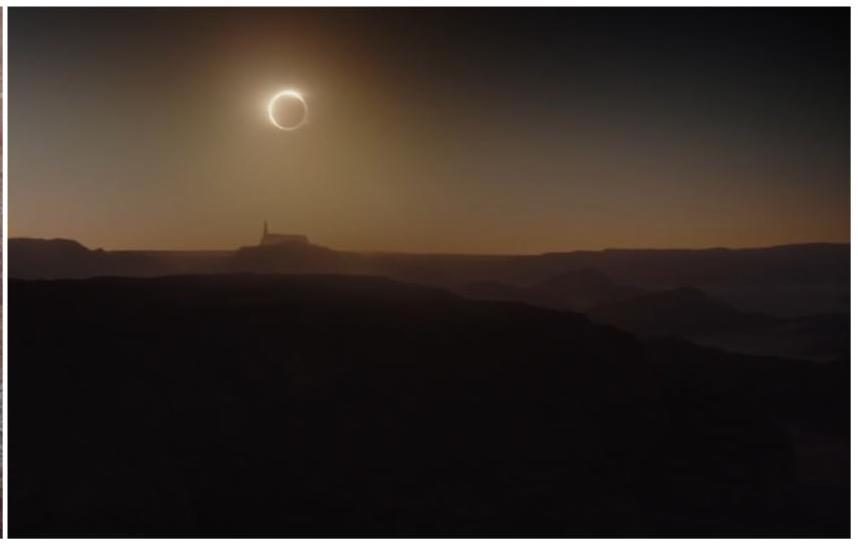
Star Wars Rogue One

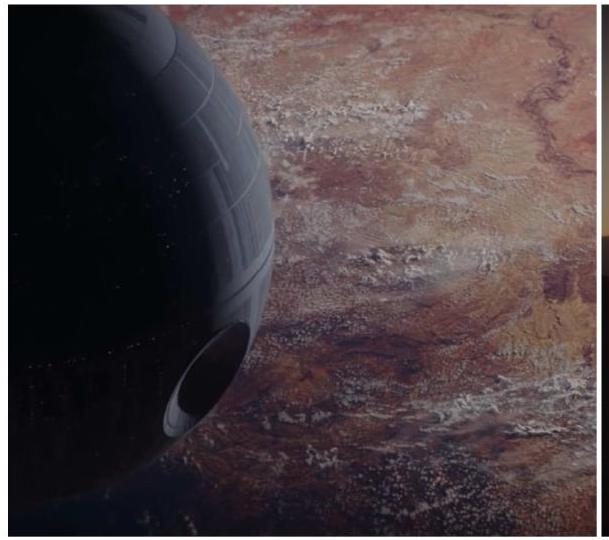
The new Star Wars film Rogue One concentrates on the creation of the first Death Star, which in one scene causes a total eclipse on the planet Scarif, where it is being built.

figure
figure
a. Assume the Death Star is being built in orbit around the Earth instead, but still causes a very brief total solar eclipse when it passes in front of the Sun. The Death Star has a diameter of 120 km, and so by comparing it to the size and distance to the Sun, calculate the altitude it is being built at. How does that compare to the altitude of the International Space Station (400 km)? b. What will be its orbital period, assuming it moves in a circular orbit?
Show answer · 显示答案
Final answers · 最终答案
  • (a)$\frac{h_{DS}}{h_{\text{ISS}}} \approx 34.4$
  • (b)$T \approx 7.89 \text{ hours}$

Full worked solutions: BAAO Astro Challenge: Complete Solutions (book)

2016 Q132016Section C · Long answerCelestial Mechanics and Orbits · Tidal disruption and the Roche limit
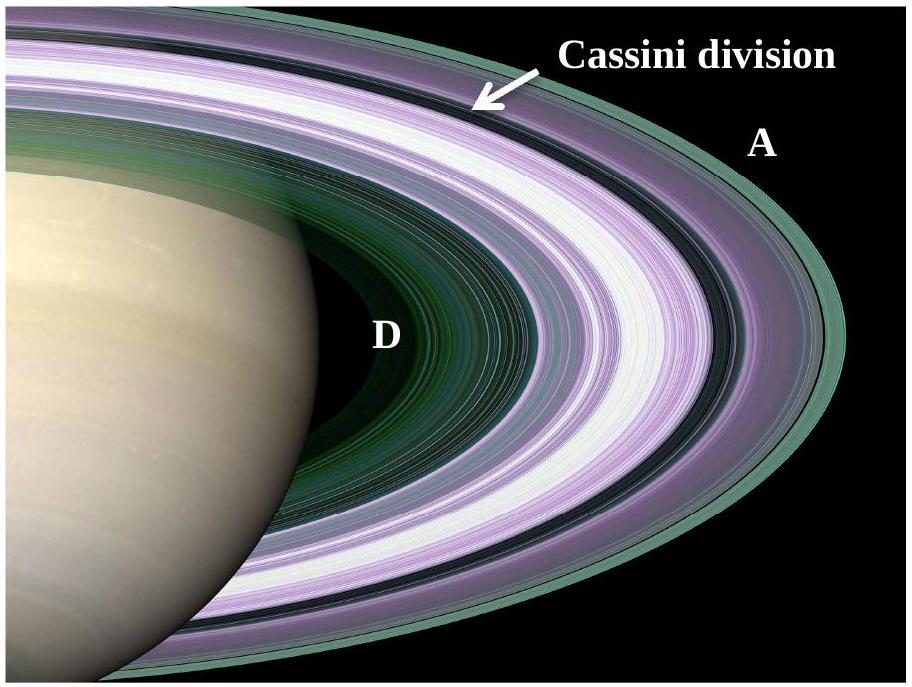
Saturn's Rings

One possible theory for why the gas giants have ring systems is that a small moon got too close to the parent planet. When the gravitational tidal forces (due to the difference between the strength of the planet's pull on the near and far sides of the moon) became greater than the gravitational forces holding the moon together, it was ripped apart. This minimum distance is called the ``Roche limit'', named after the French astronomer Edouard Roche who first calculated it. It is defined as when the gravitational force generated by the moon at its surface is equal to the tidal forces it experiences at that distance.

figure

Consider a spherical planet with mass $M$ and radius $R$, and a perfectly rigid spherical moon with mass $m$ and radius $r$, orbiting the planet in a circular orbit of radius $d$. For a small particle of mass $\mu$ on the surface of the moon, the gravitational and tidal forces are:

$$F_{\text{grav}} = \frac{Gm\mu}{r^2}$$ $$F_{\text{tidal}} = \frac{2GM\mu r}{d^3}$$

a. By making these two expressions equal, derive an expression for the Roche limit, $d_{\text{RL}}$, purely in terms of $R$ and the uniform densities of the planet and the moon ($\rho_{P}$ and $\rho_{m}$ respectively). b. Use your formula to calculate the Roche limit of Saturn for a moon made of water ice ($\rho_{m} = 930$ kg m$^{-3}$), given that $M_{\text{Saturn}} = 5.68 \times 10^{26}$ kg and $R_{\text{Saturn}} = 60,270$ km. c. In practice, as a moon approaches the Roche limit it will start to deform and become more of an ellipsoid than a sphere, causing the tidal forces to increase, and so the Roche limit from our simple model is really a minimum radius. The opposite extreme would be to assume that both the planet and moon are made of a fluid, and so can deform without resistance (this works well when looking at things like stars in close binary systems). In that situation it can be shown that the equivalent formula for the Roche limit becomes: $$d_{\text{RL}} \approx 2.44 R\left(\frac{\rho_{P}}{\rho_{m}}\right)^{1/3}$$ Calculate this new maximum value for the Roche limit for water ice around Saturn. d. The inner edge of Saturn's rings (D ring) occurs at $1.11 R_{\text{Saturn}}$, and the outer edge of the A ring is at $2.27 R_{\text{Saturn}}$. Do the rings of Saturn fall between the two Roche limits calculated above? e. Assuming a moon called Veritas orbited in what is now the Cassini Division (at around $2 R_{\text{Saturn}}$), and that the fluid Roche limit was most relevant, estimate the radius of Veritas. The mass of Saturn's rings is $3.0 \times 10^{19}$ kg.
Show answer · 显示答案
Final answers · 最终答案
  • (a)$d_{RL} = R\left(\frac{2\rho_P}{\rho_m}\right)^{1/3}$
  • (b)$\frac{d_{RL}}{R_{\text{Saturn}}} = 1.101$
  • (c)$\frac{d_{RL}}{R_{\text{Saturn}}} = 2.13$
  • (d)The outer edge of the A ring ($2.27\, R_{\text{Saturn}}$) is slightly beyond the fluid Roche limit ($2.13\, R_{\text{Saturn}}$).
  • (e)$r = 1.853 \times 10^5 \text{ m}$

Full worked solutions: BAAO Astro Challenge: Complete Solutions (book)

2017 Q52017Section A · Multiple choiceCelestial Mechanics and Orbits · Artificial gravity on a rotating ring

In the video game Halo, players are able to move around on the inner edge of a ring structure, which has a radius of 5000 km. Roughly how many rotations per (Earth) day would the ring need to achieve in order for the players' characters to experience Earth-like gravity whilst walking around?
A. 15
B. 17
C. 19
D. 21

Show answer · 显示答案
Answer · 答案
C

Full worked solutions: BAAO Astro Challenge: Complete Solutions (book)

2017 Q82017Section A · Multiple choiceCelestial Mechanics and Orbits · Kepler's third law

If a planet orbits the Sun with a semi-major axis of 4 AU, what is the period of its orbit?
A. 4 years
B. 8 years
C. 12 years
D. 64 years

Show answer · 显示答案
Answer · 答案
B

Full worked solutions: BAAO Astro Challenge: Complete Solutions (book)

2017 Q142017Section C · Long answerCelestial Mechanics and Orbits · Barycentres and the Pluto-Charon double planet
Double Planet

When two objects of unequal mass orbit around each other, they both orbit around a barycentre -- this is the name given to the location of the centre of mass of the system. The masses of both objects, and the distance between their centres, affects the position of their barycentre. Imagine two objects, Object 1 and Object 2, with masses $m_1$ and $m_2$ respectively, and the average distance between the centre of both objects is $a$, then the average distance from the centre of Object 1 to the barycentre, $r$, is given by the formula:

$$r = a\frac{m_2}{m_1 + m_2}$$

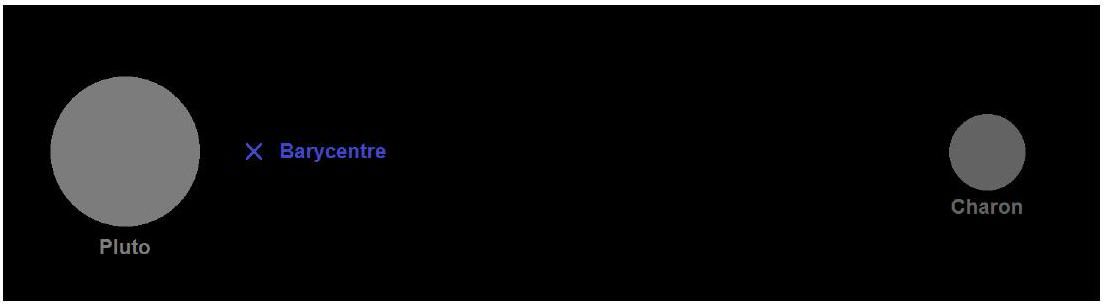
figure
Figure 4: The relative positions of Pluto, Charon and the system's barycentre.

(a) Verify that the barycentre of the Sun-Jupiter system lies outside the Sun (i.e. $r > \mathrm{R}_{\odot}$), given that the mass of Jupiter is $1.90 \times 10^{27}~\mathrm{kg}$ and it is on average 5.20 AU from the Sun.

(b) One of the most famous examples of a system with the barycentre lying outside the larger object is the Pluto-Charon system (see Fig 4), which is why many considered it to be a double-planet long before it was reclassified as a dwarf planet. Given the barycentre of the system is at $1.83~\mathrm{R}_{\mathrm{Pluto}}$ (where $\mathrm{R}_{\mathrm{Pluto}} = 1187~\mathrm{km}$) and the average separation between Pluto and Charon (as measured from centre to centre) is 19570 km, calculate the ratio of their masses (i.e. $m_{\mathrm{Pluto}}/m_{\mathrm{Charon}}$).

(c) Some have claimed that a double planet should be distinguished from a planet and large moon when a system fulfils the criterion $r > R_1$. The Earth-Moon system does not currently satisfy that condition for a double planet despite the Moon being rather large relative to the Earth, but the Moon is slowly moving away from the Earth at roughly 4 cm per year. Assuming this rate stays constant, calculate the number of years until $r = \mathrm{R}_{\mathrm{E}}$. [Average distance between centres of Earth and Moon $= 384400~\mathrm{km}$, and the Earth has 83.1 times the mass of the Moon.]

(d) The Moon's orbit is not quite circular - it is in fact an ellipse with an eccentricity of 0.055. Will this mean your answer to part (c) is an overestimate or an underestimate? Explain your reasoning.

Show answer · 显示答案
Final answers · 最终答案
  • (a)$r/R_{\odot} = 1.07$
  • (b)$\frac{m_{\text{Pluto}}}{m_{\text{Charon}}} = 8.01$
  • (c)$t = 3.77 \times 10^9~\text{years}$
  • (d)The condition $r = R_{\text{Earth}}$ will be met first at apogee (when the Moon is farthest away), before it is met at the average distance used in our calculation.

Full worked solutions: BAAO Astro Challenge: Complete Solutions (book)

2018 Q12018Section A · Multiple choiceCelestial Mechanics and Orbits · Velocity and force in a circular orbit

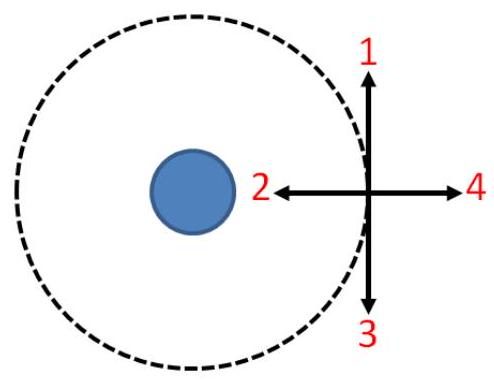
For a satellite in a circular orbit around the Earth, which of the arrows in the figure below describe the direction of the velocity and the resultant force?

figure

A. Velocity = 1, Resultant force = 1
B. Velocity = 1, Resultant force = 2
C. Velocity = 2, Resultant force = 1
D. Velocity = 3, Resultant force = 4

Show answer · 显示答案
Answer · 答案
B

Full worked solutions: BAAO Astro Challenge: Complete Solutions (book)

2018 Q62018Section A · Multiple choiceCelestial Mechanics and Orbits · Ellipse geometry of a comet orbit

A comet is orbiting the Sun in an orbit with a semi-major axis of 5.0 au and an eccentricity, $e = 0.80$. Calculate its semi-minor axis, $b$.
A. 1.0 au
B. 2.0 au
C. 3.0 au
D. 4.0 au

Show answer · 显示答案
Answer · 答案
C

Full worked solutions: BAAO Astro Challenge: Complete Solutions (book)

2018 Q72018Section A · Multiple choiceCelestial Mechanics and Orbits · Period of an elliptical orbit

What is the period of the comet from the previous question?
A. 2.1 years
B. 2.9 years
C. 5.2 years
D. 11.2 years

Show answer · 显示答案
Answer · 答案
D

Full worked solutions: BAAO Astro Challenge: Complete Solutions (book)

2018 Q112018Section B · Short answerCelestial Mechanics and Orbits · Neso and Mercury: Kepler's third law and Hill spheres
Neso and Mercury

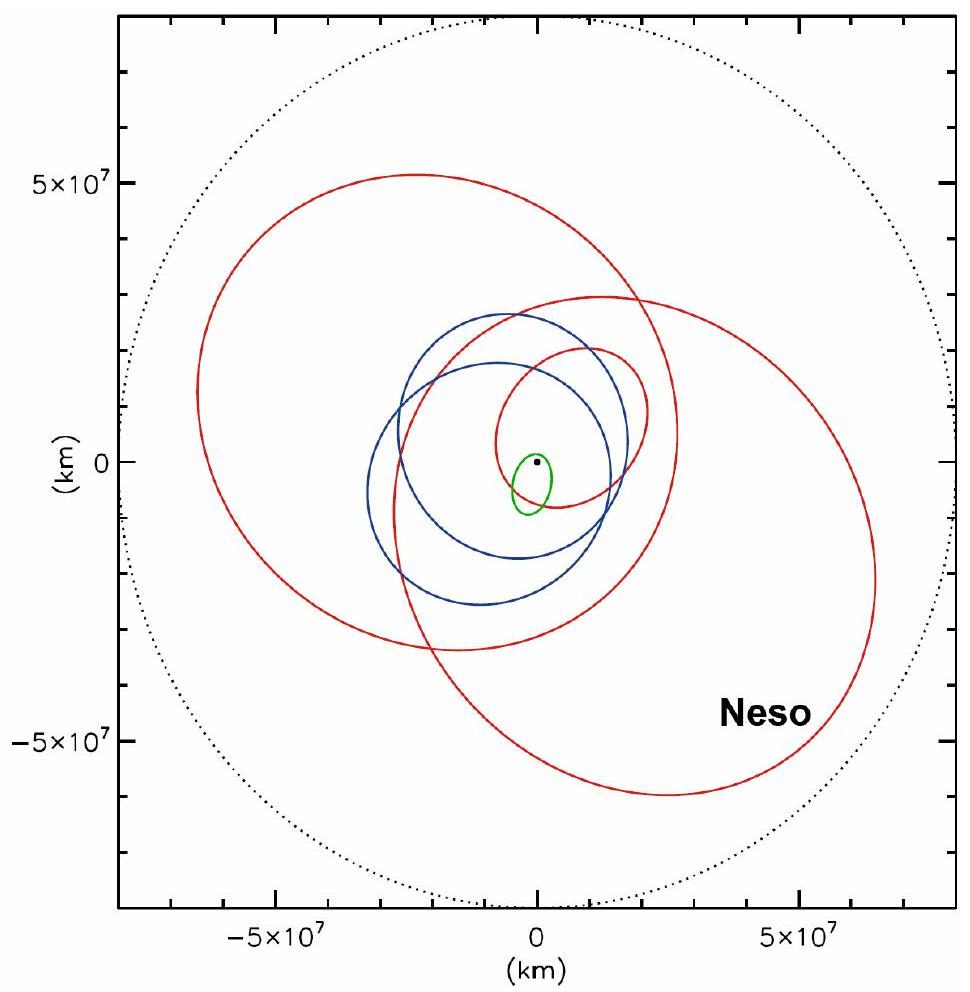
Neso is the outermost moon of Neptune, and is notable for being the moon with the greatest known orbital distance from its planet, corresponding to a period of over 26 Earth years. At its furthest point (apoapsis), it is further from Neptune than Mercury gets from the Sun, meaning it is close to the limit of being held by Neptune's gravity (see Figure 1).

figure
Figure 1: Plan view of Neptune's outermost satellite orbits. Neptune is represented by the black dot at the centre. The green orbit corresponds to Nereid, the two in blue are the prograde orbits of Sao and Laomedeia, and the red are the retrograde orbits of Halimede, Psamathe and Neso (bottom right). The dotted circle shows the theoretical outer limit of stability for Neptune satellites. Taken from Shepperd et al.\ (2006).

Orbital data about Neso and Mercury are summarised below:

MercuryNeso
Semi-major axis, $a$ ($\times 10^9$ m)57.90949.285
Eccentricity, $e$0.20560.5714
Orbital period, $T$ (Earth days)87.979740.73

(a) Given that the apoapsis of an elliptical orbit can be calculated as $r_{\mathrm{ap}} = a(1+e)$, verify that the apoapsis of Neso's orbit is greater than that of Mercury's.

(b) Use the orbital data to work out the ratio of Neptune's mass to the Sun's, $M_{\mathrm{Nep}}/M_{\odot}$.

(c) Hence work out the mass of Neptune, $M_{\mathrm{Nep}}$.

Show answer · 显示答案
Final answers · 最终答案
  • (a)$r_{\text{ap,Neso}} \approx 77.4\,\text{Gm}$
  • (b)$\frac{M_\text{Nep}}{M_\odot} = 5.02 \times 10^{-5}$
  • (c)$M_\text{Nep} = 1.00 \times 10^{26}\,\text{kg}$

Full worked solutions: BAAO Astro Challenge: Complete Solutions (book)

2019 Q72019Section A · Multiple choiceCelestial Mechanics and Orbits · Surface gravity and density: Moon and Titan

Earth's moon has a radius of 1737 km and Titan has a radius of 2576 km. At the surface, their gravitational field strengths are $1.63~\mathrm{N~kg^{-1}}$ and $1.35~\mathrm{N~kg^{-1}}$ respectively. Determine the ratio of masses, $M_{\mathrm{Titan}}/M_{\mathrm{Moon}}$, given $g \propto M/R^2$.
A. 1.23
B. 1.79
C. 1.82
D. 2.66

Show answer · 显示答案
Answer · 答案
C

Full worked solutions: BAAO Astro Challenge: Complete Solutions (book)

2019 Q92019Section A · Multiple choiceCelestial Mechanics and Orbits · Geostationary orbit spacing

There are approximately 450 geostationary satellites in orbit with period 1 day. Assuming circular orbits and equidistant arrangement, what is the distance between two satellites?
A. 560 km
B. 570 km
C. 580 km
D. 590 km

Show answer · 显示答案
Answer · 答案
D

Full worked solutions: BAAO Astro Challenge: Complete Solutions (book)

2019 Q112019Section B · Short answerCelestial Mechanics and Orbits · Mercury's 3:2 spin-orbit resonance and solar day
Mercurian Days

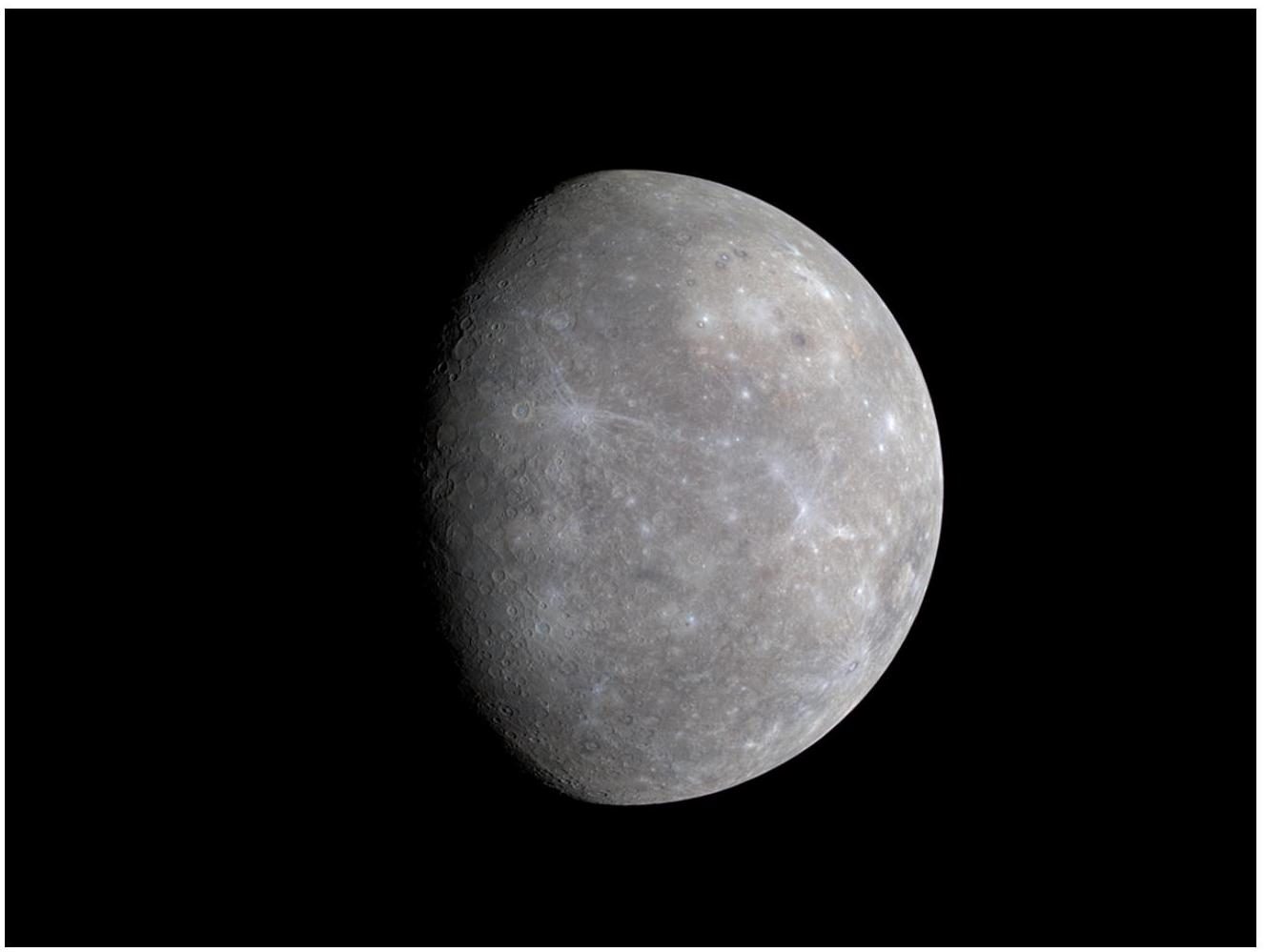
Mercury is the innermost of the Solar System's planets and so is most influenced by gravitational interactions with the Sun, tying its rotational period to its orbital period in a similar way to the tidal locking between the Moon and the Earth. It orbits the Sun in a $3:2$ resonance, meaning that it rotates on its axis three times for every two orbits of the Sun.

figure
Figure 1: True colour image of Mercury taken by the probe MESSENGER after its closest approach in 2008. Credit: NASA/Johns Hopkins University Applied Physics Laboratory/Carnegie.

Mercury has an orbital period of 88 Earth days and a radius of 2440 km, and spins in the same direction as it orbits (both are anti-clockwise as viewed from high above the Sun).

(a) Thinking carefully about the geometry of the situation, calculate the length of a solar day as observed on Mercury (i.e. the length of time from one noon to the next). Hint: you should find it is longer than a Mercurian year.

(b) Hence calculate the speed an astronaut would need to move at whilst travelling along its equator in order to keep the Sun in the same position in the sky. Assume Mercury has no axial tilt, and give your answer in $\mathrm{km~h^{-1}}$.

Show answer · 显示答案
Final answers · 最终答案
  • (a)$T_{\mathrm{solar}} = 176 \text{ Earth days}$
  • (b)$v \approx 3.6 \text{ km h}^{-1}$

Full worked solutions: BAAO Astro Challenge: Complete Solutions (book)

2020 Q102020Section A · Multiple choiceCelestial Mechanics and Orbits · Elliptical capture orbit at Mars

The Hope probe reached Mars in February 2021 and entered an elliptical capture orbit (closest approach 1000 km, furthest 49400 km). Given Mars has mass $6.39 \times 10^{23}$ kg and radius 3390 km, what is the orbital period?
A. 37.3 hours
B. 40.9 hours
C. 105 hours
D. 116 hours

Show answer · 显示答案
Answer · 答案
B

Full worked solutions: BAAO Astro Challenge: Complete Solutions (book)

2021 Q92021Section A · Multiple choiceCelestial Mechanics and Orbits · Comet speed around an eccentric orbit

A comet orbits the Sun with a period of 172 years and eccentricity 0.94. It is currently at a distance of 60 au away from the Sun. After which of these times will the comet be moving the fastest?
A. 43 years
B. 86 years
C. 129 years
D. 172 years

Show answer · 显示答案
Answer · 答案
B

Full worked solutions: BAAO Astro Challenge: Complete Solutions (book)

2021 Q102021Section A · Multiple choiceCelestial Mechanics and Orbits · Synodic period and orbital radius

In the rotating reference frame where the Earth is stationary, an asteroid orbits the Sun in 3.5 years. What is the distance between the asteroid and the Sun?
A. 1.25 au
B. 2.08 au
C. 3.95 au
D. 6.54 au

Show answer · 显示答案
Answer · 答案
A

Full worked solutions: BAAO Astro Challenge: Complete Solutions (book)

2022 Q82022Section A · Multiple choiceCelestial Mechanics and Orbits · CAPSTONE's near-rectilinear halo orbit

The cubesat CAPSTONE will enter a near-rectilinear halo orbit (NRHO) of the Moon on $13^{\mathrm{th}}$ November 2022. It is a polar orbit, going from 1500 km above the North pole to 70000 km above the South pole. Treating it as an ellipse, what is the eccentricity of the orbit? The Moon has a radius of 1740 km.
A. 0.83
B. 0.88
C. 0.91
D. 0.96

Show answer · 显示答案
Answer · 答案
C

Full worked solutions: BAAO Astro Challenge: Complete Solutions (book)

2022 Q92022Section A · Multiple choiceCelestial Mechanics and Orbits · Synodic period and orbital speed of an asteroid

An asteroid in a circular orbit around the Sun is at its closest to Earth every 300 days. What is its orbital speed? Assume the Earth's orbit is also circular and that both orbit in the same direction.
A. $21$ km s$^{-1}$
B. $28$ km s$^{-1}$
C. $32$ km s$^{-1}$
D. $39$ km s$^{-1}$

Show answer · 显示答案
Answer · 答案
D

Full worked solutions: BAAO Astro Challenge: Complete Solutions (book)

2022 Q112022Section B · Short answerCelestial Mechanics and Orbits · Shepherd moon of Neptune's rings
Shepherd Moon of Neptune

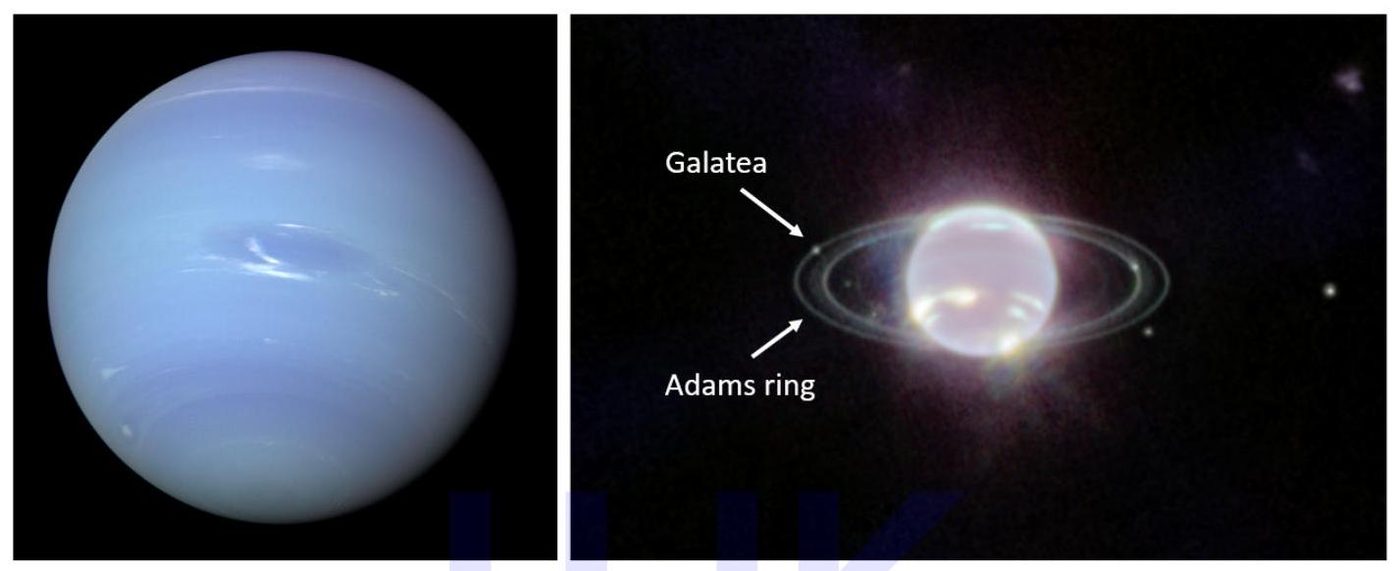
Although Saturn is famous for its rings, all of the gas giants in the Solar System have ring systems. The outer ring of Neptune is known as the Adams ring and is very thin. Normally such a thin structure would widen over time so there needs to be a process keeping it constrained. One hypothesis is that the Neptunian moon Galatea, with an orbit just slightly smaller than the ring, acts as a `shepherd moon' by having a $42:43$ orbital resonance with particles in the ring, in terms of the period of their orbits. The ring and the moon are shown in Figure 1.

figure
Figure 1: Left: Neptune as seen by the Voyager 2 mission in August 1989, a few days before its flyby. Right: Neptune and its ring system as imaged in the infrared by the NIRCam instrument on the James Webb Space Telescope in July 2022. Multiple moons and rings are visible, with Galatea and the Adams ring labelled.

The semi-major axis of Galatea is 61953 km. Assume the moon and the ring particles travel in circular orbits.

(a) Calculate the semi-major axis of a particle in the centre of the ring.

(b) Measurements of the amplitude of ripples in the ring caused by gravitational attraction towards the moon indicate the ring particles closest to the moon have a radial acceleration of $0.15$ mm s$^{-2}$ m$^{-1}$. Estimate the mass of the moon.

Show answer · 显示答案
Final answers · 最终答案
  • (a)$a_{\mathrm{ring}} \approx 62{,}933 \text{ km}$
  • (b)$M \approx 2.16 \times 10^{18} \text{ kg}$

Full worked solutions: BAAO Astro Challenge: Complete Solutions (book)

2022 Q132022Section C · Long answerCelestial Mechanics and Orbits · ISS transit across the Sun
Transit by the ISS

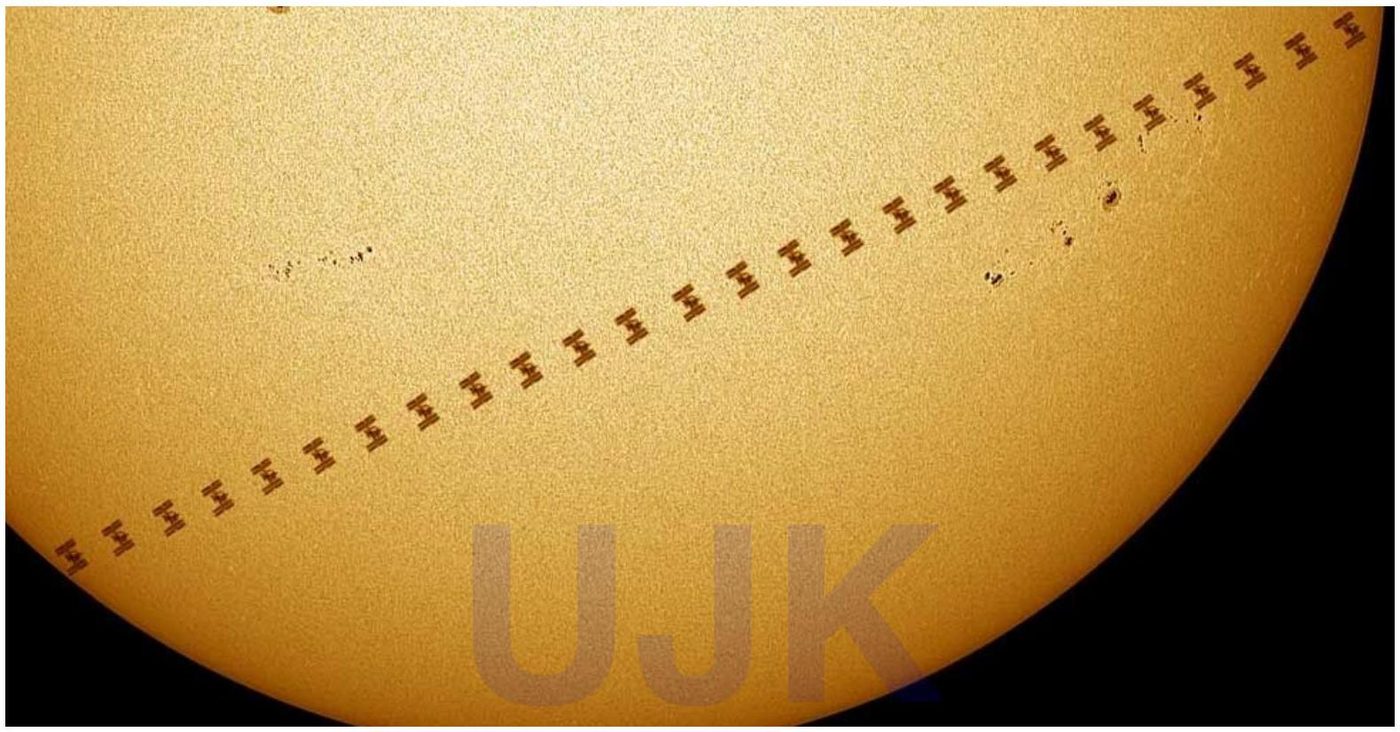
Figure 4 below is a composite image which depicts a transit of the International Space Station (ISS) across the disc of the Sun. The image comprises 26 individual photographs which were taken at regular time intervals during the transit. The total duration of the transit was less than one second. In this question we will ignore any effects caused by the rotation of the Earth.

figure
Figure 4: A composite of a selection of the frames taken with a high-speed camera of a transit of the ISS in front of the Sun, taken from Northamptonshire at 10:22 BST on $17^{\mathrm{th}}$ June 2022. Credit: Jamie Cooper Photography.

(a) During the transit, the angular diameter of the Sun as viewed from the position of the camera was $31'29''$. Use the image to calculate the angle $\theta_1$ subtended by the ISS between the first and last photographs, as viewed from the position of the camera. [You are given that $1^{\circ} = 60' = 3600''$.]

(b) The ISS maintained a mean height of 415 km above the surface of the Earth during the transit. What is the angle $\theta_2$ subtended by the ISS between the first and last photographs, as viewed from the centre of the Earth? [Assume that the Sun was at the zenith (directly overhead) during the transit.]

(c) The orbital period of the ISS is approximately 93 min. Estimate the frame rate of the camera used to photograph the transit.

Show answer · 显示答案
Final answers · 最终答案
  • (a)$\theta_1 \approx 27'05''$
  • (b)$\theta_2 \approx 1'40''$
  • (c)$f \approx 58\ \text{fps}$

Full worked solutions: BAAO Astro Challenge: Complete Solutions (book)

2023 Q22023Section A · Multiple choiceCelestial Mechanics and Orbits · Kepler's third law in terms of speed

In a given system, for all circular orbits of period $T$ and orbital speed $v$, which of the following quantities is the same for each orbit?
A. $Tv$
B. $Tv^{3/2}$
C. $Tv^2$
D. $Tv^3$

Show answer · 显示答案
Answer · 答案
D

Full worked solutions: BAAO Astro Challenge: Complete Solutions (book)

2023 Q112023Section B · Short answerCelestial Mechanics and Orbits · SpinLaunch centripetal acceleration and launch speed
SpinLaunch

SpinLaunch is an engineering project that aims to build a new type of rocket launching system that will allow satellites up to 200 kg to be put into orbit far more cost effectively than with current chemical fuel rockets. The payload is accelerated in a 45 m radius circle, using an electric motor system in a vacuum chamber, until it reaches about 1/5th escape velocity and is released, firing its onboard rocket once it reaches 60 km altitude to accelerate it further and ending up in orbit.

figure
a. Show that the satellites launched in the orbital launcher must be able to endure centripetal accelerations of up to $\sim 10^4$ g. b. Calculate the minimum number of revolutions per second required to release the rocket.
Show answer · 显示答案
Final answers · 最终答案
  • (a)$a \sim 10^4\,g$
  • (b)$f \approx 7.9\,\mathrm{rev\,s^{-1}}$

Full worked solutions: BAAO Astro Challenge: Complete Solutions (book)

2023 Q122023Section B · Short answerCelestial Mechanics and Orbits · Super Blue Moon: perigee and apparent size
Super Blue Moon

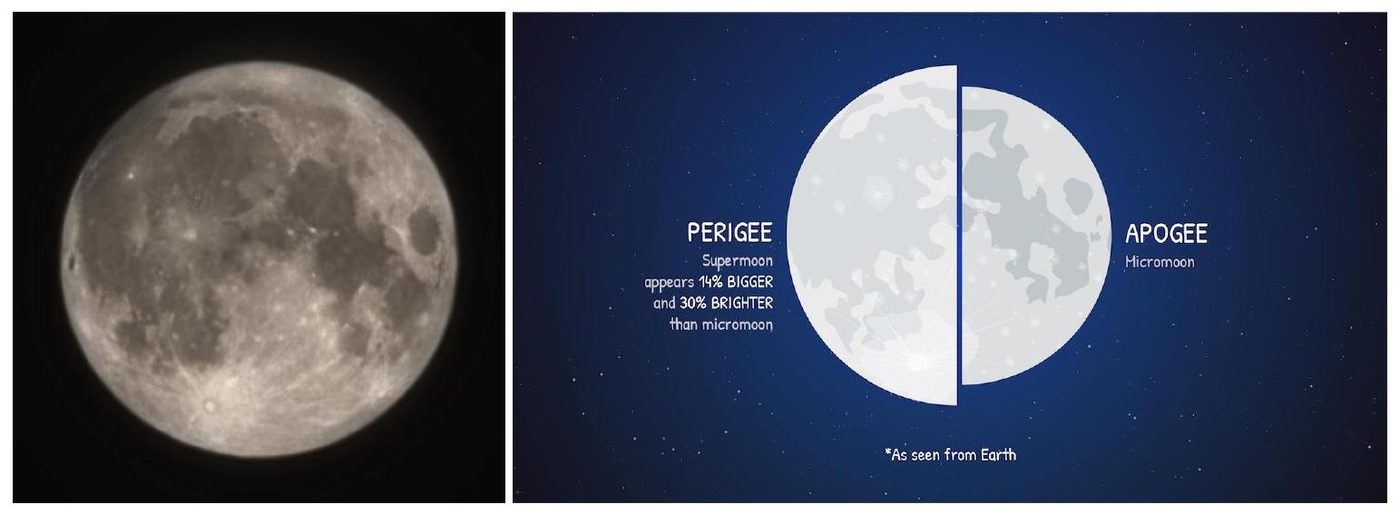
On the evening of $30^{\mathrm{th}}$ August 2023, the UK experienced a 'Blue Moon', which refers (in the modern definition) to the second full moon in a calendar month. It was also around the time of perigee and so is considered a 'supermoon' as it appears larger than normal, so was overall a 'super blue moon'.

figure

There is no formal definition of how close a full moon needs to be to the perigee to count as a supermoon, but by most definitions $\sim 25\%$ of all full moons are supermoons. Considering a supermoon that happens exactly at perigee then, relative to one that happens exactly at apogee (known as a 'micromoon'), the angular diameter of the supermoon is $14.1\%$ larger than the micromoon.

(a) Given the time between full moons is 29.53 days, how long (on average) would we have to wait for the next super blue moon? [Hint: Consider that during a year with a blue moon there will have been a total of 13 full moons in those 365 days.]

(b) Based upon the difference in angular diameter of a supermoon and micromoon, what does this suggest for the eccentricity of the Moon's orbit?

Show answer · 显示答案
Final answers · 最终答案
  • (a)$t_{\mathrm{super\,blue}} = 11.1\,\mathrm{years}$
  • (b)$e = 0.0659$

Full worked solutions: BAAO Astro Challenge: Complete Solutions (book)

2024 Q22024Section A · Multiple choiceCelestial Mechanics and Orbits · Half-Moon geometry and the Sun-Earth-Moon angle

If the Moon appears to be exactly half illuminated by the Sun, what is the Sun-Earth-Moon angle, assuming the Earth and Moon travel in circular orbits? The (centre-to-centre) average distance between the Earth and the Moon is 384400 km.
A. $87^{\circ}$
B. $89.85^{\circ}$
C. $90.00^{\circ}$
D. $90.15^{\circ}$

Show answer · 显示答案
Answer · 答案
B

Full worked solutions: BAAO Astro Challenge: Complete Solutions (book)