写在前面
不可盲目地一头扎进一项研究中去,必须要设定计划。接下来从全局出发每次完成一个步骤。从大处着眼将整个研究过程设立成多个小目标,以便一次攻克一个。
最好的研究是以一个你想要回答的问题来开启的。但是接下来你必须要想象评委会问些什么问题:如果你不予回答会怎样?而你又为什么要关注这些问题?
从一开始就要每天做笔记,不仅仅是对所用资料加以记载,而且要清楚记下如何看待这些原始资料。同时也要记录下你的思想的形成轨迹,从而使这些思想能离开你的大脑来到冷静的日光之下,这时你可以进一步看看这些思想是否还有意义。你不会在调查报告的终稿中用到这一阶段的东西,但是这一部分的写作是必要的准备。
不管你如何认真地做研究,评委对你的评价都只是通过你的研究报告,所以你必须知道一份表述清晰的得到认可的研究报告应该包含什么。
学术论文阅读方法
基础阅读方法
1. 文献搜索 通常情况下,绝大部分的英文文献都可以通过Google Scholar进行,在丘成桐的比赛中,我们强烈推荐学生进行全英文的科研学习,如果有文献涉及版权问题,可以询问学校是否可以提供帮助。除非情不得已,不推荐使用Sci-Hub.
对于中文文献而言,可以查询知网,百度学术等相关搜索平台。
2. 评估文献的相关性和可靠性
书籍:
一旦你认定了一本书可能与你的研究主题相关,请按照下面的步骤有序进行浏览:
A. 如果它的索引引出了与你的问题和答案相关的关键词,快速浏览那些出现了这些关键词的页面。
B. 快速浏览它的引言部分,特别是这部分的最后一页,作者通常会给出全文的概要。
C. 浏览最后一章,特别是前六七页和最后六七页。
D. 如果你有时间,以同样的方式阅读看起来相关的章节,特别是那些在索引里列出了许多你需要的关键词的章节。
E. 如果这个文献是个论文集,看看编者的介绍部分。
期刊:
如果你的资料是篇期刊文章,要以如下所示来做:
A. 阅读摘要。
B. 浏览引言的最后两三段(或者其他类型的开篇部分),将任何称之为“结论”的部分看完。
C. 如果该文没有独立出来的引言和结论,浏览它的前几段和最后几段。
D. 如果有次标题,需要看一下次标题的内容,思考全文的结构,看看每个次标题下的第一段或前两段。
E. 阅读文章中的图和表
3. 总结记录参考文献信息 评估完成后,如果该资料确认与科研内容相关,则需要将文献入库并记录相应信息。通常,文献信息会以下面的格式出现,在对有关的信息进行收集整理时,推荐使用Endnote,Mendeley类似的文献管理软件。
作者;编辑;译者;识别文献的信息;标题和副标题、包含该文献的更大的一个文献的标题和副标题(例如选集、期刊或报纸);页码,如果该文献出现在一个更大的文献里;卷号;刊号;版次;对于网上资源,提供URL(全球资源定位器)和搜索日期;出版人和出版时间;出版人的名字;出版地;出版日期。
与文献交互
在阅读文献的过程中,需要始终带着问题和思考才能更好的理解文献的内容。下面我们来看一下文章每一部分,需要心存哪些问题。
前言:他们要做什么(What They Do, WTD )。作者声称要在论文/书中做什么;在阅读前言时需要提炼出作者在文本中提出的主要问题。
文献综述:现有文献综述 (Summary of Previous Literature,SPL)情况,具体指的是 前人研究结果的简要综述。该过程要求大量的提炼工作,要理解复杂的观点并把它们浓缩为几段话或几句话,优秀的作者甚至能将其浓缩为一句话。
文献综述:现有文献批评 (Critique of Previous Literature,CPL), 作者评论先行学者著述的学术文献并指出其局限。CPL与POC,GAP以及SPL都有概念联系,因为已有文献在理论、方法论和分析工具方面的不足正是目前研究的必要性之所在。CPL常常会紧随SPL,因为作者首先要提供一些思想作为靶子才能进行批评。
文献综述:空白(GAP),作者指出现有文献中缺失的成分。如果GAP和CPL得以恰当操作,那么读者就应该能够在作者明示之前就预测出RAT。
文献综述:理论依据(Rationale,RAT),作者在此处提出依据,证明其研究是必要的,有理由的。给出现有文献的CPL和 GAP后,应该顺利成章地、逻辑清晰地在其后推导出RAT。
研究结果/讨论:研究结果(Results of Findings,ROF), 描述该文的主要研究结果。该密码常常先后出现在摘要、研究结果和结论部分,因为在大多数社会科学期刊中,要求对这一点反复强调至少三次。
讨论:与现有文献观点一致的研究发现 (Results Consistent with Literature,RCL), 描述该文和现有文献观点一致的研究发现。也就是说,作者自己的研究工作支持其他人已经做出的研究工作。
讨论:与现有文献观点相反的研究发现 (Results to The Contrary,RTC), 描述该文和现有文献观点不一致的研究发现。也就是说,作者自己的研究工作并不支持其他人已经做出的研究工作。
结论:他们做了什么(What They Did,WTDD), 作者在文章/书中做了什么;这是由WTD顺理成章导出的姊妹问题。这一密码提炼出了作者在文本中已经回答的主要研究问题,作者正是借此对该主题的相关文献作出自己的贡献。
结论:对未来研究的建议 (Recommendations for Future Works,RFW), 目前的研究工作还不完善;作者针对目前文献仍存的研究空白(GAP)提出路线图,借此对其他研究者的未来研究提出建议。
整体:批评点(Point of Critique,POC),现有文章或文献中的一个缺陷,可供你(学生作者)批评,并在未来论文中针对其加以弥补。
整体:明显的遗漏点 (Missed Obvious Point,MOP),你所阅读的文献的作者明显忽视了与先前文献的理论、概念或分析方法上的某一联系。(MOP常常是由于文章作者文献阅读不充分或不全面所致。)
整体:待探讨的相关问题 (Relevant Point to Pursue,RPP), 有待另文探讨。尽管这一部分未能指出现有文献的任何局限性或空白点,但该点提出后可以成为未来文章的POC。很明显,RPP的出现意味着相应的MOP和GAP的存在。
整体:能否(Will,WIL), 能否将这一理论或概念联系加以逻辑梳理,以得出相应结论,来化解文章中随处可见的矛盾和待解决问题?
学术论文写作方法
学术论文格式及相关要求
这里,我们以《清华大学学报(自然科学版)》为例进行说明。
1 文稿的篇幅、构成、首页注释、层次标题
文稿的内容应包括:文题、作者姓名、作者单位、摘要、关键词、分类号(英文稿不需要)、首页注释、正文、(致谢、)参考文献、及英文部分。 首页地脚注释按以下格式。
文稿的层次标题采用阿拉伯数字分级编码。例如,一级标题使用1、2、3、……;二级标题使用1.1、1.2、1.3、……。层次标题以下,还可使用1)、2)、3)、……。再以下,使用a)、b)、c) 、……。文稿的引言部分不写编号和标题。
图片、表格、引文、公式、定理等的序号,均要按其在正文中被引用的顺序,全文统一用阿拉伯数字顺序编码。例如:图1、表2、文[3]、式(4)、定理5。
2 文题、作者姓名、作者机构、摘要、关键词和中图分类号
中文文题一般不超过20字。
作者姓名按署名顺序排列。各作者之间以“,”分隔。
作者机构应写正式全称,不用简称,后加城市名、邮政编码及国名。多个机构的情况下,机构名称之前加编号,同时作者姓名右上角加相应编号。不同机构之间以“;”分隔。
中文摘要不少于200汉字。其中的缩略语应说明后再使用。中文摘要应包括4个层次:研究目的、研究方法、研究结果和研究结论。
中文摘要独立成篇,不分段,意义完整;信息具体:使用科学性文字和具体数据,不使用文学性修饰词;不使用图、表、参考文献、复杂的公式和复杂的化学式。
关键词应有3 8个关键词。第一个关键词与分类号对应。不同关键词之间用“;”分隔。缩略语应先写中文全称。
中图分类号应按《中国图书馆分类法》查找。
3 英文部分(置于文末,通栏排)
英文文题的内容与中文标题相应。其长度一般不超过100个字符。第一个词不用冠词。除第一字母及专有名词应大写以外,一律小写。
作者姓名 其内容和顺序均与中文相同。中国作者姓名应按汉语拼音:例如:WANG Dazhong。
作者机构的英文 应写正式全称,不用缩写。
英文摘要不少于100个英文单词,缩略语应加以说明。
英文摘要的文字要求:
1) 第一句话不应与文题重复; 2) 尽量使用简单句; 3) 尽量使动词靠近主语;4) 不用第一人称作主语;5) 以重要的事实开头,而不以辅助从句开头;6) 在有动作主体的情况下,使用主动语态。
英文关键词的内容、数量和顺序,均应与中文关键词相应。缩略语应先写全称再写简称。除专有名词大写以外,一律小写。
4 量名称、量符号与量单位
文稿作者应当严格执行国家标准,正确地使用量的名称、量的符号与量单位的符号。文中所用量符号,应在首次出现时加以定义。同一个量的符号,应全文统一。
量的符号、一般函数及其变数等,一般用单个斜体拉丁字母或希腊字母表示。量符号可带有角标或带有括弧中的说明。量的数值与量的单位符号之间, 留一英文空格。如“10毫米”应为“10 mm”。
5 数字和字符的正体和斜体
单一字母量的符号、变量符号、从量的符号转化的角标、一般函数符号等使用斜体。多个字母组成的量的符号:除特征量使用斜体以外,一般使用正体。
矢量(向量)、矩阵、张量的符号使用黑斜体。使用正体的情况有:国际标准单位(SI)词头和量单位、从文字转化的角标、阿拉伯数字、叙述性文字、化学元素符号、缩略语、仪器的规格型号、自然对数的底 e、圆周率 、复数的虚部 i 或 j、矩阵转置号T、微分号d、偏微分号 、连加号、对数号(lg、ln、lb)、及sin、tan、lim、min、max等。
6 数值的表示和有效位数
数值用阿拉伯数字表示。合理地选取数值的有效位数。合理地使用SI词头或10的幂,使数值范围在0.100 999之间。
数值中从小数点算起,向左或向右,每3位空一英文空格。如 “= 3.141 592 6”。
7 插 图
插图应当清晰,有自明性。插图一般不超过6幅。幅面一般为 hw = 50 mm70 mm。
插图应随文给出,先见文字,后见插图,即放在引用该插图的文字自然段之后。
图注的字体:汉字用宋体;英文和数字用Times New Roman。图注的字号统一用8磅(point,p)。图线应做到主、辅线分明:轮廓线、框线、曲线用粗线(0.8 p,或0.3 mm);尺寸线、指引线、坐标轴用细线(0.4 p,或0.15 mm)。
函数图的标目中,应使用量的符号与该量单位的符号之比,例如“p / MPa” ;标值应圆整:即宜为2、5的整倍数;标线(刻度)、标值的数目:3 7个;标线(刻度)朝向图内。
应当以比例尺来表示地图或显微图的尺度放大或缩小。
8 表 格
表格在文中的位置:应随文给出,先见文字,后见表格。单栏内的表格,其宽度限25汉字(或48字符)。表示量值的表格宜用“三线表”。三线表的第一行作为表头。表头中,使用量符号与该量单位符号之比,如“”。
9 参考文献的要求
9.1 参考文献表的著录原则
1) 本刊所发表科技论文必须列出参考文献表,以便向读者提供有关信息的详细出处,提供论文论点的科学依据,反映科学技术的继承与发展的传承关系,表示作者的严肃科学态度,尊重研究人员(不仅包括其他研究人员,也可以包括该文作者)的前期研究成果。
2) 所引用文献必须是作者本人直接阅读过的、正式出版的、最主要的、最新鲜的相关文献。不能公开的内部资料、个人通讯、报纸及未公开发表(包括录用待发表)的文章不能作为参考文献。
9.2 参考文献著录表的一般要求
1) 参考文献表应放在文后。
2) 本刊采用顺序编码制,即按参考文献在正文中被引用的顺序进行编码,并在正文中指明其标引处。同一处引用多篇文献时,只须将各篇文献的序号在方括号内全部列出,各序号间用“,”。如遇连续序号,可标注起讫序号。
示例:李刚[4,6]提出Petrowski对稳定区的节理格式的研究[7,10-12]
3) 研究型论文的参考文献,一般不得少于12条。
4) 对中文的参考文献,在中文参考文献之后需要附加英文译文。文献译文与文献原文共用一个引文编号,并在译文之后加注“(in Chinese)”。
9.3 作者人名的表示方法
1) 作者人数不超过 3 人的,全体作者姓名都写;作者人数超过 3 人的,前3人的姓名都写,余者不写,后面加“,等”或“, et al”。人名之间用“, ”分隔,不用“和”或“and”。
2) 不论中国和外国作者,姓名一律“姓在前,名在后”。
3) 外国作者姓名中,姓全大写,名缩写,但是缩写后不加缩写点。
4) 拼音写法书写的中国作者姓名中,姓全大写,名缩写,取每个汉字拼音的首字母。
例如对于作者“Albert Einstein”和“王大中”,应分别写为“EINSTEIN A”和“WANG D Z”。
5) 外国作者的中译名只著录其姓;一篇文献有同姓不同名的外国作者,则其中译名不仅要著录其姓,还需要著录其名的首字母。
例如对于“UNWIN S”,中文是“昂温”;对“UNWIN S, UNWIN G”,中文是“昂温 S, 昂温 G”。
9.4 文题的表示方法
英文文题首字母大写,其他一律小写(专有名词除外)。
9.5 版本的表示方法
版次通常采用阿拉伯数字序号的形式,如第3版对应的中文是“3版”,英文是“3rd ed”;描述性的版次也应采取缩写的形式(如“New revised edition”缩写为“New rev ed”)。第1版无须标注。
9.6 出版地的表示方法
出版地采用所在地城市名来表示,对同名异地或不为人们熟悉的城市名,宜在城市名后附省、州名或国名等限定词。
9.7 日期的表示方法
日期采用“YYYY-MM-DD”的方式来表示。
9.8 其他注意事项
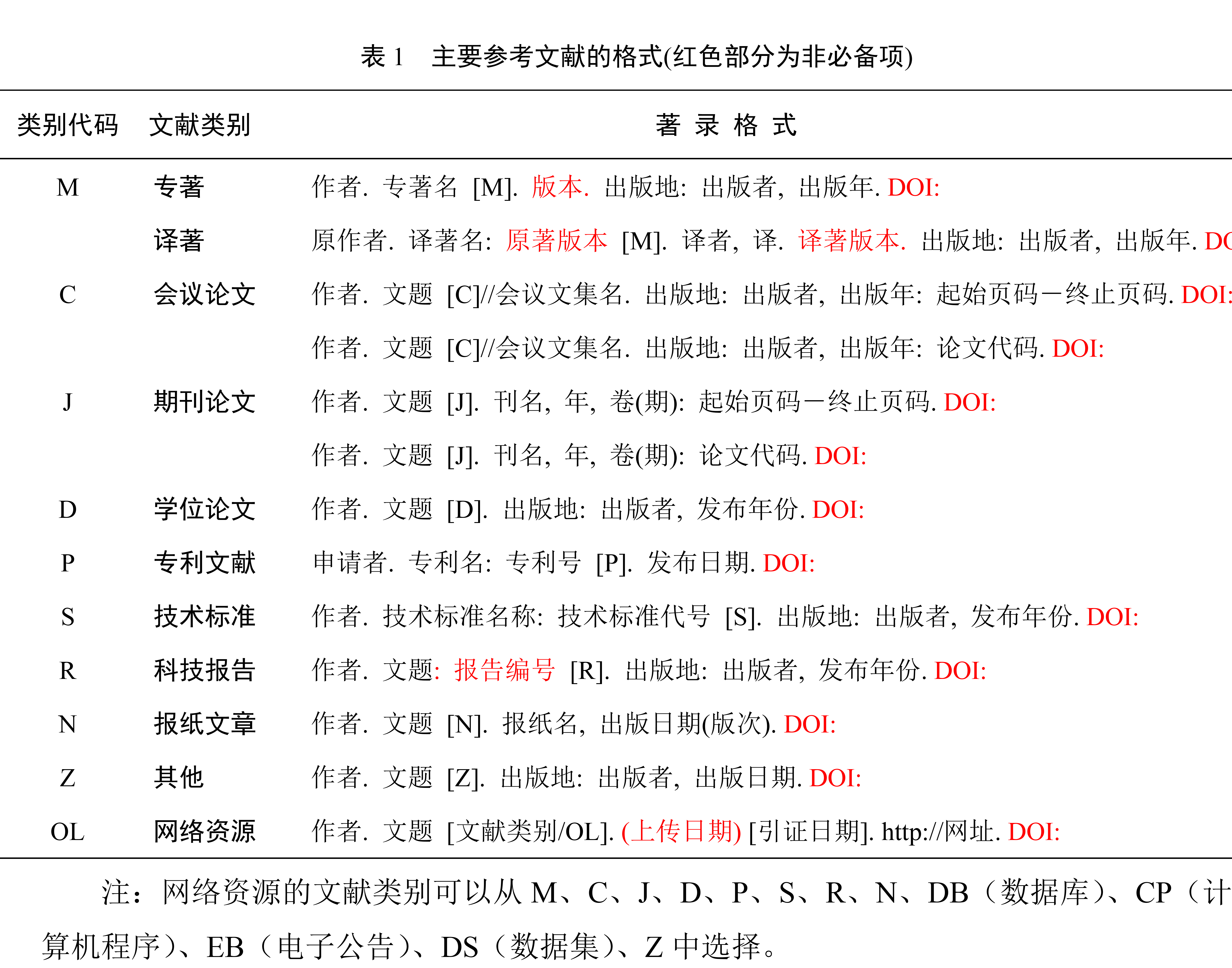
会议文集名和刊名的英文应用全称,不使用缩写,如“清华大学学报(自然科学版)”英文应写为“Journal of Tsinghua University (Science and Technology)”;起始页码中如果出现转页,可以用“起始页码-终止页码, 转页页码”来表示,如“211-215,219”;参考文献中标点符号全部采用英文标点符号。
参考文献必须依照类别格式提供完整的引用信息,不可缺项,否则将视为不可靠文献而被拒绝引用或要求更换。如有不确定的著录项目,请参考国家标准《信息与文献 参考文献著录规则(GB/T7714-2015)》中的参考文献著录格式。

学术论文写作建议
1. 设计初稿
I. 草拟一个可行的介绍部分
简要概述你阅读过且与你的主题具体相关的研究。
如果有知识上的缺漏或理解上的障碍,重述你的研究问题。
II. 确定统一论文和区分各部分的主要术语及其概念
在草稿纸圈出4-5个词语表达你需要表达的最重要的概念,你应该在对研究主张的最精确表述中用到这些词语。这时需要忽略明显与你的题目不相关的词,并聚焦那些你进行论证并想要继续拓展的概念。
针对每一个概念,选一个关键术语,让它在论文的主体部分重复出现。你可以用相同的步骤找到统一每个章节的关键术语。在列出论证理由的每一页上,从论证理由中圈出重要词语。有些词语应该与引言和结论中圈出的词语相关联。剩下的词语应该能用以辨别这些概念,区分该章节与其他章节。为每一个关键概念选出一个关键术语。
III. 用关键术语创立小标题,独特呈现每一章节
即使你的领域内的研究报告不适用小标题,我们也推荐你在草稿中使用它们。用你确定出的关键术语来创设小标题。如果你不能找到关键术语来区分一个章节,要仔细考虑一下你如何看待该章节对整个论文的贡献,读者有可能认为它是重复性的或与主题不相关的。
如果你的领域不用小标题,那就用小标题来保证自己不偏离研究方向,然后在终稿里删去它们。
IV. 整理论证理由
当你不确定如何才能合理地安排论证的顺序时,考虑一下下面这些建议:
比较和对比。如果你正在比较两个实体、概念或者物体,可以采用这个形式。 有两种方法来比较和对比,相比较两者之中,一个通常比另一个更好。例如,你正在比较A与B相比是否具有更多XX意义,你可以在前半部分篇幅写A,后半部分写B。然而这种组织架构通常导致前后两部分文字成为一对不相关的情况的介绍。因此要尝试将题目分解成以不同概念为主题的章节。在面具这个例子里,这些概念可以是面具的象征意义、设计特点、演化阶段等。 还有其他几种常用方法可用以理顺你的论证思路。有两个是专注于主题的:
按时间顺序。最简单的就是先后顺序或者因果顺序。
逐项论证。如果你把题目拆分为不同的构成部分,你可以逐项对它们进行探讨,但是你仍然必须将这些部分按某个方式组织好以便于读者理解。
你还可以按读者的理解方式去组织这些部分:
由短到长,由简到繁。大多数读者倾向于先处理不太复杂的话题,然后再进入更复杂一些的话题。
从熟悉到不熟悉。大多数读者会愿意先读他们有所了解的知识,然后再读他们不太了解的。
从不太有争议的到有争议的。大多数读者与从他们意见相和的观点逐渐移步到与他们意见相左的观点,会觉得更容易接受一点。
从不太重要的到更重要的(反之亦然)。读者倾向于首先阅读更重要的论辩理由,但是这些理由如果稍晚些出现也许有更大的冲击力。
先期的理解可以作为后期理解的基础。读者可能需要先了解一些事件、原理、概念等,才能更好地理解另一件事物。
V. 用转接词让次序清晰
要确定你的读者能看出你选择的是怎样的写作次序,在故事板里每个理由的起始页上用上一些词语让你的排序方法一目了然:首先、其次、然后、最后、更重要的、一个更复杂的问题是……因此。
VI. 拟出每一章节的证据、理论依据及小结
在相关章节里,概述你的论证,许多部分自成论点,但仍需要有更多小的论证来给予支持。
证据:大多数章节主要包含了支持论证的证据。在阐述论证理由之后将证据进行概述。如果你有不同类的证据支持一个论证,将它们分组并整理,让读者能看明白。
对证据进行阐释:你可能必须阐释证据—它来自哪里、为什么可靠、它如何能支持论证。通常这样的解释就跟在证据之后,但是你也可以事先对它们进行概述,如果那样看起来更合乎逻辑的话。
对以往研究进行确认和回应:想象一下读者可能反对什么,在什么地方反对,简单做一个回应。这个回应通常是带有至少一个诉求和一些论证理由的论辩,一般包括论据,甚至包括针对自己的首次回应而假想的反驳意见再次进行的回应。
理论依据:如果你需要一个理论依据来证明一个论辩理由的相关性,那就要在陈述该论辩理由之前将它展现出来。(如果你使用理论依据只是为了其强化作用,那就将之放在论辩理由之后。)如果你认为读者会质问理论依据的真实性,拟一个小论辩来支持它的真实性。如果读者可能会认为你的理由和诉求不是理论依据的有效例子,你要用一个论辩证明它是。
总结:如果你的论文有20页或更长,你要在每一个主要章节末尾简要总结一下你的论辩过程。特别是当你的报告在日期、人名、事件、数字方面的信息量很大的时候。大量事实接踵而至会使得论点模糊不清。这个章节里你确立的是什么?你的论点迄今为止是如何形成的?如果在终稿中,这些扼要总结看上去明白得一览无遗,那就删掉这些总结。
不同领域的作者安排这些要素的方式可能会稍有不同,但是各要素本身和它们的组织原则在每个领域和专业里都是相同的。不论什么领域,在研究报告中,关键是你要组织好自己的论辩,它不但要能反映你的思想,还要能帮助读者理解你的思想。
VII. 草拟研究报告的建议
用关键术语来确保研究方向
适当引证、改述和概述
将引证融入自己的文本
审慎使用脚注和尾注
提前阐释复杂或细节烦琐的论据
防范无意中的剽窃
标出所有文献原文,即使你注明了其来源
不要有太接近原文的改述
对于不属于自己的观点,援引其来源
不要借口无知、误解或其他所谓无辜意图
克服习惯性拖延和写作障碍
2. 用表格和图形呈现论据
I. 选择语言或图表方式呈现 除去常规的语言表达之外,图标对于一篇学术论文非常重用,下面我们来简单叙述一下需要图表时的场景。
要强调特定的数据值,就用纯数字表。
要强调对比效果,并能一目了然,就用直方图。
要强调趋势,就用线形图。
表格看上去要精确而直观。它重点呈现个体数据,可使读者推断其间的关系和趋势(除非你以导语来表述)。
图形和线状图着重于视觉形象,在传达数字时比表格要稍欠精确,但是它能更直观呈现图形含义。它们还具有以下差别:条形图着重于独立项之间的对照。线状图突出趋势,通常是随时间推移出现的趋势。
II. 设计表格和图形 在使用图表时,我们需要注意一下几点:
在文中用一句话介绍表格和图形,表述一下这些数据如何支持论点。这句话中可以包括任何一个你想要读者特别注意的数据(那个数据必须也出现在图表里)。
为每一个图形和表格做标注。描述出数据类型,如有可能,描述其重要关系。表格的标签为标题。图表名称和文字说明要简短,但要能充分描述数据的独特属性并可将图表一一区分。
把有利于读者理解数据是如何支持论点的信息放入图表中。例如,如果表格中的数字显示某个趋势,并且如果该变化的规模很重要,将这个变化加到最后一个纵列里。或者如果一个图形的某条线的变化对应的是图中未提及的某种影响,如图8.3所示,在图形中加入文字给予说明。
突出表格中你想要读者着重关注的部分,特别是表格导语中提到的数字或关系。
最后,我们需要注意图表应尽量简化,不要过多的放入无用的或者关联性差的信息。读者只想看到与你的论点相关联的信息,这些信息需要以不受干扰的方式呈现在图表里。
当制作图表时,我们对于不同的情形需要考虑不同的注意事项。
表格:含很多数据的表格看上去尤其密集,因此要让其内容保持尽可能的简单。
纵列与横列的安排要遵循一个原则,让读者能快速找到你想要他们看到的内容。不要选择自动按字母顺序。
取整数相关值。如果小于1000的差别不重要的话,那么标注2123499与2124886 的精确性是无意义的。
在纵列的底部和横列的最右边算出总数,不要在顶部和最左边。
不要同时使用水平线和竖直线来划分纵列和横列。如果你想要将读者的视线导入某个方向对比数据的话,或者表格不同寻常地复杂的话,可以用浅灰色线条。但是不要将浅灰色线条和阴影用在任何将来会被微缩拍摄的表格上,因为影印图像会模糊不清。
有很多行的表格中,每五行淡淡涂一次阴影。
不要在会被微缩拍摄的文件中使用小于9号的字体。太小的字体会难以辨认。
图形:图形的使用一般用来强调趋势(曲线图),或者比例关系(柱状/饼状图)。这里同时要保证图形的清晰易懂。
选择的变量要让曲线向着一个方向延伸,向上或向下,来支持你的观点。这里需要在图中清晰的呈现变化趋势。
保证在一张图中设计6条以下的曲线使得读者可以不受各曲线干扰,同时颜色需要保证色差较大,易于区分。
当依据很少的几个数值来创建一条曲线时,可以加入这几个值的具体数据点。
只有当图表很复杂,读者需要看到准确的数字时,才应使用网格线。
一定要在坐标轴上加入标注,单位与刻度,并保证清晰准确。
有些特别数字很重要,将其标注于条形、柱形或轴线的点上。
3. 修订草稿
I. 检查论证中的盲点
II. 检查引言、结论和论点
你的读者必须清晰快速地看到并认可三样东西:
你的引言在哪里结束。
你的结论从哪里开始。
这两者之一或两者中都陈述了你的研究主张的是哪些句子。
III.确保研究报告的主要部分是连贯的
哪些关键术语贯穿报告的所有章节。
每一章节和分段在哪里结束,下一部分从哪里开始。
每一章节如何与前一章节相衔接。
每个章节在整体报告中的作用。
每个章节和分段的哪句话表述了它的观点。
贯穿每个章节的有哪些特定的关键术语。
IV. 拟出最终的引言和结论 你的引言有三个目的。它应该做到以下几点:
将你的研究置于其他研究的背景下。
让读者理解为什么他们应该读你的报告。
给他们提供一个理解报告的阅读框架。
大多数引言部分占总篇幅的10%(在科学领域,它们通常要更短一些)。
你的结论也应该有三个目的。它应该做到以下几点:
给读者一个清晰的概念,你的主张是什么。
让读者理解它的重要性。
给未来的研究提出建议。
你的结论部分通常比引言部分要短。(在学术论文和博士论文中,引言和结论通常是单独的章节。)
V. 修订句子
避免太长的引导性分句和短语
主语要短而具体
主语和动词之间要避免插入超过一个或多个词语
将主要动作用动词表示而不用名词
将读者熟悉的信息放于句子的开头,新的信息放最后
按上述原则选择动词的主动或被动语态
适当使用第一人称代词
查重、降重、步骤及分析
1. 检测须知
检测报告中的总文字复制比,即为抄袭率。知网检测报告中标注为红色的表示文字复制部分,绿色文字表示引用部分,均算入总文字复制比,都是需要修改的。
如果您的总文字复制比低于规定的最低下限,那么恭喜你,不需要任何修改就可以提交了。如果超过了下限,那么也不要害怕,自行检测的好处就是可以提前拿到报告,然后根据报告中标明存在重复的文字进行修改,那么就可以有效降低重复率了。
报告里面含有系统认为重复的所有文字的标色,只要把重复的文字用适当的方法进行修改,都可以降低重复率。
2.如何有效降重
根据实战经验,修改论文,降低重复率是一件比较辛苦的工作。为什么呢?因为检测系统采用了模糊对比方法,也就是说,你把“蓝天上有一朵白云在飘”改成“白云在蓝天上飘”,同样会被系统检测出来。这就是所谓的抗干扰功能。所以要有效降低重复率是一件颇费脑筋的事情。虽然可以使用一些修改的技巧,但是在实际操作中,还是需要和系统斗智斗勇,难免耗费很多的脑细胞。在实际修改过程中,常常是修改一次,检测一次;再修改,再检测;再修改,再检测。
以下介绍一些降重方法:
改头换面:改词、换句、改变描述方式(变原句为倒装句、被动句、主动句等)、打乱段落顺序、删除关键词汇、关键句等。 改变句子的结构:比如,将:“弯变的月亮”改变成:“天上有个弯弯的像镰刀一样的月亮”。这样改后,可以有效降低重复率。 对于论述性的文字,如果觉得有必要保留,简单改变文字顺序,或者修改一两个字,是不会有效的。最好的办法就是用自己的话进行重写了,例子:“一日之计在于晨”改为“早上是一天中工作效率最高的时段”,改到这样的程度可以保证百分之百没有问题。如果简单的改成“一日之计在于早晨”,则不会有丝毫的用处。
翻译巧用:将外语或繁体资料转化成简体后,再用自己的语言和逻辑重新组织一下,这样做会一般来说显著降低文章的重合率。跨语言的论文检测系统还没有研发出来。广泛查阅外文资料,挑出可以为我所用的部分进行引用。
3. 修改例句展示
例句一:
标红抄袭段落:过热故障中的过热与变压器正常运行下的发热是有区别的,正常运行时的其发热源来自于绕组和铁芯,即铜损和铁损,而变压器过热故障是由于受到效热应力而造成的绝缘加速劣化,它具有中等水平的能量密度。
被标红,说明与相似文献存在重合和高度相似,经过以上方式结合,本句可改为:过热故障中出现的过热容易与变压器正常运行下的发热相混淆,后者是因为其绕组和铁芯会出现铜损和铁损的现象,这是正常运行过程中的发热,而变压器过热故障是受到有效热应力造成的绝缘加速劣化,具有中等水平的能力密度。
如此这般修改几乎可以降低抄袭率一半。
例句二:
标红抄袭段落:上世纪九十年代以来,在生产力提高、科技进步、跨国公司活跃等因素的共同驱动下,经济全球化席卷全球,世界经济越来越成为一个整体,跨国公司根据其战略部署在世界范围内对生产要素和资源进行优化配置和重新整合,这导致国际贸易和分工的方式悄然发生了变化,由传统的产业间分工模式逐步演化为同一产品不同工序和区段上的分工体系,即产品内分工。
论文更改为:从20世纪末以来,在新的科技革命及跨国公司迅速发展的带动下,全球经济日趋一体化,各国经济在世界范围内实现了竞争与协作相结合的良好共存局面。在全球范围内,各生产要素由于跨国公司的快速发展实现了优化配置和重新整合,从而使国际贸易和世界分工的方式产生了适应新时代要求的变化,传统的产业分工方式开始转变为因产品在工序和区段上的差异而进行的分工方式,这也就是我们所说的产品之中的分工。
A word before we begin
Do not plunge blindly into a piece of research; you must set a plan. From there, take a global view and complete one step at a time. Looking at the big picture, break the whole research process into several small goals so you can tackle them one by one.
The best research opens with a question you want to answer. But next you must imagine the questions the judges will ask: what happens if you fail to answer them? And why should you care about these questions in the first place?
From the very start, take notes every day — not merely recording the material you use, but also clearly noting how you regard those primary sources. Record, too, the trajectory by which your ideas form, so that those ideas can leave your head and come into the cool light of day, where you can look again at whether they still make sense. You will not use this stage's material in the final draft of your report, but writing it is necessary preparation.
However conscientiously you do your research, the judges assess you only through your research report, so you must know what a clearly stated, well-regarded research report should contain.
How to Read Academic Papers
Basic Reading Methods
1. Searching the literature. In general, the vast majority of English-language literature can be found through Google Scholar. In the Yau competition we strongly recommend that students do their research entirely in English; if a document raises copyright issues, you can ask whether the school can help. Unless absolutely necessary, we do not recommend using Sci-Hub.
For Chinese-language literature, you can search platforms such as CNKI and Baidu Scholar.
2. Assessing the relevance and reliability of a source.
Books:
Once you have decided that a book may be relevant to your research topic, browse it in the following ordered steps:
A. If its index turns up keywords related to your question and answer, quickly skim the pages on which those keywords appear.
B. Quickly skim the introduction, especially its last page, where the author usually gives a summary of the whole book.
C. Skim the last chapter, especially the first six or seven and the last six or seven pages.
D. If you have time, read the chapters that seem relevant in the same way, especially those whose index entries list many of the keywords you need.
E. If the source is an edited collection, look at the editor's introduction.
Journals:
If your source is a journal article, proceed as follows:
A. Read the abstract.
B. Skim the last two or three paragraphs of the introduction (or other kind of opening section), and read in full any part called the "conclusion."
C. If the article has no separate introduction and conclusion, skim its first and last few paragraphs.
D. If there are subheadings, look at their content, think about the structure of the whole article, and read the first paragraph or two under each subheading.
E. Read the figures and tables in the article.
3. Summarizing and recording reference information. Once the assessment is done, if the source is confirmed relevant to the research, you need to add it to your library and record the corresponding information. Reference information usually appears in the following format; for collecting and organizing it, we recommend reference-management software such as EndNote or Mendeley.
Author; editor; translator; information identifying the source; title and subtitle; the title and subtitle of any larger work containing the source (such as an anthology, journal, or newspaper); page numbers, if the source appears within a larger work; volume number; issue number; edition; for online resources, the URL (Uniform Resource Locator) and the date accessed; publisher and date of publication; the publisher's name; place of publication; date of publication.
Engaging with the Literature
While reading the literature, you must always carry questions and reflection in order to understand the content better. Let us look at each part of an article and at the questions you should keep in mind.
Introduction: What They Do (WTD). What the author claims to do in the paper/book; when reading the introduction, you need to distill the main question the author poses in the text.
Literature review — Summary of Previous Literature (SPL): a brief summary of earlier researchers' results. This requires a great deal of distillation: you must understand complex ideas and condense them into a few paragraphs or sentences — and the best authors can condense them into a single sentence.
Literature review — Critique of Previous Literature (CPL): the author critiques the scholarly literature of earlier scholars and points out its limitations. CPL is conceptually linked to POC, GAP, and SPL, because the inadequacies of existing literature in theory, methodology, and analytical tools are precisely what makes the present research necessary. CPL often follows SPL, since the author must first set up some ideas as a target before critiquing them.
Literature review — GAP: the author points out what is missing from the existing literature. If GAP and CPL are handled properly, the reader should be able to predict the RAT before the author states it explicitly.
Literature review — Rationale (RAT): here the author offers the grounds proving that their research is necessary and justified. Given the CPL and GAP of the existing literature, the RAT should follow smoothly and with clear logic.
Results/discussion — Results of Findings (ROF): describes the paper's main findings. This code often appears in the abstract, the results section, and the conclusion, because most social-science journals require it to be emphasized at least three times.
Discussion — Results Consistent with Literature (RCL): describes the paper's findings that agree with the existing literature. That is, the author's own work supports work others have already done.
Discussion — Results to the Contrary (RTC): describes the paper's findings that disagree with the existing literature. That is, the author's own work does not support work others have already done.
Conclusion — What They Did (WTDD): what the author did in the article/book; this is the sister question that follows naturally from WTD. This code distills the main research question the author has answered in the text, by which the author makes a contribution to the relevant literature on the topic.
Conclusion — Recommendations for Future Works (RFW): the present research is still incomplete; the author offers a roadmap addressing the gaps (GAP) that remain in the literature, thereby suggesting future research to others.
Overall — Point of Critique (POC): a flaw in the existing article or literature that you (the student author) can critique and remedy in a future paper.
Overall — Missed Obvious Point (MOP): the author of the work you are reading has clearly overlooked some theoretical, conceptual, or methodological connection to prior literature. (An MOP often results from the author's insufficient or incomplete reading of the literature.)
Overall — Relevant Point to Pursue (RPP): something to be explored in another paper. Although this point does not identify any limitation or gap in the existing literature, once raised it can become the POC of a future article. Clearly, the appearance of an RPP implies the existence of a corresponding MOP and GAP.
Overall — Will (WIL): can this theoretical or conceptual connection be logically organized to reach a corresponding conclusion that resolves the contradictions and unsolved problems found throughout the article?
How to Write an Academic Paper
Paper Format and Related Requirements
Here we use the Journal of Tsinghua University (Science and Technology) as an example.
1. Length, components, first-page notes, and section headings.
A manuscript's content should include: title, author names, author affiliations, abstract, keywords, classification number (not required for English-language manuscripts), first-page notes, main text, (acknowledgments,) references, and the English section. The first-page footnotes follow a set format.
Section headings use Arabic-numeral hierarchical coding. For example, first-level headings use 1, 2, 3, …; second-level headings use 1.1, 1.2, 1.3, …. Below the heading levels, one may also use 1), 2), 3), …, and below that, a), b), c), …. The introduction is given no number or heading.
The numbers of figures, tables, citations, formulas, theorems, and so on are all coded with Arabic numerals throughout the text in the order in which they are cited — for example, Figure 1, Table 2, reference [3], equation (4), Theorem 5.
2. Title, author names, affiliations, abstract, keywords, and CLC number.
The Chinese title should generally not exceed 20 characters.
Author names are listed in order of authorship, separated by commas.
Affiliations should give the full official name, not an abbreviation, followed by city, postal code, and country. With multiple affiliations, prefix each name with a number and add the corresponding superscript number after the author's name. Different affiliations are separated by a semicolon.
The Chinese abstract should be no fewer than 200 characters. Any abbreviations should be defined before use. The Chinese abstract should cover four levels: research purpose, research method, research results, and research conclusion.
The Chinese abstract should stand on its own, be unparagraphed, and be complete in meaning; its information should be concrete, using scientific language and specific data rather than literary embellishment; it should not use figures, tables, references, complex formulas, or complex chemical formulas.
There should be 3–8 keywords. The first keyword corresponds to the classification number. Keywords are separated by semicolons. Abbreviations should first be written out in full in Chinese.
The CLC number should be looked up in the Chinese Library Classification.
3. The English section (placed at the end, set full-width).
The English title corresponds in content to the Chinese title. Its length should generally not exceed 100 characters. The first word should not be an article. Apart from the first letter and proper nouns, everything is lowercase.
Author names: their content and order are the same as in the Chinese. Chinese author names should follow Hanyu Pinyin — for example, WANG Dazhong.
Affiliations in English should give the full official name, not an abbreviation.
The English abstract should be no fewer than 100 English words; abbreviations should be explained.
Requirements for the English abstract:
1) the first sentence should not repeat the title; 2) use simple sentences where possible; 3) keep verbs close to the subject; 4) do not use the first person as the subject; 5) open with an important fact, not a subordinate clause; 6) use the active voice when there is an agent for the action.
The content, number, and order of the English keywords should correspond to the Chinese keywords. Abbreviations should be written out in full before the short form. Apart from proper nouns, everything is lowercase.
4. Quantity names, symbols, and units.
Authors should strictly follow the national standards and correctly use the names of quantities, the symbols for quantities, and the symbols for units. Any quantity symbol used in the text should be defined on first appearance. The symbol for a given quantity should be uniform throughout.
Quantity symbols, general functions and their variables, and so on are generally represented by a single italic Latin or Greek letter. A quantity symbol may carry a subscript or a parenthetical note. A space (one English space) is left between the numerical value of a quantity and its unit symbol. For example, "10 毫米" should be "10 mm".
5. Roman vs. italic type for numbers and characters.
Single-letter quantity symbols, variable symbols, subscripts derived from quantity symbols, and general function symbols use italic type. Quantity symbols made up of several letters use Roman type, except that characteristic quantities use italic.
Vector, matrix, and tensor symbols use bold italic. Roman type is used for: SI prefixes and unit symbols, subscripts derived from words, Arabic numerals, descriptive text, chemical-element symbols, abbreviations, instrument specifications and model numbers, the base of natural logarithms e, the circumference ratio , the imaginary part of a complex number i or j, the matrix transpose mark T, the differential mark d, the partial-differential mark, the summation sign , the logarithm marks (lg, ln, lb), and sin, tan, lim, min, max, and so on.
6. Representation of numerical values and significant figures.
Numerical values are written in Arabic numerals. Choose the number of significant figures reasonably. Use SI prefixes or powers of 10 sensibly so that the numerical range lies between 0.100 and 999.
In a numerical value, starting from the decimal point and going left or right, leave one English space every three digits — for example, "= 3.141 592 6".
7. Figures.
Figures should be clear and self-explanatory. There should generally be no more than 6 figures. The size is generally hw = 50 mm70 mm.
Figures should be placed with the text — text first, then the figure — that is, after the paragraph that cites the figure.
Figure-caption fonts: Chinese in Song; English and numbers in Times New Roman. The caption font size is uniformly 8 point (p). Figure lines should distinguish main from auxiliary lines: outlines, frames, and curves use thick lines (0.8 p, or 0.3 mm); dimension lines, leader lines, and axes use thin lines (0.4 p, or 0.15 mm).
In the axis labels of a function graph, use the ratio of the quantity symbol to its unit symbol — for example, "p / MPa"; scale values should be rounded, ideally to integer multiples of 2 or 5; the number of tick marks and scale values should be 3–7; ticks point into the figure.
The scale (enlargement or reduction) of a map or micrograph should be shown with a scale bar.
8. Tables.
Position in the text: place tables with the text — text first, then the table. A table within a single column should be no wider than 25 Chinese characters (or 48 characters). Tables presenting quantitative values should use a "three-line table." The first row of a three-line table serves as the header. In the header, use the ratio of the quantity symbol to its unit symbol, as in "".
9. Requirements for references.
9.1 Principles for the reference list.
1) Every scientific paper published in this journal must list its references, in order to provide readers the detailed sources of relevant information, supply the scientific basis for the paper's arguments, reflect the inheritance and development of science and technology, express the author's serious scientific attitude, and respect the prior work of researchers (not only others but possibly the paper's own authors).
2) The references cited must be the most important and most recent relevant works that the author has personally read directly and that have been formally published. Non-public internal materials, personal communications, newspapers, and unpublished articles (including those accepted but not yet published) cannot serve as references.
9.2 General requirements for the reference list.
1) The reference list should be placed at the end of the paper.
2) This journal uses the sequential-coding system: references are numbered in the order they are cited in the text, with the citation point indicated in the text. When citing several references at one place, list all of their numbers within the square brackets, separated by commas; for consecutive numbers, mark the first and last numbers.
Example: Li Gang[4,6] proposed Petrowski's study of joint formats in the stable region[7,10-12].
3) A research paper should generally have no fewer than 12 references.
4) For a Chinese-language reference, an English translation should be appended after the Chinese. The translation shares the same citation number as the original and is marked "(in Chinese)" after the translation.
9.3 How to write author names.
1) For 3 or fewer authors, write all the authors' names; for more than 3, write the first 3 and add ", 等" or ", et al." Names are separated by ", ", not by "和" or "and".
2) For both Chinese and foreign authors, the surname comes first, the given name after.
3) For foreign authors, the surname is in full capitals and the given name is abbreviated, with no period after the abbreviation.
4) For Chinese author names written in Pinyin, the surname is in full capitals and the given name is abbreviated to the initial of each character's Pinyin.
For example, "Albert Einstein" and "王大中" should be written "EINSTEIN A" and "WANG D Z" respectively.
5) For the Chinese translation of a foreign author's name, record only the surname; if a reference has foreign authors with the same surname but different given names, the translation must record the surname and also the initial of the given name.
For example, "UNWIN S" is "昂温" in Chinese; for "UNWIN S, UNWIN G," the Chinese is "昂温 S, 昂温 G".
9.4 How to write titles.
For English titles, capitalize the first letter and lowercase the rest (except proper nouns).
9.5 How to indicate the edition.
The edition usually takes the form of an Arabic-numeral ordinal — e.g., "3rd ed" in English; a descriptive edition should also be abbreviated (e.g., "New revised edition" abbreviated as "New rev ed"). The first edition need not be marked.
9.6 How to indicate the place of publication.
The place of publication is given by the city name; for a city with a duplicate name elsewhere or one not widely known, add a qualifier such as the province, state, or country after the city name.
9.7 How to indicate dates.
Dates are written in the form "YYYY-MM-DD".
9.8 Other points to note.
The names of conference proceedings and journals should be written out in full in English, not abbreviated — e.g., "清华大学学报(自然科学版)" should be written "Journal of Tsinghua University (Science and Technology)"; if a page range jumps pages, write "start page–end page, jump page," as in "211-215,219"; all punctuation in references uses English punctuation.
References must provide complete citation information per the format for their category, with no missing items; otherwise they will be treated as unreliable and refused or required to be replaced. For any uncertain bibliographic item, consult the citation format in the national standard Information and Documentation — Rules for Bibliographic References and Citations of Information Resources (GB/T 7714-2015).
Advice on Writing the Paper
1. Drafting the first version.
I. Draft a workable introduction.
Briefly summarize the research you have read that is specifically relevant to your topic.
If there is a gap in knowledge or an obstacle to understanding, restate your research question.
II. Identify the key terms and concepts that unify the paper and distinguish its parts.
On scratch paper, circle the 4–5 words that express your most important concepts — the words you should use in the most precise statement of your research claim. Ignore words clearly unrelated to your topic and focus on the concepts you are arguing for and want to develop further.
For each concept, choose one key term and let it recur in the body of the paper. You can use the same procedure to find the key terms that unify each section. On every page that lists a reason in your argument, circle the important words in that reason. Some should be linked to the words circled in the introduction and conclusion. The rest should help identify the concepts and distinguish that section from the others. Choose one key term for each key concept.
III. Use the key terms to create subheadings, giving each section its own identity.
Even if research reports in your field do not use subheadings, we recommend using them in your draft. Create subheadings from the key terms you have identified. If you cannot find a key term to distinguish a section, think carefully about how you see that section contributing to the whole paper — readers may find it repetitive or off-topic.
If your field does not use subheadings, use them to keep yourself from straying off-course, then delete them in the final draft.
IV. Organize the reasons in your argument.
When you are unsure how to order your argument sensibly, consider the following suggestions:
Compare and contrast. If you are comparing two entities, concepts, or objects, you can use this form. There are two ways to compare and contrast; of the two being compared, one is usually better than the other. For example, if you are comparing whether A is more meaningful in some respect than B, you can write about A in the first half and B in the second. This structure, however, often leaves the two halves as a pair of unrelated descriptions. So try breaking the topic into sections themed around different concepts. In the example of masks, those concepts might be the symbolic meaning of masks, their design features, their stages of evolution, and so on. There are several other common ways to straighten out your argument; two focus on the subject matter:
Chronological order. The simplest is sequence in time, or cause and effect.
Item by item. If you break the topic into its constituent parts, you can discuss them one at a time, but you must still organize the parts in some way that aids the reader's understanding.
You can also organize the parts according to how the reader understands them:
From short to long, simple to complex. Most readers prefer to deal with the less complex topics first, then move to the more complex.
From familiar to unfamiliar. Most readers prefer to read first what they know something about, then what they know less about.
From less controversial to more controversial. Most readers find it easier to move gradually from views they agree with to views they disagree with.
From less important to more important (or vice versa). Readers tend to read the more important reasons first, but those reasons may make a greater impact if they appear a little later.
Earlier understanding can be the basis for later understanding. The reader may need to grasp certain events, principles, or concepts first in order to understand another thing better.
V. Use transition words to make the order clear.
To make sure your reader can see what order you have chosen, use, on the first page of each reason in your storyboard, words that make your ordering plain: first, second, then, finally, more important, a more complex issue is …, therefore.
VI. Sketch the evidence, rationale, and summary for each section.
In the relevant section, outline your argument; many parts make a point of their own but still need smaller arguments to support them.
Evidence: most sections mainly contain the evidence that supports the argument. Summarize the evidence after stating the reason. If you have different kinds of evidence supporting one argument, group and organize them so the reader can see clearly.
Interpret the evidence: you may have to explain the evidence — where it comes from, why it is reliable, how it supports the argument. Such explanation usually follows the evidence, but you can also summarize it beforehand if that seems more logical.
Acknowledge and respond to prior research: imagine what the reader might object to, and where, and make a brief response. Such a response is usually an argument with at least one claim and some reasons, generally including grounds and even a response to an imagined rebuttal of your own first response.
Rationale: if you need a rationale to prove a reason's relevance, present it before stating that reason. (If you use the rationale only for reinforcement, place it after the reason.) If you think the reader will question the truth of the rationale, draft a small argument supporting its truth. If the reader might think your reason and claim are not valid instances of the rationale, prove with an argument that they are.
Summary: if your paper is 20 pages or longer, briefly summarize your line of argument at the end of each major section, especially when your report is information-heavy in dates, names, events, and numbers. A flood of facts can obscure the point. What have you established in this section? How has your argument formed so far? If, in the final draft, these summaries look perfectly obvious, delete them.
Authors in different fields may arrange these elements somewhat differently, but the elements themselves and their organizing principles are the same in every field and specialty. Whatever the field, the key in a research report is to organize your argument so that it not only reflects your thinking but also helps the reader understand it.
VII. Suggestions for drafting the research report.
Use key terms to keep your research on track.
Quote, paraphrase, and summarize appropriately.
Weave quotations into your own text.
Use footnotes and endnotes judiciously.
Explain complex or detail-heavy evidence in advance.
Guard against inadvertent plagiarism.
Mark all source text, even when you note its source.
Do not paraphrase too closely to the original.
For ideas that are not your own, cite their source.
Do not plead ignorance, misunderstanding, or other so-called innocent intent.
Overcome habitual procrastination and writer's block.
2. Presenting evidence with tables and figures.
I. Choose between words and graphics. Besides ordinary prose, charts are very important to an academic paper. Below we briefly describe the situations in which a chart is called for.
To emphasize specific data values, use a plain numerical table.
To emphasize contrast and make it obvious at a glance, use a bar chart.
To emphasize a trend, use a line graph.
A table looks precise and intuitive. It focuses on individual data points and lets the reader infer the relationships and trends among them (unless you state them in an introductory line).
Graphs and line charts stress the visual image; they convey numbers slightly less precisely than a table but present meaning more intuitively. They also differ as follows: a bar chart stresses the contrast between independent items; a line chart highlights a trend, usually one over time.
II. Designing tables and figures. When using charts, note the following points:
Introduce the table or figure with a sentence in the text, stating how the data support your point. This sentence may include any datum you want the reader to notice especially (that datum must also appear in the chart).
Label each figure and table. Describe the type of data and, if possible, the important relationship. A table's label is its title. Chart titles and captions should be short but should fully describe the data's distinctive properties and tell the charts apart.
Put information into the chart that helps the reader see how the data support the point. For example, if the numbers in a table show a trend and the size of that change matters, add the change to the last column. Or if a line in a graph corresponds to some effect not mentioned in the figure, as in Figure 8.3, add text to the figure to explain it.
Highlight the part of a table you want the reader to focus on, especially the numbers or relationships mentioned in the table's introductory line.
Finally, keep charts as simple as possible; do not stuff in useless or weakly related information. Readers only want to see information related to your point, presented in the chart without distraction.
When making charts, you must consider different points for different situations.
Tables: a table with much data looks especially dense, so keep its content as simple as possible.
Arrange columns and rows on the principle of letting the reader quickly find what you want them to see. Do not default to alphabetical order.
Round to relevant values. If a difference of less than 1,000 is unimportant, the precision of labeling 2,123,499 versus 2,124,886 is meaningless.
Compute totals at the bottom of columns and the far right of rows, not at the top or far left.
Do not use both horizontal and vertical rules to divide columns and rows. If you want to guide the reader's eye in a certain direction to compare data, or if the table is unusually complex, you can use light gray lines. But do not use light gray lines or shading on any table that will later be microfilmed, because the photocopied image will be blurry.
In a table with many rows, lightly shade every fifth row.
Do not use a font smaller than 9 point in a document that will be microfilmed. Type too small is hard to read.
Figures: figures are generally used to emphasize a trend (line graph) or a proportional relationship (bar/pie chart). Here, too, ensure the figure is clear and easy to understand.
Choose variables so the curve extends in one direction, up or down, to support your point. The trend of change must be shown clearly in the figure.
Keep fewer than 6 curves in one figure so the reader is not distracted by the curves, and make sure the colors differ enough to be easily distinguished.
When a curve is built from only a few values, you may add the specific data points for those values.
Use gridlines only when the chart is complex and the reader needs to read exact numbers.
Always add labels, units, and scales to the axes, and make sure they are clear and accurate.
If certain numbers are especially important, label them on the bar, column, or point on the axis line.
3. Revising the draft.
I. Check for blind spots in the argument.
II. Check the introduction, conclusion, and main point.
Your reader must clearly and quickly see and recognize three things:
Where your introduction ends.
Where your conclusion begins.
Which sentences, in one or both of these, state your research claim.
III. Ensure the main parts of the report are coherent.
Which key terms run through all the report's sections.
Where each section and subsection ends and the next begins.
How each section connects to the previous one.
The role of each section in the whole report.
Which sentence in each section and subsection states its point.
Which specific key terms run through each section.
IV. Draft the final introduction and conclusion. Your introduction has three purposes. It should:
Place your research in the context of other research.
Make the reader understand why they should read your report.
Give them a framework for understanding the report.
Most introductions make up about 10% of the total length (in the sciences they are usually shorter).
Your conclusion should also have three purposes. It should:
Give the reader a clear sense of what your claim is.
Make the reader understand its importance.
Suggest future research.
Your conclusion is usually shorter than your introduction. (In academic papers and doctoral theses, the introduction and conclusion are usually separate chapters.)
V. Revise the sentences.
Avoid overly long introductory clauses and phrases.
Keep the subject short and concrete.
Avoid inserting more than one or two words between subject and verb.
Express the main action with a verb, not a noun.
Put information familiar to the reader at the start of the sentence and new information at the end.
Choose the active or passive voice of the verb on the principles above.
Use first-person pronouns appropriately.
Plagiarism Checking and Reduction: Steps and Analysis
1. What to know about the check.
The total text-duplication ratio in the check report is the plagiarism rate. In a CNKI report, text marked red indicates copied text and green text indicates quoted text; both count toward the total duplication ratio and both need revision.
If your total duplication ratio is below the prescribed minimum, congratulations — you can submit without any revision. If it exceeds the threshold, do not be afraid: the benefit of checking it yourself is that you get the report in advance and can then revise the text flagged as duplicated, effectively lowering the rate.
The report color-marks all the text the system considers duplicated; as long as you revise the duplicated text by an appropriate method, you can lower the duplication rate.
2. How to reduce duplication effectively.
From hands-on experience, revising a paper to lower the duplication rate is rather laborious work. Why? Because the detection system uses fuzzy matching — that is, if you change "蓝天上有一朵白云在飘" ("a white cloud drifts in the blue sky") to "白云在蓝天上飘" ("a white cloud drifts across the blue sky"), the system still detects it. This is its so-called anti-interference function. So effectively lowering the duplication rate takes real thought. Although there are some revision tricks, in practice you still have to outwit the system, inevitably burning a lot of brain cells. In actual revision, the cycle is often: revise once, check once; revise again, check again; revise again, check again.
Here are some duplication-reduction methods:
Make over the wording: change words, swap sentences, change the manner of description (turn the original into an inverted sentence, a passive sentence, an active sentence, etc.), shuffle the order of paragraphs, and delete key words and sentences. Change the sentence structure: for instance, change "弯弯的月亮" ("the curved moon") to "天上有个弯弯的像镰刀一样的月亮" ("in the sky there is a curved, sickle-like moon"). After such a change, the duplication rate drops effectively. For expository text you feel you must keep, simply reordering the words or changing one or two characters will not work. The best method is to rewrite it in your own words. Example: change "一日之计在于晨" ("the plan for the day lies in the morning") to "早上是一天中工作效率最高的时段" ("morning is the most productive time of the day"); a change of this degree guarantees no problem. Merely changing it to "一日之计在于早晨" will be of no use whatsoever.
Clever use of translation: convert foreign-language or traditional-character material into simplified Chinese, then reorganize it in your own words and logic; this generally lowers the article's overlap rate noticeably. A cross-language plagiarism-detection system has not yet been developed. Read foreign-language material widely and pick out the parts you can use to quote.
3. Worked examples of revised sentences.
Example 1:
Red-flagged plagiarized passage: "The overheating in an overheating fault differs from the heat generated by a transformer in normal operation; in normal operation the heat sources are the windings and the iron core — that is, copper loss and iron loss — whereas a transformer overheating fault is the accelerated deterioration of insulation caused by effective thermal stress, and has a medium-level energy density."
Being flagged red shows overlap and high similarity with a similar source; combining the methods above, this sentence can be revised to: "The overheating that appears in an overheating fault is easily confused with the heat a transformer generates in normal operation; the latter arises because copper loss and iron loss occur in its windings and iron core, which is the heat of normal operation, whereas a transformer overheating fault is the accelerated deterioration of insulation caused by effective thermal stress, with a medium-level energy density."
A revision like this can lower the plagiarism rate by almost half.
Example 2:
Red-flagged plagiarized passage: "Since the 1990s, driven jointly by rising productivity, technological progress, and the activity of multinational corporations, economic globalization has swept the world, the world economy has increasingly become a single whole, and multinationals, according to their strategic deployment, optimize the allocation and reintegrate the factors of production and resources worldwide; this has quietly changed the modes of international trade and the division of labor, evolving from the traditional inter-industry division of labor into a system of division across different processes and segments of the same product — that is, intra-product division of labor."
The paper revised it to: "Since the end of the 20th century, driven by the new technological revolution and the rapid development of multinational corporations, the global economy has become increasingly integrated, and the economies of all countries have achieved a sound coexistence combining competition and cooperation on a world scale. Worldwide, the factors of production have, thanks to the rapid development of multinationals, been optimally allocated and reintegrated, so that the modes of international trade and the world division of labor have changed to meet the demands of the new era: the traditional industrial division of labor has begun to shift toward a division based on the differences between a product's processes and segments — what we call intra-product division of labor."