
Research Levels for US & UK Admissions
英美本科申请背提科研的不同层次项目及意义
This post is deliberately basic. I want to lay out the full landscape of research and enrichment activities on the market, so students and parents can finally see clearly what "research background" actually means. The inspiration came from a circular conversation I had with a parent from a certain Shenzhen international school — I ended up feeling like I'd lost an argument I shouldn't have had to fight. So here is the map, once and for all.
To understand where research sits in a student's development, start from the beginning. Humans learn first by imitation — we take classes, and class teaches the foundational knowledge society needs: 1+1=2, F=ma, that sort of thing. Those foundations rapidly branch out. F=ma leads quickly into fluid mechanics, structural mechanics, mechanical engineering, and a hundred other sub-fields. Not everyone needs to follow every branch. So student A might fall in love with aerodynamics for racing cars, student B might want to build bridges. At the point where a single teacher can no longer satisfy everyone, formal class ends and Independent Study begins — a common and recognised learning mode in schools abroad, often carrying actual credit.
Then keep drilling down into any sub-field, specifying conditions and assumptions until you arrive at a question that is, so far as we know, unique in human history — for example: at standard temperature and pressure, if a glass tube of 3 cm diameter is dropped from 5 m at 60° to the horizontal with initial water velocity 30 m/s, what is the maximum height of the resulting splash? When you are studying that kind of question, congratulations: you have started doing scientific research.
The research process works roughly like this. Once you have fixed enough conditions you notice there are still many variables — water purity, bubble concentration, wall roughness, ground hardness. You design experiments, maybe dye the water and put a whiteboard at the base to measure the splash. You vary each parameter to see its effect. Then you ask whether F=ma plus Bernoulli is enough to explain it, or whether you need to propose your own formula. If stochasticity overwhelms you, you bring in simulation. So the normal learning path is:
Class → Independent Study → Scientific Research
Class is systematic, building internal strength — the foundation. Independent Study is where you have outgrown the teacher and go to the library to teach yourself, then come back and spar. Scientific Research is where you invent something new. If you produce a genuine breakthrough, that is Nature or Science. If your invention defeats no one, you keep it to yourself, write a grant proposal, and maintain a collegial atmosphere in the lab.
What is actually on the market
Many programmes on the market dress up Independent Study as Research. Here is the honest taxonomy.
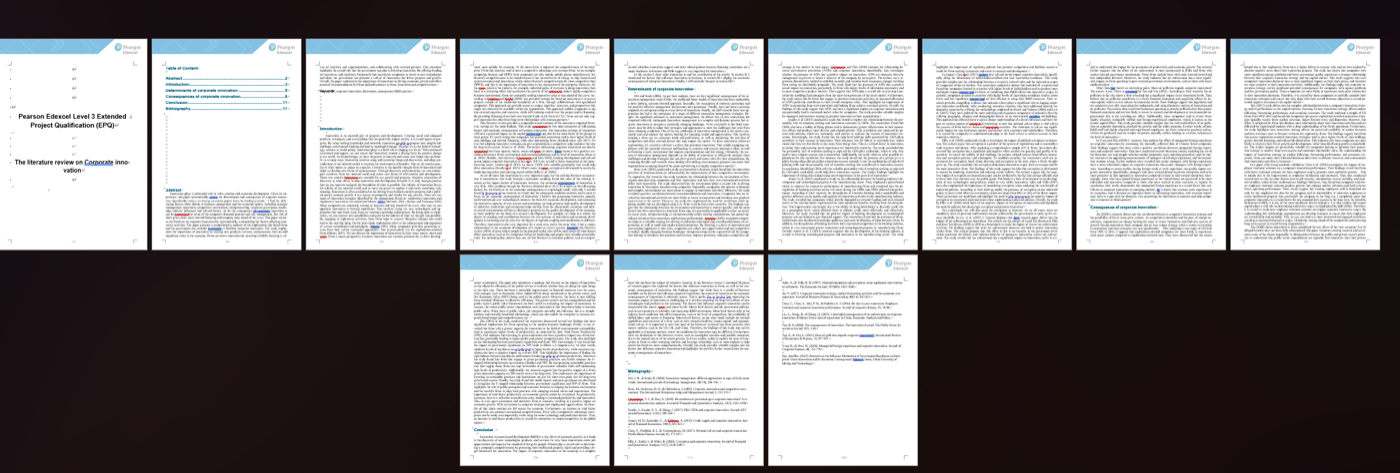
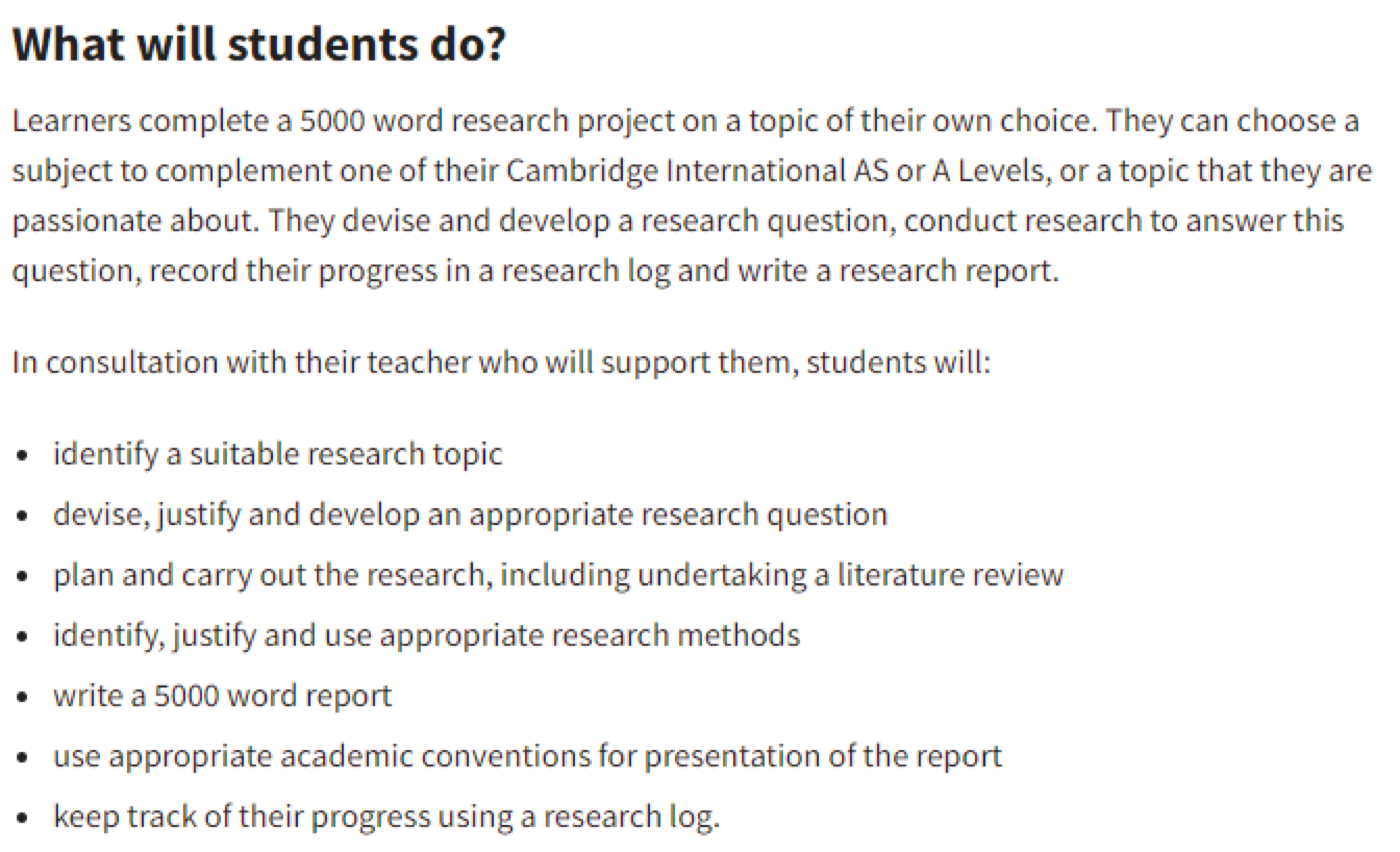
EPQ (Extended Project Qualification). Common for students on the AQA/UK track. The student picks a topic, analyses, compares, summarises — almost no empirical investigation, at least none in the natural-science sense. The product is mostly text, as in the samples below. I have been invited to judge EPQ twice. The process is essentially brain-dead, and the institutional pressure is to give high marks and not cause trouble. If an agency promises to guarantee you a top EPQ score for tens of thousands of RMB extra, they are charging you an intelligence tax.

JS-style "professor + many students" programmes. A well-known professor takes hundreds of students, delivers some foundational lectures, then the students try to produce a paper, and the publisher collects royalties. The commercial model is genuinely inspired — but this type of programme is already widely cited as a negative in admissions. Reasons: (1) the papers have no quality; (2) the recommendation letters are bizarre; (3) the programme is entirely disconnected from the rest of the application. Institutions promote these because they look impressive — Ivy professor! Oxbridge department head! Research! Publication! Recommendation! — but for high-schoolers this is a net negative. If your counsellor recommends it, they are either naive or acting in bad faith.
IPQ (International Project Qualification). Closer to real Scientific Research — the final product approximates a lab report and the official standards approach academic science. I have judged a few of these too, and they are more serious than EPQ. But the invisible hand ensures everyone leaves with a high mark.
Most high-schoolers who reach IPQ standard have already done very well, and UK universities — including Oxford and Cambridge — are sensible about it: they know where the ceiling for high-school science sits, and they don't require you to go higher. Better to spend that time on competitions with a B (for British), your admissions tests, and your grades.
The serious tier: ISEF, S.-T. Yau Award, STS
Continuing up the ladder: genuine Scientific Research competitions such as the S.-T. Yau High School Award, ISEF, and STS — or physics-problem-based competitions like IYPT. These are the ceiling. The honest answer to "can high-schoolers actually do this?" is: 99% cannot.
So what is the point? People say science competitions are fraudulent, useless, unrelated to admissions. But if science research doesn't help, does a ghost-written essay about protecting lions in Africa decide everything? No. The point is:
- Identity signal. Someone who loves growing plants will naturally research soil composition, watering schedules, light and humidity. Even if the student produces nothing as world-changing as hybrid rice, the process shows that they genuinely investigate what they love.
- Communication, poise, charisma. You have to explain your project — essentially sell a product to sceptical buyers. Whether the product is entirely yours or not, the ability to pitch it is a real and valuable skill. This is precisely why many families send children abroad young: science fairs and science exhibitions train exactly this.
- Problem-solving. Many universities list problem-solving as a key admissions criterion, and it is also what university education tries to build. The cycle of observation → theory → experiment design → data analysis → conclusion trains exactly that, even if the student was guided to the answer rather than finding it independently.
- Practical intellectual exposure. Even setting aside specialist knowledge, a genuine research project teaches you how to read papers for the key point, what rigorous academic language looks like, how to explain something complicated clearly. Concretely: you will use LaTeX to typeset a paper, Python for basic programming, MATLAB or SPSS for data analysis. Anyone who has done this will recognise it; any admissions officer who has done it will too.
So science competitions are an opportunity to learn things, widen your horizon, develop capability, and sharpen your image. Nobody expects a high-schooler to achieve controlled nuclear fusion.
Finding good guidance: the frank guide
Because top-tier competitions are necessarily bespoke, market prices are high — typically above 100,000 RMB. And the fee structure means the teacher's cut is a small fraction, which means quality variance is enormous. The young, energetic teacher who takes it seriously and even backs the student up: great, but may not know the competition well and may accidentally set the bar too low. The veteran who collects the session fee and disappears: the student arrives at the competition completely lost. Neither outcome is the teacher's fault in any clear sense.
So what should you do? First option: use personal academic connections to find a non-political research academic who will supervise properly, or go through university administration to place your student with a third-year-or-above PhD student, pay well, be clear about expectations — the quality threshold is roughly "publishable in a Q3/Q4 SCI journal." Second option: if you don't have the connections, shop around carefully. The simplest filter: if a biology-track student asks an agency and they immediately push bioinformatics, walk away. Why? Because bioinformatics requires no lab, just a laptop, so it is easy to produce, but it almost never wins top prizes, because real experimental work — the kind that requires safety training, dangerous materials, logistics — is what judges actually value and that agencies tend to avoid. Trust the agency that recommends the hard, expensive, in-person track.
One more practical note for parents negotiating with agencies: do not reveal your true background honestly. Say you have ten thousand student referrals at stake. Say your partner works in an adjacent technical field. Ask to speak directly with the company's most senior responsible person. This will get the best teacher assigned to your child. I say this not as endorsement of deception but as a description of how the system actually functions — I have been on the receiving end of this negotiation many times.
The bottom line
With standardised test scores, GPAs, and course rigour converging across applicants — and without the buffers of a feeder school, legacy status, recruited-athlete status, or ability to pay full freight — a well-executed research profile still matters enormously. Yale has an entire portal for submitting papers and research. ISEF finals have admissions officers sitting in the room. Research comes up in finalist interviews. If a student cannot reach IMO, the path is to raise composite ability, leverage connections, and collect awards in adjacent competitions. All roads, to be frank, lead somewhere ordinary. But research is still one of the less ordinary ones.