BPhO R1 S1 · Section 1

Young's Modulus

9 questions — reveal each final answer.

2011 · eYoung's Modulus

A submerged wreck, mass $10^{4} \mathrm{~kg}$ and mean density $8 \times 10^{3} \mathrm{~kg} \mathrm{~m}^{-3}$, is lifted out of the water by a crane with a steel cable $10 \mathrm{~m}$ long, cross-sectional area $5 \mathrm{~cm}^{2}$ and Young's modulus $5 \times 10^{10} \mathrm{~N} \mathrm{~m}^{-2}$. Determine the change in the extension of the cable as the wreck is lifted clear of the water. [5]

Show answer · 显示答案
Final result
  • The change in extension as the wreck clears the water is $\approx 4.9\,\mathrm{mm}$, set entirely by the loss of the buoyant force $F_{\text{buoyant}}=\rho_w V g$; the weight cancels in the difference.

Worked solutions are in the book.
2014 · eYoung's Modulus

Two $1.00 \mathrm{~m}$ lengths of wire, one copper and one tungsten, are joined vertically end to end. The copper wire has a diameter of $0.500 \mathrm{~mm}$. When a $100 \mathrm{~kg}$ block is suspended from one end, the combined length of wire stretches by $6.00 \mathrm{~cm}$. What is the diameter, $d$, of the tungsten wire if the Young's modulus for copper is $12.4 \times 10^{10}$ $\mathrm{Pa}$, and that for tungsten is $35.5 \times 10^{10} \mathrm{~Pa}$? [6]

Show answer · 显示答案
Final result
  • The tungsten diameter is $d \approx 0.423 \, \text{mm}$.

Worked solutions are in the book.

2017 · pYoung's Modulus

A submerged wreck is lifted from a dock basin by means of a crane to which is attached a steel cable $10 \mathrm{~m}$ long of cross-sectional area $5.0 \mathrm{~cm}^{2}$ and Young modulus $5.0 \times 10^{10} \mathrm{~Pa}$. The material being lifted has a mass of $1.0 \times 10^{4} \mathrm{~kg}$ and mean density $8000 \mathrm{~kg} \mathrm{~m}^{-3}$. Find the change in extension of the cable as the load is lifted clear of the water. Assume that at times the tension in the cable is the same throughout its length. (Density of water is $1000 \mathrm{~kg} \mathrm{~m}^{-3}$). [5]

Show answer · 显示答案
Final result
  • The change in extension is $4.9 \times 10^{-3} \, \text{m}$.

Worked solutions are in the book.

2018 · nYoung's Modulus

A steel girder is planted securely between two sides of a ravine in order to provide a bridge. The total cross-sectional area of the girder is $30 \mathrm{~cm}^{2}$, and the length of the girder is $4.0 \mathrm{~m}$. Installed at a temperature of $5^{\circ} \mathrm{C}$, the temperature now rises to $20^{\circ} \mathrm{C}$. Calculate the force exerted by the girder due to the change in temperature, assuming the ends do not move.

Young modulus of steel $=2.0 \times 10^{11} \mathrm{~Pa}$

Linear expansivity of steel (fractional expansion per unit temperature rise) $=1.2 \times 10^{-5}{ }^{\circ} \mathrm{C}^{-1}$ at $5^{\circ} \mathrm{C}$. [4]

Show answer · 显示答案
Final result
  • The clamped ends prevent the thermal expansion, so the girder is compressed by exactly $\Delta l$; the resulting force is $F = EA\,\alpha\,\Delta T = 1.08\times10^{5}\,\text{N}\approx108\,\text{kN}$ (note the length cancels -- the force depends only on $E$, $A$, $\alpha$ and $\Delta T$).

Worked solutions are in the book.

2021 · oYoung's Modulus

A solid square cross-section mild steel bar, of side $2.0 \mathrm{~cm}$ is to be bent on the arc of a circle. What is the smallest radius to which it can be bent, if the breaking stress of the steel is $840 \mathrm{MPa}$, and Young's Modulus is $210 \mathrm{GPa}$. Assume that the radius of curvature is much larger than the thickness of the bar. [4]

Show answer · 显示答案
Final result
  • The smallest radius is $2.5 \, \text{m}$.

Worked solutions are in the book.

2023 · nYoung's Modulus

A steel tube of $4.0 \mathrm{~cm}$ internal diameter and $30 \mathrm{~cm}$ long, with a wall $0.25 \mathrm{~cm}$ thick, is covered externally and lined internally with copper tubes $0.20 \mathrm{~cm}$ thick. The three tubes are firmly connected. This compound tube is placed under tension by a load and the stress produced equals $6.2 \times 10^7 \mathrm{Nm}^{-2}$. Determine
(i) the extension of the tube
(ii) The stress in the copper tubes
(iii) The load carried by the compound tube
Young's Moduli: Steel $200 \mathrm{GPa}$, Copper $110 \mathrm{GPa}$ [5]

Show answer · 显示答案
Final result
  • The bonded tubes share a common strain, so the stiffer steel carries the larger stress ($8.6\times10^7\,\mathrm{N\,m^{-2}}$) while the copper carries $4.7\times10^7\,\mathrm{N\,m^{-2}}$.

Worked solutions are in the book.

2023 · tYoung's Modulus

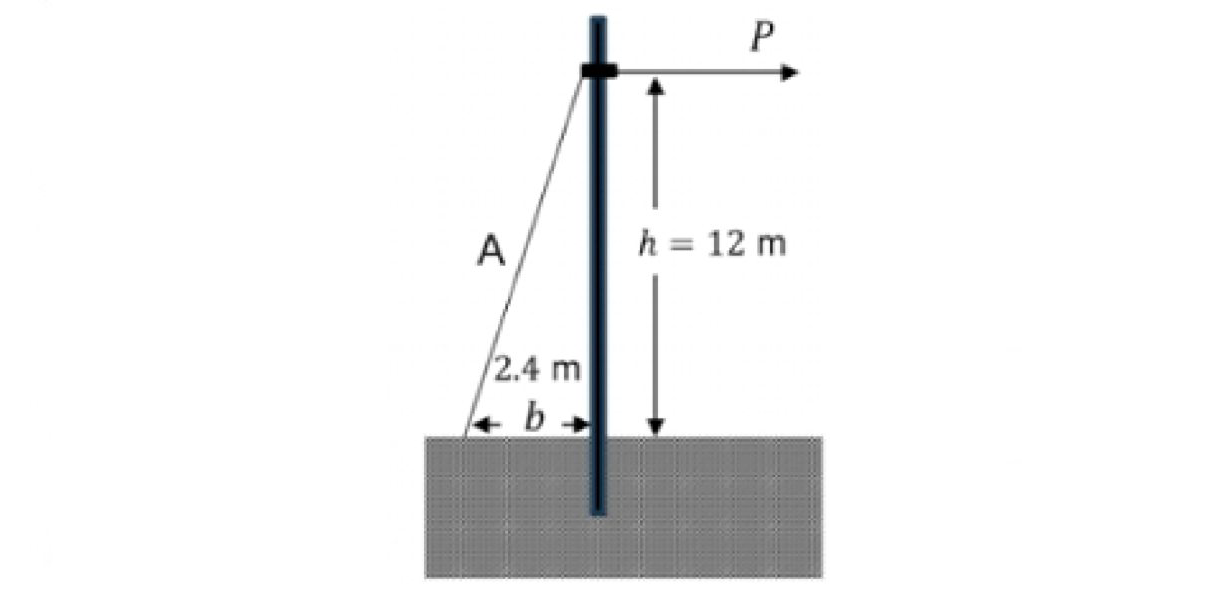
A vertical wooden pole with a circular cross section of diameter $30 \mathrm{~cm}$ has its footing embedded in a concrete block. A loose steel guy wire, A, is fixed to the ground a distance $b=2.4 \mathrm{~m}$ from the base of the pole, and is attached to the pole at a height $h=12 \mathrm{~m}$ above the ground. It is subject to a pull to the right by tension $P$ in a cable, attached at the same height, as shown in Fig. 9. This causes the wooden pole to bend a small amount to the right in the are of a circle of radius $r$ with $r>h$. The loose steel guy wire, A, then becomes tight and prevents the pole from bending any further. The bent pole stretches on one side and compresses on the other, with a neutral line down the centre of the pole. The pole has a maximum stress of $4000 \mathrm{Nm}^{-2}$ at one side when bent.
(i) Calculate radius $r$ and the angle of the circular are formed by the bent pole when the neutral line remains unstressed.
(ii) Draw a diagram to show how this angle can be used to calculate the length of the guy wire, $\mathrm{A}$, when it is tight.
(iii) Calculate an approximate value for the length of slack in the guy wire when the pole is unloaded and straight and vertical.
You may assume that the bend is small enough so that the height of the pole when bent is not changed significantly.
Young's modulus for wood is $14 \mathrm{GPa}$.

figure
Show answer · 显示答案
Final result
  • The radius of curvature is enormous ($\sim 5\times10^{5}\,\mathrm{m}$) because the permitted stress is tiny, so the arc angle and the top deflection are minute and the required slack is only tens of microns.

Worked solutions are in the book.

2024 · pYoung's Modulus

An elastic material called neoprene is used within sections of motorway roads in hot countries to maintain a flat road with no discontinuities under different temperatures. If we have a road built with 2.0 cm of neoprene placed between every 20 m lengths of concrete, and the concrete has a thermal expansion coefficient of $\alpha = 12 \times 10^{-6}\ \text{K}^{-1}$, what is the highest temperature it can go up to before the road cracks?

Assume that the elastic material is initially under no deformation at a temperature of $20\,^\circ\text{C}$.

Thermal expansion coefficient $\alpha$ is specified by $\ell = \ell_0(1 + \alpha\,\Delta T)$ in which $\ell$ is the expanded length, $\ell_0$ the initial length, and $\Delta T$ the temperature rise.

Young's Modulus of neoprene $= 2.7\ \text{MPa}$
Breaking stress of concrete $= 30\ \text{MPa}$ [5]

Show answer · 显示答案
Final result
  • The maximum temperature before the road cracks is about $946\,^\circ\text{C}$.

Worked solutions are in the book.

2025 · iYoung's Modulus

When we pour hot water into an otherwise cold glass cup, there is a chance the glass might unfortunately crack. Suppose, as a result of conduction of heat, the temperature difference between the inner and outer surface of the glass is $\Delta T$. The following are some information regarding the glass:

  • Young's modulus $E = 70\ \text{GPa}$
  • Coefficient of linear expansion $\alpha = 8.0 \times 10^{-6}\ \text{K}^{-1}$
  • Compressive strength $\sigma = 21\ \text{MPa}$
  1. (i) By estimating the maximum stress developed in the glass, find the minimum temperature difference $\Delta T$ required to make the glass break.
  2. (ii) Is making the glass wall of the cup thicker a solution to this problem?
[5]

Show answer · 显示答案
Final result
  • The minimum temperature difference to break the glass is $\Delta T \approx 37.5\ \text{K}$.

Worked solutions are in the book.