BPhO R1 S1 · Section 1

Rotation and Circular Motion

12 questions — reveal each final answer.

2012 · eRotation and Circular Motion

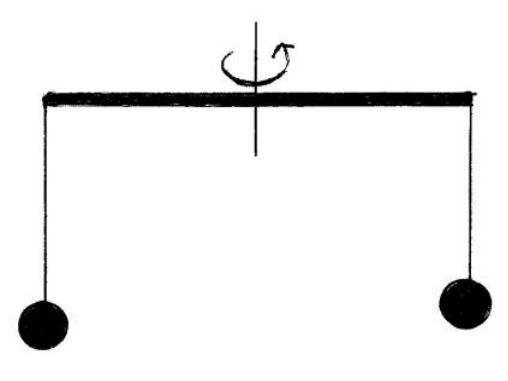
A horizontal bar, $8.0 \mathrm{~m}$ in length, has a $2.0 \mathrm{~m}$ rope attached at each end, with a small metal sphere at each end of each rope hanging under gravity, Figure. When the bar rotates about a vertical axis through its centre, the ropes are inclined at $30^{\circ}$ to the vertical. Determine the period, $T$, of rotation of the system. [5]
figure
Show answer · 显示答案
Final result
  • The period is about $5.9\,\mathrm{s}$.

Worked solutions are in the book.

2012 · mRotation and Circular Motion

A smooth flat horizontal turntable $4.0 \mathrm{~m}$ in diameter is rotating at $0.050$ revs per second. A student at the centre of the turntable, and rotating with it, releases a smooth flat puck on the turntable $0.50 \mathrm{~m}$ from the edge. Describe the motion of the puck as seen by a stationary observer who is standing at the side of the turntable.

(i) How long does the puck remain on the turntable?

(ii) At what relative velocity would the student, at the centre of the turntable, see the puck leave the turntable? [10]

Show answer · 显示答案
Final result
  • To the stationary observer the frictionless puck travels in a straight line at constant speed, reaching the rim after about $2.8\,\mathrm{s}$.

Worked solutions are in the book.

2014 · lRotation and Circular Motion

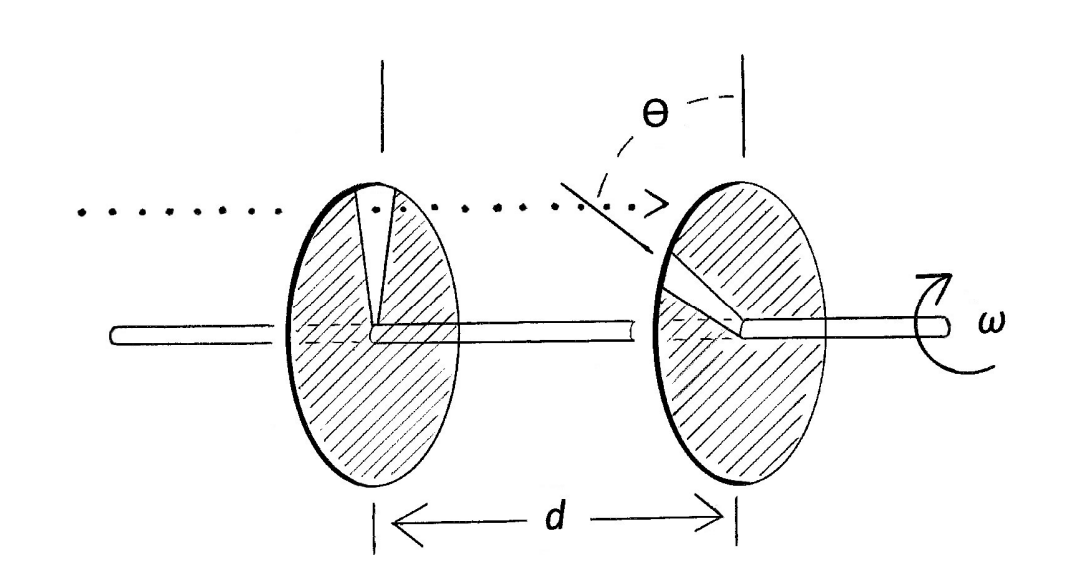
A velocity selector, consists of two slotted discs mounted on a common axis a distance $d$ apart. The slots are displaced relative to each other by an angle $\theta$. The axis is driven at an angular velocity $\omega$. Particles in a horizontal beam, with all possible velocities, will get through the first slit, in the first disc, for a short time interval. To subsequently get through the second slit, particles must travel a distance $d$ in the times it takes the second slot to line up with the beam. This will occur, for rotations of the second slit of $\theta, 2 \pi+\theta, 4 \pi+\theta$,.. etc.

If $d=1.00 \mathrm{~m}, \omega=24,000 \mathrm{rpm}$ and $\theta=60^{\circ}$, what are the speeds of those particles that pass through the velocity selector? [5]

figure
Show answer · 显示答案
Final result
  • The selector transmits a discrete family of speeds, not a single value: the largest ($2400\,\text{m/s}$, for $n = 0$) corresponds to the slot lining up after the minimum rotation $\theta$, and each extra full turn ($n \to n+1$) admits a slower particle.

Worked solutions are in the book.

2015 · eRotation and Circular Motion

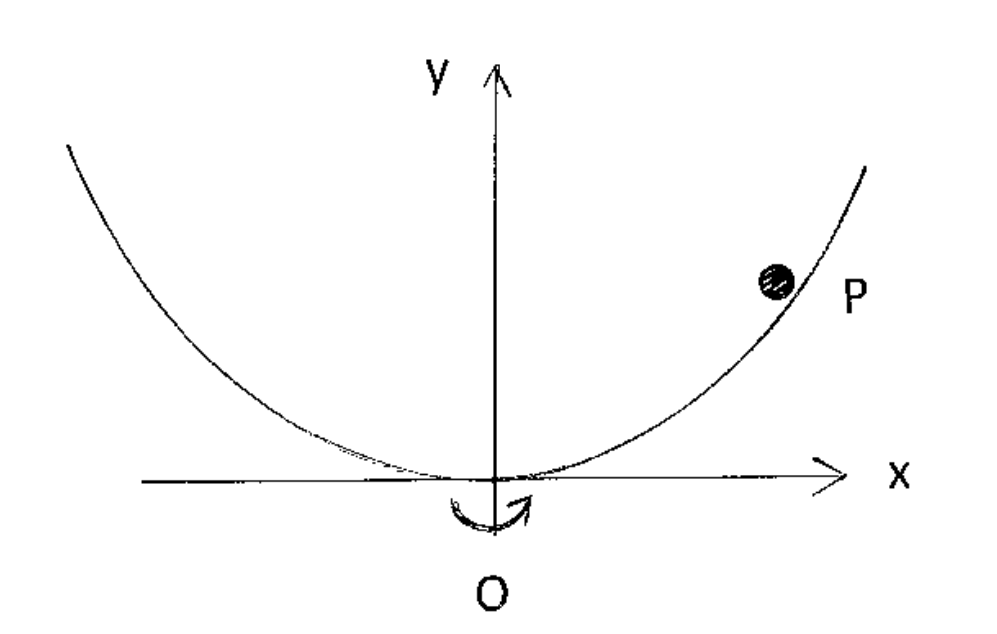
Figure is a section through a smooth parabolic metal bowl, which can be rotated about its vertical axis of symmetry, the $y$-axis. Its equation, in Cartesian coordinates, is $y=a x^{2}$. The gradient at the point $(x, y)$ is $2 a x$.

There is one angular speed of rotation, $\omega$, of the bowl about the $y$ - axis for which a small metal sphere remains at rest relative to the rotating bowl, wherever it is placed on the inner surface. Determine $\omega$ in terms of $a$ and $g$. [4]

figure
Show answer · 显示答案
Final result
  • The key feature is that the position $x$ cancels: the required $\tan\theta = \omega^2 x/g$ and the surface slope $2ax$ both grow linearly with $x$.

Worked solutions are in the book.

2016 · qRotation and Circular Motion

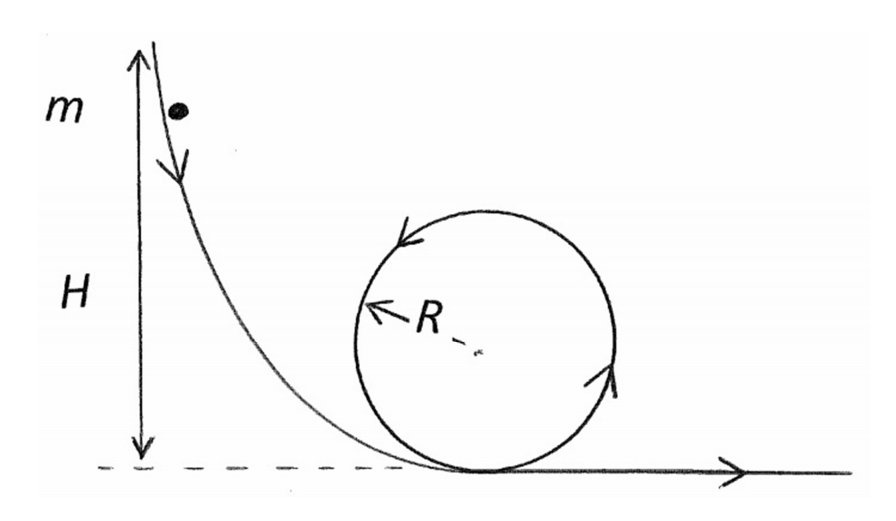
A particle, mass $m$, slides down the smooth track, Figure $\mathbf{1}(\mathbf{q})$, from a height $H$ under gravity. It is to complete a circular trajectory of radius $R$ when reaching its lowest point. Determine the smallest value of $H$. [3]

figure
Show answer · 显示答案
Final result
  • The smallest release height is $H = \tfrac{5}{2}R$, i.e. one quarter of a loop diameter above the top of the loop.

Worked solutions are in the book.

2017 · kRotation and Circular Motion

A lead ball is attached to the end of a light metal rod of length $l$, the other end being attached to a horizontal axle of negligble friction. The rod is given an intial impulse and swings round in a vertical circle. When it is at the top of the circle, the tension in the rod is zero. What is the tension in the rod at the lowest point of its swing? [6]

Show answer · 显示答案
Final result
  • At the bottom the rod must both support the weight $mg$ and supply the centripetal force $mv_l^2/l = 5mg$, giving $T = 6mg$.

Worked solutions are in the book.

2018 · aRotation and Circular Motion

The Milky Way galaxy has a period of rotation of $240 \times 10^{6}$ years. The Sun is 26 light years from the centre of the galaxy. How fast is the Sun moving with respect to the centre of the galaxy, given in units of $\mathrm{ms}^{-1}$ ?

A light year is the distance that light travels in one year of $365.25$ days. [3]

Show answer · 显示答案
Final result
  • The Sun drifts round the galactic centre at only about $200\,\text{m/s}$ on this scale, despite the enormous distances involved.

Worked solutions are in the book.

2018 · hRotation and Circular Motion

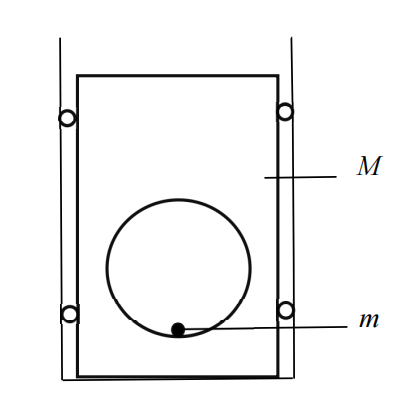
A small particle of mass $m$ can slide without friction round the inside of a cylindrical hole of radius $r$, in a rectangular shaped object of mass $M$. The rectangular object is held between rigid walls by small wheels so that it can slide up and down without friction, as shown in Figure. If the small particle $m$ is initially at rest at the bottom of the cylindrical hole, and is then given an impulse to give it a speed $v$, what is the minimum speed $v$ needed to just lift the rectangular mass $M$ off the ground? [5]

figure
Show answer · 显示答案
Final result
  • The minimum launch speed is $v = \sqrt{gr\left(\dfrac{M}{m}+5\right)}$.

Worked solutions are in the book.

2019 · mRotation and Circular Motion

An aeroplane flies due East along the equator at a constant low altitude and constant speed relative to the ground. On the aeroplane, a one kilogram mass is suspended on a spring balance and records a weight $W_{1}$. The aeroplane then flies due West along the equator, at the same altitude and speed, and measures a balance reading of $W_{2}$. If the speed of the plane relative to the ground is $250 \mathrm{~m} \mathrm{~s}^{-1}$, calculate the difference in apparent weights. [5]

Show answer · 显示答案
Final result
  • The West-bound reading exceeds the East-bound reading by about $0.073\,\text{N}$, since the East-bound flight has the greater speed and so the smaller support force.

Worked solutions are in the book.

2021 · lRotation and Circular Motion

The standard railway gauge has tracks separated by $1435 \mathrm{~mm}$. To travel around a curve the track is banked. Calculate the vertical displacement between the two tracks such that a train travelling at $200 \mathrm{~km} \mathrm{~h}^{-1}$ along a curve of radius $1500 \mathrm{~m}$ will experience a normal reaction force on the wheels only. [5]

Show answer · 显示答案
Final result
  • The required vertical displacement is about $0.295 \, \text{m}$ (295 mm).

Worked solutions are in the book.

2022 · cRotation and Circular Motion

Riding round a corner at $10 \mathrm{~km} \mathrm{~h}^{-1}$ a cyclist leans over at an angle of $12^{\circ}$ to the vertical. At what angle would they lean over if they went round the corner at $15 \mathrm{~km} \mathrm{~h}^{-1}$? [3]

Show answer · 显示答案
Final result
  • Since $\tan\theta \propto v^2$ and $r$ is the same corner, the radius and $g$ cancel, so the answer needs only the speed ratio. The lean grows from $12^\circ$ to about $26^\circ$ when the speed is multiplied by $1.5$.

Worked solutions are in the book.

2024 · dRotation and Circular Motion

A mass $m$ hangs from the end of a light string of length $\ell$, which is attached to a point on the ceiling. It is set in motion so that the mass moves in a horizontal circle of radius $r$ with the string at angle $\theta$ to the vertical as it traces out the curved surface of a cone.

  1. (i) By resolving the forces on the mass, obtain an expression for the period of orbit, $T$, of the mass, in terms of $r$, $g$ and $\tan\theta$.
  2. (ii) Substitute for $\tan\theta$ to express the period of orbit in terms of $\ell$, $g$ and $\cos\theta$.
[4]

Show answer · 显示答案
Final result
  • The period is $T = 2\pi\sqrt{\dfrac{r}{g\tan\theta}} = 2\pi\sqrt{\dfrac{\ell\cos\theta}{g}}$.

Worked solutions are in the book.