BPhO R1 S1 · Section 1

Resistors and Conductors

9 questions — reveal each final answer.

2012 · hResistors and Conductors

A thundercloud has a horizontal lower surface, area $25.0 \mathrm{~km}^{2}, 750 \mathrm{~m}$ above the surface of the Earth. Using a capacitor as a model, calculate the electrical energy, $E_{1}$, stored when its potential is $1.00 \times 10^{5} \mathrm{~V}$ above the earth potential.

If the cloud rises to $1250 \mathrm{~m}$ :

(i) explain why the energy, $E_{2}$, has increased or decreased

(ii) What is the change in electrical energy, $\triangle E$? [10]

Show answer · 显示答案
Final result
  • The stored energy rises by about $983\,\mathrm{J}$ as the cloud climbs from 750 m to 1250 m.

Worked solutions are in the book.
2013 · jResistors and Conductors

A capacitor, capacitance $C_{1}$, with a charge $Q_{0}$, is connected in a closed (loop) series circuit with an uncharged capacitor, capacitance $C_{2}$ and a switch, which is initially open. Compare the energy stored in the capacitors before and after the switch is closed by considering the potential across each capacitor. What can one conclude? [8]

Show answer · 显示答案
Final result
  • By comparing the initial and final energies, we see that: $$\text{Initial energy} = \frac{1}{2} \frac{Q_0^2}{C_1}$$ $$\text{Final energy} = \frac{1}{2} \frac{Q_0^2}{C_1 + C_2}$$ Since $C_1 + C_2 > C_1$, the final energy is always less than the initial.

Worked solutions are in the book.

2015 · bResistors and Conductors

The temperature coefficients of resistance, $\alpha$, of certain alloys are positive and others are negative. They have resistance per unit length of $r$. This makes it possible to produce a resistor, using the two wires in series, which does not vary with temperature. The values of $r$, at $0^{\circ} \mathrm{C}$, and $\alpha$ are given in Table 1.b for constantan and manganin. These wire have lengths $L_{c}$ and $L_{m}$ respectively at $0^{\circ} \mathrm{C}$. What values of $L_{c}$ and $L_{m}$ are required to produce a $5.0 \Omega$ resistor?

Wire$r / \Omega \mathrm{m}^{-1}$$\alpha /{ }^{\circ} \mathrm{C}^{-1}$
Constantan$6.3$$-3.0 \times 10^{-5}$
Manganin$5.3$$+1.4 \times 10^{-5}$
Show answer · 显示答案
Final result
  • With $L_c \approx 0.25\,\text{m}$ and $L_m \approx 0.64\,\text{m}$, the constantan section's fall in resistance with temperature exactly offsets the manganin section's rise, giving a resistor that holds $5.0\,\Omega$ independent of temperature.

Worked solutions are in the book.

2019 · eResistors and Conductors

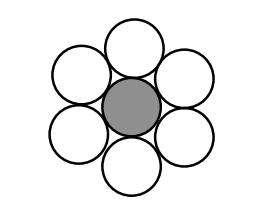
Figure shows the cross section of a high voltage overhead electrical transmission cable. The central strand is of steel and the six outer strands are of aluminium. The resistivity of steel is $2.0 \times 10^{-7} \Omega \mathrm{m}$, and that of aluminium $3.2 \times 10^{-8} \Omega \mathrm{m}$. The cross-sectional area of each strand is $5.0 \times 10^{-4} \mathrm{~m}^{2}$. The steel is present to give mechanical strength to the cable and only reduces the resistance of a length $\ell$ of cable by $1.4 \times 10^{-4} \Omega$ when it is included. Calculate the length of the cable. [5]

figure
Show answer · 显示答案
Final result
  • The steel core is a poorer conductor (higher $\rho$) and only one strand, so it carries little current and shaves only $1.4\times10^{-4}\,\Omega$ off the resistance.

Worked solutions are in the book.

2020 · eResistors and Conductors

A long wire of uniform diameter 1.40mm has a resistance of 0.478 $\Omega$ . It is wrapped into a ball in order to find its weight, which is 4.60N. When weighed in water it is 4.08N. Calculate the resistivity of the wire.
Density of water = 1000 kgm$^{-3}$ [3]

Show answer · 显示答案
Final result
  • The result $\rho \approx 2.1\times10^{-8}\,\Omega\,\text{m}$ is close to the resistivity of copper, consistent with a common metal wire.

Worked solutions are in the book.

2020 · pResistors and Conductors

Electron beam lithography is used for etching microscopic patterns on surfaces. Typically, a $5 \mathrm{~nm}$ layer of aluminium deposited on an insulating substrate will remove the incident charge. If the beam current is $1.0 \mathrm{nA}$, and the electron beam of width $15 \mathrm{~nm}$ is incident centrally on a circular aluminium covered surface of diameter $5.0 \mathrm{~cm}$, calculate the electrical resistance and potential difference between the edge of the spot and the edge of the surface.

Resistivity of aluminium $=2.8 \times 10^{-8} \Omega \mathrm{m}$. [5]

Show answer · 显示答案
Final result
  • Despite aluminium's low resistivity, squeezing nanoamp current out from a nanometre spot through a 5 nm film still gives a measurable few-ohm resistance; the logarithm keeps it modest because most of the resistance accrues near the tiny inner radius.

Worked solutions are in the book.

2020 · qResistors and Conductors

A leaky capacitor is one which does not have a perfectly insulating dielectric layer between the plates upon which the charge is stored. Such a capacitor contains a dielectric material filling the space between the plates, and with an effective resistivity of $1.5 \times 10^{12} \Omega \mathrm{m}$. The area of the plates is $A=0.603 \mathrm{~m}^{2}$, and the dielectric film thickness $d=0.82 \mu \mathrm{m}$. The capacitor is charged from a $24 \mathrm{~V}$ supply connected in series with a $4.7 \mathrm{M} \Omega$ resistor.

(i) Calculate the maximum charge that can be accumulated on one of the capacitor plates. [For a parallel plate capacitor, $C=\frac{\epsilon_{0} A}{d}$ ]

(ii) If the capacitor is disconnected from the circuit, calculate the time taken for the capacitor to lose half its maximum charge. [5]

Show answer · 显示答案
Final result
  • The leakage that limits the charging voltage to 7.3 V is the same path that drains the capacitor afterwards, so the discharge uses $R = 2.04\,\text{M}\Omega$ (not the external $4.7\,\text{M}\Omega$, which is no longer in the circuit).

Worked solutions are in the book.

2021 · sResistors and Conductors

A capacitor is made of two parallel conducting plates of area $A$ and initial separation $d$. It is attached to a constant voltage supply, $V$. The energy stored in the capacitor is $E_{1}$. The separation of the plates is gradually reduced to $d / 3$. The supply is then disconnected and the separation of the plates is gradually restored to the value $d$, where the energy stored is now $E_{3}$.

Calculate the difference in the energy stored in the capacitor between the final $\left(E_{3}\right)$ and initial $\left(E_{1}\right)$ states. [4]

Show answer · 显示答案
Final result
  • The difference in energy between the final and initial states is $8 E_{1}$.

Worked solutions are in the book.

2023 · gResistors and Conductors

The resistance of a copper wire $1 \mathrm{~m}$ long with a mass of $1 \mathrm{~g}$ is $0.15 \Omega$. Find the length of a wire of the same material with a mass of $1000 \mathrm{~kg}$ and a resistance of $6000 \Omega$. [3]

Show answer · 显示答案
Final result
  • Eliminating the cross-sectional area gives $L \propto \sqrt{mR}$, so a wire $10^{6}$ times heavier and $4\times10^{4}$ times more resistive is $\sqrt{4\times10^{10}}=2\times10^{5}$ times longer.

Worked solutions are in the book.