BPhO R1 S1 · Section 1

Principles of Optics

14 questions — reveal each final answer.

2011 · fPrinciples of Optics

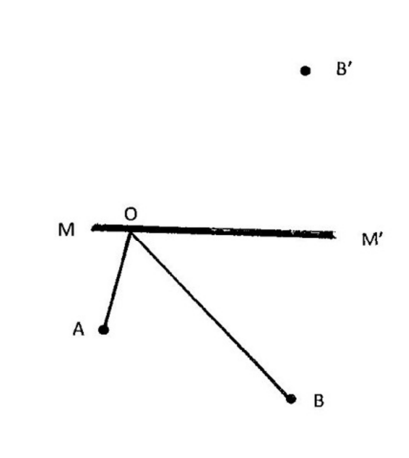
MM', Figure, is a plane mirror. A and $\mathrm{B}$ are points in front of the mirror and $\mathrm{O}$ is a variable point on the mirror. B' is the image of B in the mirror. Prove geometrically that:

(i) the paths $A O B$ and $A O B$ ' are equal.

(ii) the path length of the ray reflected in the mirror has the minimum possible value of AOB.
figure
Show answer · 显示答案
Final result
  • Because $OB = OB'$, every path $AOB$ equals the corresponding $AOB'$; the latter is shortest when $A$, $O$, $B'$ are collinear.

Worked solutions are in the book.
2014 · cPrinciples of Optics

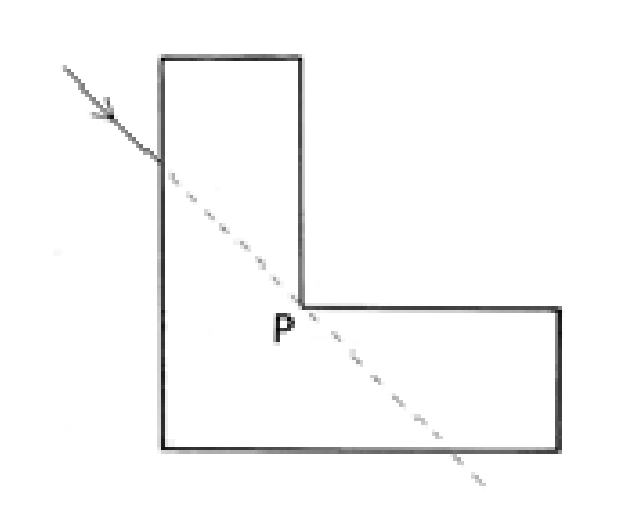
A glass block of refractive index $\mu=1.5$ has an ' $L$ ' cross-section, and is of constant width and thickness.

figure

(i) A laser beam enters the block from the left, as indicated in Figure, at an incident angle of $\theta=45^{\circ}$. If the block was absent the beam would pass through the point $P$. Determine the angle at which the beam will emerge from the bottom face after refraction through the block.

(ii) If this beam enters the block below the horizontal through $P$, determine its possible subsequent path(s). [6]

Show answer · 显示答案
Final result
  • Unlike part (i)'s straight-through (parallel-slab) path, this ray is folded once: it reflects off the bottom face (incidence $\alpha = 61.87^\circ$, equal reflected angle $\alpha$) and then travels up and out through the right vertical face, emerging at $45^\circ$ to that face's normal -- exactly the path drawn in the figure.

Worked solutions are in the book.
2014 · iPrinciples of Optics

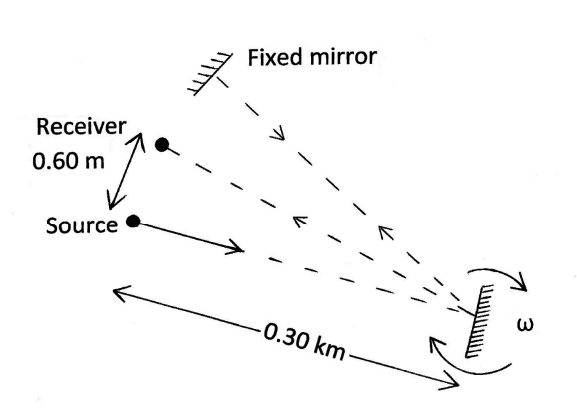
In a fixed mirror, a light source and a light receiver are all $0.30 \mathrm{~km}$ from a rotating mirror, with angular frequency $\omega$. The distance between the light source and the receiver is $0.60 \mathrm{~m}$. What is the lowest value of $\omega$ required for detection of the reflected light? [4]

figure
Show answer · 显示答案
Final result
  • The lowest detectable angular frequency is $\omega \approx 0.50 \times 10^3 \, \text{rad/s}$.

Worked solutions are in the book.
2015 · cPrinciples of Optics

A monochromatic sodium lamp, wavelength $\lambda=6.0 \times 10^{-7} \mathrm{~m}$, radiates $100 \mathrm{~W}$ of radiation uniformly in all directions. At what distance from the lamp will the photons have an average density of $10^{6} \mathrm{~m}^{-3}$? [5]

Show answer · 显示答案
Final result
  • The density falls as $1/R^2$, so the target density $10^6\,\text{m}^{-3}$ is reached at $R \approx 283\,\text{m}$.

Worked solutions are in the book.
2015 · fPrinciples of Optics

A ray of light is incident on a $60^{\circ}$ glass prism of refractive index $1.500$ at an angle of incidence of $48.59^{\circ}$. Determine:

(i) the angle of emergence, $\theta$, from the prism; i.e. the angle between the emergent ray and the normal to the prism face.

(ii) the angle of deviation of the ray, $\delta$. [5]

Show answer · 显示答案
Final result
  • The ray emerges at $48.59^\circ$ and is deviated by $37.18^\circ$.

Worked solutions are in the book.

2018 · jPrinciples of Optics

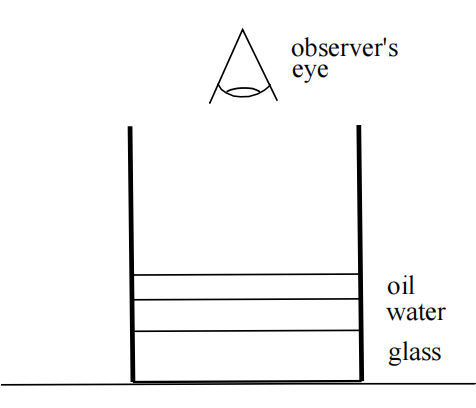
A thick-bottomed, cylindrical glass beaker is placed on a bench. Water and oil are poured into the beaker and form discrete layers, as shown in Figure. The bottom of the beaker is $1.8 \mathrm{~cm}$ thick, the water is $1.2 \mathrm{~cm}$ deep, and the oil layer is $0.8 \mathrm{~cm}$ deep.

(i) Draw a diagram showing the path of a ray at a small angle to the normal, travelling from the underside of the beaker and being refracted through the layers.

(ii) Assuming the angles of deviation of the ray are small, calculate the apparent vertical displacement of the lab bench when viewed from above.

The refractive indices are $1.5,1.3$ and $1.1$ for the glass, water and oil respectively. [7]

figure
Show answer · 显示答案
Final result
  • The apparent vertical displacement is $d_v \approx 0.95\,\text{cm}$, the bench appearing closer (shallower) than it really is.

Worked solutions are in the book.

2020 · hPrinciples of Optics

Two transparent miscible liquids of refractive indices $n_{a}=1.15$ and $n_{b}=1.52$ can be mixed together to produce a liquid of refractive index $n$ by mixing volumes $V_{a}$ and $V_{b}$ of the liquids. The refractive index of the mixture varies linearly with the volumes of the two liquids. The refractive index of powdered glass, $n_{g}$, poured into the mixture can be found by adjusting the liquid mixture until the powdered glass cannot be observed in the liquid.

(i) Obtain an expression for $n_{g}$ in terms of $n_{a}, V_{a}, n_{b}$ and $V_{b}$.

(ii) If the powdered glass is poured into $100 \mathrm{ml}$ of liquid $\mathrm{A}$ and is seen to disappear when $64 \mathrm{ml}$ of liquid $\mathrm{B}$ is added, what is the refractive index of the glass? [3]

Show answer · 显示答案
Final result
  • The glass disappears when the mixture's refractive index equals the glass's, so $n_g \approx 1.29$ is just the volume-weighted average of $n_a$ and $n_b$.

Worked solutions are in the book.

2021 · mPrinciples of Optics

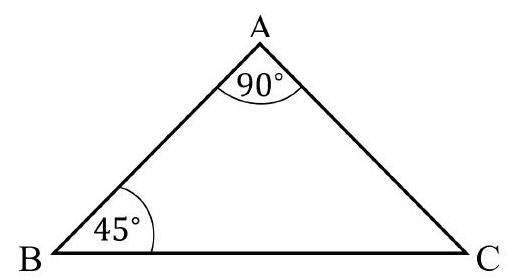
An isosceles glass prism is shown in Fig. 1. A ray of light in the plane of the paper is incident from air on the face $\mathrm{AB}$.

(i) Calculate the critical angle for light in the prism.

(ii) Sketch the path of the ray incident on face $\mathrm{AB}$ such that the refracted ray strikes the face $\mathrm{BC}$ at the critical angle.

(iii) Calculate the angle of incidence on face $\mathrm{AB}$ for this same condition.

Refractive index of glass, $n=1.5$

figure
Show answer · 显示答案
Final result
  • The critical angle is $41.81^\circ$, and the required angle of incidence on face $\mathrm{AB}$ is $\approx 4.8^\circ$, at which the internal ray meets $\mathrm{BC}$ exactly at $\theta_c$ and is on the verge of total internal reflection.

Worked solutions are in the book.

2022 · sPrinciples of Optics

A binary star system is 2140 light years away and consists of two stars like the Sun. The average separation between the stars is 0.00593 light years.

Determine the diameter of the telescope needed to resolve them if using a visible wavelength of $550 \mathrm{~nm}$. [2]

Show answer · 显示答案
Final result
  • A telescope of diameter $\gtrsim 24.2 \, \text{cm}$ just resolves the pair at $550 \, \text{nm}$; the units of the separation and distance (both light years) cancel, so only their ratio enters.

Worked solutions are in the book.

2022 · tPrinciples of Optics

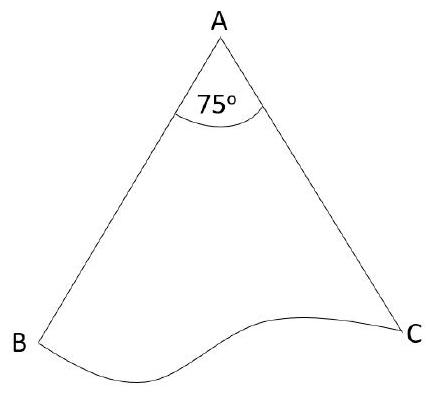
A glass prism of refracting angle $75.0^{\circ}$ is shown in Fig. 4 has a refractive index of $n=1.40$.

(i) For what range of incident angles will light from air that is incident on face $\mathbf{A B}$ emerge from face $\mathbf{A C}$ ?

(ii) Show your result on a diagram. [3]

figure
Show answer · 显示答案
Final result
  • $43.44^\circ < \phi_i < 90^\circ$ for rays crossing out through AC; the lower equality may be included for grazing emergence. Corrected — the printed closed interval includes a 90° ray that cannot enter the prism; see the interactive walkthrough.

Worked solutions are in the book.

2023 · hPrinciples of Optics

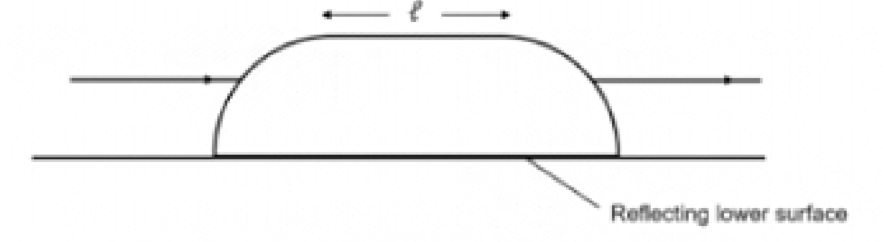
A glass block, with a reflecting lower surface, is shaped as a rectangular slab but whose left and right sides are curved in the shape of quarter circles of radius $R$, as shown in Fig. 3. The base A ray of light enters horizontally from the left and passes out through the right side of the block at the same height above the base. The length of the top plane surface is $\ell$. If the depth of the block is $2.0 \mathrm{~cm}$ and the refractive index $n=1.46$, what would be the minimum value of $\ell$ to satisfy this situation? [3]

figure
Show answer · 显示答案
Final result
  • The minimum top length is set by the critical angle: $\theta_c = 43.23^\circ$ gives $\tan\theta_c = 0.940$ and hence $\ell \approx 3.76\,\text{cm}$.

Worked solutions are in the book.

2024 · qPrinciples of Optics

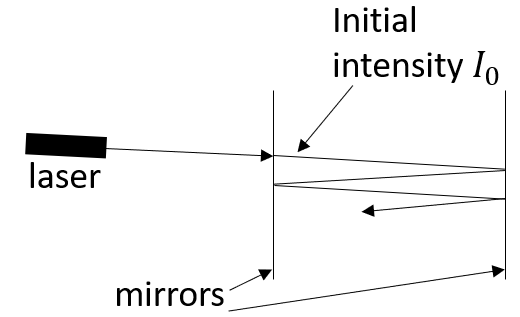
A laser beam that entered the region between two infinite ideal mirrors would reflect an infinite number of times between them, as shown in Fig. 5. However, mirrors in real life have a reflectivity constant $R$ which is the fraction of the incident energy that is reflected, meaning $1 - R$ of the energy will be transmitted (i.e. pass through the mirror). If the initial beam energy between the mirrors is $I_0$, what is the ratio of the total energy escaping through each mirror?

figure
Figure 5: A pair of parallel mirrors with a beam of initial intensity $I_0$ reflected between them. (The beam has been shown at a small angle for clarity.) [4]
Show answer · 显示答案
Final result
  • The two escaping fractions are $\dfrac{I_0}{1+R}$ through the first mirror and $\dfrac{R\,I_0}{1+R}$ through the second, in the ratio $1 : R$.

Worked solutions are in the book.

2025 · oPrinciples of Optics

An exploration ship has a circular glass filled circular porthole in the hull of the ship for studying the seabed. The porthole has a diameter of $40\,\text{cm}$ which is much greater than the thickness of the glass. Calculate the area of seabed that is visible through the porthole if the refractive index of seawater is $n_{\text{w}} = 1.4$ and the seabed is $5.0\,\text{m}$ below the porthole. [4]

Show answer · 显示答案
Final result
  • The visible area is $A \approx 88\,\text{m}^2$ (about $90\,\text{m}^2$ to one significant figure).

Worked solutions are in the book.

2025 · pPrinciples of Optics

The inner surface of a right circular cone is coated with a mirror-like reflecting material to form a conical mirror. A thin straight wire heated to white heat is stretched along the inner axis of the conical mirror. What is the minimum angle $\theta$ of the cone such that rays of light emitted by the filament will not be reflected off the cone more than once? [4]

Show answer · 显示答案
Final result
  • The minimum half-angle is $\theta = 60^{\circ}$ (apex angle $120^{\circ}$).

Worked solutions are in the book.