BPhO R1 S1 · Section 1

Oscillations and Waves

18 questions — reveal each final answer.

2011 · kOscillations and Waves

An organ pipe has one end closed and at the other end is a vibrating diaphragm, which is a displacement antinode. When the frequency of the diaphragm is $2,000 \mathrm{~Hz}$ a stationary or standing wave pattern is set up in the tube. The distance between adjacent nodes is $8.0 \mathrm{~cm}$. As the frequency is slowly reduced the stationary wave pattern disappears, but another stationary wave pattern reappears at frequency 1,600 Hz. Calculate:

(i) the speed of sound in air

(ii) the distance between adjacent nodes at $1,600 \mathrm{~Hz}$

(iii) the length of the tube

(iv) the next frequency below $1,600 \mathrm{~Hz}$ at which a stationary pattern occurs. [6]

Show answer · 显示答案
Final result
  • Because consecutive resonances are always $\dfrac{v}{2L}$ apart, the data fix both $L = 0.40\,\text{m}$ (part iii) and the next pattern below $1600\,\text{Hz}$, at $1200\,\text{Hz}$.

Worked solutions are in the book.
2013 · dOscillations and Waves

A car travels along a horizontal road starting at time $t=0$, and finishing at $t=\pi / 10$. At time $t$ it has travelled a distance $x$, has a speed $v$ and an acceleration $f$ given by $x=A \sin (5 t), \quad v=5 A \cos (5 t)$ and $\quad f=-25 A \sin (5 t), \quad$ where $A$ is a constant.

Determine the average speed, $v_{A V}$, and average acceleration, $f_{A V}$. [3]

Show answer · 显示答案
Final result
  • The interval $0$ to $\pi/10$ is exactly a quarter period of the $\sin(5t)$ motion: the car moves from $x=0$ to $x=A$ (so $v_{\text{AV}}=10A/\pi$) while its speed falls from $5A$ to $0$ (so $f_{\text{AV}}=-50A/\pi$).

Worked solutions are in the book.

2013 · hOscillations and Waves

A sound source, frequency $f$ and velocity $u$, is moving along a straight line towards an observer who is approaching the sound source with velocity $v$. Determine the frequency $f_{o}$ heard by the observer if the speed of sound is $c$.

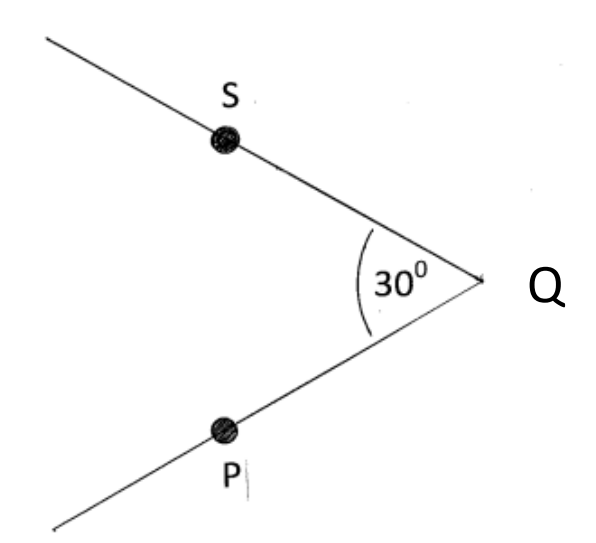
A moving sound source, $\mathrm{S}$, has velocity of $15.0 \mathrm{~m} \mathrm{~s}^{-1}$ and frequency $200 \mathrm{~Hz}$. An observer $P$, speed $18.0 \mathrm{~ms}^{-1}$, and $S$ are approaching a point $Q$ along paths inclined at $30^{\circ}$ to each other. What frequency is heard by the observer when $\mathrm{S}$ and $\mathrm{P}$ are equidistant from Q? The speed of sound is $331 \mathrm{~ms}^{-1}$. [8]

figure
Show answer · 显示答案
Final result
  • Both source and observer are closing on each other along $SP$, so both effects raise the pitch, giving $f_o\approx 205\,\text{Hz}$.

Worked solutions are in the book.
2014 · jOscillations and Waves

A car travelling at $90 \mathrm{~km} / \mathrm{hr}$ in a straight line sounds its horn continuously, frequency $400 \mathrm{~Hz}$, as it passes a stationary observer. At the closest point, A, to the observer the car is at a distance $D=100 \mathrm{~m}$ from the observer. Determine the frequency heard by the observer when the car is:

(i) at A;

(ii) at a distance $x$ from $A$, after passing $A$

The velocity of sound is $v_{S}=343 \mathrm{~ms}^{-1}$. [8]

Show answer · 显示答案
Final result
  • At A the radial speed is zero, so $\nu=400\,\text{Hz}$; as $x$ grows the radial speed rises toward $25\,\text{m s}^{-1}$ and $\nu$ falls toward $400\cdot\frac{343}{368}\approx 373\,\text{Hz}$.

Worked solutions are in the book.
2015 · gOscillations and Waves

A man blowing a whistle of frequency $f$ moves away from a stationary observer at speed $u$. Derive the formula for the frequency $f_1$ heard by the observer. The velocity of sound is $c$.
If a man blowing a whistle of frequency 500 Hz moves away from a stationary observer towards a fixed wall, in a direction perpendicular to the wall at 2.00 m s$^{-1}$, determine the beat frequency heard by the observer if $c$ = 330 m s$^{-1}$. [6]

Show answer · 显示答案
Final result
  • The direct wave is red-shifted and the wall-reflected wave is blue-shifted, so their difference $F=\dfrac{2cuf}{c^2-u^2}\approx 6.06\,\text{Hz}$ is roughly $2uf/c$ for $u\ll c$ -- the beat scales with the source speed.

Worked solutions are in the book.

2016 · hOscillations and Waves

A small object of mass $m$ rests on a scale-pan which is supported by a spring. The period of vertical oscillations is $0.50 \mathrm{~s}$. When the amplitude of the oscillations exceeds the value, $A$, the mass leaves the scale-pan. Determine $A$. [5]

Show answer · 显示答案
Final result
  • The object stays on the pan only while the pan can pull it down at up to $g$; above $A=6.2\,\text{cm}$ the required acceleration exceeds $g$ at the top of the cycle and the object lifts off.

Worked solutions are in the book.

2016 · oOscillations and Waves

A trumpeter travelling in an open car sounds a note at $440 \mathrm{~Hz}$. A stationary pedestrian directly in the path of the car hears a note at frequency $466 \mathrm{~Hz}$. What is the speed of the car? The velocity of sound is $331 \mathrm{~ms}^{-1}$. [3]

Show answer · 显示答案
Final result
  • The car approaches at about $18.5\,\text{ms}^{-1}$ ($\approx 67\,\text{km h}^{-1}$).

Worked solutions are in the book.

2017 · lOscillations and Waves

Some sand is sprinkled onto a loudspeaker cone which is pointing vertically upwards. The louspeaker is driven in simple harmonic motion when attached to a signal generator and the frequency is gradually raised. At a particular frequency, when the amplitiude of oscillation is $0.20 \mathrm{~mm}$, the sand begins to lose contact with the cone. At what frequency does this occur? [3]

Show answer · 显示答案
Final result
  • The sand loses contact at about $35\,\text{Hz}$.

Worked solutions are in the book.

2018 · qOscillations and Waves

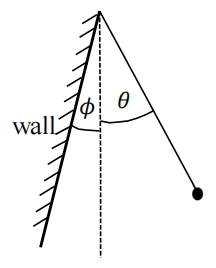
A simple pendulum consists of a small mass on the end of a light, inextensible string, as shown in Figure. It swings from an initial angle $\theta=14^{\circ}$, for which it would have a period $T_{0}$, but it hits a wall elastically, which is at angle $\phi=7^{\circ}$ to the vertical. What is the new period of oscillation in terms of $T_{0}$ ?

$(\theta, \phi$ are small angles such that $\sin \theta \approx \theta$ and $\sin \phi \approx \phi) .$ [4]

figure
Show answer · 显示答案
Final result
  • The wall removes the part of the swing beyond $-7^\circ$, so the bob spends only $t=\tfrac13 T_0$ travelling from $+14^\circ$ to the wall instead of the $\tfrac12 T_0$ it would need to reach $-14^\circ$.

Worked solutions are in the book.

2019 · sOscillations and Waves

A bicycle pump of cross-sectional area $4.0 \mathrm{~cm}^{2}$ has one end sawn off and a cork is fitted into the end. The piston is pushed slowly inwards and the cork is fired out with a popping sound which has a frequency of $512 \mathrm{~Hz}$. The initial distance between the cork and the piston is $25 \mathrm{~cm}$, with atmospheric pressure equal to $1.0 \times 10^{5} \mathrm{~Pa}$ and the speed of sound in air being $330 \mathrm{~m} \mathrm{~s}^{-1}$.

Calculate the force required to eject the cork. [4]

Show answer · 显示答案
Final result
  • The cork is held by the pressure difference it has built up; ejection needs about $22\,\text{N}$.

Worked solutions are in the book.

2021 · kOscillations and Waves

An oscillating pendulum bob has a maximum angle of swing of $\theta$. In its lowest position, the tension in the string is $n$ times the weight of the bob. Obtain an expression for $\cos \theta$ in terms of $n$. [4]

Show answer · 显示答案
Final result
  • A useful check: at the extremes the bob is momentarily at rest, so the swing requires $v^2=(n-1)gL\ge 0$, i.e. $n\ge 1$; and $\cos\theta\le 1$ requires $n\ge 1$ as well.

Worked solutions are in the book.

2021 · uOscillations and Waves

Beats are variations in sound intensity, produced by interference between two sources of sound very close in frequency.

The beat frequency is simply the difference in the frequencies of the two sources.

Three tuning forks in the audible range produce beats: $\mathbf{B}$ and $\mathbf{C}$ produce beats at $7 \mathrm{~Hz}, \mathbf{A}$ and $\mathbf{C}$ produce beats at $8 \mathrm{~Hz}$. The frequency of $\mathbf{B}$ is $5.9 \%$ higher than that of $\mathbf{A}$. Find the frequencies of the three tuning forks. [4]

Show answer · 显示答案
Final result
  • Check: $f_B-f_C = 269.2-262.2 = 7$ Hz and $f_A-f_C = 254.2-262.2 = -8$ Hz, giving an 8 Hz beat, as required.

Worked solutions are in the book.

2022 · qOscillations and Waves

A car drives along a road that has small depressions regularly spaced about $8.0 \mathrm{~m}$ apart. When four $80 \mathrm{~kg}$ passengers enter the $800 \mathrm{~kg}$ car, it sinks down by $1.8 \mathrm{~cm}$.

At approximately what speed might travelling in the vehicle become very uncomfortable? [3]

Show answer · 显示答案
Final result
  • At about $16\,\text{m s}^{-1}$ ($57\,\text{km h}^{-1}$) the car meets one depression per suspension cycle, driving the system at resonance and amplifying the vertical motion.

Worked solutions are in the book.

2022 · rOscillations and Waves

A pendulum clock is controlled by the swing of a simple pendulum (a mass on the end of a light rod) and is intended to have a period of 1.00 seconds. However, the clock runs slow by ten minutes each day. What percentage change should be made in the length of the pendulum? [3]

Show answer · 显示答案
Final result
  • The pendulum's length should be decreased by approximately 1.4% to correct the period and ensure the clock runs accurately.

Worked solutions are in the book.

2023 · oOscillations and Waves

A thin wire of mass $m=6.0 \mathrm{~g}$ and length $L=1.2 \mathrm{~m}$ is stretched to a tension $T$ between two fixed supports. The wire is excited so that the third harmonic standing wave is formed of maximum amplitude $A_{\text {max. }}$. In such a wire, the total $K E$ and elastic PE are equal. The tension is $T=45 \mathrm{~N}$ and $A_{\text {max }}=1.8 \mathrm{~cm}$.
(i) Sketch a graph of the maximum kinetic energy of the particles in the wire against their position along the length of the wire in the range 0 to $L$. Draw a line on your graph to show the the total energy of the particles along the wire from 0 to $L$.
(ii) Calculate the frequency of vibration of the wire.
(iii) Calculate the total energy due to the vibration of the wire.
Hint: The speed of a wave $v$ in a stretched wire is given by $\nu=\sqrt{\frac{T}{\mu}}$ where $\mu$ is the mass per unit length of the wire. [5]

Show answer · 显示答案
Final result
  • The total energy $\tfrac14 m(\omega A_{\max})^2\approx 0.27$ J reflects that the mean of $\sin^2(kx)$ over the wire is $\tfrac12$, so only half the mass-equivalent moves at the antinode amplitude.

Worked solutions are in the book.

2024 · hOscillations and Waves

The displacement $y$ of a point in an elastic medium when a wave passes through depends on the time $t$ and the location $x$ of the point, relative to the starting time and the origin. The displacement is obtained from the phase of the wave at that point, which is the sum of the phases due to the time increment and the relative distance from the origin. The displacement of a point at $x$ and $t$, is given by $$y = 4.0 \times 10^{-6}\,(\text{m})\,\cos\!\left( 1800\,\frac{t}{(\text{s})} + 5.72\,\frac{x}{(\text{m})} \right)$$ (Units are given in brackets)

  1. (i) Determine the amplitude, frequency, wavelength, and speed of the wave.
  2. (ii) What is the maximum speed of motion of the point in the medium?
[4]

Show answer · 显示答案
Final result
  • The wave parameters are $A = 4.0\times10^{-6}\,\text{m}$, $f = 286\ \text{Hz}$, $\lambda = 1.1\ \text{m}$, $v = 314\ \text{m s}^{-1}$, and the maximum speed of a point in the medium is $7.2\ \text{mm s}^{-1}$.

Worked solutions are in the book.

2024 · iOscillations and Waves

Beats are produced when two waves of similar frequencies interfere, causing slowly varying constructive and destructive interference. If the frequencies differ by 1 Hz then the constructive to destructive to constructive interference will occur once each second, giving a beat frequency of 1 Hz.

A siren producing a note of 256 Hz and an organ pipe of slightly lower frequency full of air at $17\,^{\circ}\mathrm{C}$, when played together give a beat frequency of 4 Hz. On slowly changing the temperature of the air in the pipe, the beat frequency first reduces to zero and then increases again to 4 Hz. What is the change in temperature of the air in the pipe?

The speed of a wave in air is given by $v = \sqrt{\dfrac{\gamma P}{\rho}}$ where $\gamma$ is a numerical constant, $P$ is the pressure and $\rho$ is the density of the air. [4]

Show answer · 显示答案
Final result
  • The air in the pipe must be warmed by about $19\,^{\circ}\mathrm{C}$ (from $17\,^{\circ}\mathrm{C}$ to roughly $36\,^{\circ}\mathrm{C}$).

Worked solutions are in the book.

2025 · rOscillations and Waves

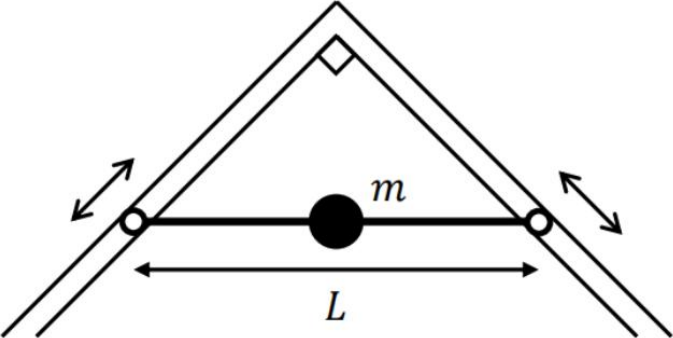
As shown in Figure 7, the ends of a massless, rigid rod of length $L$ are attached to a set of rails which form a right angle to each other. The endpoints of the rod can slide freely without friction on the rails. A mass $m$ is attached to the mid-point of the rod.

Find the period $T$ of small oscillations of the rod about its equilibrium position, and express your answer in terms of $L$, $m$ and $g$.

figure

[3]

Show answer · 显示答案
Final result
  • The period is $T = 2\pi\sqrt{\dfrac{L}{2g}}$.

Worked solutions are in the book.