BPhO R1 S1 · Section 1

Motion

26 questions — reveal each final answer.

2013 · lMotion

Three boats start at time $t=0$ from the corners of an equilateral triangle, of side 50 $\mathrm{km}$, and maintain constant speeds of $30 \mathrm{~km} \mathrm{hr}^{-1}$ during the subsequent motion. They each maintain a heading, clockwise, towards the neighbouring boat. They all eventually meet at P.

Determine:

(i) qualitatively, the evolution of the triangle formed by the three boats

(ii) the velocity components of the three boats in the direction of $P$, as a function of time, $t$, and in the perpendicular directions

(iii) the time, $t_{\mathrm{M}}$, at which they all meet

(iv) the distance travelled by each boat, $D$. [8]

Show answer · 显示答案
Final result
  • Only the radial component $v\cos30^\circ$ shrinks the distance to the centre, so $t_M = d/(v\cos30^\circ)=10/9\,\text{h}$ and $D = vt_M = 33.3\,\text{km}$.

Worked solutions are in the book.
2014 · bMotion

A man, on an open wagon of a train travelling along a straight horizontal track at a constant speed of $10 \mathrm{~ms}^{-1}$, throws a ball into the air in line with the track, that he judges to be at $60^{\circ}$ to the horizontal. A woman standing on the ground observes the ball rise vertically.

How high does the ball rise relative to

(i) the man and;

(ii) the woman? [5]

Show answer · 显示答案
Final result
  • Since the woman sees the ball rise vertically, its ground-frame horizontal velocity is zero, so the man's $10\,\text{m/s}$ horizontal throw component must equal the wagon speed; this fixes $v=20\,\text{m/s}$.

Worked solutions are in the book.

2016 · fMotion

A van, travelling at constant speed of $80 \mathrm{~km} \mathrm{hr}^{-1}$ ( $\mathrm{km} / \mathrm{hour}$ ), passes a car. The car immediately begins to accelerate at a constant rate of $1.2 \mathrm{~m} \mathrm{~s}^{-2}$ and passes the van $0.50 \mathrm{~km}$ further down the road. What is the speed, $v$, of the car when it passes the van? [4]

Show answer · 显示答案
Final result
  • The car is doing $v = 35.7 \, \text{m/s}$ (about $129 \, \text{km/h}$) as it draws level with the van, having begun the manoeuvre at $8.7 \, \text{m/s}$.

Worked solutions are in the book.

2017 · cMotion

A particle moves in a straight line with an intial acceleration of $10 \mathrm{~m} \mathrm{~s}$. The acceleration decreases uniformly with time until, after ten seconds, the acceleration is $5 \mathrm{~m} \mathrm{~s}{ }^{-2}$, and from then on the acceleration remains constant. If the intial velocity is $100 \mathrm{~m} \mathrm{~s}^{-1}$,

(i) find when the velocity has doubled;

(ii) sketch a graph of the velocity against time. [7]

Show answer · 显示答案
Final result
  • The results show that the velocity doubles at $t = 15 \, \text{seconds}$, and the graph provides a visual representation of how the velocity changes over time, first increasing at a decreasing rate, then increasing at a constant rate.

Worked solutions are in the book.

2017 · dMotion

A student standing at a distance $a$ from a vertical wall kicks a ball from ground level with velocity $V$ at an angle $\alpha$ to the horizontal in a plane perpendicular to that of the wall. The ball strikes the wall and rebounds. The coefficient of restitution for the collision is $e=2 / 3$. The ball first strikes the ground at a distance $2 a$ from the wall. $e$ is the ratio of the components of velocity at normal incidence to the wall, before and after collision; $e=\frac{v_{\text {after }}}{v_{\text {before }}} \leq 1$.

Find $a$ in terms of $V, \alpha$ and $g$, the gravitational field strength. [6]

Show answer · 显示答案
Final result
  • The distance is $a = V^2\sin(2\alpha)/(4g)$, which is positive as required; the earlier negative result came from taking the post-bounce horizontal travel as $a$ rather than $2a$.

Worked solutions are in the book.

2017 · fMotion

In this question, distances are measured in nautical miles and speeds in nautical miles per hour. A motor boat sets out at 2 p.m. from a point with position vector $-4 \hat{\mathbf{i}}-5 \hat{\mathbf{j}}$ relative to a marker buoy (where $\hat{\mathbf{i}}$ and $\hat{\mathbf{j}}$ are two fixed perpendicular unit vectors) and travels at a steady speed of magnitude $\sqrt{41}$ in a straight line to intercept a ship $\mathbf{S}$. The ship $\mathbf{S}$ maintains a steady velocity vector $\hat{\mathbf{i}}+4 \hat{\mathbf{j}}$ and at 3 p.m. is at a position $3 \hat{\mathbf{i}}-\hat{\mathbf{j}}$ relative to the buoy. Find

(i) the position vector of the ship at 2 p.m.,

(ii) the velocity vector of the motor boat,

(iii) the time of interception. [7]

Show answer · 显示答案
Final result
  • Because both vessels have the same northward velocity component, the chase reduces to closing the $6$ nautical-mile eastward gap; the boat does so in $1.5$ hours, intercepting at 3:30 p.m. with velocity $5\hat{i}+4\hat{j}$.

Worked solutions are in the book.

2017 · mMotion

Two radio stations on the equator, diametrically opposite each other, communicate by sending and receiving radio signals that are tangential to the Earth's surface via two geostationary satellites in circular orbits at $3.59 \times 10^{4} \mathrm{~km}$ above the Earth's surface. Calculate the time delay between sending and receiving a signal. [6]

Show answer · 显示答案
Final result
  • Each station-to-satellite leg is the tangent length $d=\sqrt{R^2-r^2}$, and the total path is $l=2d+2r\approx9.63\times10^4\,\text{km}$.

Worked solutions are in the book.
2018 · dMotion

The distance in which a train can be stopped is given by:

$$ s=a v+b v^{2} $$

where $s$ is the stopping distance, $v$ the initial velocity, and $a$ and $b$ are constants. When moving at $40 \mathrm{~km} \mathrm{hr}^{-1}$, the train can be stopped in $100 \mathrm{~m}$, and at $80 \mathrm{~km} \mathrm{hr}^{-1}$ it can be stopped in $280 \mathrm{~m} .$

Find the greatest speed such that the train can be stopped in $500 \mathrm{~m}$. [4]

Show answer · 显示答案
Final result
  • The two data points fix $a=1.5$ and $b=1/40$ (in the stated mixed units).

Worked solutions are in the book.

2018 · eMotion

Two planes set out at the same time from an aerodrome. The first flies north at $360 \mathrm{~km} \mathrm{~h}^{-1}$, the second south-east at $300 \mathrm{~km} \mathrm{~h}^{-1}$. After 40 minutes they both turn and fly towards each other. Calculate

(i) the bearing, and

(ii) the distance

of the meeting point from the aerodrome. [7]

Show answer · 显示答案
Final result
  • The meeting point lies about $83.5\,\text{km}$ from the aerodrome on a bearing of $\approx 067.5^\circ$.

Worked solutions are in the book.

2019 · aMotion

A golf ball is struck and begins to move at an initial velocity of $60 \mathrm{~m} \mathrm{~s}^{-1}$ at an angle $40^{\circ}$ above the horizontal. Determine at time $t=3 \mathrm{~s}$ after the strike

(i) the velocity of the ball, and

(ii) the position of the ball relative to the origin. [4]

Show answer · 显示答案
Final result
  • At $t = 3\, \text{s}$, the golf ball has a velocity of $46.9 \, \text{m/s}$ at an angle of $11.2^\circ$ above the horizontal, and it is located at a horizontal distance of $138 \, \text{m}$ and a vertical distance of $71.6 \, \text{m}$ from the origin.

Worked solutions are in the book.

2019 · bMotion

A drone flies horizontally. The displacement of the drone is given by $s=2 t \hat{i}+6 t \hat{j}$, where $\hat{i}$ and $\hat{j}$ are unit vectors to the East and North respectively. Determine at $t=2 \mathrm{~s}$ :

(i) the speed of the drone,

(ii) its bearing in degrees,

(iii) its acceleration.

Note: all bearings are measured clockwise from North. [2]

Show answer · 显示答案
Final result
  • The displacement is linear in $t$, so the velocity $2\hat{i}+6\hat{j}$ is constant and the acceleration is zero.

Worked solutions are in the book.

2019 · hMotion

This question concerns three vessels at sea: a ferry $(\mathbf{F})$, a container ship $(\mathbf{C})$, and a pilot boat $(\mathbf{P})$. The ferry is sailing on a bearing of $090^{\circ}$ at $5 \mathrm{~m} \mathrm{~s}^{-1}$. Relative to the ferry, the container ship is sailing on a bearing of $160^{\circ}$. The pilot boat is sailing on a bearing of $270^{\circ}$ at $7.5 \mathrm{~m} \mathrm{~s}^{-1}$, and the pilot boat observes the container ship moving on a bearing of $120^{\circ}$.

Determine the speed and direction of the container ship relative to the water.

Note: all bearings are measured clockwise from North. [7]

Show answer · 显示答案
Final result
  • Two relative-velocity triangles (container relative to the ferry, and relative to the pilot boat) share the unknown heading $\theta$; the sine rule in each gives two equations, whose solution fixes $\theta \approx 47.7^\circ$ and $V_c \approx 12.4\,\text{m/s}$.

Worked solutions are in the book.
2020 · bMotion

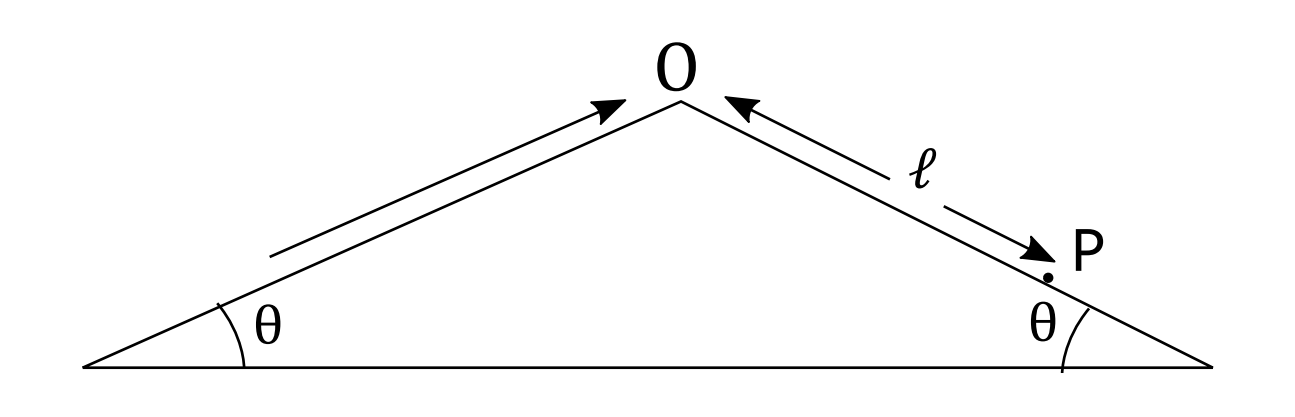
A motorcycle rider is propelled up the left side of a symmetric ramp shown in Figure.

figure

The rider reaches the apex of the ramp at speed of $u$, and falls to a point $\mathbf{P}$ on the descending ramp. In terms of $u, \theta$ and $g$, obtain expressions for,

(i) The time $t_{\mathrm{a}}$ for which the rider is airborne.

(ii) The distance OP $(=\ell)$ along the descending ramp. [4]

Show answer · 显示答案
Final result
  • The airborne time then follows as $t_a = l/u = 4u\sin\theta/g$.

Worked solutions are in the book.

2020 · dMotion

A rugby pitch lies in a north-south direction. In this question $\hat{\mathrm{i}}$ represents a unit vector due east, and $\hat{\mathbf{j}}$ represents a unit vector due north. Rugby player $\mathbf{Y}$ collects the ball and runs with a velocity $(3 \hat{\mathbf{i}}+4 \hat{\mathbf{j}}) \mathrm{m} \mathrm{s}^{-1}$. Player $\mathbf{X}$, starting $20 \mathrm{~m}$ due east of player $\mathbf{Y}$, immediately gives chase at a speed of $8 \mathrm{~m} \mathrm{~s}^{-1}$. She is an expert player and runs in a straight line to intercept player $\mathbf{Y}$. Calculate

(i) the velocity of player $\mathbf{Y}$,

(ii) the time taken for the players to meet, and

(iii) the displacement of $\mathbf{Y}$ from her original position at their point of contact. [4]

Show answer · 显示答案
Final result
  • The interception occurs after about $2.0\,\text{s}$, with Y displaced $(6\hat{i}+8\hat{j})\,\text{m}$, i.e. $10\,\text{m}$ from the start.

Worked solutions are in the book.

2020 · fMotion

A train travels at a constant speed for one hour but is then delayed on the line for half an hour. When it restarts, its speed is reduced to $75 \%$ of its previous speed. It arrives at its destination $1 \frac{1}{2}$ hours later than if it had travelled at its initial speed throughout. If the delay had occurred $45 \mathrm{~km}$ further on, then the train would only have been 1 hour late. Determine,

(i) the distance travelled, and

(ii) the initial speed of the train. [4]

Show answer · 显示答案
Final result
  • The 45 km comparison isolates the speed effect: covering that stretch at $\tfrac34 v$ instead of $v$ costs $\tfrac{45}{0.75v}-\tfrac{45}{v}=\tfrac{15}{v}=0.5\,\text{h}$, fixing $v=30\,\text{km/h}$, after which the first scenario gives $s=120\,\text{km}$.

Worked solutions are in the book.

2021 · cMotion

A ball is thrown vertically upwards with a velocity of $40 \mathrm{~m} \mathrm{~s}^{-1}$. After $1.0 \mathrm{~s}$, a second ball is thrown upwards with a velocity of $60 \mathrm{~m} \mathrm{~s}^{-1}$.

For this question, you may take $g=10 \mathrm{~m} \mathrm{~s}^{-2}$

(i) Sketch, on the same axes, velocity-time graphs for each ball. Take the direction upwards as positive.

(ii) After what time, and at what height do they meet?

(iii) What would be the required time separation between the two balls being thrown if they were to meet at the moment the first ball reached its maximum height? [5]

Show answer · 显示答案
Final result
  • The balls meet $2.17\,\text{s}$ after the first throw at a height of about $63.2\,\text{m}$.

Worked solutions are in the book.

2021 · eMotion

Two aeroplanes A and B travel with velocities $\overrightarrow{\boldsymbol{v}}_{\mathrm{A}}=50 \hat{\mathbf{i}}-125 \hat{\mathbf{j}}$ and $\overrightarrow{\boldsymbol{v}}_{\mathrm{B}}=-90 \hat{\mathbf{i}}+60 \hat{\mathbf{j}}$, where $\hat{\mathbf{i}}$ and $\hat{\mathbf{j}}$ are unit vectors to the east and north respectively, and the values are in units of $\mathrm{m} \mathrm{s}^{-1}$.

(i) Find the relative velocity of plane $\mathbf{A}$ as seen from plane $\mathbf{B}$.

(ii) When time $t=0 \mathrm{~s}$, plane $\mathbf{A}$ has position $\overrightarrow{\boldsymbol{r}}_{\mathrm{A}}=-400 \hat{\mathbf{i}}+1200 \hat{\mathbf{j}}$ and plane $\mathbf{B}$ has position $\vec{r}_{\mathrm{B}}=800 \hat{\mathbf{i}}-600 \hat{\mathbf{j}}$. Find the time and distance of closest approach of the two aeroplanes. [4]

Show answer · 显示答案
Final result
  • In the frame of B, plane A drifts in a straight line at $\overrightarrow{v}_{\text{A/B}} = 140 \hat{\mathbf{i}} - 185 \hat{\mathbf{j}}\,\text{m/s}$; the perpendicular distance from B to that line is the closest approach, $\approx 129\,\text{m}$, reached at $t \approx 9.31\,\text{s}$.

Worked solutions are in the book.

2022 · aMotion

A steel ball is thrown down with a speed of $3.0 \mathrm{~m} \mathrm{~s}^{-1}$ on to a hard surface from a height of $2.0 \mathrm{~m}$. It retains $70 \%$ of its energy on each bounce. Calculate

(i) the speed at which it hits the ground for the first time, and

(ii) the maximum height it reaches after the $4^{\text {th }}$ bounce. [2]

Show answer · 显示答案
Final result
  • Each bounce scales the bounce height by the energy-retention factor $\eta=0.7$, so the heights form a geometric sequence; after four bounces only $0.7^4\approx24\%$ of the original kinetic energy remains.

Worked solutions are in the book.

2022 · jMotion

Observed from an air traffic control tower, an aeroplane has a bearing of $068^{\circ}$ and a range of $43 \mathrm{~km}$. Five minutes later the bearing of the aircraft is $040^{\circ}$ with a range of $52 \mathrm{~km}$. Determine

(i) The speed of the aircraft in $\mathrm{m} \mathrm{s}^{-1}$.

(ii) Its bearing and range 10 minutes after the second sighting. [4]

Show answer · 显示答案

See the book for the worked solution.

Full worked solutions: the book

2023 · cMotion

Distance between village A and village B is $50 \mathrm{~km}$. Helen and Robert decided to cycle from $\mathrm{A}$ to $\mathrm{B}$.
Robert left $\mathrm{A}$ at $8.00 \mathrm{am}$, with a speed of $12 \mathrm{~km} \mathrm{~h}^{-1}$ and made a break of 30 minutes. Helen left at $8.30 \mathrm{am}$, did not take any break and reached $\mathrm{B}$ an hour before Robert. What was Helen's speed? [3]

Show answer · 显示答案
Final result
  • The only subtlety is bookkeeping: Robert's clock includes his $0.5\,\mathrm{h}$ break, Helen starts $0.5\,\mathrm{h}$ later and finishes $1\,\mathrm{h}$ earlier, which strips $2\,\mathrm{h}$ off his $4.667\,\mathrm{h}$ to leave her $3.167\,\mathrm{h}$.

Worked solutions are in the book.

2023 · eMotion

An object falls under gravity. The ratio of the distance fallen by the object in the last second of its fall to the distance covered in the last but one second of its fall is $3: 2$.
(i) Find the height from which the object fell, and
(ii) The speed at which it hit the ground. [3]

Show answer · 显示答案
Final result
  • The distance fallen in the $n$-th second of free fall is $\frac{1}{2}g(2n-1)$, so the ratio of two consecutive seconds is $(2t-1):(2t-3)$; setting this equal to $3:2$ fixed $t=3.5\,\mathrm{s}$, from which $h$ and the impact speed follow directly.

Worked solutions are in the book.

2023 · mMotion

Two ships, $\mathrm{A}$ and $\mathrm{B}$ spot each other at the moment ship $\mathrm{B}$ is due south of $\mathrm{A}$ with a range of 2.0 nautical miles. Ship A is travelling on a bearing $090^{\circ}$ at 5.0 knots, and ship B on a bearing of $030^{\circ}$ at 20 knots. What is their distance of closest approach?
$1 \mathrm{knot}=1$ nautical mile per hour.
A bearing is an angle measured clockwise from $0^{\circ}$ as due north. [5]

Show answer · 显示答案
Final result
  • Working in the frame of A reduces the problem to a single point B moving in a straight line at constant relative velocity; minimising $|\vec{S}_{B\to A}|^2$ then gives the closest approach of $2/\sqrt{13}\approx0.55$ nautical miles.

Worked solutions are in the book.

2024 · aMotion

A stone is dropped from rest from a height of $5.0\,\text{m}$ above the water surface of a pool. After hitting the water, it sinks to the bottom, $4.0\,\text{m}$ below the surface. If it sinks with the same speed as it struck the water, for how long is the stone in motion? [3]

Show answer · 显示答案
Final result
  • The stone is in motion for $T \approx 1.4\,\text{s}$.

Worked solutions are in the book.

2024 · gMotion

A rocket testing machine consists of a track of length $d$, along which a rocket can accelerate uniformly from rest at $15\,\text{m\,s}^{-2}$ up to the end point, where a set of brakes rapidly brings it to rest in a negligible time. It is then drawn back to the start at a constant speed of $v_c = 12\,\text{m\,s}^{-1}$. If the time taken from firing the rocket to its return to the starting point is $48\,\text{s}$, what is the length of the track, $d$? [6]

Show answer · 显示答案
Final result
  • The track length is $d = 480\,\text{m}$.

Worked solutions are in the book.

2025 · cMotion

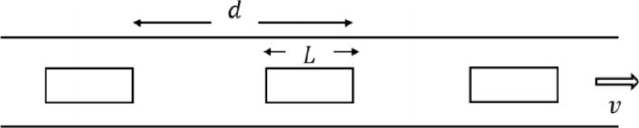
We can develop a simple model for traffic flow as follows; each car has a length $L$ and travels at speed $v$, with the distance between the fronts of two consecutive cars being $d$, as shown in Fig. 2.

figure
Figure 2: Flow of cars each of length $L$ separated by distance $d$ between car fronts.
  1. (i) Give the flow rate $n$ of cars passing a point per unit time in terms of $v$ and $d$.

    Cars brake with a deceleration $a$ and the drivers choose the value of $d$ such that if the car in front were to stop instantaneously, the car behind could brake before hitting the back of the car in front.

  2. (ii) Obtain $d$ in terms of $v$, $a$ and $L$. Ignore the “thinking time”.
  3. (iii) Find an expression for the optimum speed $v$ for maximum flow rate in terms of $L$ and $a$.
[4]

Show answer · 显示答案
Final result
  • The flow rate is $n = v/d$; the safe spacing is $d = v^2/(2a) + L$; and the optimum speed for maximum flow is $v = \sqrt{2aL}$.

Worked solutions are in the book.

2025 · qMotion

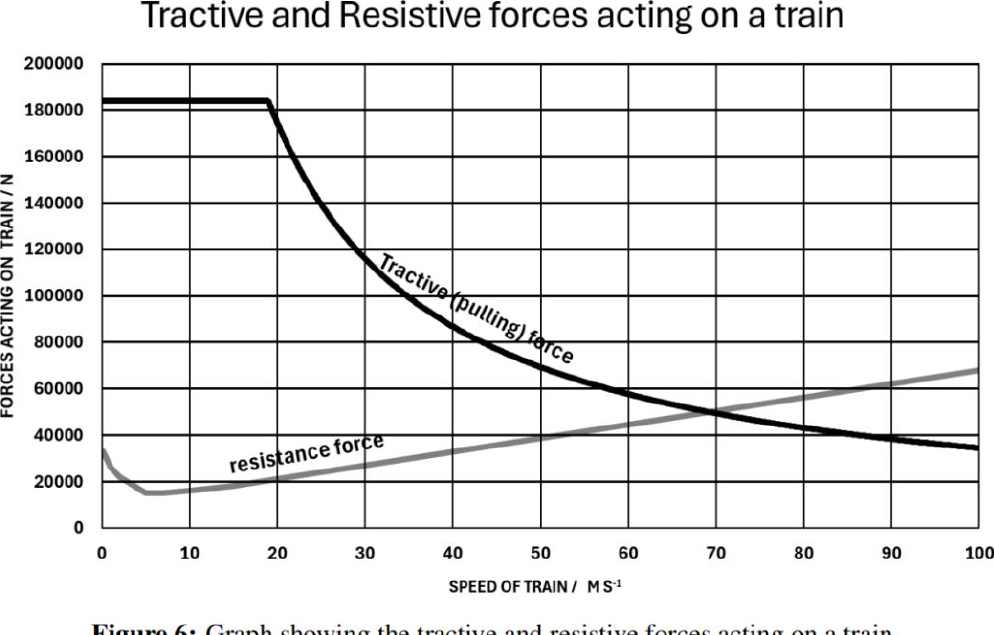
The tractive force of a locomotive is plotted vertically with the speed horizontally in the graph of Fig. 6. Also shown on the same axes is the resistance of the train against its speed. If the weight of the train is 336 tonnes determine approximately the distance travelled before the train reaches its maximum speed.

$$1\ \text{tonne} = 1000\ \text{kg}$$

figure
Figure 6: Graph showing the tractive and resistive forces acting on a train.

[4]

Show answer · 显示答案
Final result
  • The train travels approximately $10\ \text{km}$ before reaching its maximum speed of about $70\ \text{m s}^{-1}$.

Worked solutions are in the book.