BPhO R1 S1 · Section 1

Momentum and Energy

17 questions — reveal each final answer.

2011 · dMomentum and Energy

A proton travelling with a velocity of $3.00 \times 10^{7} \mathrm{~m} \mathrm{~s}^{-1}$ collides with an oxygen nucleus, of mass $2.56 \times 10^{-26} \mathrm{~kg}$ that is at rest, and is scattered through an angle of $90^{\circ}$. Calculate the velocity and direction of the oxygen nucleus using Newtonian mechanics. [12]

Show answer · 显示答案
Final result
  • The oxygen recoils at $\approx 2.68 \times 10^{6}\,\mathrm{m/s}$, $43.1^\circ$ below the incident line.

Worked solutions are in the book.
2011 · lMomentum and Energy

A rescue helicopter of mass $810 \mathrm{~kg}$, supports itself in a stationary position by imparting a downward velocity, $v$, to the air in a circle of radius $4.0 \mathrm{~m}$. The density of the air is $1.20 \mathrm{~kg} \mathrm{~m}^{-3}$.

Calculate:

(i) the value of $v$

(ii) the power, $P$, required to support the helicopter [5]

Show answer · 显示答案
Final result
  • The thrust equals the weight ($F = mg$), but the power $\tfrac{1}{2}mgv \approx 45.7\,\mathrm{kW}$ depends on how fast the air is pushed down.

Worked solutions are in the book.

2012 · iMomentum and Energy

A square metal plate of uniform density has dimensions $3 R \times 3 R$. Its centre is the centre of a Cartesian coordinate system, with axes parallel to the edges of the plate. A complete circular region, radius $R$, is removed from the plate. Determine the position of the centre of gravity of the remaining square plate when the centre of the circular hole is at (i) $(x, 0)$ and (ii) $(x, y)$. [6]

Show answer · 显示答案
Final result
  • Because the full square's centroid is at the origin, the result is simply $-\,M_{\text{circle}}/M_{\text{remaining}}$ times the hole's position, $-\frac{\pi}{9-\pi}(x,y)$ -- the centre of gravity shifts away from the hole, as expected.

Worked solutions are in the book.

2012 · oMomentum and Energy

The value of a device for storing energy can be assessed by the height to which it would rise if all the stored energy were used to propel it upwards under gravity. Calculate the height of the following:

(i) a $12 \mathrm{~V}$ car battery of capacity $60 \mathrm{Ah}$ and mass $20 \mathrm{~kg}$

(ii) a quantity of petrol of calorific value $4 \times 10^{7} \mathrm{~J} / \mathrm{kg}$ [5]

Show answer · 显示答案
Final result
  • The battery reaches about $1.3\times10^4\,\mathrm{m}$ while the petrol reaches about $4.1\times10^6\,\mathrm{m}$ -- some 300 times higher.

Worked solutions are in the book.

2014 · gMomentum and Energy

Explain why the centre of gravity of a triangular plate lies along a median; the line joining a vertex to the midpoint of the opposite side. An equilateral triangular plate, sides of length $b$, has a triangle, formed by two corners and the centre of gravity of the original plate, removed. Determine the centre of gravity of the remaining plate. The centre of gravity of a triangular plate is at a point two thirds along the length of a median measured from the vertex. [7]

Show answer · 显示答案
Final result
  • The remaining plate's centre of gravity sits $\frac{2\sqrt{3}}{9}b \approx 0.385\,b$ above $AB$ -- higher than the original centroid ($\frac{\sqrt{3}}{6}b \approx 0.289\,b$), as expected since material was removed from near the base.

Worked solutions are in the book.

2014 · kMomentum and Energy

A ball of mass $m$ and velocity $u$ collides elastically with a larger ball of mass $M$, initially at rest. The ball of mass $m$ rebounds along its original line of motion with speed $v_{1}$ and the ball of mass $M$ has velocity $v_{2}$ in the direction of $u$.

(i) Write down the conservation equations for the system.

(ii) Deduce the result that $u-v_{1}=v_{2}$. [5]

Show answer · 显示答案
Final result
  • Dividing the energy equation by the momentum equation is the standard trick for 1D elastic collisions; it yields the relative-velocity rule $u = v_1 + v_2$, i.e. the speed of separation ($v_1 + v_2$) equals the speed of approach ($u$).

Worked solutions are in the book.

2016 · nMomentum and Energy

Four masses of $1 \mathrm{~kg}, 4 \mathrm{~kg}, 3 \mathrm{~kg}$, and $4 \mathrm{~kg}$ are arranged cyclically at the corners of a square of side $2 b$ and centre 0 . A thin circular metal ring has radius $a$, mass $8 \mathrm{~kg}$, and with the same centre $O$ lies in the same plane as the square. Determine the position of the centre of mass of the system from 0. [3]

Show answer · 显示答案
Final result
  • Symmetry collapses most of the problem: the ring and the matched $4\,\mathrm{kg}$ masses sit at $O$, so only the unequal $1\,\mathrm{kg}$ and $3\,\mathrm{kg}$ pair shifts the centre of mass, to $\frac{\sqrt{2}}{10}b$ from $O$ along their diagonal (toward the $3\,\mathrm{kg}$ mass).

Worked solutions are in the book.

2017 · eMomentum and Energy

A helicopter of total mass $1000 \mathrm{~kg}$ is able to remain in a stationary position by imparting a uniform downward velocity to a cylinder of air below it of effective diameter $6 \mathrm{~m}$. Assuming the density of air to be $1.2 \mathrm{~kg} \mathrm{~m}^{-3}$, calculate the downward velocity of the air. [5]

Show answer · 显示答案
Final result
  • The thrust is the rate of downward momentum given to the air, $\dot{m}v = (\rho A v)v = \rho A v^2$. Setting this equal to the weight gives $v \approx 17\,\text{m/s}$.

Worked solutions are in the book.

2018 · fMomentum and Energy

A neutron moving through heavy water strikes an isolated and stationary deuteron (the nucleus of an isotope of hydrogen) head-on in an elastic collision.

(i) Assuming the mass of the neutron is equal to half that of the deuteron, find the ratio of the final speed of the deuteron to the initial speed of the neutron.

(ii) What percentage of the initial kinetic energy is transferred to the deuteron?

(iii) How many such collisions would be needed to slow the neutron down from $10 \mathrm{MeV}$ to $0.01 \mathrm{eV}$ ? [6]

Show answer · 显示答案
Final result
  • A single light moderator nucleus is highly effective: the neutron loses $8/9$ of its energy per head-on collision, so the energy falls by a factor $9$ each time and only about ten collisions span the nine orders of magnitude from $10\,\mathrm{MeV}$ to $0.01\,\mathrm{eV}$.

Worked solutions are in the book.

2018 · gMomentum and Energy

A uniform chain of mass per unit length, $\mu$, is suspended from one end above a table, with the lower end just touching the surface. The chain is released, falls and comes to rest on the table without bouncing.

(i) Determine an expression, in terms of $\mu$ and the gravitational field strength $g$, for the reaction force exerted by the table on the chain as a function of time, $t$. Hint: you might consider $F$ in the form $F=\frac{\Delta m}{\Delta t} v$.

(ii) In terms of the total weight $W$ of the chain, what is the maximum reaction force exerted by the table, and at what time during the fall does this occur? [6]

Show answer · 显示答案
Final result
  • Both rise as $t^2$, peaking together at $R_{\text{max}} = 3W$ just as the last link arrives -- three times the static weight -- before the impact term disappears and the reaction falls to $W$.

Worked solutions are in the book.

2019 · lMomentum and Energy

An excited neon-20 isotope travels with a velocity of $3.0 \times 10^{6} \mathrm{~m} \mathrm{~s}^{-1}$ into a detector and disintegrates into an alpha particle and oxygen-16. The event produces an additional 6.25 MeV of kinetic energy. The oxygen nucleus leaves the event at right angles to the path of the original neon nucleus.

Determine the velocity of the alpha particle. Relativistic effects may be neglected. $1 \mathrm{eV}=1.6 \times 10^{-19} \mathrm{~J}$. [5]

Show answer · 显示答案
Final result
  • Because the oxygen leaves perpendicular to the beam, the alpha alone must carry the neon's forward momentum, fixing $V_{\alpha x} = 5V_{Ne}$.

Worked solutions are in the book.

2020 · aMomentum and Energy

Estimate from what height, under free-fall conditions, a heavy stone would need to be dropped if it were to reach the surface of the Earth at the speed of sound of $330 \mathrm{~m} \mathrm{~s}^{-1}$ [2].

Show answer · 显示答案
Final result
  • Both routes give $h = v^2/(2g)$, since the kinematic relation $v^2 = 2gh$ is just energy conservation per unit mass.

Worked solutions are in the book.

2021 · aMomentum and Energy

A railway truck travelling along a level track at $5.0 \mathrm{~m} \mathrm{~s}^{-1}$ collides with a truck of twice the mass moving in the same direction at $2.5 \mathrm{~m} \mathrm{~s}^{-1}$. The trucks couple together and continue moving. Calculate

(i) the final speed of the combined trucks, and

(ii) the percentage of the kinetic energy lost in the collision. [3]

Show answer · 显示答案
Final result
  • Momentum conservation fixes the common final speed, $\frac{10}{3}\,\mathrm{ms}^{-1}$; the kinetic-energy ledger then shows about $11\%$ of the initial energy is dissipated in coupling.

Worked solutions are in the book.

2022 · bMomentum and Energy

A long-distance cyclist uses a cycle computer that is dual-powered: it has an internal battery and a solar panel. While the cyclist is riding in direct sunlight, the solar panel on the computer provides energy at a rate equal to $\frac{1}{3}$ of the power consumption. If a fully-charged cycle computer lasts 10 hours when riding at night, calculate how long a fully charged computer will run for in direct sunlight. [2]

Show answer · 显示答案
Final result
  • Reducing the battery's drain to $\frac{2}{3}$ of its night-time value multiplies the run time by $\frac{3}{2}$, giving 15 hours.

Worked solutions are in the book.

2022 · eMomentum and Energy

A particle of mass $m_{1}$ and initial speed $u$ makes an elastic collision with a stationary particle of mass $m_{2}$. The particles move off at speeds $v_{1}$ and $v_{2}$ respectively, at equal angles $\theta$ either side of the initial incident direction of $m_{1}$.

(i) What is the largest ratio of $\frac{m_{1}}{m_{2}}$ for which this equal angle condition can occur?

(ii) If $m_{1}=m_{2}$, what is the largest angle of deflection, $\theta$, of particle $m_{1}$ for this equal angle condition? [5]

Show answer · 显示答案
Final result
  • The equal-angle constraint forces $m_1 v_1 = m_2 v_2$, and combining this with energy conservation gives the single relation $4\cos^2\theta = 1 + m_1/m_2$.

Worked solutions are in the book.

2024 · fMomentum and Energy

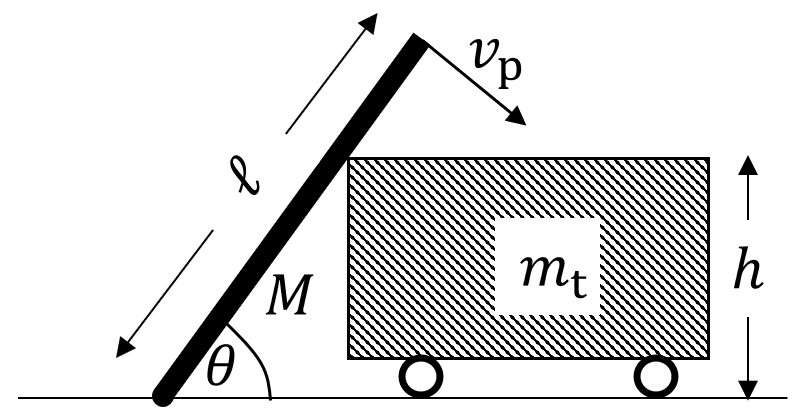
A heavy uniform plank of length $\ell$ and mass $M$ is fixed to the ground at its lower end by a smooth hinge. Initially it stands upright next to a stationary trolley of mass $m_\text{t}$ and height $h$, as shown in Fig. 1. The plank is disturbed and tips over, pushing the trolley along horizontally, with the smooth flat surface of the plank pushing the top rear corner of the trolley. When the plank is falling over, the top end swings in a circle at speed $v_\text{p}$, such that the plank's rotational kinetic energy about the pivot at the lower fixed end is $\tfrac{1}{6}M v_\text{p}^2$. At the moment the top of the plank reaches the top corner of the trolley, obtain an expression for the speed of the trolley, $v_\text{t}$, in terms of $g$ and $h$, given $M = \tfrac{m_\text{t}}{2}$ and $\ell = 3h$. Neglect friction in this question. [4]

figure
Show answer · 显示答案
Final result
  • The trolley's speed when the plank lays it flat against its corner is $v_\text{t} = \sqrt{\tfrac{2}{5}gh}$.

Worked solutions are in the book.

2025 · jMomentum and Energy

Weights $m_1$ and $m_2$ hung from a massive chain with a mass of $\lambda$ per unit length on a light frictionless pulley. The system is released from rest with the weights initially level, and then $m_1$ reaches the floor ($m_1 > m_2$). By considering the energy of the system, for what ratio of masses $\dfrac{m_1}{m_2}$ does the value of the mass of the chain not make any difference? [4]

Show answer · 显示答案
Final result
  • When $m_1/m_2 = 3$ (i.e. $m_1 = 3m_2$), the chain's contribution scales identically in the numerator and denominator, so $v$ at landing is the same regardless of how heavy the chain is.

Worked solutions are in the book.