BPhO R1 S1 · Section 1

Heat and Heat Transfer

16 questions — reveal each final answer.

2011 · hHeat and Heat Transfer

A beaker is fitted with a heating coil and stirrer and contains $40.0 \mathrm{~cm}^{3}$ of liquid A. When the power dissipated in the heating coil is $4.80 \mathrm{~W}$, the temperature of the contents rises from $15.0^{\circ} \mathrm{C}$ to $35.0^{\circ} \mathrm{C}$ in $400 \mathrm{~s}$. The experiment is repeated using $20.0$ $\mathrm{cm}^{3}$ of liquid A mixed with $20.0 \mathrm{~cm}^{3}$ of liquid B. It is found that, with a heater power of $4.90 \mathrm{~W}$, the temperature again rises from $15.0^{\circ} \mathrm{C}$ to $35.0^{\circ} \mathrm{C}$ in $400 \mathrm{~s}$.

Determine

(i) the specific heat capacity, $s$, of B and

(ii) the heat lost, $H$, in both experiments.

Density of A is $1.60 \times 10^{3} \mathrm{~kg} \mathrm{~m}^{-3}$, Specific heat capacity of A is $8.60 \times 10^{2} \mathrm{~J} \mathrm{~kg}^{-1} \mathrm{~K}^{-}$ Density of B is $2.00 \times 10^{3} \mathrm{~kg} \mathrm{~m}^{-3}$ [6]

Show answer · 显示答案
Final result
  • The specific heat capacity of liquid B is $738 \, \mathrm{J} \, \mathrm{kg}^{-1} \, \mathrm{K}^{-1}$, and the heat lost is $819.2 \, \mathrm{J}$ in each experiment.

Worked solutions are in the book.
2012 · gHeat and Heat Transfer

To determine the specific heat capacity, $s$, of a liquid flowing at a constant rate of $0.060 \mathrm{~kg} \mathrm{~min}^{-1}$ down a pipe, heat from an electrical supply is maintained at the rate of $12 \mathrm{~W}$. It produces a temperature rise of $2.0 \mathrm{C}$ along the flow. Calculate $\mathrm{s}$. [2]

Show answer · 显示答案
Final result
  • The specific heat capacity is $s = P/(\dot m\,\Delta T) = 6000 \, \mathrm{J\,kg^{-1}\,{}^\circ C^{-1}}$.

Worked solutions are in the book.

2016 · gHeat and Heat Transfer

A calorimeter contains $0.800 \mathrm{~kg}$ of water at a temperature of $15.0^{\circ} \mathrm{C}$. The heat capacity of the calorimeter is $42.8 \mathrm{~J}^{\circ} \mathrm{C}^{-1} .0 .400 \mathrm{~kg}$ of molten lead is poured into the calorimeter. The final equilibrium temperature is $25.0^{\circ} \mathrm{C}$. What was the initial temperature of the lead?

The specific heat of molten lead is $158 \mathrm{~J} \mathrm{~kg}^{-1}{ }^{\circ} \mathrm{C}^{-1}$, the specific heat of solid lead is $137 \mathrm{~J}$ $\mathrm{kg}^{-1}{ }^{\circ} \mathrm{C}^{-1}$ and the specific latent heat is $2.323 \times 10^{4} \mathrm{~J} \mathrm{~kg}^{-1}$. Lead freezes at $327^{\circ} \mathrm{C}$. The specific heat of water is $4200 \mathrm{~J} \mathrm{~kg}^{-10} \mathrm{C}^{-1}$. [5]

Show answer · 显示答案
Final result
  • The lead arrives molten, so its heat release has three parts: cooling the liquid to the freezing point $327^\circ\text{C}$ ($Q_2$), solidifying ($Q_3 = mL$), then cooling the solid to $25^\circ\text{C}$ ($Q_4$).

Worked solutions are in the book.

2017 · gHeat and Heat Transfer

In a factory heating system, water enters the radiators at $60^{\circ} \mathrm{C}$ and leaves at $38^{\circ} \mathrm{C}$. The system is replaced by one in which steam at $100^{\circ} \mathrm{C}$ is condensed in the radiators, the condensed steam leaving at $82^{\circ} \mathrm{C}$. What mass of steam will supply the same heat energy as $1.00 \mathrm{~kg}$ of hot water described in the first instance? (The latent heat of vaporisation of water is $2.260 \times 10^{6} \mathrm{~J} \mathrm{~kg}^{-1}$ at $100^{\circ} \mathrm{C}$. The specific heat capacity of water is $4200 \mathrm{~J} \mathrm{~kg}^{-1} \mathrm{C}^{-1}$). [4]

Show answer · 显示答案
Final result
  • So, 39.6 grams of steam will supply the same amount of heat energy as 1.00 kg of hot water in the first instance.

Worked solutions are in the book.

2017 · rHeat and Heat Transfer

A pond is covered by a layer of ice $5 \mathrm{~cm}$ thick. How long will it be before the ice is $10 \mathrm{~cm}$ thick if the air temperature stays constant at $-10^{\circ} \mathrm{C}$ ?

Assume the density of ice $=900 \mathrm{~kg} \mathrm{~m}^{-3}$; the latent heat of fusion of ice $=330 \mathrm{~kJ} \mathrm{~kg}^{-1}$; the thermal conductivity of ice $=2.1 \mathrm{~W} \mathrm{~m}{ }^{-1} \mathrm{~K}^{-1}$.

The power flowing perpendicular to the faces through a uniform material is given by power flow $P=\lambda A \frac{\left(T_{\mathrm{H}}-T_{\mathrm{C}}\right)}{x}$, in which $\lambda$ is the thermal conductivity of the material, $T_{\mathrm{H}}$ is the hotter temperature at one face of the material, $T_{\mathrm{C}}$ is the colder temperature on the other face, $A$ is the area of a face, and $x$ is the thickness of the material. [7]

Show answer · 显示答案
Final result
  • The time it takes for the ice to thicken from 5 cm to 10 cm is 14.7 hours, assuming the air temperature remains constant at -10 °C.

Worked solutions are in the book.

2018 · mHeat and Heat Transfer

A volume of $80 \mathrm{~cm}^{3}$ of water in a copper calorimeter of mass $150 \mathrm{~g}$ takes 12 minutes to cool from $40^{\circ} \mathrm{C}$ to $15^{\circ} \mathrm{C}$ in a cold room. The same volume of ethanol of density $0.8 \mathrm{~g} \mathrm{~cm}^{-3}$ takes 8 minutes to cool also from $40^{\circ} \mathrm{C}$ to $15^{\circ} \mathrm{C}$ in the same calorimeter in the same circumstances. Calculate the specific heat capacity of ethanol.

The specific heat capacity of copper $=400 \mathrm{~J} \mathrm{~kg}^{-1}{ }^{\circ} \mathrm{C}^{-1}$ and of water $=4200 \mathrm{~J} \mathrm{~kg}^{-1}{ }^{\circ} \mathrm{C}^{-1}$.

The density of water, $\rho_{\mathrm{w}}=1.0 \mathrm{~g} \mathrm{~cm}^{-3}$. [5]

Show answer · 显示答案
Final result
  • The specific heat capacity of ethanol is about $3190 \, \text{J kg}^{-1 \circ} \mathrm{C}^{-1}$, below that of water.

Worked solutions are in the book.

2019 · gHeat and Heat Transfer

One kilogram of ice at $0{ }^{\circ} \mathrm{C}$ is placed in a thermally insulated bucket of volume 5 litres. Water at $15^{\circ} \mathrm{C}$ is added until the bucket is completely filled. Calculate the temperature of the water when half of the ice has melted.

1 litre $=1000 \mathrm{~cm}^{3}$

Latent heat of fusion of ice, $L_{\text {ice }}=3.34 \times 10^{5} \mathrm{~J} \mathrm{~kg}^{-1}$

Specific thermal capacity of water, $c_{\text {ice }}=4180 \mathrm{~J} \mathrm{~kg}^{-1} \mathrm{~K}^{-1}$

Densities: $\rho_{\text {ice }}=920 \mathrm{~kg} \mathrm{~m}^{-3}$ and $\rho_{\text {water }}=1000 \mathrm{~kg} \mathrm{~m}^{-3}$ [5]

Show answer · 显示答案
Final result
  • The final temperature is $4.25^\circ\text{C}$.

Worked solutions are in the book.

2019 · rHeat and Heat Transfer

The thermal power flowing by conduction through a surface is proportional to the temperature difference across the surface, $\Delta \theta$, the area of the surface, $A$ and inversely proportional to the thickness $\Delta x$. The constant of proportionality is known as the thermal conductivity.

A $60 \mathrm{~cm}$ composite rod, of constant cross section, is made of $20 \mathrm{~cm}$ lengths of steel, copper and aluminium joined together. The rod is well insulated. The tip of the steel end of the rod is maintained at $100^{\circ} \mathrm{C}$ and the tip of the aluminium end, at $0{ }^{\circ} \mathrm{C}$. What are the temperatures at each of the two junctions of dissimilar metals?

Thermal conductivities are as follows: steel $60 \mathrm{Wm}^{-1} \mathrm{~K}^{-1}$; copper $400 \mathrm{Wm}^{-1} \mathrm{~K}^{-1}$; aluminium $240 \mathrm{~W} \mathrm{~m}^{-1} \mathrm{~K}^{-1}$. [5]

Show answer · 显示答案
Final result
  • The junction temperatures are $28.57^\circ C$ (steel/copper) and $17.86^\circ C$ (copper/aluminium).

Worked solutions are in the book.

2020 · nHeat and Heat Transfer

The petrol engine of a car consumes $5.3$ litres of petrol for every $100 \mathrm{~km}$ travelled at a speed of $100 \mathrm{~km} \mathrm{~h}^{-1}$ with the outside temperature being $16^{\circ} \mathrm{C}$. The heat of combustion of the petrol is $30 \mathrm{MJ}$ per litre, and $23 \%$ of this energy finds its way to the water cooling system. Calculate the mass rate of flow of cooling water such that the temperature rise of the cooling water is limited to $40^{\circ} \mathrm{C}$.

Specific thermal capacity of water $=4180 \mathrm{~J} \mathrm{~kg}^{-1}{ }^{\circ} \mathrm{C}^{-1}$. [4]

Show answer · 显示答案
Final result
  • The required cooling-water flow rate is about $0.10 \, \text{kg/s}$.

Worked solutions are in the book.

2020 · oHeat and Heat Transfer

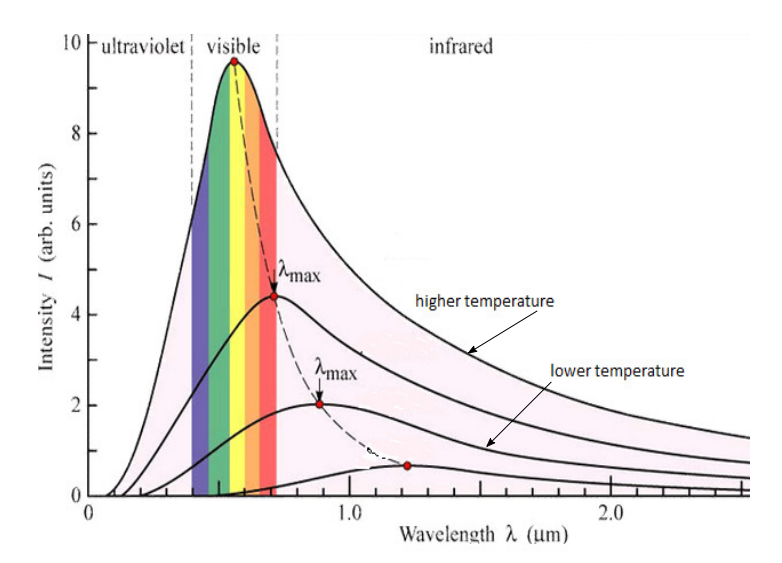
Stefan's Law states that for a given perfectly radiating surface at an absolute temperature $T$, the radiated power $\Phi$ is directly proportional to $T^{4}$. The radiated energy is distributed over a range of wavelengths of electromagnetic radiation, with the peak in emission occurring at $\lambda_{\max }$, as shown in Figure. The value of $\lambda_{\max }$ is determined by Wien's Law which states $\lambda_{\max }$ is inversely proportional to absolute temperature. Determine:

(i) The ratio of the radiative powers of the surface at $500^{\circ} \mathrm{C}$ and $1000^{\circ} \mathrm{C}$, i.e. evaluate $\Phi_{1000} / \Phi_{500}$,

(ii) the wavelength of maximum emission at $1000^{\circ} \mathrm{C}$ if the wavelength of maximum emission at $500^{\circ} \mathrm{C}$ is $3750 \mathrm{~nm}$. [4]

figure
Show answer · 显示答案
Final result
  • Doubling the Celsius temperature raises the radiated power by a factor of $7.35$ (Stefan's $T^4$ law in kelvin, not celsius), while the peak wavelength shifts down from $3750\,\text{nm}$ to $\approx 2280\,\text{nm}$ (Wien's inverse-$T$ law).

Worked solutions are in the book.

2021 · fHeat and Heat Transfer

Water flows at a steady rate of 1.0 litre $\mathrm{min}^{-1}$ through a pipe in which there is an electrical heater connected to a $230 \mathrm{~V}$ supply. The rise in temperature of the water after passing through the heater is $60^{\circ} \mathrm{C}$. Calculate the resistance of the heater. Assume no heat loss to the surroundings. [3]

$$1 \text { litre }=1000 \mathrm{~cm}^{3}$$ $$\text { Density of water is } 1000 \mathrm{~kg} \mathrm{~m}^{-3}$$

Show answer · 显示答案
Final result
  • The resistance of the heater is about $12.6 \, \Omega$.

Worked solutions are in the book.

2021 · gHeat and Heat Transfer

Dry steam at $100^{\circ} \mathrm{C}$ is passed into $0.250 \mathrm{~kg}$ of water at $0^{\circ} \mathrm{C}$ contained in a calorimeter whose thermal capacity is equivalent to $0.010 \mathrm{~kg}$ of water. When the temperature is $30^{\circ} \mathrm{C}$ it is found that $0.0128 \mathrm{~kg}$ of steam have condensed. Calculate the specific latent heat of steam.

Specific latent heat of ice =334 $\mathrm{~kJ} \mathrm{~kg}^{-1}$ [4]

Show answer · 显示答案
Final result
  • The specific latent heat of steam is about $2.26 \times 10^3 \, \text{kJ/kg}$, agreeing with the standard value ($\approx 2256\,\text{kJ/kg}$).

Worked solutions are in the book.

2021 · hHeat and Heat Transfer

The expansion of a metal rod varies linearly with temperature, in the form of

$$ \ell=\ell_{0}(1+\alpha \Delta T) $$

where $\ell_{0}$ and $\ell$ are the initial and final lengths respectively, $\Delta T$ is the temperature change, and $\alpha$ is the coefficient of linear expansion.

An iron rod is $1.00 \mathrm{~m}$ at $0^{\circ} \mathrm{C}$. What is the length of a copper rod at $0^{\circ} \mathrm{C}$ if the difference between its length and that of the iron rod is not to vary with temperature? [3]

Coefficient of expansion of copper, $\alpha_{\mathrm{Cu}}=17.0 \times 10^{-6{ }^{\circ}} \mathrm{C}^{-1}$

Coefficient of expansion of iron, $\alpha_{\mathrm{Fe}}=11.9 \times 10^{-6{ }^{\circ}} \mathrm{C}^{-1}$

Show answer · 显示答案
Final result
  • The difference $\ell_{\text{Fe}}-\ell_{\text{Cu}}$ is temperature-independent only when the absolute expansions match, i.e. $\ell_{0,\text{Fe}}\alpha_{\text{Fe}} = \ell_{0,\text{Cu}}\alpha_{\text{Cu}}$. This gives $\ell_{0,\text{Cu}} \approx 0.700 \, \text{m}$; the higher-expansion copper must be shorter to compensate.

Worked solutions are in the book.

2022 · iHeat and Heat Transfer

An open topped steel drum is completely filled with oil on a day when the temperature is $5.0^{\circ} \mathrm{C}$. On a warm day the temperature rises, and $2.4 \%$ of the oil spills out. What is the temperature reached on that day?

The volume coefficient of expansion of oil is $7.0 \times 10^{-4}{ }^{\circ} \mathrm{C}^{-1}$

The linear coefficient of expansion of steel is $1.2 \times 10^{-5{ }^{\circ}} \mathrm{C}^{-1}$ [3]

Show answer · 显示答案
Final result
  • The oil spills because it expands more than the drum it sits in; the relevant quantity is the difference of the two volume coefficients, with the steel linear coefficient tripled to $\beta_{\text{drum}}=3\alpha$.

Worked solutions are in the book.

2022 · oHeat and Heat Transfer

The Stefan-Boltzmann law says that the emitted power of a spherical "black body", $P$, is related to the radius, $R$, and absolute surface temperature, $T$, as $P \propto R^{2} T^{4}$. Wien's "displacement law" says that the wavelength $\lambda_{\text {max }}$ corresponding to the peak value of the emitted power of this spectrum is inversely proportional to the absolute surface temperature. The Sun currently has its peak wavelength as $500 \mathrm{~nm}$.

What will be the new peak wavelength when it becomes a red giant, given its radius will be 200 times larger and its power output 4000 times larger? [3]

Show answer · 显示答案
Final result
  • The calculations show that when the Sun becomes a red giant, its peak wavelength will shift to approximately 889 nm, moving it into the infrared part of the spectrum.

Worked solutions are in the book.

2024 · jHeat and Heat Transfer

Pure water can be cooled down to $-10\,^\circ\mathrm{C}$ without freezing. If a small piece of ice is dropped into this supercooled water held in a thermally insulated container, some of the water immediately freezes. What fraction will freeze? $$L_{\text{ice}} = 335\,000 \ \mathrm{J\,kg^{-1}}$$ $$c_{\text{water}} = 4180 \ \mathrm{J\,kg^{-1}\,{}^\circ C^{-1}}$$ [3]

Show answer · 显示答案
Final result
  • About $0.125$, or roughly $12.5\%$, of the water freezes.

Worked solutions are in the book.