BPhO R1 S1 · Section 1

Fluids

12 questions — reveal each final answer.

2012 · lFluids

A tank contains water to a depth of $1.0 \mathrm{~m}$. Water emerges from a small hole in the vertical side of the tank at $20 \mathrm{~cm}$ below the surface. Determine:

(i) the speed at which the water emerges from the hole

(ii) the distance from the base of the tank at which the water strikes the floor on which the tank is standing. [5]

Show answer · 显示答案
Final result
  • The jet leaves at $1.98\,\mathrm{m/s}$ and lands $0.80\,\mathrm{m}$ from the base.

Worked solutions are in the book.
2013 · cFluids

(i) A uniform vertical tube, open at the lower end and sealed at the upper end, is lowered into sea water, trapping air in the tube. When the tube is submerged to a depth of $10.0 \mathrm{~m}$, sea water has exactly filled the lower half of the tube. To what depth must the tube be lowered so that sea water fills $90 \%$ of the tube?

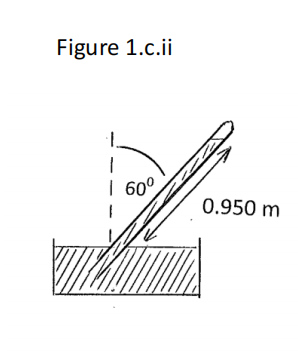
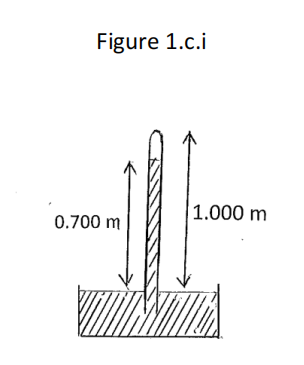
(ii) A mercury barometer has some air above the mercury, Figure 1.c.i. The top of the barometer is $1.000 \mathrm{~m}$ above the level of the mercury in the reservoir. When the tube is vertical the height of the mercury column is $0.700 \mathrm{~m}$. When the tube is inclined at $60^{\circ}$ to the vertical, Figure 1.c.ii, the reading of the mercury level is $0.950 \mathrm{~m}$. What is the atmospheric pressure in $\mathrm{mm}$ of mercury? [6]

figure
figure
Show answer · 显示答案
Final result
  • In (i), Boyle's law gives $A = 10\rho g$ (so atmospheric pressure equals about $10\,\mathrm{m}$ of sea water) and a depth of $90\,\mathrm{m}$ to compress the air to one tenth of the tube.

Worked solutions are in the book.
2013 · iFluids

A beaker, containing some water, has a total mass of $0.300 \mathrm{~kg}$. The beaker rests on a weighing scale. A $250 \mathrm{~g}$ copper sphere, density $8.93 \times 10^{3} \mathrm{~kg} \mathrm{~m}^{-3}$, is suspended so that it is completely immersed in the water, but does not touch the bottom of the beaker. What is the reading on the weighing scale in newtons? The density of water is $1.00 \times 10^{3} \mathrm{~kg} \mathrm{~m}^{-3}$. [3]

Show answer · 显示答案
Final result
  • The scale therefore reads the beaker-plus-water weight plus the buoyancy, $2.943 + 0.275 \approx 3.22\,\mathrm{N}$.

Worked solutions are in the book.

2014 · hFluids

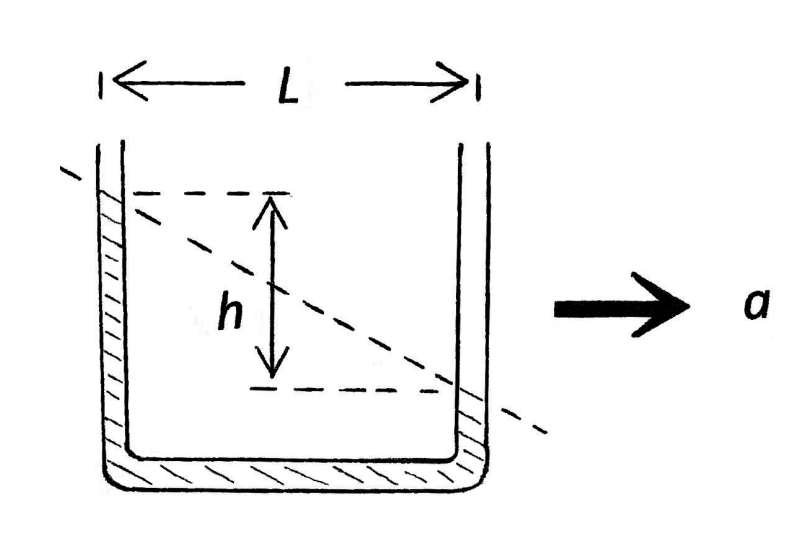
A vertical U-tube, partially filled with liquid, is accelerated vertically upwards in a lift, acceleration $\alpha$. What is the effective value of ' $g$ ', $g_{v}$ ? If the U-tube is mounted in a vehicle accelerating in a horizontal straight line, acceleration $a$, what is the effective $' \boldsymbol{g}$ ',$g_{h}$ ? Express $a$ in terms of the distance between the arms of the Utube, $L$, and the difference in heights, $h$, of the liquid in the arms. [7]

figure
Show answer · 显示答案
Final result
  • Horizontal acceleration tilts effective gravity, and the surface tilts to match; measuring the resulting height difference $h$ over the arm separation $L$ directly yields $a = (h/L)g$.

Worked solutions are in the book.

2018 · lFluids

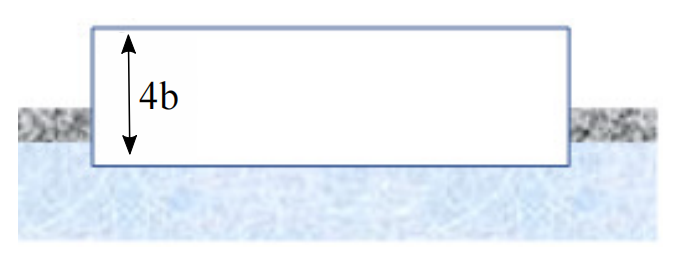
A pond containing water of density $\rho$ is covered to a depth $b$ by oil of density $\frac{2}{3} \rho$. A long wood block of square cross section $4 b \times 4 b$, with the same density as the oil, floats in the pond, as shown in Figure. What fraction of the wood block is immersed below the surface oil level? [4]

figure
Show answer · 显示答案
Final result
  • The block settles with $3/4$ of its height submerged, leaving a freeboard of $b$ above the oil surface.

Worked solutions are in the book.

2019 · fFluids

Platinum (symbol Pt) and potassium (symbol K) have densities of $21.5 \mathrm{~g} \mathrm{~cm}^{-3}$ and $0.89 \mathrm{~g} \mathrm{~cm}^{-3}$ respectively. How many cubic centimetres $\left(\mathrm{cm}^{3}\right)$ of platinum could be attached to $10.0 \mathrm{~cm}^{3}$ of potassium before the combination sinks in mercury of density $13.6 \mathrm{~g} \mathrm{~cm}^{-3}$ ? Ignore any chemical reactions. [4]

Show answer · 显示答案
Final result
  • Equating displaced-mercury weight to total weight gives the tipping point at $V_{Pt}\approx16.1\,\mathrm{cm^3}$.

Worked solutions are in the book.

2019 · jFluids

An experiment is proposed which involves submerging a ball of mass $m$ and radius $r$ to a depth of $d \gg r$ in a swimming pool. The ball is then released, and emerges from the water and rises to a height $h \gg r$ above the surface. The quantities $d$ and $h$ are measured from the centre of the ball to the water surface. An initial model is proposed, which ignores any resistive effects and the inertia of the water. Determine the prediction this initial model makes for the ratio $h / d$ in terms of $m, r$ and the density of water, $\rho$. [5]

Show answer · 显示答案
Final result
  • The same constant net force (buoyancy minus weight) acts over the rise underwater as gravity acts over the rise in air, so $h/d$ equals the ratio of those forces, $\rho V/m - 1$.

Worked solutions are in the book.

2021 · nFluids

An aluminium block $5.0 \mathrm{~cm} \times 5.0 \mathrm{~cm} \times 10 \mathrm{~cm}$ is attached to a newton-meter that records a weight of $6.6 \mathrm{~N}$. A beaker of water sits on a mass balance and records a mass of $600 \mathrm{~g}$. The aluminium block is then lowered into the water and completely submerged without touching the sides of the beaker. What is

(i) the new reading on the newton-meter, and

(ii) the new reading on the mass balance?

Density of water is $1000 \mathrm{~kg} \mathrm{~m}^{-3}$. [4]

Show answer · 显示答案
Final result
  • The newton-meter falls by the buoyant force to $4.15\,\text{N}$, and the balance rises by the same force (expressed as mass) to $850\,\text{g}$.

Worked solutions are in the book.

2022 · gFluids

A cylindrical container is filled with equal volumes of $n$ different liquids which do not mix, so that they form horizontal layers each of height $h$. The densities of the liquids are $\rho, 2 \rho, 3 \rho, \cdots$, with the lowest liquid of density $n \rho$. The curved surface area of the cylinder enclosing each liquid is $A$.

(i) Give an expression for the force $F_{1}$ on the area $A$ surrounding the top liquid in terms of $\rho, g, h, A$.

(ii) What is the force $F_{2}$ on the surface $A$ surrounding the second liquid down from the top, in terms of $F_{1}$ ?

(iii) Give an expression for the force $F_{n}$ on the area $A$ surrounding the $n^{\text {th }}$ liquid at the bottom of the cylinder in term of $F_{1}$ ?

Hint : $1+2+3+\cdots+n=\sum_{i=1}^{n} i=\frac{n}{2}(n+1)$ [4]

Show answer · 显示答案
Final result
  • Each band feels the pressure at its centre, and because the layer densities increase as $1,2,\dots,n$ the running pressure grows quadratically, giving the compact result $F_n = n^2 F_1$.

Worked solutions are in the book.

2023 · sFluids

Two balls $\mathrm{A}$ and $\mathrm{B}$ of masses and volumes $m_{\mathrm{A}}, V_{\mathrm{A}}$ and $m_{\mathrm{B}}, V_{\mathrm{A}}$ respectively are attached to the ends of a light thread. The thread is hung over a freely moving pulley above a beaker of water. The pulley is lowered so that $\mathrm{B}$ is fully submerged and ball $\mathrm{A}$ floats on the water. $V_{\mathrm{A}}=1000 \mathrm{~cm}^3, m_{\mathrm{A}}=500 \mathrm{~g}, V_{\mathrm{B}}=50 \mathrm{~cm}^3$ and $m_{\mathrm{B}}=390 \mathrm{~g}$.
(i) Sketch a diagram showing the forces on each object in the system.
(ii) What fraction $f$ of the volume of $\mathrm{A}$ is submerged below the water surface?
Suppose that a short section of the thread is replaced by a spring of negligible mass of spring constant $k=100 \mathrm{Nm}^{-1}$.
(iii) By how much is the spring extended?
Density of water $\rho=1.0 \mathrm{~g} \mathrm{~cm}^{-3}$ [6]

Show answer · 显示答案
Final result
  • $(ii)\ f=0.16$ (16% submerged); $(iii)\ x\approx3.34\,\mathrm{cm}$. Corrected — the reference sentence incorrectly says tension pins B down; tension acts upward on both balls; see the interactive walkthrough.

Worked solutions are in the book.

2024 · oFluids

A cone of circular cross section sits in a liquid of density $\rho_\ell$ with apex pointing down and its base level with the surface of the liquid. The density of the cone varies linearly along its length. The base of the cone has a density $\rho_b$ half that of the liquid. What is the ratio of the density of the apex, $\rho_a$, to the density of the liquid? [6]

Show answer · 显示答案
Final result
  • The required ratio is $\rho_a/\rho_\ell = 5/2$.

Worked solutions are in the book.

2025 · dFluids

A metal sphere of radius $2.0\,\text{cm}$ was embedded in an ice cube with a side length $10\,\text{cm}$ floating in a bowl of water. The bowl of water was completely full (i.e., adding any more water would cause it to spill). After the ice cube had completely melted, the water level of the bowl dropped. To make the bowl full again, $60\,\text{mL}$ of water had to be added. The densities of water and ice are $1.0\,\text{g\,cm}^{-3}$ and $0.90\,\text{g\,cm}^{-3}$ respectively.

  1. (i) Find the density of the metal.
  2. (ii) Suppose the metal sphere remained embedded in the ice cube throughout the melting process. What fraction of the ice cube's volume had melted when the ice cube just sank to the bottom of the bowl?
[6]

Show answer · 显示答案
Final result
  • The metal density is $\rho_s \approx 2.79\,\text{g\,cm}^{-3}$ (consistent with aluminium), and about $38\%$ of the ice has melted when the cube just sinks.

Worked solutions are in the book.