BPhO R1 S1 · Section 1

Electric Field and Potential

12 questions — reveal each final answer.

2011 · iElectric Field and Potential

The electron gun of a cathode ray tube consists of a small hot filament $\mathrm{F}$ which is located at $x=0$, Figure, and which produces electrons in the $\mathrm{x}-\mathrm{y}$ plane of the page with a very small range of velocities. A typical electron has velocity components $v_{x}$ and $v_{y}$. Between $x=0$ and $x=d$ there is a horizontal uniform electric field, $E$, which accelerates the electrons produced at the filament to velocities which are much greater than $v_{x}$ and $v_{y}$. The electrons emerge from the field, beyond $x=d$, travelling in straight lines. Show that the paths of the emerging electrons, when projected back, appear to have come from a point along the axis at approximately $x=-d$. [6]
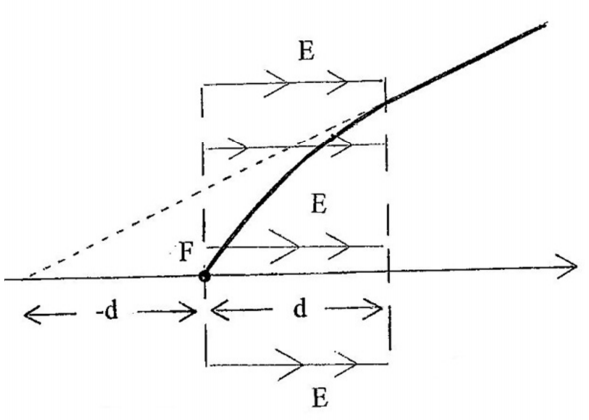
figure
Show answer · 显示答案
Final result
  • The result $x=-d$ is exact in the limit $v_x' \gg v_x$: because a uniformly accelerated body covers half the distance of one moving at its final speed for the same time, the back-projection overshoots the entry point by exactly $d$.

Worked solutions are in the book.
2012 · nElectric Field and Potential

A closed wire loop in the form of a square of side $4.0 \mathrm{~cm}$ is placed with its plane perpendicular to a uniform magnetic field, which is increasing at the rate of $0.030 \mathrm{Ts}^{-1}$. The loop has a resistance of $2.0 \times 10^{-3} \mathrm{ohms}$. Calculate the current induced in the loop, and explain, with the aid of a diagram, the relation between the direction of the induced current and the direction of the magnetic field. [4]

Show answer · 显示答案
Final result
  • In summary, the induced current in the loop is $24 \, \mathrm{mA}$ and flows in a direction that opposes the increasing magnetic field, as per Lenz's Law.

Worked solutions are in the book.

2013 · eElectric Field and Potential

One gram of hydrogen atoms is separated into electrons and protons. The electrons are deposited on the Moon, the protons remaining on the Earth. What, numerically, is the force that results? The Earth - Moon distance is $R_{E M}=3.84 \times 10^{8} \mathrm{~m}$. [5]

Show answer · 显示答案
Final result
  • Separating the charges of just one gram of hydrogen and placing them an Earth--Moon distance apart produces a force of about $565 \, \mathrm{N}$.

Worked solutions are in the book.

2013 · gElectric Field and Potential

A mixed beam of deuterons (an isotope of hydrogen, ${ }^{2} \mathrm{H}^{+}$) and protons, which have been accelerated through $1.00 \times 10^{4} \mathrm{~V}$, enter a uniform magnetic field of $0.500 \mathrm{~T}$ in a direction at right angles to the field. Calculate the separation of the proton beam from the deuteron beam when each has described a semicircle in the field. [6]

Show answer · 显示答案
Final result
  • The separation is $0.024 \, \mathrm{m}$.

Worked solutions are in the book.

2015 · mElectric Field and Potential

Two well separated identical conducting spheres of radius $10.0 \mathrm{~cm}$ are charged to $+200 \mathrm{~V}$ and $+400 \mathrm{~V}$. If they are joined by a long wire, how much heat is generated? [10]

Show answer · 显示答案
Final result
  • The spheres settle at the common potential $300 \, \text{V}$, and $1.11 \times 10^{-7} \, \text{J}$ is dissipated as heat in the connecting wire.

Worked solutions are in the book.

2016 · aElectric Field and Potential

Sketch the electric field lines due to two point charges, of magnitudes $+Q$ and $+2 Q$, at $\mathrm{A}$ and $\mathrm{B}$, separated by a distance $d$.

(i) Determine the location of the neutral point, $P$, where the electric field is zero.

(ii) Why does the magnitude of the electric field vary along a field line? [5]

Show answer · 显示答案

See the book for the worked solution.

Full worked solutions: the book

2016 · iElectric Field and Potential

Uncharged metallic spheres of radii $6 R, 3 R$ and $2 R$ are mounted on insulated stands. The spheres of radii $2 R$ and $6 R$ are charged to a potential $V$ above earth potential. All three spheres are then briefly joined by a copper wire. What, in terms of $V$, is the subsequent potential of the sphere of radius $3 R$ ?

What fraction of the original total charge is held by the sphere of radius $3 R$? [5]

Show answer · 显示答案
Final result
  • The subsequent potential of the sphere of radius $3R$ is $\frac{8V}{11}$, and it holds $\frac{3}{11}$ of the original total charge.

Worked solutions are in the book.

2016 · pElectric Field and Potential

A beam of protons is accelerated from rest through a potential difference of $2000 \mathrm{~V}$ and enters a uniform magnetic field which is perpendicular to the direction of the proton beam. If the flux density is $0.2000 \mathrm{~T}$, calculate the radius of the path of the beam.

How is the result modified for deuterons? [4]

Show answer · 显示答案
Final result
  • The proton radius is $3.23 \, \text{cm}$ and the deuteron radius is $4.57 \, \text{cm}$.

Worked solutions are in the book.

2018 · rElectric Field and Potential

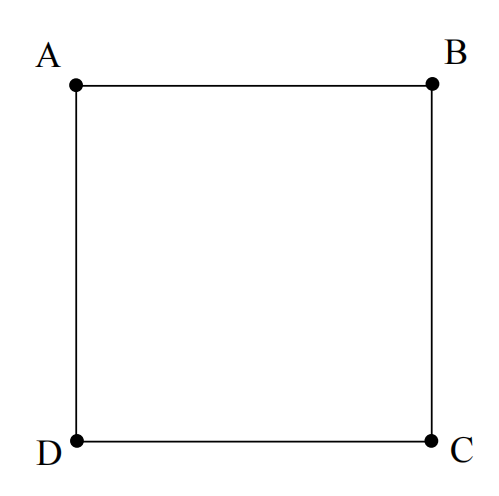
Four charges are placed at the corners of a square of side $10 \mathrm{~cm}$, as shown in Figure

$$ \begin{aligned} &A=+10 \times 10^{-9} \mathrm{C} \\ &\mathrm{B}=+8 \times 10^{-9} \mathrm{C} \\ &\mathrm{C}=-12 \times 10^{-9} \mathrm{C} \\ &\mathrm{D}=-6 \times 10^{-9} \mathrm{C} \end{aligned} $$

(i) Calculate the magnitude and direction of the electric field strength at the centre of the square.

(ii) Calculate the work done taking an electron from the centre to the mid-point of side CD.

figure
Show answer · 显示答案

See the book for the worked solution.

Full worked solutions: the book

2019 · qElectric Field and Potential

Three conducting spheres of radii $\frac{1}{3} R, \frac{1}{2} R$ and $R$ are mounted on insulating rods, and are well separated from each other. The $\frac{1}{3} R$ and $R$ spheres are each charged to a potential $V$, whilst the $\frac{1}{2} R$ sphere is uncharged. Then a thin copper wire is used to briefly connect all three spheres. What fraction of the original charge on the two spheres is now on the $\frac{1}{2} R$ sphere? [5]

Show answer · 显示答案
Final result
  • Thus, $\frac{3}{11}$ of the original charge on the two spheres is now on the $\frac{1}{2}R$ sphere.

Worked solutions are in the book.

2022 · uElectric Field and Potential

A particle $\mathbf{A}$, of mass $m$ carrying a charge of $Q$ is suspended by an insulating thread of length $\ell$. Another particle $\mathbf{B}$, of negligible mass but of positive charge $+q$ is brought towards $\mathbf{A}$, which is repelled. When $\mathbf{B}$ arrives at the point previously occupied by $\mathbf{A}$, the system is in (neutral) equilibrium.

Calculate the work done in terms of $m, g, \ell, q, Q$, and $k$, where $k=\frac{1}{4 \pi \epsilon_{0}}$. [6]

Show answer · 显示答案
Final result
  • The work splits into a gravitational part $mgh$ and an electrostatic part $kqQ/r$, which turn out to be in the ratio $1:2$.

Worked solutions are in the book.

2025 · kElectric Field and Potential

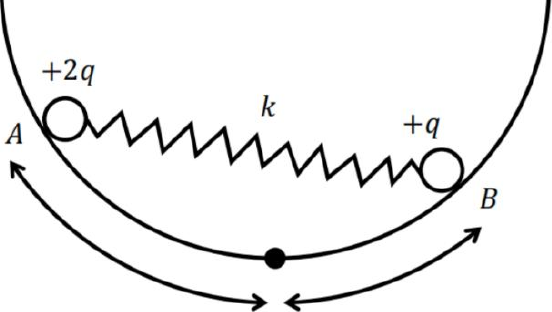
Two tiny conducting spheres $A$ and $B$ of different masses are placed in a smooth hemispherical insulating bowl of radius $10\,\text{cm}$, and connected with an insulating spring with a natural length $8.0\,\text{cm}$ and spring constant $k = 120\,\text{N\,m}^{-1}$, as illustrated in Fig. 5. The charges on $A$ and $B$ are $+2q$ and $+q$ respectively. At equilibrium, the arc length of $A$ to the bottom of the bowl is $d_1 = 7.0\,\text{cm}$, and the arc length of $B$ to the bottom of the bowl is $d_2 = 5.0\,\text{cm}$.

figure
Figure 5: Two charges in a bowl
  1. (i) Determine the elastic potential energy stored in the spring.
  2. (ii) Determine the ratio of the masses of $A$ and $B$.
[5]
Show answer · 显示答案
Final result
  • The spring stores $E \approx 0.065\,\text{J}$, and the masses are in the ratio $m_A : m_B \approx 0.74 : 1$ (equivalently $m_B \approx 1.34\,m_A$), so $B$ is the heavier sphere.

Worked solutions are in the book.