BPhO R1 S1 · Section 1

Dimensional Analysis

4 questions — reveal each final answer.

2019 · dDimensional Analysis

The speed of surface waves of wavelength $\lambda$ on a liquid of density $\rho$ is given by

$$ v=\left[\frac{a \lambda}{2 \pi}+\frac{2 \pi b}{\rho \lambda}\right]^{\frac{1}{2}} $$

where $a$ and $b$ are constants. Determine the units of $a$ and $b$.

Show answer · 显示答案
Final result
  • The units of constants $a$ and $b$ are derived as $\text{m}/\text{s}^2$ and $\text{kg}/\text{s}^2$, respectively, ensuring the given expression for the speed of surface waves maintains consistency in units.

Worked solutions are in the book.
2019 · kDimensional Analysis

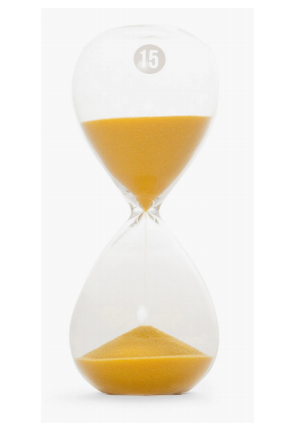
A sand timer is a sealed glass vessel with a narrow section acting as a constraint, so that sand can flow through at a steady rate. A fifteen minute sand timer is shown in Figure below. Unlike a liquid, the rate of flow of sand grains through the constrained section is independent of the height of the sand above.

Thus the rate of flow of sand through the time can be expressed as a product of powers of the remaining relevant variables:

$$ \frac{\mathrm{d} m}{\mathrm{dt}}=k \rho^{\alpha} \times A^{\beta} \times g^{\gamma} $$

where $k$ is a dimensionless constant, $\rho$ is the density of the sand, $A$ is the cross sectional area at the narrowest point, and $g$ is the gravitational field strength, and $\alpha, \beta, \gamma$ are numbers.

(i) By considering the units of the variables on each side of the equation, find the values of $\alpha, \beta$ and $\gamma$.

(ii) On the Moon, the gravitational field strength is $g_{\mathrm{M}}=1.6 \mathrm{~N} \mathrm{~kg}^{-1}$. How long would the sand timer last on the Moon if it runs for 15 minutes on Earth? [4]

figure
Show answer · 显示答案
Final result
  • The flow rate depends on gravity only through $g^{1/2}$, so weaker lunar gravity slows the sand and lengthens the run to about $37\,\text{minutes}$.

Worked solutions are in the book.

2020 · mDimensional Analysis

Large craters can be produced on the Earth by meteorites. The size of a crater with diameter $d$ is dependent on the kinetic energy of the meteorite $E$, the density of the rock removed from the crater $\rho$, and the field strength $g$, since the rock must be lifted out of the crater. We can express this as

$$ d=k E^{\alpha} \rho^{\beta} g^{\gamma} $$

where $k$ is a numeric constant and $k \approx 1$.

(i) By considering the dimensions (or units) of the quantities above, obtain an expression relating the diameter of the crater to $E, \rho$ and $g$.

(ii) The Barringer Crater in Arizona was made by a meteorite that landed there 30000 years ago. It has a diameter of $1200 \mathrm{~m}$ and is in rock of typical density $3000 \mathrm{~kg} \mathrm{~m}^{-3}$. If the impact speed was $15 \mathrm{~km} \mathrm{~s}^{-1}$, estimate the mass of the meteorite.

(iii) If the spherical meteorite was made of iron of density $8000 \mathrm{~kg} \mathrm{~m}^{-3}$ what was its diameter? [6]

Show answer · 显示答案
Final result
  • Dimensional analysis fixes the exponents up to the numeric constant $k\approx1$; since $d\propto E^{1/4}$, the crater size is very insensitive to impact energy, so an order-of-magnitude meteorite mass ($\sim5\times10^8\,\text{kg}$) is the most one can claim.

Worked solutions are in the book.

2021 · bDimensional Analysis

The fundamental frequency of a drum skin has been shown to be given by $f=\frac{0.47 h v}{a^{2} \sqrt{1-\rho^{2}}}$ where $h$ is the thickness of the skin, $v$ is the speed of sound in the skin, and $\rho$ is a constant of elasticity. Units are in SI units.

(i) What are the units of $\rho$ ?

(ii) Determine the units of quantity $a$. [2]

Show answer · 显示答案
Final result
  • The frequency then scales as $f\propto v/a$, the expected behaviour for a wave of speed $v$ on a region of size $a$.

Worked solutions are in the book.