A particle travels at a constant speed around a circular path of radius $R$. If the particle makes one complete trip around the entire circle, what is the magnitude of the displacement for this trip?
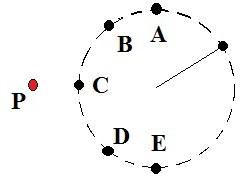
A girl twirls a small mass connected to the end of a string counterclockwise in a horizontal circle above her head. The figure shows an outline of the mass's path viewed fr om above the twirling mass. If the girl needs the mass to pass through the point labeled $\mathrm{P}$ in the figure, at which lettered point on the path should
A girl swings a 4.0 $kg$ mass with a constant speed of 3. $24\displaystyle \frac{m}{s}$ in a vertically-oriented circle of radius 0.75 $m$. What is the net force acting on the mass when it is at the lowest point of the circle?
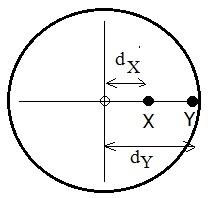
Two small identical coins (labeled X and Y) are at rest on a horizontal disk rotating at a constant rate about an axis perpendicular to the plane of the disk and through its center. The distance of the coins from the center of disk is related by $d_X=\frac{1}{2}d_Y$. Which one of the following choices correctly identifies the relationship between $f_X$ and $f_Y$, the frictional force on coin X and on coin $\mathrm{Y}$, respectively?
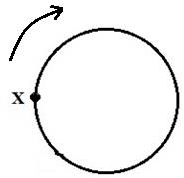
An object moves clockwise with constant speed around the vertical circle shown. Which arrow best indicates the direction of the object's instantaneous acceleration at the point labeled X?
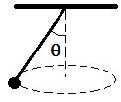
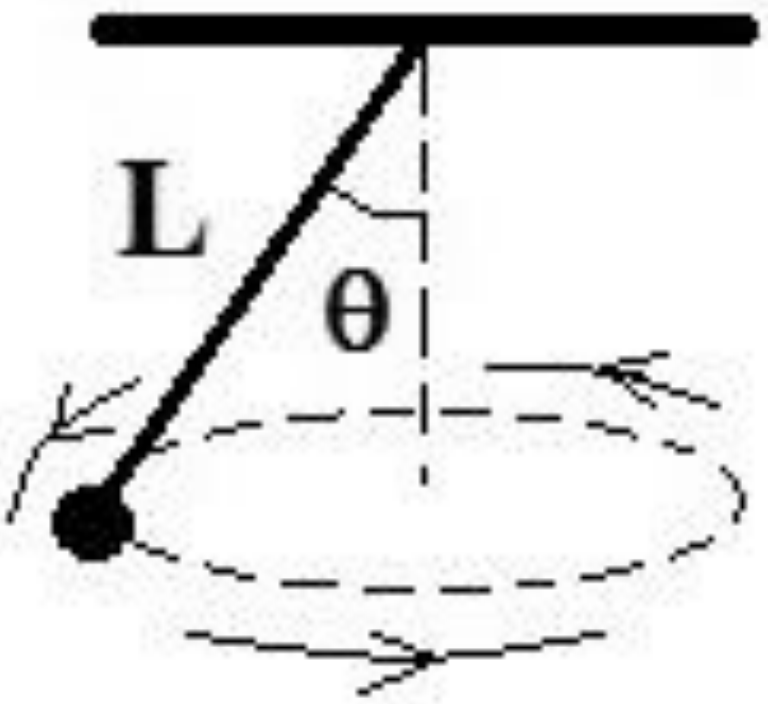
A 2.0 $kg$ mass is connected to the end of string and moves about the string's fixed end in a conical motion with a constant speed of $4.0\displaystyle \frac{m}{s}$. The string has a length of 2.50 $m$ and forms an angle of $\theta$ with the vertical. What is the tension in the string?
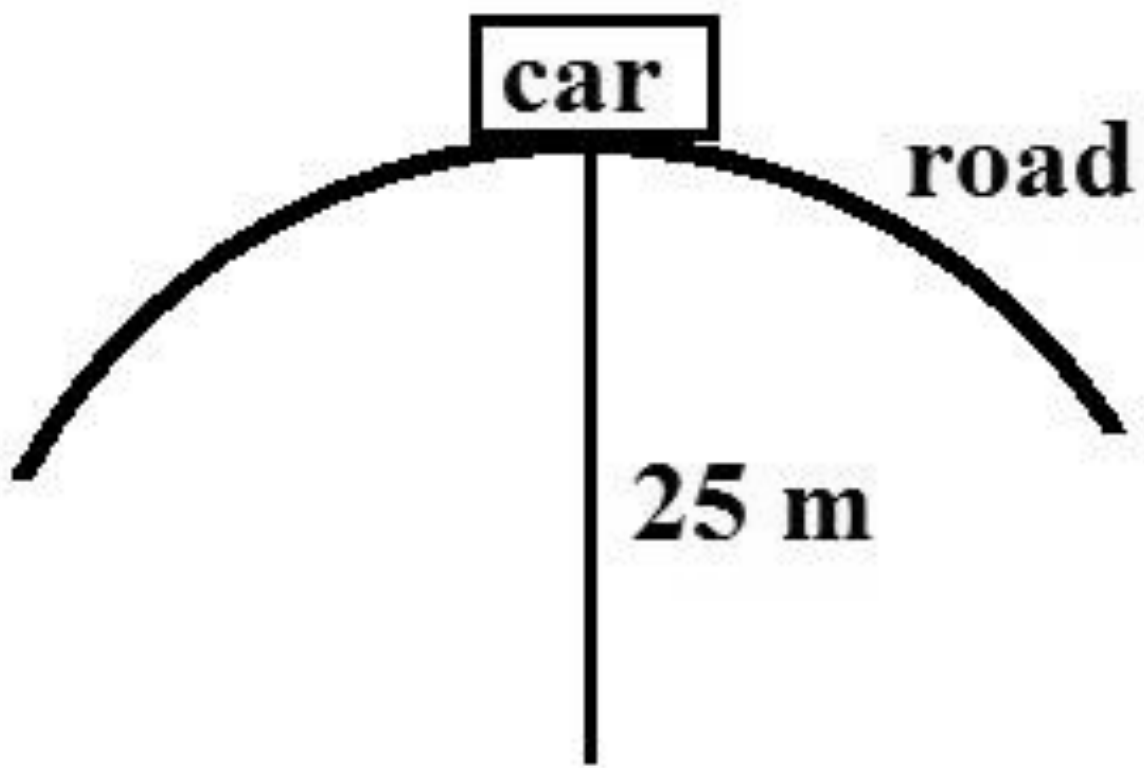
A 2000 $kg$ car moves over a hill at a constant speed of 12.0 $\displaystyle \frac{m}{s}$. At the very top of the hill, the shape of the road can be approximated as a circle with radius 25 $m$, as indicated in the figure. Which one of the following choices best represents the magnitude of the upward force exerted by the road on the car?
A 4.00 $kg$ mass is in uniform circular motion as shown in the figure. The string to which the mass is attached has a length of $L=3.00m$ and forms an angle of $\theta=50.0^{\circ}$ with the vertical. What is the speed of the mass?
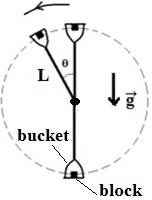
A sma11 2.0 $kg$ block rests at the bottom of a bucket. The bucket is spun in a vertical -- circle of radius $L$ by a rope. When the bucket reaches the highest point in its motion, it moves just fast enough for the block to remain in place in the bucket. When the bucket is at an angle $\theta=30^{\circ}$ from the vertical, as seen in the figure, what is the magnitude of the normal force (perpendicular to the surface) provided by the bucket onto the block? Note that the direction of the gravitational field is indicated in the diagram by $\vec{g}$ and that the block does not touch any sides of the bucket aside from the bottom of it.
A particle travels at a constant speed around a circular path of radius $R$. If the particle makes one complete trip around the entire circle, what is the magnitude of the displacement for this trip?
An Olympic bobsled needs to negotiate a 100 $\mathrm{m}$ radius turn at 35 $\mathrm{m}/\mathrm{s}$ without skidding. What minimum banking angle of the turn is needed for this to happen? (Ignore friction)
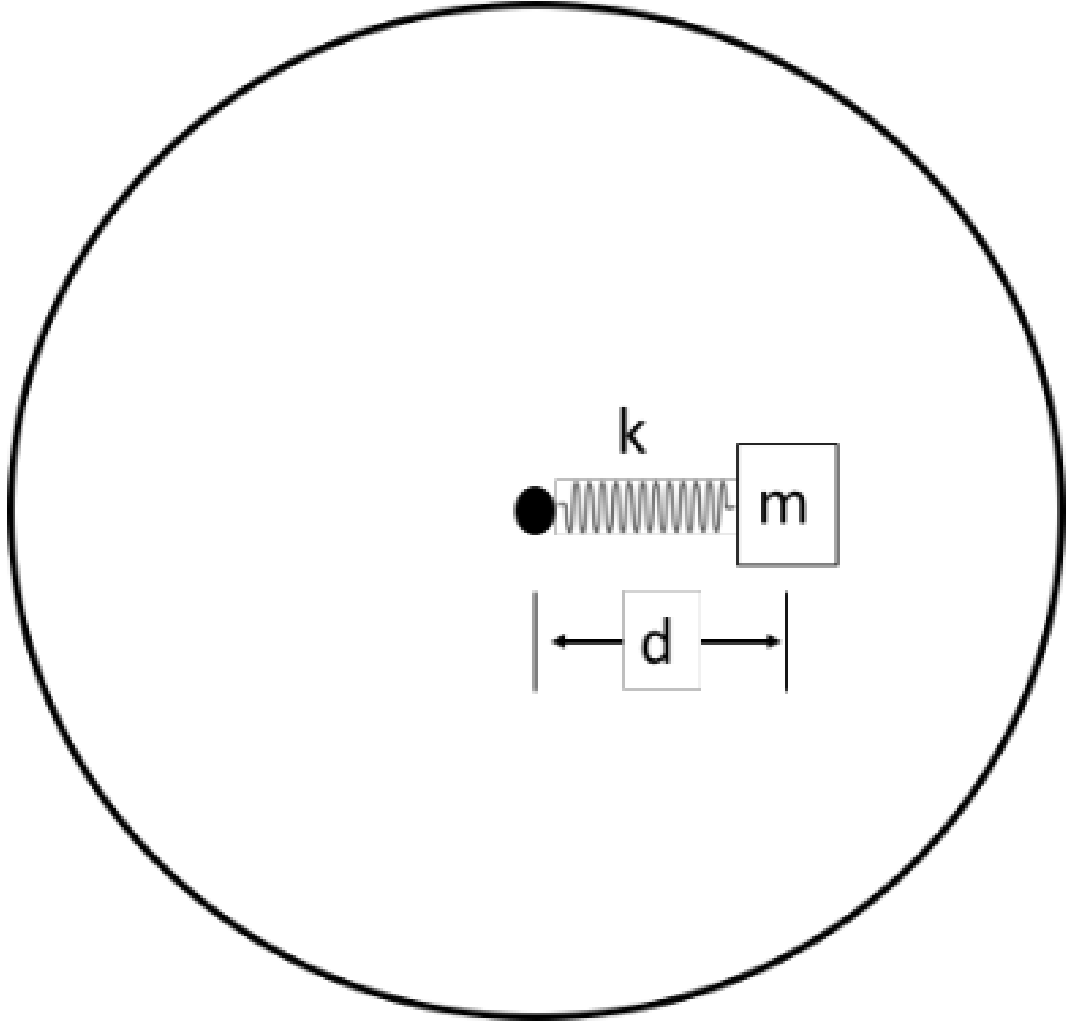
A horizontal disk has a spring and a mass attached to a rod passing through its center. The spring has a spring constant of $k$ and the attached mass is $m.$ When the disk is not rotating, the equilibrium length of the spring is $d$. The disk is now angularly accelerated until it reaches a constant angular velocity of $\omega$. At this angular velocity the length of the spring is now $2d$. What is the angular velocity of the disk?
A curve on a racetrack has a radius of 80 $\mathrm{m}$ and is banked at $45^{\mathrm{o}}$. Suppose that the road surface on the curve somehow became frictionless (perhaps caused by an ice storm or an oil spill) and a car needs to navigate this curve. What is the safe speed with which to take the curve without either sliding up or down the bank of the curve?
A fighter jet pilot is capable of tolerating an upward force that is equivalent to seven times their weight. This pilot is traveling at a speed of $250 \mathrm{~m} / \mathrm{s}$ while pulling out of a vertical dive. What is the minimum radius of curvature of the plane's dive path?
(A) 4.25 m
(B) 3.64 m
(C) 1042 m
(D) 893 m
(E) 450 m
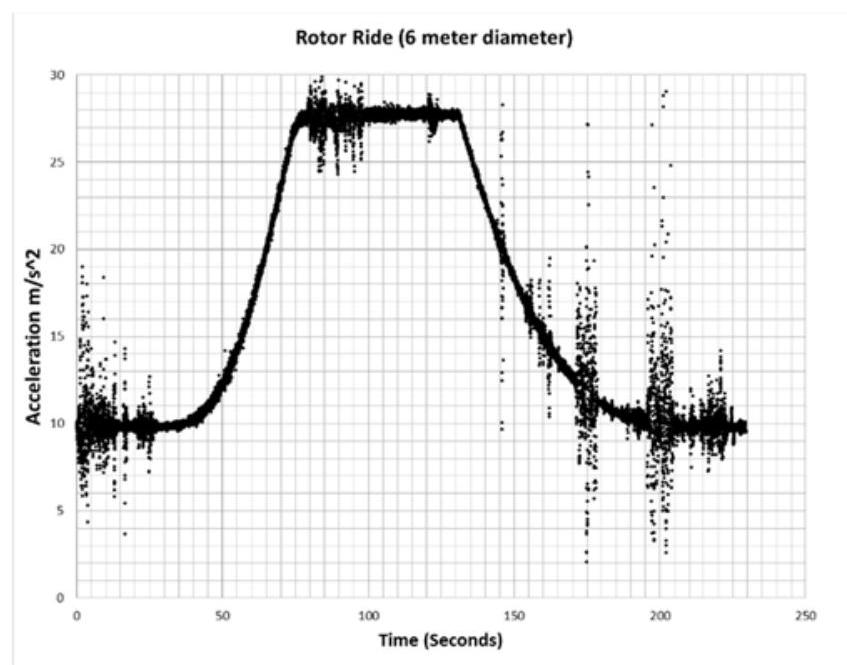
An amusement park ride called "The Rotor" has people standing in a vertical cylinder, in this case 6 m in diameter, which rotates and presses them against the wall with sufficient force that the floor can then drop without them sliding down the wall. Shown here is the magnitude of accelerometer data from a device carried in a pocket by a rider. Assuming the high plateau averages $27.7 \mathrm{~m} / \mathrm{s}^{2}$, what is the peak centripetal acceleration? (Consider the spikes noise caused by movement of the rider.)
Two bodies of equal mass are moving in circular paths at equal speed. The first body moves in a circle whose radius is twice that of the second. The ratio of the radial acceleration of the first body to that of the second is:
(A) 1 to 4
(B) 1 to 3
(C) 1 to 2
(D) 1 to 1
(E) 1 to 0.5
An object starting from rest moves on a circular path with a radius 40 cm and a constant tangential acceleration of $10 \mathrm{~cm} / \mathrm{s}^{2}$. How much time is needed after the motion begins for the centripetal acceleration of the object to be equal to the tangential acceleration?
(A) 0.2 s
(B) 1.0 s
(C) 1.2 s
(D) 1.8 s
(E) 2.0 s
For an object moving in uniform circular motion, the magnitude of the centripetal acceleration is given by $a_{c}=v^{2} / r$, where $v$ is the speed of the object, and $r$ is the radius of the circle. The "jerk" is the rate of change of acceleration. For uniform circular motion, the magnitude of the jerk is given by:
(A) zero
(B) $v^{2} / r$
(C) $v^{2} r$
(D) $v^{3} / r$
(E) $v^{3} / r^{2}$
Consider one horizontal circular path that a ball makes on the inside surface of a cone. In this situation, the normal force on the ball
(A) is mg .
(B) is always greater than mg.
(C) may be greater or less than mg .
(D) is always less than mg.
(E) depends upon the speed of the ball.
When riding the Wild Thing roller coaster, the passengers feel $50 \%$ heavier than their actual weight as the car goes through a dip with a 30 m radius of curvature. What is the car's speed at the bottom of the dip?
(A) $14.3 \mathrm{~m} / \mathrm{s}$
(B) $11.1 \mathrm{~m} / \mathrm{s}$
(C) $12.3 \mathrm{~m} / \mathrm{s}$
(D) $10.1 \mathrm{~m} / \mathrm{s}$
(E) $15.0 \mathrm{~m} / \mathrm{s}$
A small sphere of mass $m$ is attached to one end of a light string of length $L$ with the other end of the string attached to a fixed point. The ball is moving at a constant speed $v$ in a horizontal circle of radius $r$ such that the string makes an angle $\theta$ with the vertical. Given that the tension in the string is $T$, what is the correct expression for the object's speed $v$ ?
(A) $v=\sqrt{\frac{T L \sin \theta}{m}}$
(B) $v=\sqrt{\frac{g \sin \theta}{L}}$
(C) $v=\sqrt{\frac{T L}{m g}}$
(D) $v=\sqrt{\frac{m g}{T L}}$
(E) $v=\sqrt{\frac{2 T L}{m g}}$
Show answer · 显示答案
Answer key
A
Key as published. A force balance gives v = sinθ√(TL/m); the printed choice differs by a factor of √sinθ.