2010 · Q16Division 1Division 2Rolling, Torque and Angular Momentum
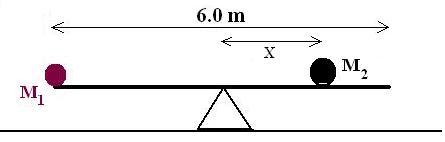
A mass $M_{1}=40kg$ is at the very edge of a 6.0 $m$ long plank which is pivoted about its center of mass located directly at the center of its length. How far from the center of the plank (X) should the mass $M_{2}=80kg$ be placed so that the plank remains in static equilibrium in a horizontal position?
(A) 0.50 $m$
(B) 1.33 $m$
(C) 1.50 $m$
(D) 2.00 $m$
(E) 3.00 $m$
Show answer · 显示答案
2010 · Q35Division 1Division 2Rolling, Torque and Angular Momentum
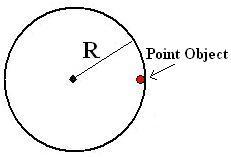
A point object with mass $M=2.0kg$ is attached a distance $R=1.75m$ from the fixed center of a disk as shown in the figure. The disk starts rotating from rest with constant angular acceleration $\alpha=5.00^{ra}/d_{S^{2}}$ about an axis perpendicular to the plane of the page through the disk's center. After how much time $T$ (in seconds) is the tangential component of the point object's acceleration equal in magnitude to the centripetal component of the point object's acceleration?
(A) 0.769
(B) 0.592
(C) 0.500
(D) 0.447
(E) 0.350
Show answer · 显示答案
2010 · Q40Division 1Division 2Rolling, Torque and Angular Momentum
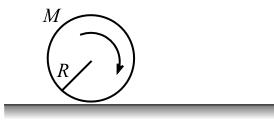
A uniform, solid cylinder with a mass $M$ and radius $R$ is pulled by a horizontal force $F$ acting through the center. The cylinder rolls to the right without slipping. What is the magnitude of the force of friction between the cylinder and the ground?
(A)$\displaystyle \frac{1}{4}F$
(B) $\displaystyle \frac{1}{3}F$
(C) $\displaystyle \frac{1}{2}F$
(D) $\displaystyle \frac{2}{3}F$
(E) $\displaystyle \frac{3}{4}F$
Show answer · 显示答案
2011 · Q35Division 1Division 2Rolling, Torque and Angular Momentum
Mary rides her bicycle directed due South. She applies the brakes quickly bringing the bicycle to rest with the wheels rolling without slipping on the ground. Which one of the following choices best represents the direction of the angular acceleration of the bicycle's front wheel while it is slowing to rest fr om Mary's point of view?
(A) Into the ground
(B) North
(C) South
(D) East
(E) West
Show answer · 显示答案
2011 · Q40Division 1Division 2Rolling, Torque and Angular Momentum
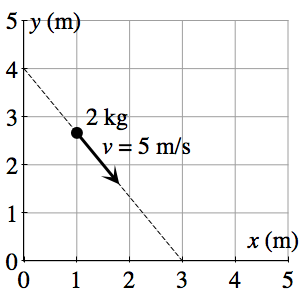
A 2.0 $kg$ particle travels at a constant speed of 5.0 $m/s$ along the line shown in the figure. What is the magnitude of the particle's angular momentum calculated from the origin?
(A) 10 $kg\cdot m^{2}/s$
(B) 24 $kg\cdot m^{2}/s$
(C) 30 $kg\cdot m^{2}/s$
(D) 32 $kg\cdot m^{2}/s$
(E) 40 $kg\cdot m^{2}/s$
Show answer · 显示答案
2011 · Q49Division 2Rolling, Torque and Angular Momentum
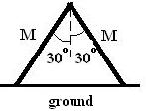
An inverted“V” in static equilibrium is made from two uniform beams each of mass $M=12kg$. Each beam of the $\mathrm{V}$” has the same length and makes an angle of $30^{\circ}$ with the vertical as shown in the diagram. Which one of the following choices best represents the magnitude of the static friction force acting on the left leg of the $\mathrm{V}$” fr om the level ground? The coefficient of static friction between each beam and the ground is $\mu_{s}=0.76. \mathcal{X}^{\mathrm{I}}$
(A) 26.3 $N$
(B) 34.6 $N$
(C) 45.6 $N$
(D) 69.3 $N$
(E) 91.2 $N$
Show answer · 显示答案
2012 · Q25Division 1Division 2Rolling, Torque and Angular Momentum
Which one of the following choices best represents the average angular speed of the hour hand on a standard clock (in units of $\displaystyle \frac{rad}{s}$)?
(A) $5.24\times 10^{-1}$
(B) $2.62\times 10^{-1}$
(C) $1.75\times 10^{-3}$
(D) $1.45\times 10^{-4}$
(E) $7.27\times 10^{-5}$
Show answer · 显示答案
2012 · Q33Division 1Division 2Rolling, Torque and Angular Momentum
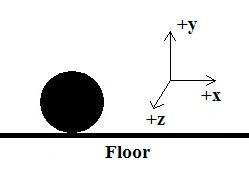
A solid, uniform sphere rolls without slipping on a floor along the $+x$-axis (to the right). The rotational kinetic energy associated with the sphere about an axis of rotation through its center of mass along the $+z$-axis (out of the plane of the page) is $20$Joules. What is the translational kinetic energy associated with the sphere?
(A) 8 $J$
(B) 10 $J$
(C) 20 $J$
(D) 40 $J$
(E) 50 $J$
Show answer · 显示答案
2012 · Q34Division 1Division 2Rolling, Torque and Angular Momentum
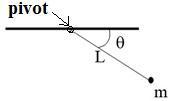
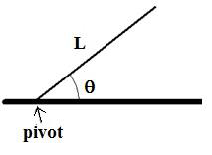
A mass $m$ attached to a light string of length $L$ is located at an angle $\theta$ below the horizontal as shown in the figure to the right. The mass then is released from rest. Calculated from an axis perpendicular to the plane of the page through the pivot, which one of the following choices represents the magnitude of the torque produced by the gravitational force acting on the mass at this instant?
(A) $mgL$
(B) $ mgL\sin\theta$
(C) $ mgL\cos\theta$
(D) $mgL(1-\sin\theta)$
(E) $mgL(1-\cos\theta)$
Show answer · 显示答案
2012 · Q43Division 2Rolling, Torque and Angular Momentum
Several forces act on a rigid body. If the resultant (net) force on the body is zero, which one of the following statements must be true?
(A) The object is in translational equilibrium and rotational equilibrium.
(B) The object is in translational, but not necessarily rotational, equilibrium.
(C) The object is in rotational, but not necessarily translational, equilibrium.
(D) The object is in static equilibrium.
(E) The object is in neither translational nor rotational equilibrium.
Show answer · 显示答案
2013 · Q23Division 1Division 2Rolling, Torque and Angular Momentum
A small object of mass 11.0 $g$ is at rest 30.0 cm from a horizontal disk's center. The disk starts to rotate from rest about its center with a constant angular acceleration of $4.50\displaystyle \frac{racl}{s^{2}}$. What is the magnitude of the net force acting on the object after a time of $r=\displaystyle \frac{1}{3}s$ if the object remains at rest with respect to the disk?
(A) $0N$
(B) $7.43\times 10^{-3}N$
(C) $1.49\times 10^{-2}N$
(D) $1.66\times 10^{-2}N$
(E) $2.23\times 10^{-2}N$
Show answer · 显示答案
2013 · Q39–40Division 1Division 2Rolling, Torque and Angular Momentum
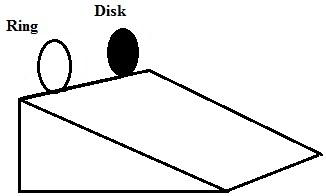
An ideal uniform solid disk and an ideal uniform ring each have mass $M$ and radius $R$. Each object begins purely rolling without slipping down a rough inclined plane. The coefficients of friction for the disk and ring with the incline are $\mu_{\text {disk }}>\mu_{\text {ring }}$
39. As each object rolls down the incline, which statement is correct about the force of friction from the incline on the objects?
(A) The ring experiences a greater force of friction than the disk.
(B) The disk experiences a greater force of friction than the ring.
(C) The force of friction is equal and non-zero for both objects.
(D) The force of friction is equal to zero for both objects.
(E) Nothing can be concluded about the force of friction without more information
40. As the objects roll, what is the ratio of the ring's angular acceleration to the disk's angular acceleration calculated about an axis perpendicular to the object's face and through its center of mass?
(A) 1: 2
(B) 2: 1
(C) $\mu_{\text{disk}}:\mu_{\text{ring}}$
(D) 4: 3
(E) 3: 4
Show answer · 显示答案
2014 · Q39Division 1Division 2Rolling, Torque and Angular Momentum
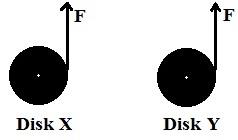
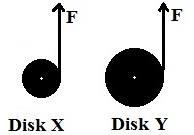
Two uniform disks, X and $\mathrm{Y}$, have masses $m_{X}<m_{\mathrm{y}}$, equal radii, and equal initial non-zero kinetic energies. Each disk rotates counterclockwise in the plane of the page about a fixed frictionless axis through its center. As shown in the figure, a force $F$ is applied tangent to each disk at its right edge for the same amount of time. after the forces are applied, let $L$ represent the magnitude of the angular momentum about the center of a disk and $K$ represent the kinetic energy of a disk. Which one of the following choices correctly compares these quantities for disk X and disk $\mathrm{Y}$?
(A) $L_{X}>L_{\mathrm{y}};K_{X}<K_{\mathrm{y}}$
(B) $L_{X}>L_{\mathrm{y}};K_{X}>K_{\mathrm{y}}$
(C) $L_{X}=L_{\mathrm{y}};K_{X}=K_{\mathrm{y}}$
(D) $L_{X}<L_{\mathrm{y}};K_{X}<K_{\mathrm{y}}$
(E) $L_{X}<L_{\mathrm{y}};K_{X}>K_{\mathrm{y}}$
Show answer · 显示答案
2014 · Q43Division 2Rolling, Torque and Angular Momentum
A long rod of length $L$ is pivoted about its left end. It is released fr om an angle $\theta$ above the horizontal. What is the magnitude of the angular acceleration of the rod about the pivot when the rod is released?
(A) $(^{6g}/_{L})\cos\theta$
(B) $(^{6g}/_{L})\sin\theta$
(C) $(^{3g}/_{2L})\sin\theta$
(D) $(^{3g}/_{2L})\cos\theta$
(E) $(^{3g}/_{L})\sin\theta$
Show answer · 显示答案
2014 · Q49Division 2Rolling, Torque and Angular Momentum
A solid, uniform disk of mass $M$ and radius $R$ rotates clockwise about its center with an angular speed $\omega_{0}$. The disk then is placed onto a horizontal surface and begins moving only to the right, slipping as it rolls. The coefficient of friction between the floor and the disk is $\mu$ and the frictional force is considered constant throughout the motion. What is the angular speed of the disk when the disk starts rolling without slipping?
(A)$\displaystyle \frac{\mu}{2}\omega_{0} \\
(\displaystyle \mathrm{B})\frac{1}{2}\omega_{0} \\
(\displaystyle \mathrm{C})\frac{1}{3}\omega_{0} \\
(\displaystyle \mathrm{D})\frac{2\mu}{3}\omega_{0} \\
(\displaystyle \mathrm{E})\frac{3}{5}\omega_{0}$
Show answer · 显示答案
2015 · Q35Division 1Division 2Rolling, Torque and Angular Momentum
Two uniform disks, X and $\mathrm{Y}$, have equal masses, , but different radii such that $r_x<r_y$ . Both disks initially are at rest. A force is applied tangent to each disk at its right edge for the same amount of time. As a result, each disk rotates counterclockwise in the plane of the page about a fixed frictionless axis through its center. Which one of the following choices correctly compares the magnitudes of angular momentum about the center axis and total kinetic energy of disk X and disk $\mathrm{Y}$?
(A) $L_x<L_y$ ; $K_x<K_y$
(B) $L_x<L_y$ ; $K_x>K_y$
(C) $L_x=L_y$ ; $K_x=K_y$
(D) $L_x=L_y$ ; $K_x<K_y$
(E) $L_x<L_y$ ; $K_x=K_y$
Show answer · 显示答案
2015 · Q46Division 2Rolling, Torque and Angular Momentum
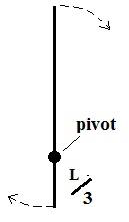
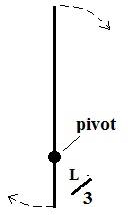
A uniform rod of mass $M$ and length $L$ is fixed to rotate about a frictionless pivot located $L/3$ from one end. The rod is released from rest incrementally away from being perfectly vertical, resulting in the rod rotating clockwise about the pivot. When the rod is horizontal, what is the magnitude of the tangential acceleration of its center of mass?
(A)$\displaystyle \frac{1}{6}g \\
(\displaystyle \mathrm{B})\frac{1}{2}g \\
(\displaystyle \mathrm{C})\frac{4}{3}g \\
(\displaystyle \mathrm{D})\frac{2}{3}g \\
(\displaystyle \mathrm{E})\frac{1}{4}g$
Show answer · 显示答案
2016 · Q16Division 1Division 2Rolling, Torque and Angular Momentum
A uniform stick is fixed to rotate about an axis through its center. The stick starts from rest and rotates through an angle of $90^{\circ}$ in a time of l.$0s$. if the angular acceleration of the stick is constant, what is the angular speed of the stick about its rotation axis after one full revolution?
(A) $4 \pi\frac{rad}{s}$
(B) $2\displaystyle \sqrt{2}\pi\frac{rad}{s}$
(C) $2\displaystyle \pi \frac{rad}{s} \\
(D)\sqrt{2}\pi\frac{rad}{s}$
(E) $\displaystyle \pi\frac{rad}{s}$
Show answer · 显示答案
2016 · Q20Division 1Division 2Rolling, Torque and Angular Momentum
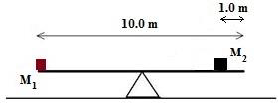
A uniform 10.0 $m$ long plank is pivoted about its center of gravity. A mass $M_{1}$ then is placed at the left edge of the plank and a second mass $M_{2}$ is placed 1.0 $m$ from the right end. This system is in static equilibrium (shown). If each mass now is moved 2.0 $m$ closer to the center of the plank, which one of the following choices best describes the subsequent motion of the plank?
(A) The plank remains in static equilibrium.
(B) The plank rotates at constant angular speed until the right side reaches the ground.
(C) The plank rotates at constant angular speed until the left side reaches the ground.
(D) The plank angularly accelerates until the right side reaches the ground.
(E) The plank angularly accelerates until the left side reaches the ground.
Show answer · 显示答案
2016 · Q43Division 2Rolling, Torque and Angular Momentum
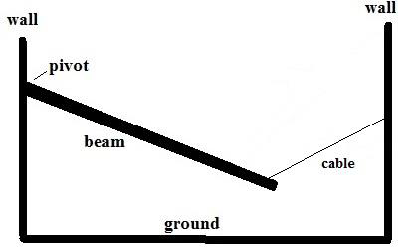
A uniform beam connected to a wall at the hinge is in static equilibrium as shown. The cable connected to the beam is massless. What are the directions of the horizontal and vertical components of force acting at the pivot on the beam?
| Horizontal component | Vertical component |
|---|
| (A) | To the right | Upward |
| (B) | To the right | Downward |
| (C) | To the left | Upward |
| (D) | To the left | Downward |
| (E) | It cannot be determined | It cannot be determined |
Show answer · 显示答案
2016 · Q50Division 2Rolling, Torque and Angular Momentum
A uniform stick of mass $M$ and length $L$ is fixed to rotate about a frictionless pivot located $L/3$ from one end. The stick is released from rest incrementally away from being perfectly vertical, resulting in the stick rotating clockwise about its pivot. When the stick is horizontal, what is the tangential speed of the center of mass about the pivot?
(A)$\displaystyle \frac{1}{\sqrt{15}}\sqrt{gL} \\
(\mathrm{B})\sqrt{\frac{3}{10}}\sqrt{gL} \\
(\displaystyle \mathrm{C})\frac{1}{\sqrt{10}}\sqrt{gL} \\
(\displaystyle \mathrm{D})\frac{3}{\sqrt{20}}\sqrt{gL} \\
(\displaystyle \mathrm{E})\frac{1}{\sqrt{12}}\sqrt{gL}$
Show answer · 显示答案
2017 · Q18Division 1Division 2Rolling, Torque and Angular Momentum
A disk of radius 75.0 cm makes 3.5 revolutions when coming to rest in 2.50 $s$. What was the initial angular speed of the disk?
(A) $1.40\displaystyle \frac{rad}{s}$
(B) $6.60\displaystyle \frac{rad}{s}$
(C) 8. $80\displaystyle \frac{rad}{s}$
(D) 13. $2\displaystyle \frac{rad}{s}$
(E) $17.6\displaystyle \frac{rad}{s}$
Show answer · 显示答案
2017 · Q24Division 1Division 2Rolling, Torque and Angular Momentum
What condition must be met for the angular momentum of a system to be constant?
(A) The mechanical energy is constant.
(B) There is no net external force acting on the system.
(C) The system is in static equilibrium.
(D) There is no net external torque acting on the system.
(E) Only the gravitational force is acting on the system.
Show answer · 显示答案
2017 · Q31Division 1Division 2Rolling, Torque and Angular Momentum
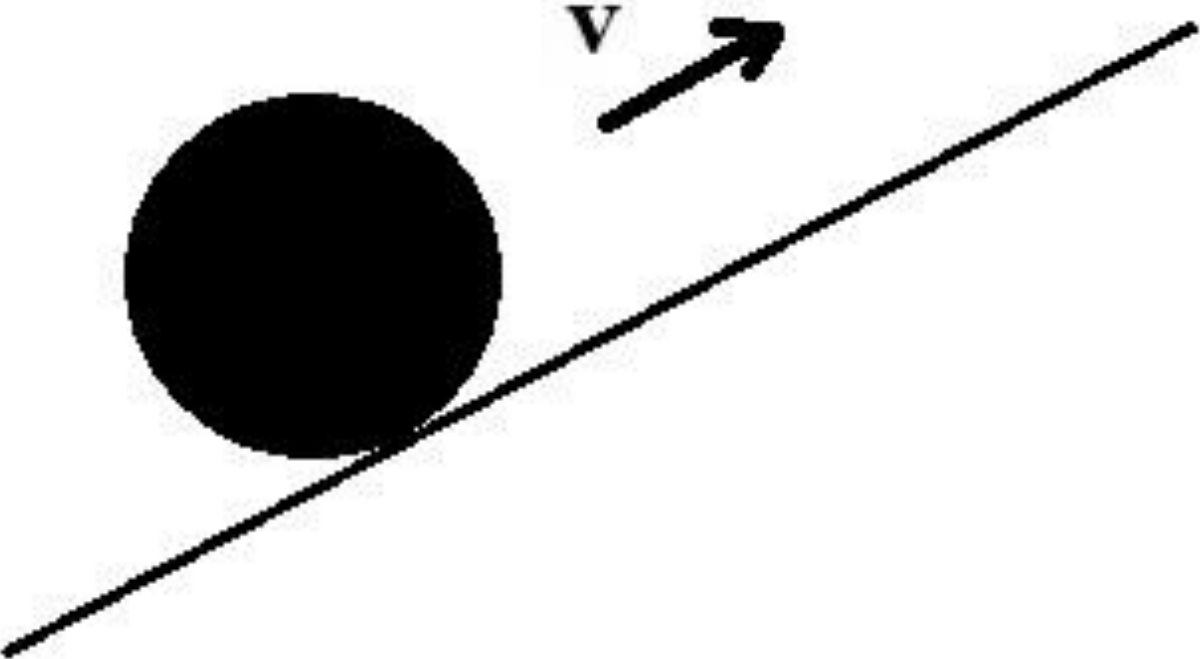
A solid cylinder rolls without slipping on a rough inclined plane. Which one of the following choices best represents the type and direction of friction (if any) acting on the cylinder as it rolls up the incline?
(A) Static friction directed up the incline
(B) Kinetic friction directed up the incline
(C) There is no friction
(D) Kinetic friction directed down the incline
(E) Static friction directed down the incline
Show answer · 显示答案
2017 · Q37Division 1Division 2Rolling, Torque and Angular Momentum
Which one of the following choices best approximates the magnitude of the Earth's angular momentum (expressed in base MKS units) associated with its orbit around the Sun?
(A) $10^{36}$
(B) $10^{40}$
(C) $10^{44}$
(D) $10^{48}$
(E) $10^{52}$
Show answer · 显示答案
2017 · Q42Division 2Rolling, Torque and Angular Momentum
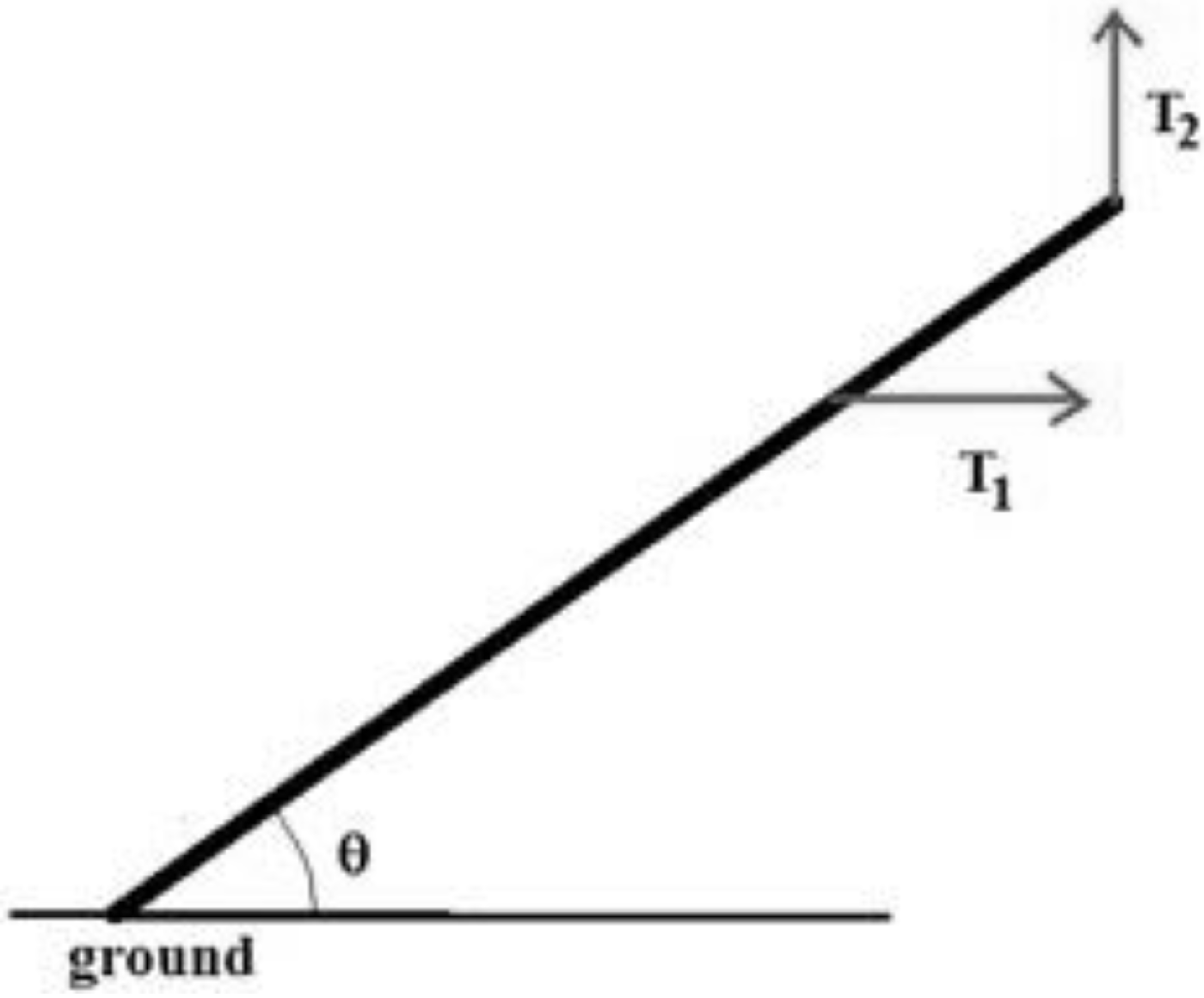
A long uniform rod, pivoted at one end affixed to the ground, is in static equilibrium A horizontal rope acts 75% of the way up the rod while a vertical rope acts at the far end. The magnitude of each rope's force is the same as the gravitational force acting on the rod. What is the value of the angle $\theta$ in the figure?
(A) $18.4^{\circ}$
(B) $21.8^{\circ}$
(C) $33.7^{\circ}$
(D) $36.9^{\circ}$
(E) 45. $0^{\circ}$
Show answer · 显示答案
2018 · Q20Division 1Division 2Rolling, Torque and Angular Momentum
A frictionless, solid disk pulley has a mass of 7.07 kg, a radius of 66.0 cm, and is free to rotate vertically about an axle. A rope is wrapped around the disk, a 1.53 kg mass is attached to the end of the rope, and the mass is allowed to fall vertically. What is the angular acceleration of the pulley?
(A) 4.58 $\mathrm{r}\mathrm{a}\mathrm{d}/\mathrm{s}^{2}$
(B) 7.98 $\mathrm{r}\mathrm{a}\mathrm{d}/\mathrm{s}^{2}$
(C) 9.87 $\mathrm{r}\mathrm{a}\mathrm{d}/\mathrm{s}^{2}$
(D) 2.25 $\mathrm{r}\mathrm{a}\mathrm{d}/\mathrm{s}^{2}$
(E) zero
Show answer · 显示答案
2018 · Q33Division 1Division 2Rolling, Torque and Angular Momentum
A torque of 150 Newton-meters causes the driveshaft of a car to rotate at 450 radians per second. How much power is produced by this torque?
(A) 53,300 $\mathrm{W}$
(B) 67,500 $\mathrm{W}$
(C) 70,000 $\mathrm{W}$
(D) 72,500 $\mathrm{W}$
(E) 75,000 $\mathrm{W}$
Show answer · 显示答案
2019 · Q30Division 1Division 2Rolling, Torque and Angular Momentum
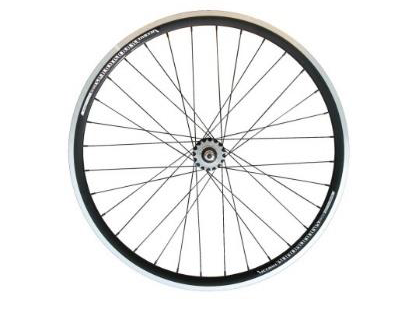
Consider the bicycle wheel shown at the right to be a ring with a 60 cm diameter and a mass of 1.5 kg. Attached to the wheel is a gear with a radius of 4.0 cm and negligible mass. A force of 20 N is applied tangentially to the gear for 4.0 s. Starting from rest, what linear speed does the wheel achieve, assuming it rolls without slipping?
(A) 3.0 m/s
(B) 5.9 m/s
(C) 7.1 m/s
(D) 16.4 m/s
(E) 24 m/s
Show answer · 显示答案
2021 · Q8Division 1Rolling, Torque and Angular Momentum
An ice skater is rotating with her arms extended. When she pulls in her arms, her rate of rotation increases. No external torques act on the skater. Which of the following statements is true?
(A) Her moment of inertia increased.
(B) Her kinetic energy is conserved.
(C) Her angular momentum decreased.
(D) She does work when pulling in her arms.
(E) Her angular momentum increased.
Show answer · 显示答案
2021 · Q35Division 1Division 2Rolling, Torque and Angular Momentum
A motorcycle has a total mass of 150 kg . Each wheel has a mass of 10 kg and a radius of 30 cm . As the motorcycle is moving, what is the ratio of the rotational kinetic energy of the wheels to the total translational kinetic energy of the motorcycle? Assume the wheels are uniform disks and roll without slipping.
(A) $0.033: 1$
(B) $0.067: 1$
(C) $0.33: 1$
(D) $0.67: 1$
(E) $3.3: 1$
Show answer · 显示答案
2022 · Q32Division 1Division 2Rolling, Torque and Angular Momentum
A star initially has a radius of $6 \times 10^{8} \mathrm{~m}$ and a period of rotation about its axis of 30 days. Eventually, it collapses to form a neutron star with a radius of only $1 \times 10^{4} \mathrm{~m}$ and a period of 0.1 s . Assuming that the mass has not changed, find the ratio of initial and final angular momentum of the star.
(A) 15.92
(B) 214.6
(C) 103.1
(D) 442.1
(E) 138.9
Show answer · 显示答案
2022 · Q40Division 1Division 2Rolling, Torque and Angular Momentum
An Olympic ice skater in Beijing spins at $4 \pi \mathrm{rad} / \mathrm{s}$ with her arms extended. If her moment of inertia with arms folded is $80 \%$ of that with arms extended, what is her angular velocity when she folds her arms?
(A) $\pi \mathrm{rad} / \mathrm{s}$
(B) $2 \pi \mathrm{rad} / \mathrm{s}$
(C) $3 \pi \mathrm{rad} / \mathrm{s}$
(D) $5 \pi \mathrm{rad} / \mathrm{s}$
(E) $6 \pi \mathrm{rad} / \mathrm{s}$
Show answer · 显示答案
2023 · Q13Division 1Division 2Rolling, Torque and Angular Momentum
An older and heavier sister can balance on a seesaw with her younger and lighter brother. This can happen because of balanced
(A) forces.
(B) torques.
(C) momenta.
(D) energies.
(E) inertia.
Show answer · 显示答案
2023 · Q46Division 2Rolling, Torque and Angular Momentum
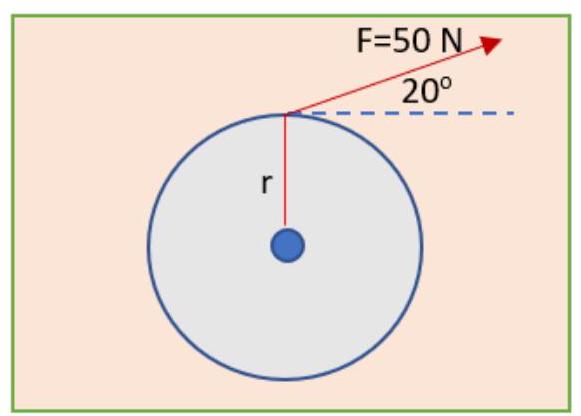
A thin cylindrical wheel has a of radius of 40 cm and is allowed to spin on a frictionless axle. The wheel, which is initially at rest, has a force of 50 N applied at $20^{\circ}$ from the perpendicular to its radius as shown. The wheel has a moment of inertia of $20 \mathrm{~kg} \cdot \mathrm{~m}^{2}$. What is the wheel's angular speed after 3.0 s ?
(A) $1.82 \mathrm{rad} / \mathrm{s}$
(B) $2.00 \mathrm{rad} / \mathrm{s}$
(C) $2.42 \mathrm{rad} / \mathrm{s}$
(D) $2.82 \mathrm{rad} / \mathrm{s}$
(E) $3.00 \mathrm{rad} / \mathrm{s}$
Show answer · 显示答案
2024 · Q3Division 1Rolling, Torque and Angular Momentum
A door is hinged on one side, and a force of 15 N is applied perpendicular to the door at a distance of 0.8 m from the hinge. How much torque is applied by this force to the door?
(A) $12 \mathrm{~N} \cdot \mathrm{~m}$
(B) $15 \mathrm{~N} \cdot \mathrm{~m}$
(C) $18 \mathrm{~N} \cdot \mathrm{~m}$
(D) $20 \mathrm{~N} \cdot \mathrm{~m}$
(E) $24 \mathrm{~N} \cdot \mathrm{~m}$
Show answer · 显示答案
2024 · Q23Division 1Division 2Rolling, Torque and Angular Momentum
A solid, uniform disk and a solid, uniform sphere are placed on a ramp where they can roll without slipping. The disk is released a distance $d$ from the bottom of the ramp and achieves a center-of-mass speed $v$ upon reaching the bottom. From what distance (also measured from the bottom of the ramp) should the sphere be released to attain the same center-of-mass speed $v$ at the bottom?
(A) $\frac{1}{5} d$
(B) $\frac{9}{10} d$
(C) $\frac{14}{15} d$
(D) $\frac{5}{4} d$
(E) $\frac{5}{3} d$
Show answer · 显示答案
2024 · Q47Division 2Rolling, Torque and Angular Momentum
Each of the two blades in the rotor of a helicopter is 6.4 m long, has a mass of 230 kg , and is attached at one end to the rotor hub at the center. The blades are rotating with a frequency of $401 \frac{\mathrm{rev}}{\mathrm{min}}$. What is the total rotational kinetic energy of the spinning blades?
(A) $1.40 \times 10^{6} \mathrm{~J}$
(B) $2.77 \times 10^{6} \mathrm{~J}$
(C) $4.14 \times 10^{6} \mathrm{~J}$
(D) $5.54 \times 10^{6} \mathrm{~J}$
(E) $9.91 \times 10^{6} \mathrm{~J}$
Show answer · 显示答案
2025 · Q11Division 1Division 2Rolling, Torque and Angular Momentum
A solid disk of mass 5 kg and radius of 0.4 m is released from rest and rolls without slipping down a 5 m long incline that makes a $30^{\circ}$ angle from the horizontal. What will be the linear velocity of the disk's center of mass at the bottom of the incline?
(A) $2.2 \frac{\mathrm{~m}}{\mathrm{~s}}$
(B) $4.2 \frac{\mathrm{~m}}{\mathrm{~s}}$
(C) $5.7 \frac{\mathrm{~m}}{\mathrm{~s}}$
(D) $7.0 \frac{\mathrm{~m}}{\mathrm{~s}}$
(E) $8.3 \frac{\mathrm{~m}}{\mathrm{~s}}$
Interactive walkthrough (free full solution) →
Show answer · 显示答案
2025 · Q36Division 1Division 2Rolling, Torque and Angular Momentum
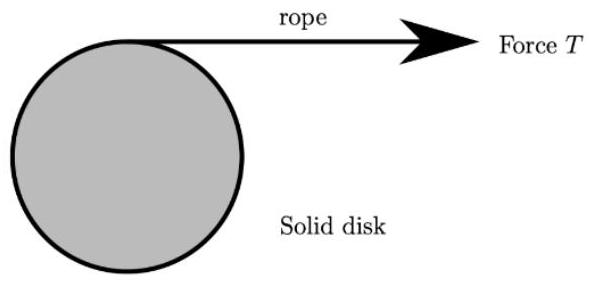
A solid disk of mass, $M$, moment of inertia, $I$, and radius, $R$, is at rest with its circular face on a horizontal, frictionless table as shown in this overhead view. A rope is wrapped around the disk tightly and pulled with a force of $T$. The disk moves linearly and rotationally as the force, $T$, accelerates the disk along the table. After the disk has accelerated some distance, determine the ratio of the translational Kinetic Energy to the total Kinetic Energy of the disk. ($K E_{\text {translational }} / K E_{\text {total }}$)
(A) $I / M R^{2}$
(B) $M R^{2} / I$
(C) $I^{3} / M R^{2}$
(D) $I /\left(M R^{2}+I\right)$
(E) $\quad M R^{2} /\left(M R^{2}+I\right)$
Show answer · 显示答案