Physics Bowl

Nuclear Physics

13 items — reveal each answer key.

2010 · Q44Division 2Nuclear Physics

A radioactive sample of gas has a half-life of 100 seconds. If there are initially 10000 of these gas molecules in a closed container, approximately how many of the molecules remain after a time of 250 seconds elapses?

(A) 2500
(B) 2190
(C) 1770
(D) 1560
(E) 1250

Show answer · 显示答案
Answer key
  • C

Worked solutions are in the books.

2010 · Q46Division 2Nuclear Physics

For the following nuclear reaction, what is the unknown labeled by X ? $$^{22}_{11}Na+X\rightarrow {}^{22}_{10}Ne+\nu_{e}$$ (A) A proton
(B) An electron
(C) A neutron
(D) An alpha particle
(E) A positron

Show answer · 显示答案
Answer key
  • B

Worked solutions are in the books.

2012 · Q41–42Division 2Nuclear Physics

A hypothetical radioactive substance Aaptinium decays via alpha-emission into Physicsbowlium. The decay constant for this alpha-emission is 20 $s^{-1}.$

41. Which one of the following statements correctly compares Physicsbowlium to Aaptinium?

(A) Physicsbowlium has 4 fewer protons and 2 fewer neutrons than Aaptinium.

(B) Physicsbowlium has 4 fewer neutrons and 2 fewer protons than Aaptinium.

(C) Physicsbowlium has 2 fewer protons and 2 fewer neutrons than Aaptinium.

(D) Physicsbowlium has 4 fewer protons than, and the same number of neutrons as, Aaptinium.

(E) Physicsbowlium has 2 fewer protons than, and the same number of neutrons as, Aaptinium.

42. What is the half-life of Aaptinium?

(A) 0.035 $s$
(B) 0.050 $s$
(C) 0.100 $s$
(D) 0.297 $s$
(E) 0.693 $s$
Show answer · 显示答案
Answer key
  • Q41C
  • Q42A

Worked solutions are in the books.

2013 · Q21Division 1Division 2Nuclear Physics

The following nuclear reaction occurs: $^{131}_{53}I\rightarrow ^{131}_{54}Xe+^{A}_{Z} X$. What is $^{A}_{Z} X$?

(A) a neutron
(B) a proton
(C) a positron
(D) an alpha particle
(E) an electron

Show answer · 显示答案
Answer key
  • E

Worked solutions are in the books.

2016 · Q22Division 1Division 2Nuclear Physics

For the following nuclear reaction, which one of the following choices correctly identifies the quantity labeled $X$?

$_{19}^{40}K + e^-\rightarrow X+ ^0_{0}v_{e}$

(A) $_{19}^{40}K$
(B) $_{18}^{40}K$
(C) $_{18}^{39}Ar$
(D) $_{19}^{39}K$
(E) $_{18}^{40}Ar$

Show answer · 显示答案
Answer key
  • E

Worked solutions are in the books.

2018 · Q47Division 2Nuclear Physics

The existence of the neutrino was proposed to explain

(A) alpha decay
(B) gamma emission
(C) beta decay
(D) fission
(E) fusion

Show answer · 显示答案
Answer key
  • C

Worked solutions are in the books.

2021 · Q28Division 1Division 2Nuclear Physics

Electric energy can be generated in many ways, two of which are with nuclear plants using nuclear fission reactions, or coal fired plants utilizing chemical reactions. Energy density for a fuel has units of Joules/kilogram. What is the approximate ratio of nuclear versus chemical energy density?
(A) 1
(B) $10^{3}$
(C) $10^{6}$
(D) $10^{9}$
(E) $10^{12}$

Show answer · 显示答案
Answer key
  • C

Worked solutions are in the books.

2021 · Q31Division 1Division 2Nuclear Physics

Any nucleus that emits an alpha particle or beta particle
(A) always becomes a nucleus of a different element
(B) may become a nucleus of a different element
(C) becomes a different isotope of the same element
(D) increases its mass number
(E) increases its mass

Show answer · 显示答案
Answer key
  • A

Worked solutions are in the books.

2021 · Q42Division 2Nuclear Physics

A radioactive sample of gas has a half-life of 100 seconds. If there are initially 10000 of these gas molecules in a closed container, approximately how many of the molecules remain after a time of 250 seconds elapses?
(A) 2500
(B) 2190
(C) 1770
(D) 1560
(E) 1250

Show answer · 显示答案
Answer key
  • C

Worked solutions are in the books.

2022 · Q44Division 2Nuclear Physics

How long would it take $4.0 \times 10^{20}$ nuclei to decay to $1.0 \times 10^{19}$ atoms if their half-life was 14.7 years?
(A) 29.4 years
(B) 58.8 years
(C) 78.2 years
(D) 147 years
(E) 161 years

Show answer · 显示答案
Answer key
  • C

Worked solutions are in the books.

2023 · Q14Division 1Division 2Nuclear Physics

Any atom that emits an alpha particle or a beta particle
(A) always becomes an atom of a different element.
(B) may become an atom of a different element.
(C) becomes a different isotope of the same element.
(D) increases its mass.
(E) becomes highly reactive.

Show answer · 显示答案
Answer key
  • A

Worked solutions are in the books.

2024 · Q50Division 2Nuclear Physics

A gas undergoes radioactive decay with time constant $\tau$. A sample of 10000 particles is put into a container. After one time constant has passed, the experimenter adds another 10000 particles into the container. How much time passes from the addition of the particles until the container of gas reaches 10000 total particles again?
a. $(0.313) \tau$
b. $(0.500) \tau$
c. $(0.693) \tau$
d. $\tau$
e. $2 \tau$

Show answer · 显示答案
Answer key
  • A

Worked solutions are in the books.

2025 · Q30Division 1Division 2Nuclear Physics

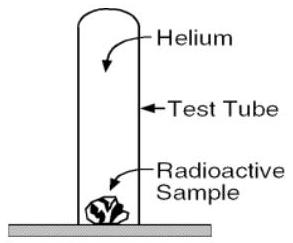
The diagram on the right shows an inverted test tube over a sample of a radioactive material. Helium has collected in the test tube. The presence of helium indicates that the sample is most probably undergoing the process of

figure

(A) alpha decay
(B) neutron decay
(C) beta decay
(D) proton decay
(E) gamma emission

Show answer · 显示答案
Answer key
  • A

Worked solutions are in the books.