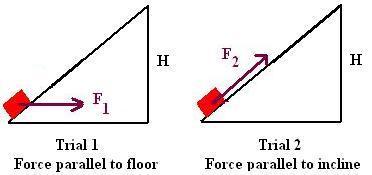
An object of mass $M$ starts from rest at the bottom of a fixed incline of height $H$. A person decides to push the object up the incline in one of two ways with an applied force shown in the diagram. In each of the trials, the object reaches the top of the incline with speed $V$. How would the work done by the person on the block compare for the two trials? Assume the same constant non-zero coefficient of kinetic friction between the incline and the object for both trials.
(A) More work would be done in Trial 1
(B) More work would be done in Tria12
(C) The work would be equal for both trials
(D) It is impossible to determine for which trial there would be more work done without knowing the value of the
speed $V.$
(E) It is impossible to determine for which trial there would be more work done without knowing the value of the coefficient of kinetic friction.
2010 · Q32–33Division 1Division 2Momentum and Energy
A rubber ball of mass 2.0 $kg$ falling straight downward hits the ground with a speed of 0.90 $m/s$ and then rebounds straight upward with a speed of 0.60 $m/s$. The collision time of the ball with the ground is $t=0.25s$. Treat $g=10^{m}/s^{2}$ for this situation.
32. What is the magnitude of the average acceleration (in units of $m/s^{2}$) of the ball while it is in contact with the ground?
(A) 1.2
(B) 6.0
(C) 10.0
(D) 13.0
(E) 16.0
33. What is the magnitude of the average force (in units of Newtons) exerted by the ground on the ball while they are in contact?
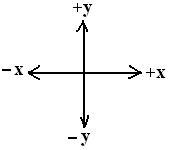
A 4.0 kg object in deep space moves at a constant velocity of 10 $m/s$ along the $+\mathrm{x}$ axis. The object suddenly explodes into 2 equal mass pieces. Immediately after the explosion, one piece is now moving directly along the $-\mathrm{y}$ axis with a speed of 8.0 $m/s$. What was the size of the impulse (in proper MKS units) provided to this piece now moving along the $-\mathrm{y}$ axis from the explosion?
A person throws an object of mass $M$ straight upward with an initial non-zero speed $\nu$. The object rises to a maximum height $H$ above the launch point. The person now throws an object of mass $\displaystyle \frac{1}{2}M$ straight upward with initial speed $ 2\nu$. In terms of $H$, to what maximum height does the object of mass $\displaystyle \frac{1}{2}M$ rise above the launch point? Ignore air resistance.
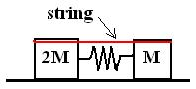
Two blocks sit on a horizontal frictionless surface connected to an ideal spring. Initially everything is at rest and there is a string compressing the mass-spring system from equilibrium. At some time after the string is cut, the block of mass $2M$ reaches its maximum kinetic energy $K$. What maximum kinetic energy does the block of mass $M$ attain in terms of $K$?
An object with mass $M$ moves due East on a frictionless horizontal surface with a speed of $V.$
A second object of mass $\displaystyle \frac{1}{2}M$ has a speed of $3V$. The two objects collide and stick together. If the objects are moving due South after the collision, with what speed are they moving?
A 1.00 $kg$ object is released from rest near the surface of the Earth. The gravitational force acting on the 1.00 $kg$ object by the Earth does $10. 0J$ of work on the object as it falls 1.00 $m$ to the ground. Which one of the following choices best represents the amount of work done by the gravitational force acting on the Earth by the 1.00 $kg$ object during the fall?
The magnitude of the linear momentum of a 4.00 $kg$ point mass is changed from 6.00 $kg\displaystyle \cdot\frac{m}{s}$ to 14.0 $kg\displaystyle \cdot\frac{m}{s}$ in a time interval of 6.00 $s$. What is the change in the kinetic energy of the mass during this time interval?
2012 · Q23–24Division 1Division 2Momentum and Energy
A collision of two blocks takes place along a horizontal surface without friction.
A block with mass $M_{1}=3.00kg$ initially moves to the left with speed $V_{1}=5.00m/s$ when it hits a block with mass $M_{2}=5.00kg$ initially moving to the right with speed $V_{2}=2.00m/s.$ After colliding, the block with mass $M_{1}$ is moving to the right with speed 1.00 $m/s.$
23. Which of the blocks underwent a larger magnitude of acceleration during the collision?
(A) The block with mass $M_{1}.$
(B) The block with mass $M_{2}.$
(C) The magnitude of the acceleration was the same for both blocks.
(D) The answer depends on how much kinetic energy was transferred out of the two-block system.
(E) More information about the time of the collision is required to answer the question.
24. What is the speed of the block with mass $M_{2}$ after the collision?
At an instant of time $\tau$, a point object of mass $M$ moves with velocity $\vec{V}$, has acceleration $\vec{A}$, and is at position $(x,\ y)$ . In what direction must the linear momentum of the object be directed at this instant?
(A) Along the direction of the velocity of the mass
(B) Along the direction of the net force acting on the mass
(C) Along the direction of the vector from the origin $(0,0)$ to $(x,\ y)$
(D) Along the direction of the acceleration of the mass
(E) Along the direction perpendicular to the object's acceleration
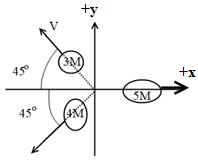
An object of mass $12M$ is at rest when it suddenly explodes into 3 pieces with masses $3M, 4M$, and $5M$. The piece of mass $3M$ moves with speed $V$ in the direction shown in the diagram. What is the speed of the piece with mass $5M$ knowing that it is moving directly to the right?
A small $l.0kg$ mass is launched from the top of a cliff with speed $V$ at an angle of $30^{\circ}$ above the horizontal. When the mass reaches the ground, its velocity is directed at $45^{\circ}$ below the horizontal. Which one of the following choices is the magnitude of the total impulse that was imparted to the mass during its flight? Ignore air resistance.
A crate gains $36.0J$ of kinetic energy while its speed is increased from $2.00\displaystyle \frac{m}{s}$ to $4.00\displaystyle \frac{m}{s}$. Which one of the following choices best represents the mass of the crate?
Two objects, A and $\mathrm{B}$, move in space and then collide.
Before collision: Object $\mathrm{A}$, of mass 5.0 $kg$, moves to the right with a speed of 25.0 $\displaystyle \frac{m}{s}$. Object $\mathrm{B}$, of mass 10.0 $kg$, moves to the left with aspeed of $20.0\displaystyle \frac{m}{s}$.
After collision: Object A moves to the left with a speed of 25. $0\displaystyle \frac{m}{s}.$
What is the velocity of object $\mathrm{B}$ after the collision?
A toy crane exerts an upward force and delivers a useful power output of 0.10 $W$ to raise a block vertically at a constant speed. At what constant speed will this crane raise a 0.20 $kg$ block?
A box of mass 12.0 $kg$ is being pushed to the right across a horizontal surface. When the box has 12. $0J$ of kinetic energy, a 12.0 $N$ net force acts on it. Which one of the following choices best represents the magnitude of the linear momentum of the box at this instant?
2015 · Q27–28Division 1Division 2Momentum and Energy
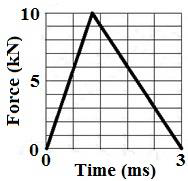
On a frictionless horizontal surface, two bodies make a head-on collision and stick together. Body 1 has a mass of 3.50 $kg$ and initially moves to the right with speed 7.0 $\displaystyle \frac{m}{s}$. Body 2 initially is at rest. A graph of the force exerted onto Body 2 from Body 1 during the collision is shown.
An object of mass 4.0 $kg$ has a total kinetic energy $\mathrm{o}\mathrm{f}100.0J$ and an $\mathrm{x}$-component of linear momentum equal to 24.0 $kg\displaystyle \frac{m}{s}$. The object is moving in the x-y plane. What is the $\mathrm{y}$-component of the object's linear momentum?
2016 · Q11–12Division 1Division 2Momentum and Energy
A 12.0 $N$ net force directed to the right is exerted on a 3.0 $kg$ block for 5.0 $s$. The block was initially at rest and slides on a horizontal surface.
11. What is the speed of the block at the end of the 5.0 $s$ interval?
A 10.0 $kg$ mass moves to the right at $8.00\displaystyle \frac{m}{s}$. A 5.0 $kg$ mass moves to the left at 7. $00\displaystyle \frac{m}{s}$. With what speed does the center of mass of this two-mass system move?
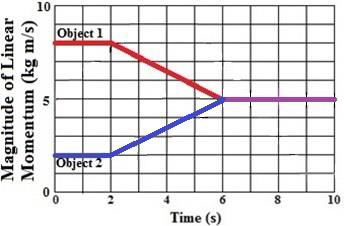
The graph shows the magnitude of the linear momentum of two solid objects colliding on the $\mathrm{x}$-axis. Which one of the following statements must be true based on the information provided?
(A) The objects remain stuck together after the collision.
(B) Object 2 experiences the greater force from the collision.
(C) Object 2 cannot have more mass than object 1.
(D) The kinetic energy loss was maximized with no external forces present in the two-object system.
(E) The kinetic energy of the two-object system is the same both before and after the collision.
Which one of the following choices is most closely associated with the following observation about an isolated object: "The linear momentum of the object is constant."?
(A) Huygens' Principle
(B) Kepler's First Law
(C) Hooke's Law
(D) Pascal's Principle
(E) Newton's First Law
A 4.00 $kg$ object moves to the right with speed $5.00 \frac{m}{s}$. A 5.00 $kg$ object moves to the left with speed 3.00 $\frac{m}{s}$. After colliding, the 4.00 $kg$ object moves to the left with speed $1.00\frac{m}{s}$. What is the speed of the 5.00 $kg$ object after the collision?
2017 · Q11–12Division 1Division 2Momentum and Energy
A 5.00 $kg$ block slides with uniform acceleration on a horizontal surface for 5.00 $s$. The block's kinetic energy strictly decreases from 50.0J to 20.0J in this time.
11. What is the average speed of the block during the motion described?
A 1500 $kg$ car and a 6000 $kg$ truck have a perfectly inelastic collision on a street. Which one of the following choices correctly identifies the object(s) that lose kinetic energy from the impact?
(A) Neither object loses kinetic energy.
(B) Only the car loses kinetic energy.
(C) Only the truck loses kinetic energy.
(D) Both the car and truck lose kinetic energy.
(E) The answer cannot be determined without more information
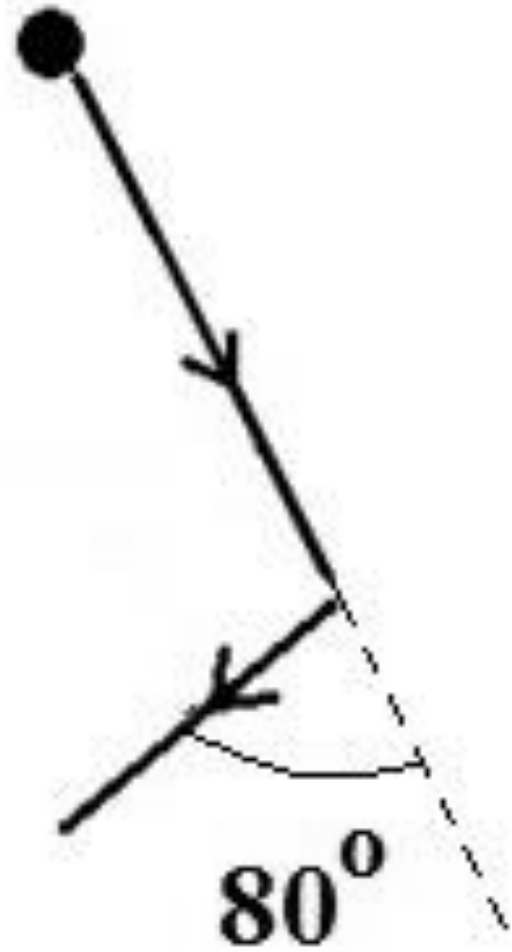
A 2.0 $kg$ mass moves at $10.0\displaystyle \frac{m}{s}$ when it has a collision in space. The mass's speed was unchanged, but the direction of its velocity was altered by $80^{\circ}$ If the collision lasted 0.25 $s$, what was the magnitude of the average force exerted on the mass?
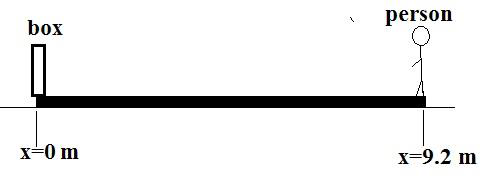
A 9.20 $m$ long uniform plank rests on a frictionless ice pond. A 52 $kg$ box rests on the plank's left end while a 71 $kg$ person stands at the plank's right end. After the person walks to the left on the plank and stands at the same location as the box, the plank has slid $|$ 3.84 $m$ to the right relative to the pond's shore. Which one of the following choices best represents the mass of the plank?
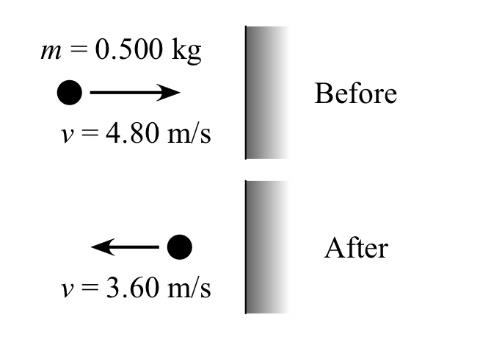
A ball with a mass of 0.500 kg traveling at 4.80 $\mathrm{m}/\mathrm{s}$ strikes a wall and rebounds in the opposite direction at 3.60 $\mathrm{m}/\mathrm{s}$. What is the magnitude of the impulse that acted on the ball during the collision with the wall?
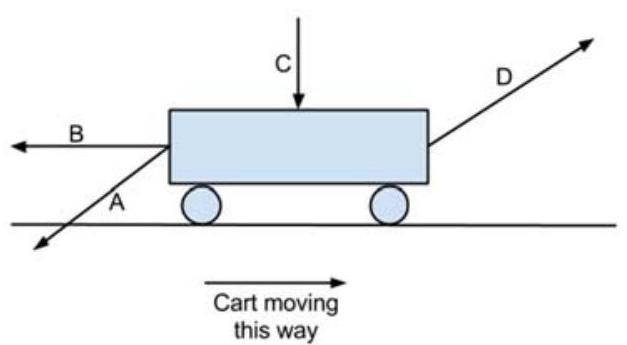
A force, $\boldsymbol{F}$, could be applied to a cart in a variety of directions as shown at right. Which of the applications of $\boldsymbol{F}$ would result in no work being done?
(A) A
(B) B
(C) C
(D) D
(E) All of them result in work being done.
A brick is moving at a speed of $3 \mathrm{~m} / \mathrm{s}$ and a pebble is moving at a speed of $5 \mathrm{~m} / \mathrm{s}$. If both objects have the same kinetic energy, what is the ratio of the brick's mass to the pebble's mass?
(A) $25: 9$
(B) $5: 3$
(C) $4: 1$
(D) $3: 1$
(E) $\sqrt{5}: \sqrt{3}$
Two cranes are used to lift loads vertically at constant speed from the ground to the top of a building. Crane 1 lifts an $8000-\mathrm{N}$ load a height of 40 m in a time of 20 minutes. Crane 2 lifts a $6400-\mathrm{N}$ load a height of 50 m in a time of 16 minutes. Which statement below correctly compares the mechanical power output of each crane?
(A) The cranes have the same power because they perform the same amount of work.
(B) The cranes have the same power because the ratio of force exerted to time is the same.
(C) Crane 1 has a greater power because it exerts more force to lift the load.
(D) Crane 1 has a greater power because it raises the load over a longer time.
(E) Crane 2 has a greater power because it performs the same amount of work in less time.
A rock that has a mass of 12 kg is sliding on a rough, horizontal surface. It has 24 J of kinetic energy and the friction force on it is a constant 0.50 N . What distance will it slide before coming to rest?
(A) 2.0 m
(B) 12 m
(C) 24 m
(D) 36 m
(E) 48 m
A child, starting from rest at the top of a $3.00-\mathrm{m}$ tall slide, has a speed of $2.52 \mathrm{~m} / \mathrm{s}$ at the bottom of the slide. What percent of the mechanical energy of the child-Earth system at the top of the slide remains when the child reaches the bottom of the slide?
(A) $8.4 \%$
(B) $10.6 \%$
(C) $32.5 \%$
(D) $46.0 \%$
(E) It cannot be determined without knowing the mass of the child.
A spring loaded projectile launcher launches a plastic ball horizontally with a speed of $4.0 \mathrm{~m} / \mathrm{s}$. If the spring were compressed twice as far, the ball's launch speed would be
(A) $1.0 \mathrm{~m} / \mathrm{s}$
(B) $2.0 \mathrm{~m} / \mathrm{s}$
(C) $4.0 \mathrm{~m} / \mathrm{s}$
(D) $8.0 \mathrm{~m} / \mathrm{s}$
(E) $16 \mathrm{~m} / \mathrm{s}$
A man of mass $m$, gets off a boat by leaping to the left in an exactly horizonal direction. Both the man and the boat were initially stationary. Immediately after the leap, the boat of mass $M$, is observed to be moving to the right at speed $v$. What is the increase of the kinetic energy in the man-boat system? (Neglect the resistive force of the water)
(A) $\frac{1}{2} M v^{2}$
(B) $\frac{1}{2} m v^{2}$
(C) $\frac{1}{2}(M+m) v^{2}$
(D) $\frac{1}{2}\left(M+\frac{M^{2}}{m}\right) v^{2}$
(E) $\frac{1}{2} \frac{M m}{(M+m)} v^{2}$
A $20,000 \mathrm{~kg}$ truck is traveling at $25 \mathrm{~km} / \mathrm{hr}$. At what speed does a 1000 kg car need to travel to have the same kinetic energy as the truck?
(A) $112 \mathrm{~km} / \mathrm{hr}$
(B) $132 \mathrm{~km} / \mathrm{hr}$
(C) $102 \mathrm{~km} / \mathrm{hr}$
(D) $79.0 \mathrm{~km} / \mathrm{hr}$
(E) $89.0 \mathrm{~km} / \mathrm{hr}$
A bullet with a mass of 5.0 g is fired horizontally into a 2.0 kg wooden block which is resting on a horizontal table. The bullet stops in the block and the block and bullet combination move 2.0 m . The coefficient of kinetic friction between the block and surface of the table is 0.2 . Find the initial speed of the bullet.
(A) $1123 \mathrm{~m} / \mathrm{s}$
(B) $1134 \mathrm{~m} / \mathrm{s}$
(C) $1132 \mathrm{~m} / \mathrm{s}$
(D) $113.2 \mathrm{~m} / \mathrm{s}$
(E) $113.4 \mathrm{~m} / \mathrm{s}$
When descending mountain roads, large trucks pulling a heavy load can burn up the brakes. Once the brakes are no longer useful, the driver may need to guide the truck up a "runaway truck lane" on the side of the road. The runaway truck lane is directed uphill and often has a thick layer or sand or gravel or both on the surface. Which of the following is one of the reasons the truck will stop?
(A) An increase in kinetic energy
(B) A decrease in potential energy
(C) A decrease in fuel
(D) A transfer of energy to the gravel on the track of the runaway truck lane
(E) The change in temperature of the engine
A block of wood initially at rest slides down an inclined plane. Neglecting friction, the kinetic energy of the block at the bottom of the plane is:
(A) all converted into heat.
(B) less than its kinetic energy at the top of the plane.
(C) dependent on the materials of which the block is made.
(D) dependent on the materials of which the inclined plane is made.
(E) equal to its potential energy (with respect to the bottom of the plane) when it was at the top of the plane.
A helicopter with a mass of 700 kg will hover when its rotating blades move through an area of $50 \mathrm{~m}^{2}$. Find the average speed imparted to the air (density of air $=1.3 \mathrm{~kg} / \mathrm{m}^{3}$ )
(A) 7.66 m/s
(B) 10.4 m/s
(C) 16.5 m/s
(D) 38.0 m/s
(E) 44.1 m/s
A machine gun fires 100 g bullets at a speed of $1000 \mathrm{~m} / \mathrm{s}$. The person holding the machine gun in their hands can exert an average force of 150 N against the gun. If the gun is to remain stationary, what is the maximum number of bullets that can be fired per minute?
(A) 10
(B) 15
(C) 30
(D) 60
(E) 90
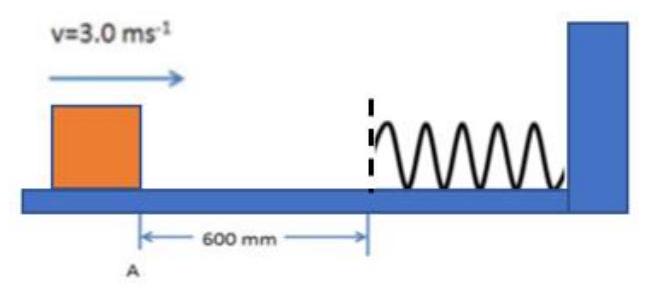
A spring with spring constant $\mathrm{k}=20 \mathrm{kN} / \mathrm{m}$, is used to stop a 50 kg box that is sliding on a horizontal surface. The spring is initially in its equilibrium state. At position $A$, shown in the top diagram, the box has a speed of $3.0 \mathrm{~m} / \mathrm{s}$. The compression of the spring when the box is instantaneously at rest (position $B$ in the bottom diagram) is 120 mm . Determine the coefficient of kinetic friction between the box and the surface.
A cyclist, using a power meter while on a training ride, checks and sees that she is doing work at the rate of 500 W . How much average force does her foot exert on the pedals when she is traveling at $8.0 \mathrm{~m} / \mathrm{s}$ ?
(A) 31 N
(B) 63 N
(C) 80 N
(D) 320 N
(E) 710 N
A radioactive carbon-14 nucleus decays into a beta particle, an antineutrino, and a nitrogen-14 nucleus. In a particular decay, the beta particle has momentum, $p$, and the nitrogen nucleus has momentum of magnitude $4 p / 3$ at an angle of $90^{\circ}$ to $p$. At what angle (with respect to the beta particle) do you expect the antineutrino to be emitted?
(A) $53^{\circ}$
(B) $37^{\circ}$
(C) $90^{\circ}$
(D) $127^{\circ}$
(E) $33^{\circ}$
A crate slides down a ramp with a rough surface that is inclined to the horizontal at $30^{\circ}$. If $70 \%$ of the initial potential energy is dissipated during the descent, find the coefficient of sliding friction
(A) 0.20
(B) 0.30
(C) 0.40
(D) 0.50
(E) 0.60
Small particles with a mass of 0.10 kg are allowed to fall from a height of 1.6 m before colliding with the pan of a balance. The collisions occur at 441 particles/min, what will the balance register if the collisions of the particles are perfectly elastic?
(A) 0.43 kg
(B) 0.53 kg
(C) 0.73 kg
(D) 0.83 kg
(E) 0.93 kg
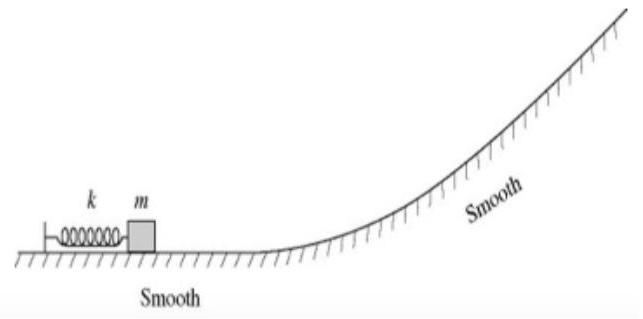
A box of mass $m$ is pressed against (but is not attached to) an ideal spring of force constant $k$ and negligible mass. The spring is compressed a distance $x$. After it is released, the box slides up a frictionless incline as shown in the diagram at right and eventually stops. If we repeat this experiment with a box of mass $2 m$,
(A) the lighter box will go twice as high up the incline as the heavier box.
(B) just as it moves free of the spring, the lighter box will be moving twice as fast as the heavier box.
(C) both boxes will have the same speed just as they move free of the spring.
(D) both boxes will reach the same maximum height on the incline.
(E) just as it moves free of the spring, the heavier box will have twice as much kinetic energy as the lighter box.
A small rocket with a mass of 5000 kg is to be launched vertically. What rate of ejection of gas, with an exhaust speed $1000 \mathrm{~m} / \mathrm{s}$, is necessary to provide the thrust to impart an initial upward acceleration of 2 g ?
(A) $50 \mathrm{~kg} / \mathrm{s}$
(B) $100 \mathrm{~kg} / \mathrm{s}$
(C) $150 \mathrm{~kg} / \mathrm{s}$
(D) $200 \mathrm{~kg} / \mathrm{s}$
(E) $250 \mathrm{~kg} / \mathrm{s}$
A rock is dropped from a cliff in a canyon. Neglecting air resistance, as it falls, which of the following statements about its energy is true, according to the law of conservation of energy?
(A) The total mechanical energy of the rock increases.
(B) The total mechanical energy of the rock remains constant.
(C) The kinetic energy of the rock decreases, but the potential energy remains constant.
(D) The potential energy of the rock decreases, but the kinetic energy remains constant.
(E) The kinetic energy of the rock increases, but the potential energy remains constant.
Two people on ice skates are initially at rest while facing one another. One person has a mass of 60 kg and the other 40 kg . They push off each other and move in opposite directions. If the $60 \mathrm{kg}$ skater moves with a speed of $2.0 \mathrm{~m} / \mathrm{s}$, what is the speed of the $40$ kg skater, assuming no external forces are acting?
(A) $1.0 \frac{\mathrm{~m}}{\mathrm{~s}}$
(B) $2.0 \frac{\mathrm{~m}}{\mathrm{~s}}$
(C) $3.0 \frac{\mathrm{~m}}{\mathrm{~s}}$
(D) $4.0 \frac{\mathrm{~m}}{\mathrm{~s}}$
(E) $5.0 \frac{\mathrm{~m}}{\mathrm{~s}}$
A small cart with a mass of 50 g is rolling on a frictionless track with a velocity of $+10 \frac{\mathrm{~m}}{\mathrm{~s}}$. It then has a head-on, elastic collision with a stationary cart of mass 100 g. What is the speed of each cart immediately after the collision? The $50 \mathrm{g}$ cart speed is listed first followed by the 100-g cart speed in all choices.
(A) $-3.3 \frac{\mathrm{~m}}{\mathrm{~s}}$ and $+6.7 \frac{\mathrm{~m}}{\mathrm{~s}}$
(B) $+3.3 \frac{\mathrm{~m}}{\mathrm{~s}}$ and $-6.7 \frac{\mathrm{~m}}{\mathrm{~s}}$
(C) $-6.7 \frac{\mathrm{~m}}{\mathrm{~s}}$ and $+3.3 \frac{\mathrm{~m}}{\mathrm{~s}}$
(D) $+6.7 \frac{\mathrm{~m}}{\mathrm{~s}}$ and $-3.3 \frac{\mathrm{~m}}{\mathrm{~s}}$
(E) $+3.3 \frac{\mathrm{~m}}{\mathrm{~s}}$ and $+6.7 \frac{\mathrm{~m}}{\mathrm{~s}}$
2024 · Q20–22Division 1Division 2Momentum and Energy
Questions 20-22 are based on the following situation: A bicycle and its rider have a combined mass of 80.0 kg . The cyclist can coast down a $6.0^{\circ}$ hill, and because of air resistance, they are limited to a constant speed of $6.0 \frac{\mathrm{~km}}{\mathrm{hr}}$. The vertical height of the hill is 120 m .
20. What total distance does the cyclist ride to climb this hill?
(A) 1024 m
(B) 1042 m
(C) 1124 m
(D) 1142 m
(E) 1148 m
21. How much work against gravity must the cyclist do to climb this hill?
(A) 800 J
(B) 1200 J
(C) 9600 J
(D) 12,000 J
(E) 96,000 J
22. If each complete revolution of the pedals moves the bike 4.9 m along its path uphill, calculate the average force that must be exerted on the pedals, tangent to their circular path. Neglect work done by friction and other losses. The pedals turn in a circle of diameter 34 cm .
(A) 383 N
(B) 410 N
(C) 234 N
(D) 518 N
(E) 449 N
A person with a mass $m$, falls from a height of $h$ onto a crash mat. The speed of the person when they reach the mat is equal to:
(A) $\sqrt{(2 g h)}$
(B) $\frac{1}{h} \sqrt{2 g}$
(C) $2 g h$
(D) $2 \sqrt{g h}$
(E) $\frac{1}{\sqrt{2 g h}}$
When an inelastic collision occurs, the total kinetic energy of the colliding bodies...
(A) increases.
(B) decreases.
(C) remains constant.
(D) decreases then increases.
(E) increases then decreases.
When NASA began conducting test flights for the space shuttle, they used a "glider" that had a mass of 980 kg (including pilot). This glider was launched horizontally at $500 \frac{\mathrm{~km}}{\mathrm{hr}}$ from a height of 3500 m . The glider eventually landed at a speed of $200 \frac{\mathrm{~km}}{\mathrm{hr}}$. What was the average force of air resistance exerted on the glider if it came in at a constant angle of $10^{\circ}$ to the Earth?
(A) 1956 N
(B) 2010 N
(C) 2056 N
(D) 2090 N
(E) 3016 N
An impulse of $10 \mathrm{~N} \cdot \mathrm{~s}$ is acting on a 5 kg object. By how much will the object's velocity change?
(A) $0 \frac{\mathrm{~m}}{\mathrm{~s}}$
(B) $0.5 \frac{\mathrm{~m}}{\mathrm{~s}}$
(C) $2.0 \frac{\mathrm{~m}}{\mathrm{~s}}$
(D) $2.5 \frac{\mathrm{~m}}{\mathrm{~s}}$
(E) $5.0 \frac{\mathrm{~m}}{\mathrm{~s}}$
A simple pendulum consists of a small mass $m$ attached to a massless string of length $L$. It is displaced to an angle $\theta_{o}$ from the vertical and released from rest. Assume no air resistance. At the lowest point of its swing, the pendulum bob collides elastically with another stationary bob of equal mass $m$, which is free to move after the collision. What is the maximum angle $\theta_{f}$ the original pendulum bob reaches after the collision?
(A) $\theta_{\mathrm{f}}=\theta^{\mathrm{o}}$
(B) $\theta_{\mathrm{f}}=\theta^{\circ} / 4$
(C) $\theta_{\mathrm{f}}=\theta^{\circ} / 2$
(D) $\theta_{\mathrm{f}}=0$
(E) $\theta_{\mathrm{f}}=2 \theta^{\circ}$
A particle with a mass of 10.0 g has an elastic, head-on collision with a second particle, also with a mass of 10.0 g , on frictionless, horizontal surface (such as an air hockey table). The collision has a coefficient of restitution, $\mathrm{e}=1.0$. Determine the percent loss of kinetic energy in the collision.
(A) $0 \%$
(B) $25 \%$
(C) $50 \%$
(D) $75 \%$
(E) 100%
An object with a mass of 0.250 kg is moving through space with a linear velocity only and a kinetic energy of 1.000 J . Determine the magnitude of the momentum of this object as it is moving through space with a linear velocity.
(A) $p=0.500 \frac{k g m}{s}$
(B) $p=0.707 \frac{k g m}{s}$
(C) $p=1.000 \frac{\mathrm{~kg} \mathrm{~m}}{\mathrm{~s}}$
(D) $p=0.250 \frac{k g m}{s}$
(E) $p=1.414 \frac{k g m}{s}$
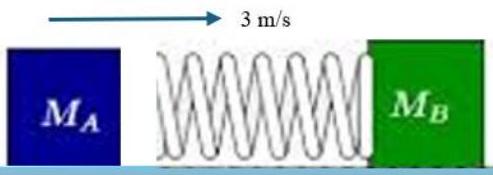
$M_{A}$ has a mass of 10 kg and slides to the right at $3 \mathrm{~m} / \mathrm{s}$ across a level, frictionless surface towards $M_{B}$ that has a mass of 6 kg and is initially at rest. There is a massless, ideal spring with $k=540 \mathrm{~N} / \mathrm{m}$ on the left side of $M_{B}$. The spring is initially compressed and held so that it will not release until the impact with $M_{A}$. After the collision, $M_{A}$ is at rest. How far was the spring compressed from its natural length in meters?
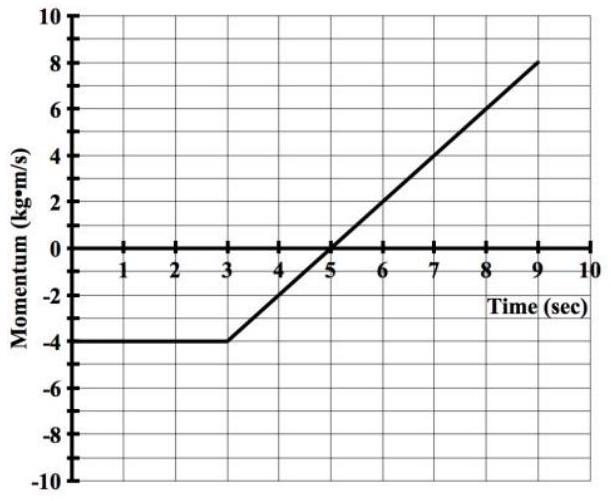
The graph shows the momentum of a particle as a function of time. What net impulse acted on the particle from $t=0.0 \mathrm{sec}$ to $t=9.0 \mathrm{sec}$ ?
(A) $0.0 \mathrm{~N} \cdot \mathrm{~s}$
(B) $1.3 \mathrm{~N} \cdot \mathrm{~s}$
(C) $2.0 \mathrm{~N} \cdot \mathrm{s}$
(D) $12 \mathrm{~N} \cdot \mathrm{s}$
(E) $32 \mathrm{~N} \cdot \mathrm{s}$