Physics Bowl

Magnetism and Induction

33 items — reveal each answer key.

2010 · Q26Division 1Division 2Magnetism and Induction

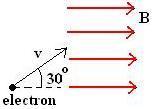
An electron moving in the plane of the page at an angle of $30^{\circ}$ to the horizontal enters a region with a constant magnetic field directed horizontally in the plane of the page as shown. At the instant that the electron enters the magnetic field, which best describes the direction of the resulting magnetic force on the electron?
figure

(A) To the right

(B) To the left

(C) In a direction not listed here

(D) Into the plane of the page

(E) Out of the plane of the page
Show answer · 显示答案
Answer key
  • E

Worked solutions are in the books.

2010 · Q39Division 1Division 2Magnetism and Induction

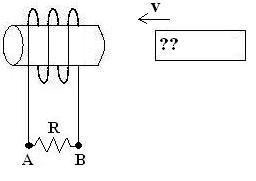
A strong bar magnet is held very close to the opening of a solenoid as shown in the diagram. As the magnet is moved to the left toward the solenoid, a conventional current through the resistor shown is directed from A to B. What is the direction of the force on the bar magnet because of the induced current in the solenoid and which magnetic pole does the“??" in the diagram represent?

figure
Force on magnetPole of magnet
(A)To the rightNorth
(B)To the leftNorth
(C)To the rightSouth
(D)To the leftSouth
(E)There is no forceIt can't be determined
Show answer · 显示答案
Answer key
  • A

Worked solutions are in the books.

2011 · Q29Division 1Division 2Magnetism and Induction

An electron moves with speed $1.00\times 10^{3}m/s$ as it enters a region of space that has only a uniform magnetic field. The electron is accelerated because of this field with a constant magnitude of $8.00\times 10^{5m}/s^{2}$ for the entire time $\mathrm{o}\mathrm{f}1.00\times 10^{-3}s$ that it is in the field. With what speed would the electron exit the field? Ignore gravity.

(A) $1.80\times 10^{3}m/s$

(B) $1.41\times 10^{3}m/s$

(C) $1.00\times 10^{3}m/s$

(D) $2.00\times 10^{2}m/s$

(E) It depends on the initial angle of the electron's velocity with respect to the magnetic field.

Show answer · 显示答案
Answer key
  • C

Worked solutions are in the books.

2011 · Q34Division 1Division 2Magnetism and Induction

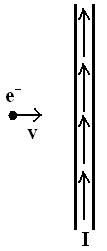
A wire lies in the plane of the page with conventional current $I$ shown. At the instant shown, what is the direction of the magnetic force on the electron that is moving directly to the right toward the wire?

figure

(A) Toward the bottom of the page

(B) Toward the top of the page

(C) Into the plane of the page

(D) Out of the plane of the page

(E) There is no force

Show answer · 显示答案
Answer key
  • B

Worked solutions are in the books.

2011 · Q41Division 2Magnetism and Induction

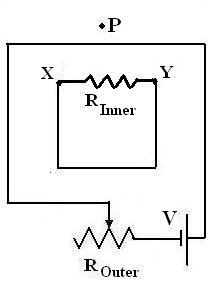
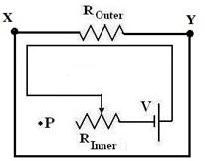
For the figure shown, the variable resistance of the outer circuit, $R_{Outer}$, is decreasing at a constant rate. While this is occurring, in which direction is the magnetic field associated with the outer circuit at the point $\mathrm{P}$ in the plane of the circuit and in which direction is the conventional current through the resistor $R_{Inner}$ in the smaller interior circuit? The two circuits lie on a flat table.

Magnetic Field at $\mathrm{P}$Current through $R_{I} r$
(A)Into the pageFrom X to $\mathrm{Y}$
(B)Into the pageFrom $\mathrm{Y}$ to X
(C)Into the pageThere is no current.
(D)Out of the pageFrom X to $\mathrm{Y}$
(E)Out of the pageFrom $\mathrm{Y}$ to X
figure
Show answer · 显示答案
Answer key
  • A

Worked solutions are in the books.

2012 · Q28Division 1Division 2Magnetism and Induction

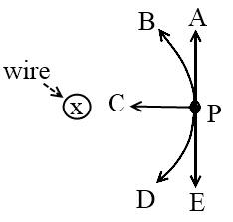
A long straight wire has a conventional current directed into the plane of the page as shown in the figure. Which one of the arrows shown best indicates the direction of the magnetic field associated with this wire at the location labeled $\mathrm{P}$?

figure

(A) $\mathrm{A}$
(B) $\mathrm{B}$
(C) $\mathrm{C}$
(D) $\mathrm{D}$
(E) $\mathrm{E}$

Show answer · 显示答案
Answer key
  • E

Worked solutions are in the books.

2012 · Q36Division 1Division 2Magnetism and Induction

A positive charge moves with constant velocity through a region of space containing both an electric field and a magnetic field. The electric field is directed out of the plane of the page. Ignoring any gravitational field, which one of the following choices represents possible directions of both the particle's velocity and the total magnetic field in the region of space?

Velocity of particleMagnetic Field
(A)Toward the bottom of the pageInto the plane of the page
(B)Into the plane of the pageOut of the plane of the page
(C)To the leftToward the bottom of the page
(D)Toward the top of the pageTo the right
(E)Out of the plane of the pageToward the top of the page
Show answer · 显示答案
Answer key
  • D

Worked solutions are in the books.

2012 · Q38Division 1Division 2Magnetism and Induction

A square, conducting wire loop sits in a plane perpendicular to a spatially uniform magnetic field pointing into the plane of the page as shown. The magnetic field strength steadily increases with time. Which one of the following effects best describes the result of this field increase?

figure

(A) The entire loop moves up the plane of the page.

(B) The loop rotates with the top edge of the loop initially moving out of the plane of

the page and the bottom edge moving into the plane of the page.

(C) The loop rotates with the top edge of the loop initially moving into the plane of the

page and the bottom edge moving out of the plane of the page.

(D) The legs of the loop attempt to increase the area enclosed by the loop.

(E) The legs of the loop attempt to decrease the area enclosed by the loop.

Show answer · 显示答案
Answer key
  • E

Worked solutions are in the books.

2012 · Q50Division 2Magnetism and Induction

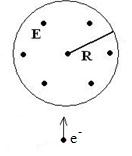
A spatially uniform electric field is constrained within the circular region of radius $R$ as shown. The field is directed out of the plane of the page and its strength is decreasing uniformly with time. Which one of the following choices best represents the direction of the Lorentz force on the electron at the instant shown in the figure when the electron is moving up the plane of the page? Ignore gravity.

figure

(A) No Force

(B) Into the plane of the page

(C) Out of the plane of the page

(D) To the right

(E) To the left

Show answer · 显示答案
Answer key
  • B

Worked solutions are in the books.

2013 · Q30Division 1Division 2Magnetism and Induction

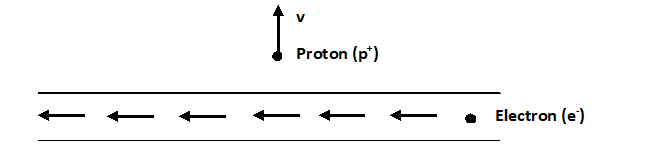
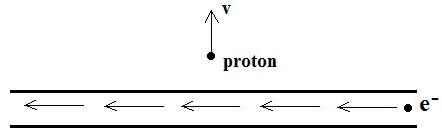
Electrons flow to the left in a wire as shown. For the proton moving toward the top of the page at the instant shown, what is the direction of the magnetic force on the proton?

(A) To the left

(B) To the right proton

(C) Into the plane of the page

(D) Out of the plane of the page

(E) There is no force --

figure
Show answer · 显示答案
Answer key
  • B

Worked solutions are in the books.

2013 · Q35Division 1Division 2Magnetism and Induction

For the figure shown, the variable resistance of the inner circuit, $R_{Inner}$, is increasing at a constant rate. While this is occurring, in which direction is the magnetic field associated with the inner circuit at the Magnetic Field at $\mathrm{P}$ in the plane of the circuit and in which direction is the flow of electrons through the resistor labeled $R_{Router}$?

Magnetic Field at PElectron flow through $R_{\text {Outer }}$
(A)There is no fieldThere is no flow
(B)Into the pageFrom Y to X
(C)Into the pageFrom X to Y
(D)Out of the pageFrom Y to X
(E)Out of the pageFrom X to Y
figure
Show answer · 显示答案
Answer key
  • C

Worked solutions are in the books.

2014 · Q24Division 1Division 2Magnetism and Induction

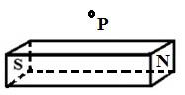
For the bar magnet shown in the figure, which choice best describes the direction of the magnetic field at the point $\mathrm{P}$ located directly above the center of the magnet?

(A) Up the plane of the page

(B) To the right

(C) Down the plane of the page

(D) To the left

(E) Out of the plane of the page
figure
Show answer · 显示答案
Answer key
  • D

Worked solutions are in the books.

2014 · Q29Division 1Division 2Magnetism and Induction

An electron with charge $-e$ and mass $m$ travels at a speed $\nu$ in a plane perpendicular to a magnetic field of magnitude $B$. The electron follows a circular path of radius $R$. In a time $r$, the electron travels halfway around the circle. What is the amount of work done by the magnetic force on the electron in this time?

(A) zero
(B)-$\pi evBR$
(C) $\pi evBR$
(D) $-2evBR$
(E)$\frac{-\pi mv}{eB}$

Show answer · 显示答案
Answer key
  • A

Worked solutions are in the books.

2014 · Q34Division 1Division 2Magnetism and Induction

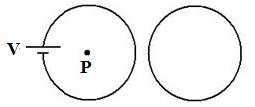
Two circular loops of resistive wire are placed next to each other as in the figure. The circular loop on the left is connected to a constant voltage source $V$. The resistance of this loop is increasing linearly with time. As the resistance is changing, what is the direction of the magnetic field at point $\mathrm{P}$ (the center of the left-hand loop) and what is the orientation of the conventional current in the right-hand loop (as viewed in the figure fr om above)?

Magnetic Field DirectionCurrent Orientation
(A)Into the plane of the pageCounterclockwise
(B)Into the plane of the pageClockwise
(C)Out of the plane of the pageCounterclockwise
(D)Out of the plane of the pageClockwise
(E)There is no fieldThere is no current
figure
Show answer · 显示答案
Answer key
  • A

Worked solutions are in the books.

2015 · Q29Division 1Division 2Magnetism and Induction

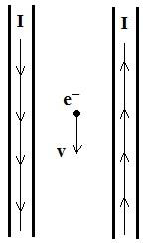
An electron moves at constant non-zero velocity directly between two long straight wires. The conventional current in each wire has the same magnitude, but the currents are in opposite directions as shown in the figure. Ignoring gravity, which choice best reflects the direction of the magnetic field and the direction of the electric field that exist at the location of the electron? Any electric field in the region originates from an unseen external source.

Electric FieldMagnetic Field
(A)No fieldNo field
(B)To the leftInto the plane of the page
(C)To the rightInto the plane of the page
(D)To the leftOut of the plane of the page
(E)To the rightOut of the plane of the page
figure
Show answer · 显示答案
Answer key
  • E

Worked solutions are in the books.

2015 · Q50Division 2Magnetism and Induction

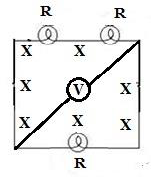
A magnetic field directed into the plane of the page is decreasing in time. A constant emf $\xi$ is produced for the square loop enclosing the field in the figure. The square loop has three identical light bulbs of resistance $R$ in it and an ideal voltmeter connected to the corners through the center of the loop. What is the magnitude of the voltmeter's reading?

figure

(A) $ 0\xi$
(B) $\frac{1}{2}\xi$
(C) $\frac{1}{3}\xi$
(D) $\frac{1}{6}\xi$
(E) $\frac{2}{3}\xi$

Show answer · 显示答案
Answer key
  • D

Worked solutions are in the books.

2016 · Q24Division 1Division 2Magnetism and Induction

A proton moves with constant non-zero velocity in a region of space that has a uniform magnetic field directed into the plane of the page. The proton moves directly up the plane of the page. What is the direction of the electric field in this region of space? Ignore gravity.

(A) To the left

(B) To the right

(C) Down the plane of the page

(D) Up the plane of the page

(E) There is no electric field necessary

Show answer · 显示答案
Answer key
  • B

Worked solutions are in the books.

2016 · Q44Division 2Magnetism and Induction

A proton moves in a circular orbit in a uniform magnetic field, $B$. A helium nucleus moves in a circular orbit in the same magnetic field. If each particle experiences the same magnitude magnetic force during its motion, what is the ratio of the speed of the helium to the speed of the proton?

(A)$4:1$ (B) $1:4$ (C) $1:1$ (D) $2:1$ (E) $1:2$

Show answer · 显示答案
Answer key
  • E

Worked solutions are in the books.

2016 · Q47Division 2Magnetism and Induction

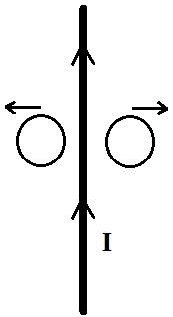
Two small loops of wire are located close to a wire with conventional current directed up the page. A scientist then moves the loops away from the current as shown. What is the orientation of the conventional current in each loop while this occurs?

figure
Left loopRight loop
(A)ClockwiseClockwise
(B)ClockwiseCounterclockwise
(C)CounterclockwiseClockwise
(D)CounterclockwiseCounterclockwise
(E)No currentNo current
Show answer · 显示答案
Answer key
  • C

Worked solutions are in the books.

2017 · Q33Division 1Division 2Magnetism and Induction

Two long wires are fixed in space so that the conventional current in the left wire $(2A)$ comes out of the plane of the page and the conventional current in the right wire $(3A)$ goes into the plane of the page. In which Region(s) is there a place on the $x$-axis (aside from infinity) at which the magnetic field is equal to zero from these currents?

(A) Only in Region I

(B) In both Regions I and II (C) Only in Region II

(D) In both Regions I and III (E) In both Regions II and III

figure
Show answer · 显示答案
Answer key
  • A

Worked solutions are in the books.

2017 · Q35Division 1Division 2Magnetism and Induction

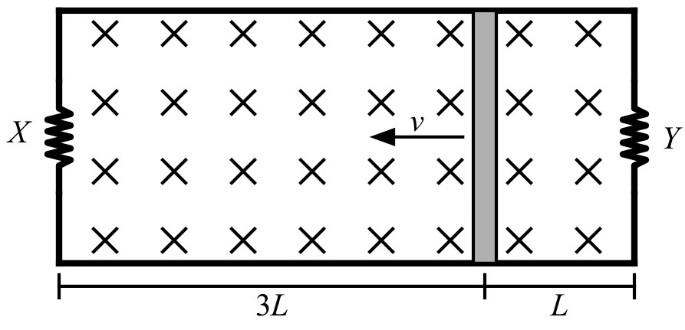
A metal bar is moving to the left across a set of frictionless conducting rails as seen in the figure. Throughout the region between the rails, there is a uniform magnetic field directed into the plane of the page. The resistors labeled $X$ and $Y$ are identical. Which one of the following choices correctly indicates the direction of the conventional current in the resistors and the relation between the magnitude of the currents through each resistor at the instant shown?

figure
Current through XCurrent through $\mathrm{Y}$Relation
(A)Up the plane of the pageUp the plane of the page$I_{X}>I_{\mathrm{y}}$
(B)Up the plane of the pageUp the plane of the page$I_{X}=I_{\mathrm{y}}$
(C)Up the plane of the pageDown the plane of the page$I_{X}>I_{\mathrm{y}}$
(D)Down the plane of the pageDown the plane of the page$I_{X}=I_{\mathrm{y}}$
(E)Down the plane of the pageDown the plane of the page$I_{X}>I_{\mathrm{y}}$
Show answer · 显示答案
Answer key
  • B

Worked solutions are in the books.

2018 · Q23Division 1Division 2Magnetism and Induction

Induced electric currents due to changing magnetic flux can be explained using which one of the following laws?

(A) Gauss's Law
(B) Faraday's Law
(C) Ohm's Law
(D) Ampere's Law
(E) Volta's Law

Show answer · 显示答案
Answer key
  • B

Worked solutions are in the books.

2018 · Q27Division 1Division 2Magnetism and Induction

Electrons flow from right to left in a wire. A proton is directly above the wire and moving upward as shown. What is the direction of the magnetic force on the proton?

(A) to the left

(B) to the right

(C) into the plane of the page

(D) out of the plane of the page
(E) toward the wire

figure
Show answer · 显示答案
Answer key
  • B

Worked solutions are in the books.

2018 · Q35Division 1Division 2Magnetism and Induction

200 turns of wire are wrapped on a square frame with sides 18 cm. A uniform magnetic field is applied perpendicular to the plane of the coil. If the field changes uniformly from 0.50 $\mathrm{T}$ to $0$ in 8.0 $\mathrm{s}$, find the average value of the induced $emf$.

(A) 2.05 V
(B) 4.05 V
(C) 0.205 V
(D) 0.405 V
(E) 0.605 V

Show answer · 显示答案
Answer key
  • D

Worked solutions are in the books.

2018 · Q37Division 1Division 2Magnetism and Induction

An electron is traveling due north and has a speed of 4.0 $\mathrm{x}10^{5}\mathrm{m}/\mathrm{s}$. It enters a region where the $\mathrm{E}\mathrm{a}\mathrm{r}\mathrm{t}\mathrm{h}^{\dagger}\mathrm{s}$ magnetic field has the magnitude 5.0 $\mathrm{x}10^{-5}\mathrm{T}$ to the north and directed downward at $45^{\mathrm{o}}$ below the horizontal. What is the magnitude of the force acting on the electron?

(A) 2.3 $\mathrm{x}10^{-18}\mathrm{N}$
(B) 3.2 $\mathrm{x}10^{-18}\mathrm{N}$
(C) 4.2 $\mathrm{x}10^{-18}\mathrm{N}$
(D) 2.5 $\mathrm{x}10^{-19}\mathrm{N}$
(E) 3.23 $\mathrm{x}10^{-19}\mathrm{N}$

Show answer · 显示答案
Answer key
  • A

Worked solutions are in the books.

2018 · Q45Division 2Magnetism and Induction

According to $\mathrm{L}\mathrm{e}\mathrm{n}\mathrm{z}^{1}\mathrm{s}$ law, the direction of an induced current in a conductor will be that which tends to produce which of the following effects?

(A) Enhance the effect which produces it.

(B) Produce a greater heating effect.

(C) Oppose the greatest voltage.

(D) Oppose the effect which produces it.

(E) Enhance the greatest voltage.

Show answer · 显示答案
Answer key
  • D

Worked solutions are in the books.

2019 · Q41Division 2Magnetism and Induction

To monitor the breathing of a hospital patient, a thin belt is wrapped around a patient's chest and back. The belt is a 200 turn coil of conducting wire. When the patient inhales, the area of the coil increases by 39.0 $\mathrm{c}\mathrm{m}^{2}$. The magnitude of the Earth's magnetic field is 50.0 $\mu \mathrm{T}$ and makes an angle of 28. $0^{}$ to the plane of the coil. Assuming the patient takes 1.80 $\mathrm{s}$ to inhale, how much $emf$ is induced in the coil?

(A) 1.91 $\mathrm{x}10^{-5}\mathrm{V}$
(B) 9.57 $\mathrm{x}10^{-8}\mathrm{V}$
(C) 9.57 $\mathrm{x}10^{-4}\mathrm{V}$
(D) 1.02 $\mathrm{x}10^{-5}\mathrm{V}$
(E) 3.44 $\mathrm{x}10^{-5}\mathrm{V}$

Show answer · 显示答案
Answer key
  • D

Worked solutions are in the books.

2019 · Q48Division 2Magnetism and Induction

It is observed that a charged particle moves through a region of space and experiences no magnetic force. From this we can conclude that

(A) no magnetic field exists in that region of space.

(B) the particle is moving parallel to the magnetic field.

(C) the particle is moving perpendicular to the magnetic field.

(D) either no magnetic field exists or the particle is moving parallel to the magnetic field.

(E) either no magnetic field exists or the particle is moving perpendicular to the magnetic field.

Show answer · 显示答案
Answer key
  • D

Worked solutions are in the books.

2021 · Q45Division 2Magnetism and Induction

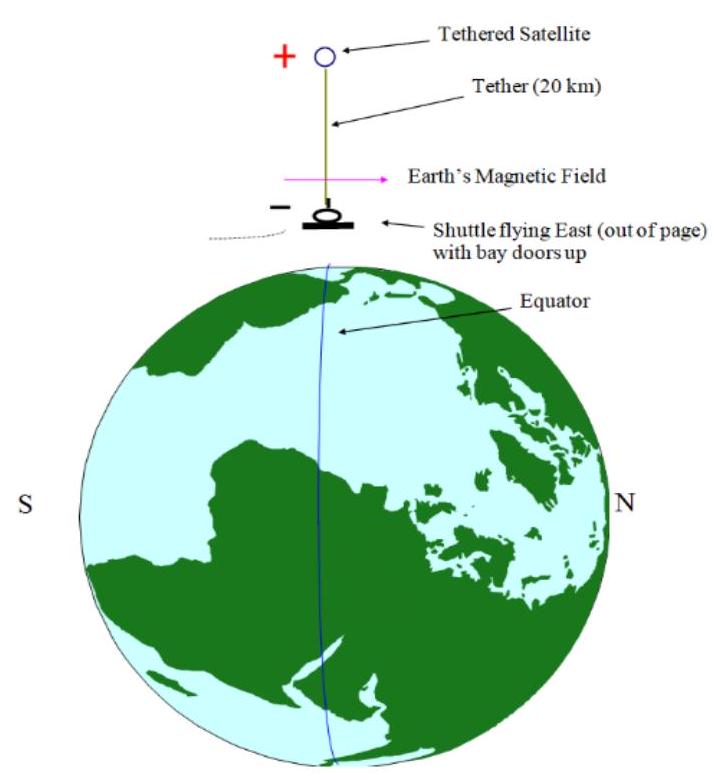
In the 1990s, the space shuttle flew two separate tethered satellite experiments. One purpose was to generate power via the induced voltage in a 20 km long tether moving perpendicular to the Earth's 0.5 Gauss magnetic field lines at roughly $8 \mathrm{~km} / \mathrm{s}$. What is the theoretical voltage across the tether to the nearest order of magnitude?
(A) 10 Volts
(B) 100 Volts
(C) 1,000 Volts
(D) 10,000 Volts
(E) 100,000 Volts

figure
Show answer · 显示答案
Answer key
  • D

Worked solutions are in the books.

2022 · Q45Division 2Magnetism and Induction

An electric field of $1500 \mathrm{~V} / \mathrm{m}$ and a magnetic field act on an electron moving with a speed of $3000 \mathrm{~m} / \mathrm{s}$. If the resultant force is to be zero, what should be the strength of the magnetic field?
(A) 0.35 T
(B) 0.50 T
(C) 0.72 T
(D) 0.81 T
(E) 0.96 T

Show answer · 显示答案
Answer key
  • B

Worked solutions are in the books.

2023 · Q41Division 2Magnetism and Induction

For a particular conductor, the magnetic flux density and current are at right angles to one another. The component of force acting on the conductor is
(A) BIL $\cos \theta$
(B) BIL $\sin \theta$
(C) BIL $\tan \theta$
(D) BL $\sin \theta$
(E) BL $\cos \theta$

Show answer · 显示答案
Answer key
  • B

Worked solutions are in the books.

2023 · Q45Division 2Magnetism and Induction

An electron moves in a circle with radius 1.9 m in a magnetic field of $3.0 \times 10^{-5} \mathrm{~T}$. What is the frequency with which this electron revolves around the circle?
(A) $8.4 \times 10^{5} \mathrm{~Hz}$
(B) $6.4 \times 10^{5} \mathrm{~Hz}$
(C) $9.4 \times 10^{5} \mathrm{~Hz}$
(D) $8.4 \times 10^{4} \mathrm{~Hz}$
(E) $6.4 \times 10^{4} \mathrm{~Hz}$

Show answer · 显示答案
Answer key
  • A

Worked solutions are in the books.

2024 · Q49Division 2Magnetism and Induction

Wire $A$ has a length of 2.0 m, a mass of 4.0 g, and it carries 10 A of current. The wire, which is parallel to the floor and can only move vertically, is placed above wire $B$ that is carrying 15 A of current in the opposite direction. What separation distance between the two wires will allow the weight of wire $A$ to be supported by magnetic force?
a. 1.25mm
b. 1.50 mm
c. 1.75 mm
d. 2.00 mm
e. 2.25 mm

Show answer · 显示答案
Answer key
  • B

Worked solutions are in the books.