A small object is thrown straight downward on Earth with an initial speed of 12.0 $m/s$ from a position 10.0 $m$ above the ground. Ignoring air resistance, the speed of the object when it reaches the ground is
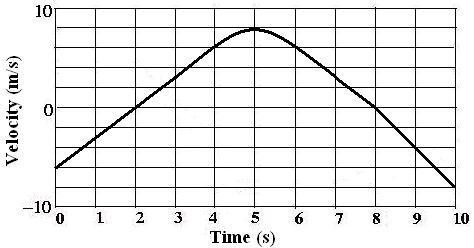
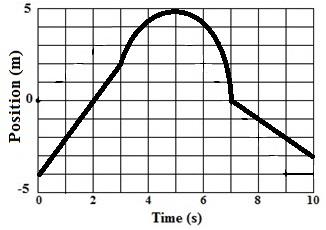
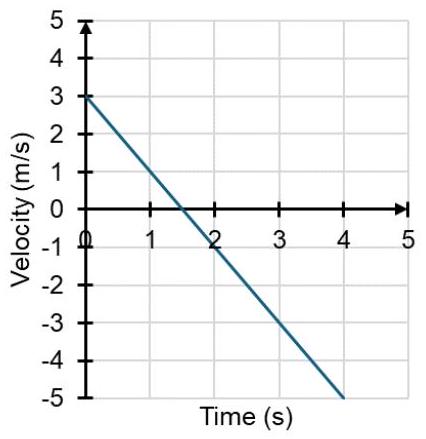
Consider the motion of an object given by the velocity vs. time graph shown. For which time(s) is the acceleration of the object equal to $\mathrm{0}{m}/s^{2}$?
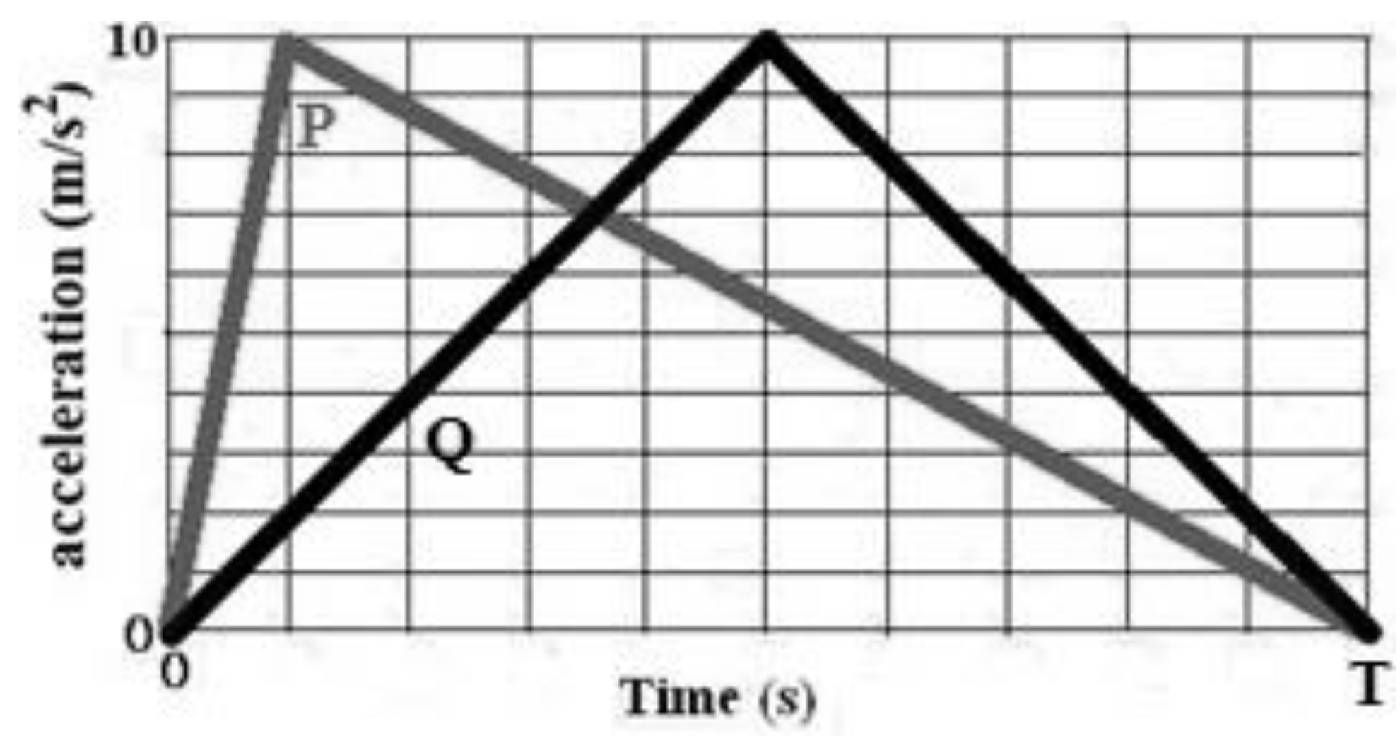
By computing the area under the acceleration vs. time graph for a fixed time interval of an object's motion, what quantity has been determined for that object?
(A) The average velocity during the time interval
(B) The velocity at the end of the time interval
(C) The average speed during the time interval
(D) The change in velocity during the time interval
(E) The velocity at the time midway through the time interval
A ball initially at rest falls without air resistance from a height $h$ above the ground. If the ball falls the first distance $\frac{h}{2}$ in a time $t$, how much time is required to fall the remaining distance of $\frac{h}{2}$ ?
An object moves along a horizontal line with increasing speed. Which one of the following choices could represent the signs of the velocity and of the acceleration for the object to achieve this motion?
Two cars travel to the right, each starting from rest, along a straight road. Car A has twice the acceleration of Car B. After traveling a distance $d$, Car A has speed $v$. When Car $\mathrm{B}$ has traveled the same distance $d$, what is its speed in terms of $v$?
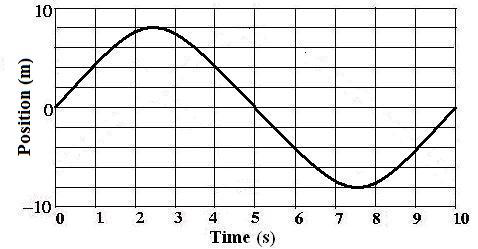
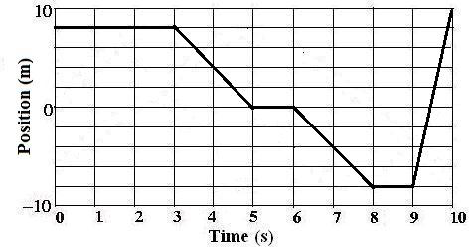
A mass moves according to the graph of position as a function of time shown below.
17. Which one of the following choices correctly represents the time instants or time interval for which the instantaneous velocity of the mass is considered always to be negative? Let $t$ represent time.
An object is thrown horizontally with speed 10.0 $m/s$ from a height $H$ above the ground. The object reaches the ground with a speed of 20.0 $m/s$. Which one of the following choices best represents the time of the object's flight to the ground? Ignore air resistance.
A vehicle completes one lap around a circular track at an average speed of 50 $m/s$ and then completes a second lap at an average speed of $V$. The average speed of the vehicle for the completion of both laps was 80 $m/s$. What was the average speed $V$ of the second lap?
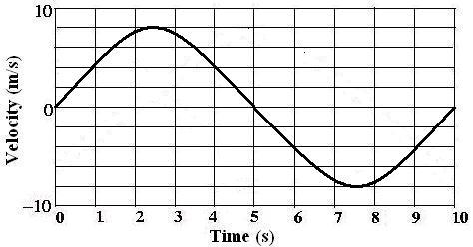
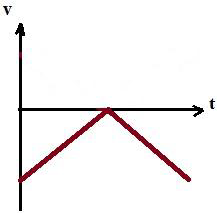
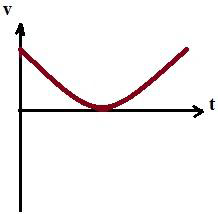
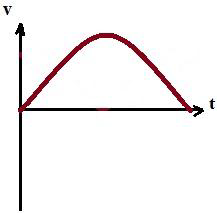
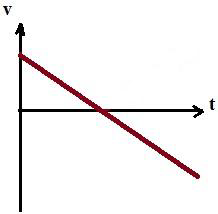
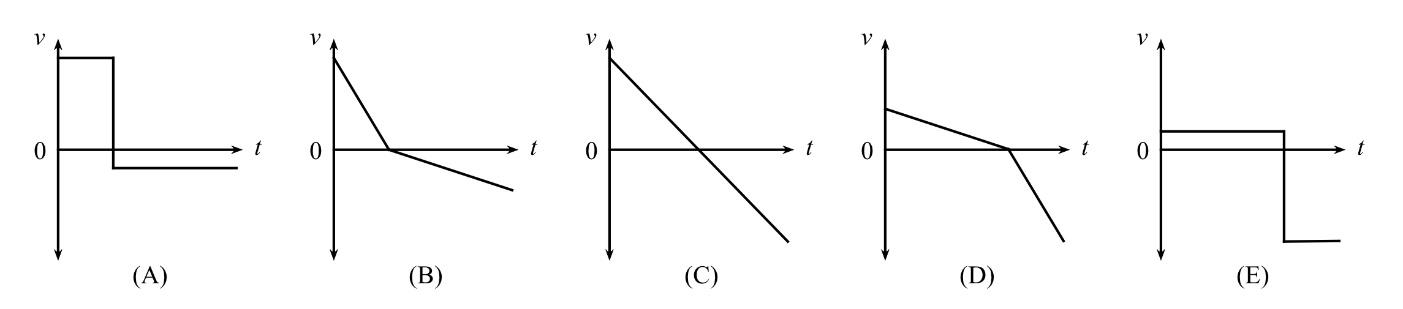
An object is thrown straight upward. The object remains in free fall until it returns to its initial launch point. Which one of the following graphs could represent the velocity of the object as a function of time during its flight?
A small ball is thrown at an angle of $30.0^{\circ}$above the horizontal ground with a speed of $20.0\displaystyle \frac{m}{s}$. To what maximum height above the launch point does the ball rise during its motion? Ignore air resistance.
A position vs. time graph of a particle moving along a horizontal axis is shown. What is the total distance traveled by the particle from $t=0s$ to $t=10s$?
An object moving only to the right completes a 20.0 second trip in two stages, I and II. The average speed of the entire 20.0 second trip is 10.0 $m/s.$
For stage I, the object moves with a constant velocity of 6.0 $m/s$ for 12.0 seconds.
What constant acceleration must the object have during the 8.0 seconds of stage II?
An object is in free fall close to the ground. A person intervenes and slows the object uniformly to rest.
Which one of the following statements must be true about the magnitude of the acceleration of the object as it is being stopped by the person? The magnitude of the object's acceleration is $a_{obj}$ and the magnitude of the acceleration from gravity is $g.$
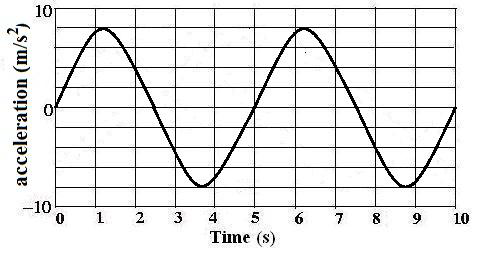
An acceleration vs. time graph for an object moving along a line is shown. The object starts from rest at time $t=0s$. At what time(s) does the object attain a maximum displacement from its starting position?
(A) At times $t=2.5s$ and $t=7.5s$ only
(B) At times $t=5.0s$ and $t=10s$ only
(C) At times $t=1.25s, t=3.75s, t=6.25s$, and $t=8.75s$ only
(D) At times $t=2.5s, t=5.0s, t=7.5s$, and $t=10s$ only
At the top of a high cliff' a small rock is dropped from rest. A ball is launched straight downward with an initial speed of $36.0\displaystyle \frac{m}{s}$ at a time 2.10 $s$ after the rock was dropped. When the ball has fallen 28.0 $m$ further than the initially dropped rock, what is the speed of the ball relative to the rock?
Starting from rest, a cart uniformly accelerates to a speed of 7. $60\displaystyle \frac{m}{s}$ in a time of 3.00 $s$. Through what distance does the cart move in this time?
A toy car initially moves to the right at $60.0\displaystyle \frac{cm}{s}$. Five seconds later, the car is moving at 40. $0\displaystyle \frac{cm}{s}$ to the left. The total displacement of the car during this time is 10.0 cm to the left of where it started.
16. Which one of the following choices best represents the magnitude of the average velocity of the car during the five second motion?
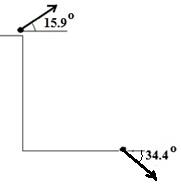
A small 1.35 $kg$ mass is launched from the top of a cliff at an angle of $15.9^{\circ}$ above the horizontal. When the mass reaches the ground 4.33 seconds later, its velocity is directed at $34.4^{\circ}$ below the horizontal. What is the speed of the mass when it reaches the ground? Ignore air resistance.
An object initially is moving upward while in free fall. Which one of the following choices best represents the direction of the object's acceleration during its flight?
Two cars are moving to the right on a horizontal track, each with constant acceleration. At an instant of time, the information about the cars is shown:
Car 1: position $=125.0m$; velocity $=13.0\displaystyle \frac{m}{s}$ ; constant acceleration $=1.5\displaystyle \frac{m}{s^{2}}$.
Car 2: position $=80.0m$; velocity $=9.30\displaystyle \frac{m}{s}$ ; constant acceleration $=5.5\displaystyle \frac{m}{s^{2}}$.
During the next 1.0 $s$ of motion, which one of the following choices best represents what happens to the distance between the cars?
(A) It decreases during the entire 1.0 second of motion.
(B) It increases during the entire 1.0 second of motion.
(C) It initially increases and then decreases resulting in a greater distance between the cars after 1.0 second.
(D) It initially increases and then decreases resulting in a smaller distance between the cars after 1.0 second.
(E) It initially increases and then decreases resulting in the same distance between the cars after 1.0 second.
A particle has a position, $\chi$, as a function of time, $t$, given as $x(t)=-15-25t+10t^{2}$. Which one of the following choices represents the magnitude of the particle's acceleration? All quantities are expressed in base SI units.
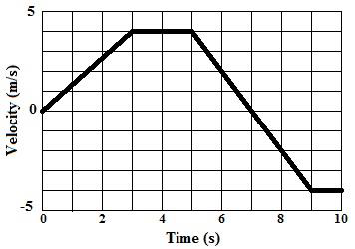
An object starts at the origin and its velocity along a line vs. time is graphed. Which one of the following choices best gives the proper interval(s) of time for which the object is moving away from the origin?
(A) Only for times $0s<\mathrm{t}<3s$
(B) Only for times $0s<\mathrm{t}<5s$
(C) Only for times 3 $s<\mathrm{t}<5s$
(D) Only for times $0s<\mathrm{t}<7s$
(E) For times $0s<\mathrm{t}<3s$ and 5 $s<\mathrm{t}<9s$
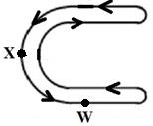
A car moves with constant speed around a horseshoe-shaped path as shown with the arrows in the figure. Which one of the following choices best describes the direction of the average acceleration of the car in traveling from $\mathrm{W}$ to X?
$(\mathrm{A})\swarrow$
(B) $\nwarrow$
(C) $\nearrow$
(D) $\searrow$
(E) There is no average acceleration $\mathrm{W}$
An object moving along a line completes a 20.0 second trip with an average speed of10.0 $m/s$ in two stages. During stage 1, the object moves with a constant velocity of 6.0 $m/s$ to the right for 12.0 seconds. What constant magnitude acceleration directed to the left must the object have during the 8.0 seconds of stage 2?
Rain falls vertically at 12.0 $\mathrm{m}/\mathrm{s}$ with respect to a stationary observer. A car is moving at an angle of $40^{\circ}$ below the horizontal with respect to the observer. A passenger sitting in the car notes that the rain makes an angle of $29.0^{\circ}$ with the vertical. What is the car's speed with respect to the observer?
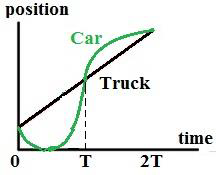
A car and a truck are moving on a horizontal track. The position vs. time graph for the two vehicles is shown.
41. For the entire time shown in the graph, which one of the following choices correctly describes the relationship between the average speed of the truck to that of the car?
(A) The truck's average speed is less than the average speed of the car.
(B) The truck's average speed is the same as the average speed of the car.
(C) The truck's average speed is greater than the average speed of the car.
(D) The truck's average speed is positive while the car's average speed is negative but of the same magnitude.
(E) A relationship cannot be determined without more information.
42. Which one of the following choices best describes the instants of time, $t$, at which the car and truck travel with the same speed?
(A) Only at times $t=0, T=T$ and $t=2T.$
(B) At one instant during the interval 0 $<t<T$ and at one instant during the interval $T<t<2T.$
(C) At two instants during the interval 0 $<t<T$ and at one instant during the interval $T<t<2T.$
(D) At one instant during the interval 0 $<t<T$ and at two instants during the interval $T<t<2T.$
(E) At two instants during the interval0 $<t<T$ and at two instants during the interval $T<t<2T.$
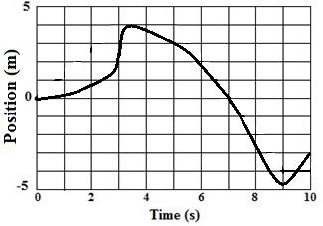
The position $\mathrm{v}\mathrm{s}$. time graph of an object moving on a horizontal line is shown. At what time(s) is the object moving with its greatest speed?
(A) At time $\mathrm{t}=3.0s$ only
(B) At time $\mathrm{t}=3.5s$ only
(C) At times $\mathrm{t}=3.5s$ and $\mathrm{t}=9.0s$
A car accelerates uniformly from $0\displaystyle \frac{km}{hr}$ to $60\displaystyle \frac{km}{hr}$ in 4.50 $s$. Which one of the following choices best represents the acceleration of the car?
An object, thrown straight downward with a speed of $20.0\displaystyle \frac{m}{s}$, takes 2.00 $s$ to reach the ground below. From what height above the ground was the object thrown? Ignore air resistance.
At 1.94 $s$ after launch, a projectile in free fall achieved its minimum speed during flight. If that minimum speed was $15.0\displaystyle \frac{m}{s}$, what was the projectile's initial angle of launch from the horizontal?
On a straight road, a self driving car races with a robot. The robot accelerates at $8.50 \displaystyle \frac{m}{s^{2}}$ until reaching its maximum constant speed of 15.0 $\displaystyle \frac{m}{s}$. The car accelerates at $5.60 \displaystyle \frac{m}{s^{2}}$ until reaching its maximum constant speed of $25.0 \displaystyle \frac{m}{s}$. The car and robot start from rest from the same location. What is the maximum distance that the robot leads the car during the race?
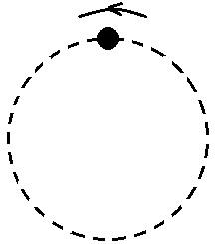
An object moves in a circle, starting at the top, with initial speed 17. $0\displaystyle \frac{m}{s}$. The object's speed increases uniformly until it has moved counterclockwise through an angle of $55^{\circ}$. The average acceleration for this motion is $9.8\displaystyle \frac{m}{s^{2}}$ directed straight downward.
A small object is launched $30^{\circ}$ above the horizontal from a height of10.0 $m$ above the ground. if the initial speed of the object is $15.0\displaystyle \frac{m}{s}$, at what angle below the horizontal is the object moving when it reaches the ground? Ignore air resistance.
A small object is released from rest and falls freely for 4.00 s until reaching the ground. What was the height above the ground from which the object was released?
A mass moves along the $x$-axis following the position $\mathrm{v}\mathrm{s}.$ time graph provided. During what time interval(s) does the mass have an acceleration of $0\displaystyle \frac{m}{s^{2}}$? Time is represented as $\mathrm{t}.$
(A) only from $0s<\mathrm{t}<3s$
(B) only at $T=5s$
(C) only from 7 $s<T<10s$
(D) only from $0s<\mathrm{t}<3s$ and 7$s<\mathrm{t}<10s$
(E) only from $0s<\mathrm{t}<3s, \mathrm{t}=5s$, and 7$s<\mathrm{t}<10s$
Two cars, $P$ and $Q$, each start from rest at the origin and will move along the $x$-axis. The acceleration $\mathrm{v}\mathrm{s}$. time graph for each car is shown. Which one of the following choices correctly identifies the relationship for both the speeds $(v_{P}$ and $v_{Q})$ and the positions ($x_{P}$ and $x_{Q}$) of the cars at time $T$?
A projectile is launched at an angle of $40^{\circ}$ above the horizontal with a speed of $30$ m/s. How much time passes before the position of the projectile makes an angle of $20^{\circ}$ above the horizontal from the original launch point?
A ball is launched vertically upward. The vertical position of the ball 0.70 $s$ after release is the same as its vertical position 4.10 $s$ after its release. At what time is the object first at a vertical position that is one-half of the maximum height it obtains during its flight?
A ball is thrown vertically downward with an initial speed of 12.0 $\mathrm{m}/\mathrm{s}$ from a height of 10.0 $\mathrm{m}$ above the ground. Ignoring air resistance, what is the speed of the ball when it reaches the ground?
A small ball is thrown at an angle of 30.0$^{\circ}$ above the horizontal ground with a speed of 20.0 $\mathrm{m}/\mathrm{s}$. What is the maximum height above the launch point to which the ball rises? Ignore air resistance.
At the top of a high cliff, a small rock is dropped from rest. A ball is launched straight downward with an initial speed of 36.0 $\mathrm{m}/\mathrm{s}$ at a time of 2.10 $\mathrm{s}$ after the rock was dropped from the same cliff. When the ball has fallen 28.0 $\mathrm{m}$ further than the initially dropped rock, what is the speed of the ball relative to the rock?
You throw a ball at angle $\theta$, and measure its horizontal range, $R$. You now throw the same ball again at the same angle, but with twice the original speed. Its horizontal range, compared to your first throw (in both cases, the ball lands at the same height from which it was thrown) would be
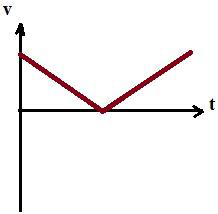
A block slides up and back down a rough incline. Which of the following graphs could represent the velocity of the block as a function of time? All graphs use the same scale and uphill as the positive direction.
Two cars are being tested on a track. Car 1 accelerates from rest on this straight track at $\mathrm{a}_{1}=3.0\mathrm{m}/\mathrm{s}^{2}.$ Two seconds later, Car 2 accelerates from rest at $\mathrm{a}_{2}=12.0\mathrm{m}/\mathrm{s}^{2}$. How much time after Car 1 starts will Car 2 pass Car 1?
The table at right lists the finish times for the 2008 Men’s Olympic 100 m butterfly swim final in Beijing. From the data, what is the best estimate of the distance the 2nd place finisher, Cavic, was behind the 1st place finisher, Phelps?
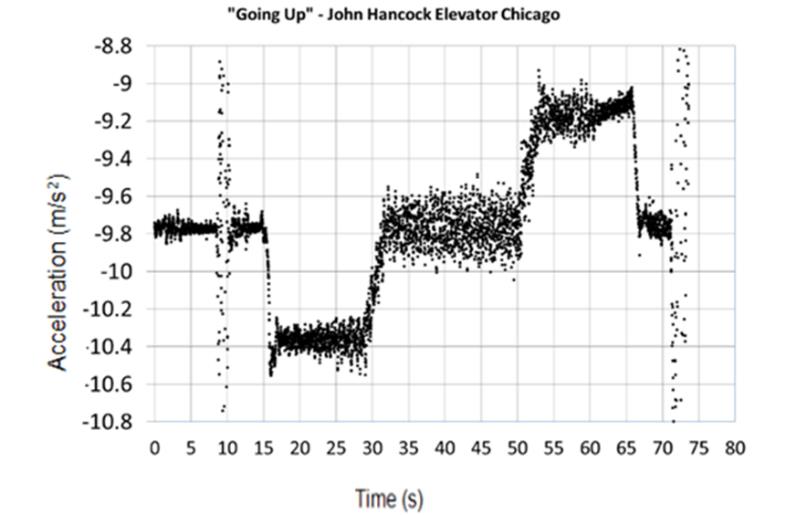
Shown here is accelerometer data for an elevator ride in a skyscraper in Chicago. The spikes at roughly $10\mathrm{s}$ and $72\mathrm{s}$ are caused by the handling of the accelerometer which rested on the floor of the elevator and occurred before the elevator started moving up, and after it reached the top, respectively. What is the best estimate for the peak vertical speed for this elevator?
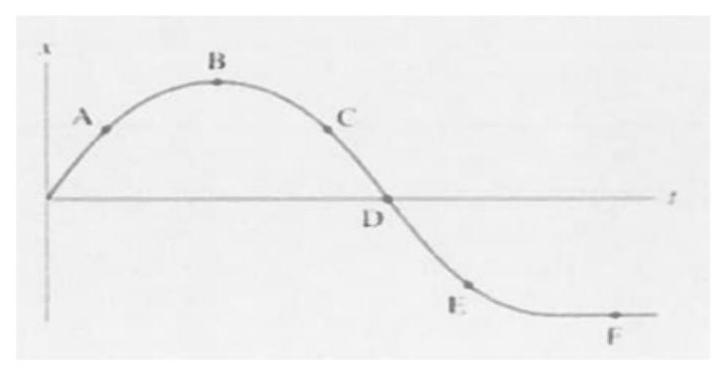
The figure to the right shows the position-time graph of an object traveling in a straight line, starting out moving to the right (the positive $x$-direction). At which points is the object moving to the left?
(A) B and F
(B) $E$ and $F$
(C) A, B, and C
(D) C, D, and E
(E) None of the above
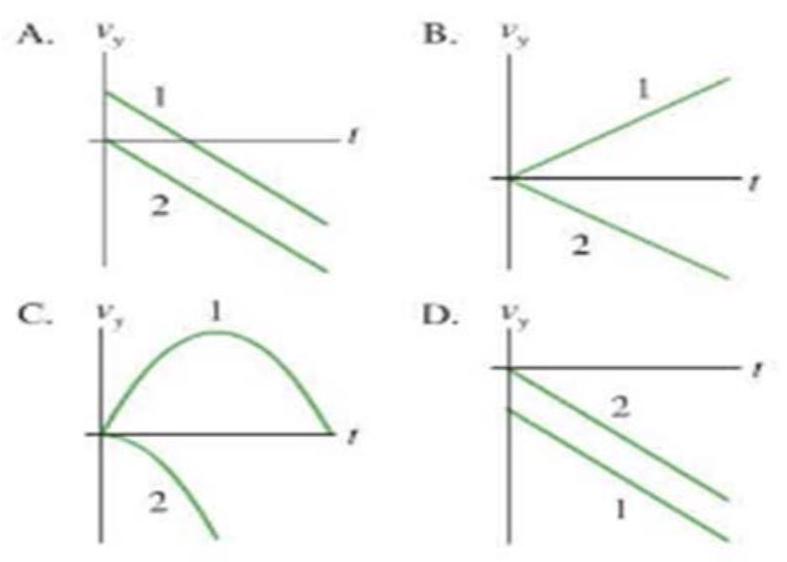
At $t=0$, Ball 1 is rolling up a ramp and Ball 2 is released from the top of the same ramp. The balls don't collide. Which velocity vs. time graph at right best represents the motion of the two balls?
(A) A
(B) B
(C) C
(D) D
(E) Both A & D
In a panic, you squeeze the brake handle on your bicycle, lock up the rear wheel, and skid a certain distance on a straight, level path before stopping. If you had been traveling twice as fast, what distance would you have skidded, under the same conditions?
(A) You would have skidded 4 times farther.
(B) You would have skidded twice as far.
(C) You would have skidded 1.4 times farther.
(D) You would have skidded 8 times farther.
(E) It is impossible to tell from the information given.
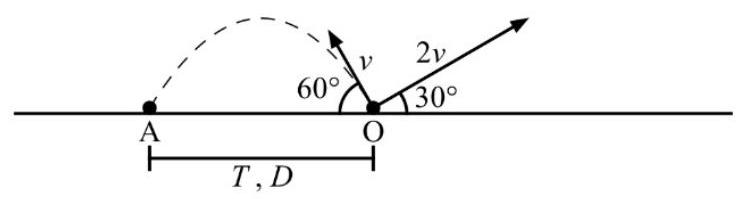
Two balls, A and B, are launched simultaneously from the origin $(\mathrm{O})$ on a level surface at the respective angles of $60^{\circ}$ and $30^{\circ}$ shown in the picture. Ball A has a launch speed $v$ while Ball B has a launch speed $2 v$. Ball A lands $T$ seconds after launch at a horizontal distance $D$ from the origin.
25. How many seconds after launch does Ball B land?
(A) 0.50 T
(B) 0.87 T
(C) 1.15 T
(D) 1.73 T
(E) 2.00 T
26. What horizontal distance separates the landing points of Ball A and Ball B?
(A) $2 D$
(B) $3 D$
(C) $4 D$
(D) $5 D$
(E) $6 D$
You drop a rock off a bridge into the river below and hear the splash 2.5 s later. How far above the river is the bridge?
(A) 25 m
(B) 27 m
(C) 29 m
(D) 31 m
(E) 33 m
A projectile will be launched from a $2.00-\mathrm{m}$ tall platform and must hit a target at a horizontal distance of 25.0 m away on an identical $2.00-\mathrm{m}$ tall platform. What is the slowest speed at which the projectile can be launched?
(A) $10.2 \mathrm{~m} / \mathrm{s}$
(B) $12.5 \mathrm{~m} / \mathrm{s}$
(C) $15.8 \mathrm{~m} / \mathrm{s}$
(D) $17.7 \mathrm{~m} / \mathrm{s}$
(E) $21.0 \mathrm{~m} / \mathrm{s}$
A fisherman watches a dolphin leap out of the water at an angle of $35^{\circ}$ above the horizontal. The horizontal component of the dolphin's velocity is $7.7 \mathrm{~m} / \mathrm{s}$. Find the magnitude of the vertical component of the velocity.
(A) $4.4 \mathrm{~m} / \mathrm{s}$
(B) $6.3 \mathrm{~m} / \mathrm{s}$
(C) $11 \mathrm{~m} / \mathrm{s}$
(D) $5.4 \mathrm{~m} / \mathrm{s}$
(E) $3.2 \mathrm{~m} / \mathrm{s}$
In the last one second of a free fall, an apple traveled three-fourths of its total path. From what height did the apple fall?
(A) 10 m
(B) 15 m
(C) 20 m
(D) 25 m
(E) 30 m
A ticker tape timer is operating at 60 Hz . It was used to analyze the motion of a batterypowered car. The following displacements were measured for five intervals on the ticker tape.
Interval 1
Interval 2
Interval 3
Interval 4
Interval 5
Displacement
0.055 m
0.065 m
0.055 m
0.070 m
0.060 m
What is the average speed of the car?
(A) $0.612 \mathrm{~m} / \mathrm{s}$
(B) $3.66 \mathrm{~m} / \mathrm{s}$
(C) $0.366 \mathrm{~m} / \mathrm{s}$
(D) $0.947 \mathrm{~m} / \mathrm{s}$
(E) $6.32 \mathrm{~m} / \mathrm{s}$
Water drips from the nozzle of a shower onto the floor 2.45 m below. The drops fall at regular intervals of time, the first drop striking the floor at the instant the third drop begins to fall. Measured from the shower head, what is the location of the second drop when the first drop strikes the floor.
(A) 0.313 m
(B) 0.613 m
(C) 0.938 m
(D) 1.25 m
(E) 1.563 m
A car and a truck are both traveling with a constant speed of $20 \mathrm{~m} / \mathrm{s}$. The car is 10 m behind the truck. The truck driver suddenly applies his brakes, causing the truck to slow to a stop at the constant rate of $2 \mathrm{~m} / \mathrm{s}^{2}$. Two seconds later, the driver of the car applies their brakes and just manages to avoid a rear-end collision. Determine the constant rate at which the car slowed.
(A) $3.33 \mathrm{~m} / \mathrm{s}^{2}$
(B) $4.33 \mathrm{~m} / \mathrm{s}^{2}$
(C) $1.33 \mathrm{~m} / \mathrm{s}^{2}$
(D) $3.03 \mathrm{~m} / \mathrm{s}^{2}$
(E) $3.93 \mathrm{~m} / \mathrm{s}^{2}$
A Boeing 737 jet is landing with a speed of $69 \mathrm{~m} / \mathrm{s}$. The jet touches down and has 750 m of runway in which to reduce its speed to $6.1 \mathrm{~m} / \mathrm{s}$. What is the average acceleration, assumed to be uniform, of the plane during landing?
(A) $-0.32 \frac{\mathrm{~m}}{\mathrm{~s}^{2}}$
(B) $-3.2 \frac{\mathrm{~m}}{\mathrm{~s}^{2}}$
(C) $-6.3 \frac{\mathrm{~m}}{\mathrm{~s}^{2}}$
(D) $-32 \frac{\mathrm{~m}}{\mathrm{~s}^{2}}$
(E) $-63 \frac{\mathrm{~m}}{\mathrm{~s}^{2}}$
On December 21, 1968, NASA launched Apollo 8. This was the first manned mission to the moon, and after 68 hours, went into orbit around the moon but never landed on the surface. That was reserved for Apollo 11. During one five-minute portion of the launch, Apollo 8 increased its speed from 7,600 to 10,800 meters per second. What was the acceleration of Apollo 8 during this time period?
(A) $8.92 \frac{\mathrm{~m}}{\mathrm{~s}^{2}}$
(B) $53.3 \frac{\mathrm{~m}}{\mathrm{~s}^{2}}$
(C) $64.0 \frac{\mathrm{~m}}{\mathrm{~s}^{2}}$
(D) $10.7 \frac{\mathrm{~m}}{\mathrm{~s}^{2}}$
(E) $18.7 \frac{\mathrm{~m}}{\mathrm{~s}^{2}}$
A person has a height 1.8 m . Beginning directly under a streetlight that is 6 m above the ground, they walk away from their starting position at $7 \mathrm{~m} / \mathrm{s}$. Find the speed at which the top of the person's shadow moves.
(A) $6 \mathrm{~m} / \mathrm{s}$
(B) $8 \mathrm{~m} / \mathrm{s}$
(C) $10 \mathrm{~m} / \mathrm{s}$
(D) $12 \mathrm{~m} / \mathrm{s}$
(E) $14 \mathrm{~m} / \mathrm{s}$
A curious physics student drops a rock from a cliff that is 5.0 m above a pond. The rock hits the water with velocity $v$ and then sinks to the bottom with the constant velocity $v$. It reaches the bottom of the pond 5.0 s after it is dropped. Find the depth of the lake
(A) 10 m
(B) 20 m
(C) 30 m
(D) 40 m
(E) 50 m
A hot air balloon is moving up at $10 \mathrm{~m} / \mathrm{s}$. At a height of 100 m above the ground, a package is released from the balloon. How much time does it take the package to reach the ground after being released?
(A) 4.58 s
(B) 5.58 s
(C) 4.24 s
(D) 5.24 s
(E) 4.64 s
An M-80 (BIG firecracker) is detonated in a valley formed between two parallel mountains. The first echo is heard 2.0 s after the detonation and the second echo is heard 2.0 s after the first one. What is the width of the valley?
(A) 340 m
(B) 740 m
(C) 1080 m
(D) 1360m
(E) 1700 m
Show answer · 显示答案
Answer key
C
Key as published. The printed times give a valley width that does not match the keyed choice exactly.
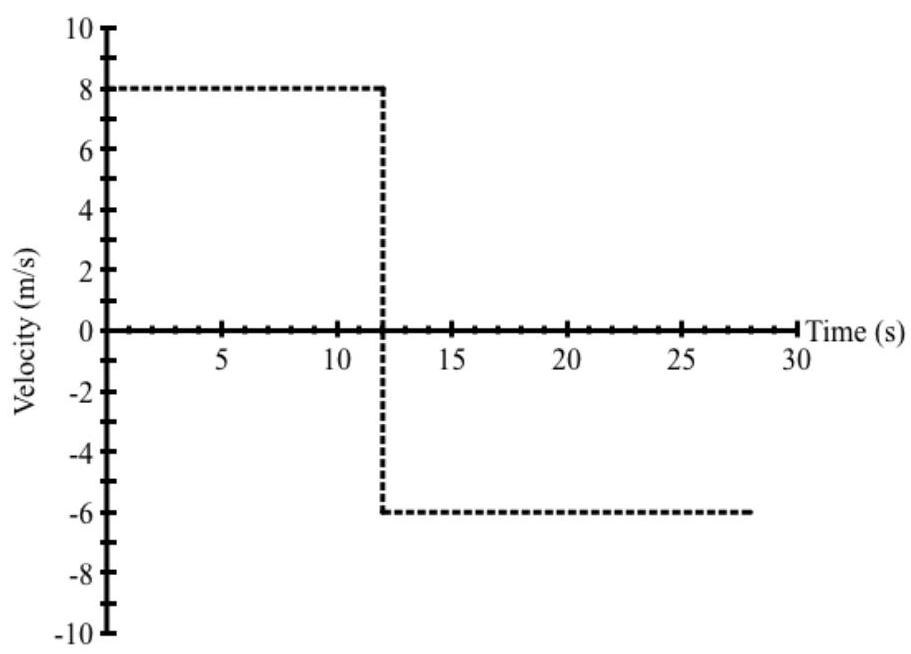
Questions 1 - 2 refer to the following graph depicting the velocity of an object from $t=0$ until $t=28$ seconds.
1. The average speed of the object for the twenty-eight second interval is ...
(A) between 6.0 and $6.5 \mathrm{~m} / \mathrm{s}$.
(B) between 6.5 and $7.0 \mathrm{~m} / \mathrm{s}$.
(C) $7.0 \mathrm{~m} / \mathrm{s}$.
(D) between 7.0 and $7.5 \mathrm{~m} / \mathrm{s}$.
(E) between 7.5 and $8.0 \mathrm{~m} / \mathrm{s}$.
2. The average velocity of the object for the twenty-eight second interval is ...
(A) $-2.0 \mathrm{~m} / \mathrm{s}$.
(B) $-1.0 \mathrm{~m} / \mathrm{s}$.
(C) $0.0 \mathrm{~m} / \mathrm{s}$.
(D) $1.0 \mathrm{~m} / \mathrm{s}$.
(E) $2.0 \mathrm{~m} / \mathrm{s}$.
A rock is thrown vertically upward with an initial velocity of $20.0 \mathrm{~m} / \mathrm{s}$. What is the maximum height the rock will reach, assuming no air resistance?
(A) 10.0 m
(B) 20.0 m
(C) 40.0 m
(D) 80.0 m
(E) 100 m
When they are fishing, pelicans tuck their wings and dive straight down. Assume a pelican starts its dive from a height of 16.0 m above a fish at the surface of the water and cannot change its path once committed. If it takes a fish 0.20 s to perform evasive action, at what minimum height must it spot the pelican to escape? Assume the fish is at the surface of the water.
(A) 2.42 m
(B) 2.94 m
(C) 3.37 m
(D) 9.12 m
(E) 12.6 m
A top-fuel dragster starts from rest and accelerates at $+17.0 \frac{\mathrm{~m}}{\mathrm{~s}^{2}}$ for 402 m . A parachute then opens behind the dragster to slow it down with an acceleration of $-6.10 \frac{\mathrm{~m}}{\mathrm{~s}^{2}}$. How fast is the dragster moving 350 m after the parachute opens?
(A) $86.9 \frac{\mathrm{~m}}{\mathrm{~s}}$
(B) $88.9 \frac{\mathrm{~m}}{\mathrm{~s}}$
(C) $96.9 \frac{\mathrm{~m}}{\mathrm{~s}}$
(D) $98.9 \frac{\mathrm{~m}}{\mathrm{~s}}$
(E) $102.9 \frac{\mathrm{~m}}{\mathrm{~s}}$
Two objects both move and uniformly accelerate to the right. At time $t=0$, the objects are at the same initial position, but Object 1 has an initial speed twice that of Object 2.
Object 1 has one-half the acceleration of Object 2 . After some time, $T$, the velocity of the two objects is the same. What is the ratio of the distance traveled in this time, $T$, by Object 2 to that traveled by Object 1?
(A) 5:6
(B) 4:5
(C) 3:4
(D) 2:3
(E) 1:2
Your sister is 50 m ahead of you and walking at a speed of $1 \mathrm{~m} / \mathrm{s}$ away from you. You run to catch up to her at a speed of $2.5 \mathrm{~m} / \mathrm{s}$. How much time does it take for you to catch her?
(A) 14 s
(B) 20 s
(C) 33 s
(D) 72 s
(E) 125 s
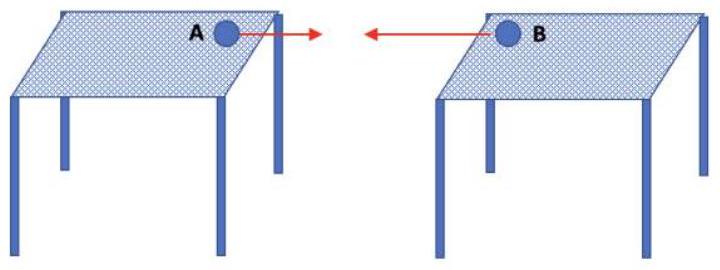
Two identical balls A and B are aimed at each other and roll off the edges of two identical horizontal tabletops at exactly the same time. Each ball has sufficient velocity to land under the opposite table, but ball B has a greater initial velocity than ball A. What will happen as they fall?
(A) Ball B will pass over the top of ball A as they fall.
(B) Ball A will pass over the top of ball B as they fall.
(C) The two balls will collide as they fall.
(D) The two balls may collide only if their velocities are exactly the right values.
(E) Ball B will hit the floor before ball A.
A swimmer is swimming in a slowly moving stream. Which of the following is NOT true?
(A) To have the largest speed relative to shore, the swimmer should swim downstream.
(B) To have the smallest speed relative to shore, the swimmer should swim upstream.
(C) The swimmer can achieve the same speed relative to shore swimming upstream or downstream.
(D) To cross the river in the shortest amount of time the swimmer should swim perpendicularly across the stream.
(E) The swimmer's speed relative to shore will depend on the speed of the stream's current.
A ball is launched at $20^{\circ}$ above the horizontal on a flat horizontal field. At what other launch angle (with respect to the horizontal) would the ball have the same horizontal range if fired at the same speed?
(A) $30^{\circ}$
(B) $45^{\circ}$
(C) $60^{\circ}$
(D) $70^{\circ}$
(E) $80^{\circ}$
A block of wood is given a certain speed at the bottom of a rough ramp. The block slides a certain distance up the ramp and returns to the point from which it was launched. Let $t_{\mathrm{up}}$ represent the time it takes the block to travel up the ramp to its highest point and $t_{\text {down }}$ represent the time it takes the block to travel down the ramp to the bottom. Let $a_{\text {up }}$ represent the magnitude of the block's acceleration while traveling up the ramp and $a_{\text {down }}$ represent the block's acceleration while traveling down the ramp. Which of the following correctly compares these quantities?
(A) $t_{\text {up }}>t_{\text {down }}$ and $a_{\text {up }}<a_{\text {down }}$
(B) $t_{\text {up }}<t_{\text {down }}$ and $a_{\text {up }}>a_{\text {down }}$
(C) $t_{\mathrm{up}}=t_{\text {down }}$ and $a_{\mathrm{up}}=a_{\text {down }}$
(D) $t_{\text {up }}>t_{\text {down }}$ and $a_{\text {up }}>a_{\text {down }}$
(E) $t_{\text {up }}<t_{\text {down }}$ and $a_{\text {up }}<a_{\text {down }}$
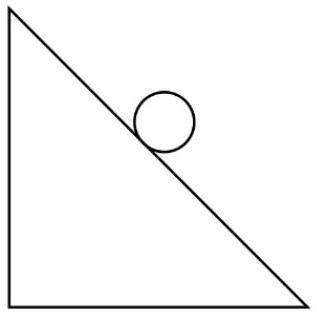
In the diagram on the right, a ball is rolling down an incline. The direction of the normal force that the incline exerts on the ball is...
(A) perpendicular to the surface.
(B) about 75 degrees measured from the surface.
(C) parallel to the surface.
(D) about 115 degrees measured from the surface.
(E) about 180 degrees measured from the surface.