Physics Bowl

Image and Ray Optics

20 items — reveal each answer key.

2010 · Q28Division 1Division 2Image and Ray Optics

Which of the following could produce an enlarged but inverted image of a real object?

(A) Place a converging lens at a distance greater than its focal length from the object.

(B) Place a converging lens at a distance less than its focal length from the object.

(C) Place a diverging lens at a distance less than the magnitude of its focal length from the object.

(D) Place a diverging lens at a distance greater than the magnitude of its focal length from the object.

(E) It is not possible to create the type of image desired.
Show answer · 显示答案
Answer key
  • A

Worked solutions are in the books.

2011 · Q33Division 1Division 2Image and Ray Optics

For the set-up shown of a candle and screen placed 30 cm apart, there are two locations at which a thin converging lens can be placed to produce a focused real image. One real image of the candle appears on the screen when the lens is located 12 cm from the candle. From this location, how does this lens now have to be moved in order to make the second real image of the candle appear on the screen?

figure

(A) 3 cm toward the screen

(B) 6 cm toward the candle

(C) 6 cm toward the screen

(D) 9 cm toward the candle

(E) 9 cm toward the screen

Show answer · 显示答案
Answer key
  • C

Worked solutions are in the books.

2011 · Q45Division 2Image and Ray Optics

An object is placed in front of a thin converging lens resulting in a focused image forming on a screen. If the bottom half of the lens were covered with black paper, what happens to the image on the screen?

(A) There is no change of any kind to the image.

(B) Only the top half of the object is focused into an image on the screen.

(C) Only the top half of the object is focused into an image on the screen and it now is half the size.

(D) The image is fully formed, only it now is half as large.

(E) The image is fully formed, only it is dimmer.

Show answer · 显示答案
Answer key
  • E

Worked solutions are in the books.

2012 · Q35Division 1Division 2Image and Ray Optics

A student wants to set up an experiment with a thin convex lens of focal length $f$ such that a thin real object produces a focused real image on a movable screen. At how many locations along the optical axis (principal axis) can the object be placed so that the distance between the object and the focused image on the screen is equal to $3f$?

(A) There is no location.

(B) There is exactly one location.

(C) There are exactly two locations.

(D) There are exactly four locations.

(E) There are an infinite number of locations.

Show answer · 显示答案
Answer key
  • A

Worked solutions are in the books.

2013 · Q37Division 1Division 2Image and Ray Optics

A real object in air is placed in front of a glass lens. The calculated image size is larger than the size of the original object. Which one of the following conclusions about the type of lens used and the type of image formed is correct?

Type of LensType of Image
(A)Convex onlyCould be virtual or real
(B)Concave onlyWill be virtual only
(C)Either concave or convexWill be virtual only
(D)Convex onlyWill be real only
(E)Either concave or convexVirtual for the concave lens; Real for the convex lens
Show answer · 显示答案
Answer key
  • A

Worked solutions are in the books.

2014 · Q36Division 1Division 2Image and Ray Optics

A concave mirror with focal length $f$ is shown in the figure. A real object now is placed to the left of the mirror. In theory, which one of the following choices best describes everywhere that it is impossible for an

figure

(A) Region II only.
(B) Regions II and III only.
(C) Regions III and IV only
(D) Regions II and IV only
(E) Regions I, II, and IV only

Show answer · 显示答案
Answer key
  • A

Worked solutions are in the books.

2015 · Q34Division 1Division 2Image and Ray Optics

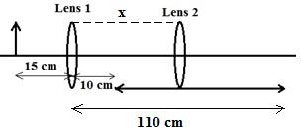
An upward-pointing object is placed 15.0 cm to the left of a lens system. The first lens is convex with focal length 10.0 cm. The second lens is convex with focal length 10 cm and its location from the first lens is varied from 10 cm away to 110 cm away. Which one of the following choices best represents the description of the final image formed as the second lens is moved from $x=10$ cm to $x=110$ cm from the first lens?

figure
(A)Real & pointing downwardVirtual & pointing downwardReal & pointing upward
(B)Virtual & pointing downwardVirtual & pointing upwardReal & pointing upward
(C)Virtual & pointing upwardVirtual & pointing downwardReal & pointing downward
(D)Real & pointing upwardVirtual & pointing downwardReal & pointing upward
(E)Virtual & pointing downwardVirtual & pointing downwardReal & pointing upward
Show answer · 显示答案
Answer key
  • A

Worked solutions are in the books.

2016 · Q29Division 1Division 2Image and Ray Optics

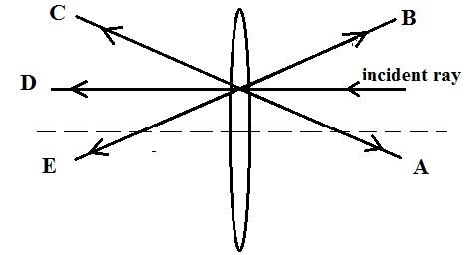
A ray of light is incident onto a thin glass lens as shown. Which one of the following arrows best indicates the path of the refracted ray?

figure

(A) $\mathrm{A}$

(B) $\mathrm{B}$

(C) $\mathrm{C}$

(D) $\mathrm{D}$

(E) $\mathrm{E}$

Show answer · 显示答案
Answer key
  • E

Worked solutions are in the books.

2016 · Q42Division 2Image and Ray Optics

An object (which points upward) is placed 21.0 cm from a converging lens of focal length 18.0 cm. Which one of the following choices is true about the image formed by the lens?

(A) The image is larger than the object, virtual, and points upward.

(B) The image is larger than the object, real, and points downward.

(C) The image is smaller than the object, virtual, and points upward.

(D) The image is smaller than the object, real, and points upward.

(E) The image is smaller than the object, real, and points downward.

Show answer · 显示答案
Answer key
  • B

Worked solutions are in the books.

2017 · Q45Division 2Image and Ray Optics

Which one of the following magnifications cannot be produced using a single converging lens?

(A) $\frac{1}{2}$
(B) 2
(C) $-\frac{1}{2}$
(D) $-1$
(E) $-2$

Show answer · 显示答案
Answer key
  • A

Worked solutions are in the books.

2018 · Q19Division 1Division 2Image and Ray Optics

Which of the following could produce an enlarged but inverted image of a real object?

(A) A converging lens placed at a distance greater than its focal length from the object.

(B) A converging lens placed at a distance less than its focal length from the object.

(C) A diverging lens placed at a distance less than the magnitude of its focal length from the object.

(D) A diverging lens placed at a distance greater than the magnitude of its focal length from the object.

(E) It is not possible to create the type of image desired.
Show answer · 显示答案
Answer key
  • A

Worked solutions are in the books.

2018 · Q29Division 1Division 2Image and Ray Optics

An object that is 8.60 cm tall is placed in front of a convex mirror. The resulting image is 7.60 cm tall, and 14.2 cm from the mirror. What is the focal length of the mirror?

(A) $-122$ cm
(B) $-105$ cm
(C) $14.0$ cm
(D) $-16.9$ cm
(E) $-4.2$ cm

Show answer · 显示答案
Answer key
  • A

Worked solutions are in the books.

2019 · Q8Division 1Image and Ray Optics

A candle, a converging lens and a white screen are placed in a line with the lens between the candle and the screen. A distance of 72 cm separates the candle and screen. As the lens is moved to all points between the candle and the screen, only one focused image of the candle can be made on the screen. What is the focal length of the converging lens?

(A) 12 cm

(B) 18 cm

(C) 24 cm

(D) 36 cm

(E) It cannot be determined without knowing the location ofthe lens when the focused image is produced.

Show answer · 显示答案
Answer key
  • B

Worked solutions are in the books.

2019 · Q21Division 1Division 2Image and Ray Optics

Let $M$ represent the magnification of an image. For which of the following arrangements of an object and an optical device would-l $<M<0$?

(A) The object is placed less than one focal length in front of a converging mirror.

(B) The object is placed between one focal length and two focal lengths in front of a diverging mirror.

(C) The object is placed less than one focal length in front of a diverging lens.

(D) The object is placed more than two focal lengths in front of a converging lens.

(E) The object is placed between one focal length and two focal lengths in front of a plane mirror.

Show answer · 显示答案
Answer key
  • D

Worked solutions are in the books.

2019 · Q29Division 1Division 2Image and Ray Optics

A convex lens has a focal length of 50 mm. How far from the lens must an object be placed if it is to form a virtual image magnified in size by a factor of three?

(A) 33 mm
(B) 38 mm
(C) 43 mm
(D) 48 mm
(E) 53 mm

Show answer · 显示答案
Answer key
  • A

Worked solutions are in the books.

2021 · Q13Division 1Division 2Image and Ray Optics

An object is placed 20 cm in front of a converging lens with a focal length of 30 cm . What is the distance between the object and its image?
(A) 8 cm
(B) 32 cm
(C) 40 cm
(D) 60 cm
(E) 80 cm

Show answer · 显示答案
Answer key
  • C

Worked solutions are in the books.

2021 · Q49Division 2Image and Ray Optics

A collimated laser beam emerging from a commercial He-Ne laser has a diameter of 1.0 mm . Two convex lenses are used to convert this beam to a well-collimated beam with 10.0 mm diameter. The first lens has a focal length of 1.5 cm and is to be mounted at the output of the laser. What is the focal length, $f$, of the second lens and how far from the first lens should it be placed?

$f(\mathrm{~cm})$Distance $(\mathrm{cm})$
(A)4.56
(B)1010
(C)1011.5
(D)1515
(E)1516.5
Show answer · 显示答案
Answer key
  • E

Worked solutions are in the books.

2022 · Q35Division 1Division 2Image and Ray Optics

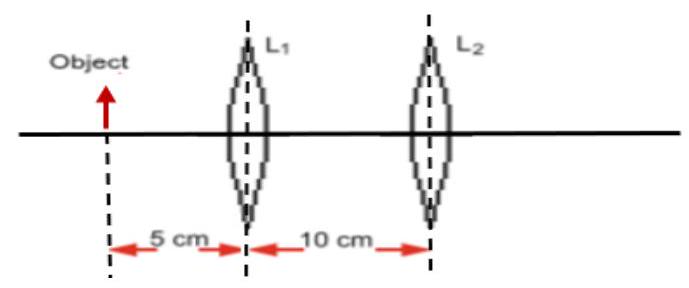
A combination of two thin convex lenses is placed as shown at right. An object is placed 5 cm in front of $L_{1}$ which has a focal length of $10 \mathrm{~cm} . L_{2}$ is 10 cm behind $L_{1}$ and has a focal length of 12 cm . How far from $L_{2}$ is the final image for this lens combination?

figure

(A) 8 cm
(B) 15 cm
(C) 22 cm
(D) 24 cm
(E) 30 cm

Show answer · 显示答案
Answer key
  • E

Worked solutions are in the books.

2023 · Q48Division 2Image and Ray Optics

The focal lengths of the objective and eyepiece convex lenses are in the ratio $8: 1$ for a particular telescope. The telescope is pointed at a building that is 10 km from the telescope and is 100 m tall. What is the distance to the image?
(A) 56.2 m
(B) 156.2 m
(C) 98.4 m
(D) 142 m
(E) 33.4 m

Show answer · 显示答案
Answer key
  • B

Worked solutions are in the books.

2024 · Q46Division 2Image and Ray Optics

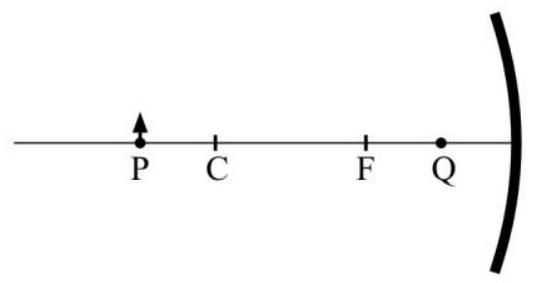
A small object is placed in front of a concave mirror and to the left of the center of curvature at point $P$ in the picture. As the object is moved from point $P$ to point Q , the size of the image produced will ...

figure

(A) always decrease.
(B) always increase.
(C) first decrease and then increase.
(D) first increase and then decrease.
(E) first increase, then decrease and then increase again.

Show answer · 显示答案
Answer key
  • D

Worked solutions are in the books.