Physics Bowl

Ideal Gas

41 items — reveal each answer key.

2010 · Q20Division 1Division 2Ideal Gas

A sample of ideal gas is in a container at a temperature of $100^{\circ}C$ and a pressure of 2.50 $atm$. If the volume of the container is 25 $L$, approximately how many molecules of gas are in the container?

(A) $4.58\times 10^{24}$
(B) $1.23\times 10^{24}$
(C) $6.25\times 10^{23}$
(D) $4.53\times 10^{22}$
(E) $1.21\times 10^{22}$
Show answer · 显示答案
Answer key
  • B

Worked solutions are in the books.

2010 · Q49Division 2Ideal Gas

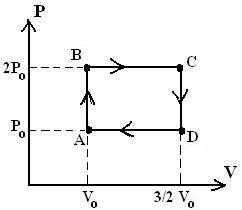
A monatomic ideal gas is the working substance for an engine that undergoes the cyclic process (ABCDA) shown in the PV diagram.

The processes are all isochoric or isobaric with pressures between $P_{0}$ and $2P_{0}$ and volumes between $V_{0}$ and $\displaystyle \frac{3}{2}V_{0}$. What is the efficiency of this engine?

figure

(A) $\frac{1}{8}$
(B) $\frac{1}{5}$
(C) $\frac{1}{3}$
(D) $\frac{2}{3}$
(E) $\frac{5}{7}$

Show answer · 显示答案
Answer key
  • A

Worked solutions are in the books.

2011 · Q22Division 1Division 2Ideal Gas

Three moles of an ideal gas occupy a container of volume $2.5\times 10^{-2}m^{3}$. The pressure inside this container is $5.00\times 10^{5}Pa$. Which one of the following choices best represents the temperature of the gas?

(A) 225 $\mathrm{K}$
(B) 500 $\mathrm{K}$
(C) 775 $\mathrm{K}$
(D) 1500 $\mathrm{K}$
(E) 50800 $\mathrm{K}$

Show answer · 显示答案
Answer key
  • B

Worked solutions are in the books.

2011 · Q44Division 2Ideal Gas

One mole of a monatomic ideal gas undergoes an isobaric expansion. In the process, the temperature of the gas increases from 300 $\mathrm{K}$ to 500 K. Which one of the following choices best represents the amount of work done by the gas on the surroundings?

(A) $665J$
(B) $1110J$
(C) $1660J$
(D) $2490J$
(E) $4160J$

Show answer · 显示答案
Answer key
  • C

Worked solutions are in the books.

2012 · Q27Division 1Division 2Ideal Gas

The pressure inside a container with two moles of an ideal gas is 0.75 $a\mathrm{t}m$. The temperature of the gas is $100^{\mathrm{o}}C$. The container maintains constant volume as the pressure is tripled. Which one of the following choices best represents the temperature of the gas after the pressure is tripled?

(A) $33^{\circ}C$
(B) $300^{\circ}C$
(C) $573^{\circ}C$
(D) $846^{\circ}C$
(E) $1119^{\circ}C$

Show answer · 显示答案
Answer key
  • D

Worked solutions are in the books.

2012 · Q40Division 1Division 2Ideal Gas

Using the kinetic theory of gases, which one of the following choices best represents the rms (root mean square) speed of 58 grams of a monatomic ideal gas at a pressure of 3.0 $a\mathrm{t}m$ in an enclosed container of volume 6.0 $L$?

(A) 0.557 $m/s$
(B) 9.71 $m/s$
(C) 177 $m/s$
(D) 307 $m/s$
(E) 3150 $m/s$

Show answer · 显示答案
Answer key
  • D

Worked solutions are in the books.

2012 · Q44Division 2Ideal Gas

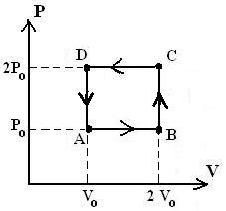
A monatomic ideal gas is the working substance for a refrigerator that undergoes the cyclic process (ABCDA) shown in the PV diagram. The processes are all isochoric or isobaric with pressures between $P_{0}$ and $2P_{0}$ and volumes between $V_{0}$ and $2\mathrm{V}_{0}$. What is the coefficient of performance for this refrigerator?

figure

(A) 1/4
(B) 1/3
(C) 4/3
(D) 11/2
(E) 13/2

Show answer · 显示答案
Answer key
  • D

Worked solutions are in the books.

2013 · Q20Division 1Division 2Ideal Gas

A sample of ideal gas at a temperature of 40. $0^{\mathrm{o}}\mathrm{C}$ is in a container of volume $3.50\times 10^{-2}m^{3}$. If the pressure of the gas is 0.50 $a\mathrm{t}m$, how many molecules of the gas are in the container?

(A) $4.05\times 10^{18}$
(B) $4.10\times 10^{20}$
(C) $4.05\times 10^{21}$
(D) $4.10\times 10^{23}$
(E) $4.10\times 10^{26}$

Show answer · 显示答案
Answer key
  • D

Worked solutions are in the books.

2013 · Q31Division 1Division 2Ideal Gas

A monatomic ideal gas undergoes a reversible isothermal expansion in an enclosed container. Which one of the following quantities associated with the gas has a value of zero?

(A) Heat
(B) Entropy change
(C) Work done
(D) Internal energy change
(E) Pressure change

Show answer · 显示答案
Answer key
  • D

Worked solutions are in the books.

2013 · Q41Division 2Ideal Gas

An engine operates between a low temperature of $273^{\mathrm{o}}\mathrm{C}$ and a high temperature of $546^{\mathrm{o}}\mathrm{C}$. What is the maximum theoretical efficiency of this engine?

(A) $1/{3}$
(B) $2/{3}$
(C) $1/{4}$
(D) $1/{2}$
(E) $3/{4}$

Show answer · 显示答案
Answer key
  • A

Worked solutions are in the books.

2013 · Q48Division 2Ideal Gas

Two identical samples of a monatomic ideal gas are to undergo reversible processes. Which one of the following choices is a correct statement about the heat associated with the processes?

Process 1: An isochoric pressure doubling

Process 2: An isobaric volume doubling

(A) There is less heat associated with Process 1 than Process 2.

(B) The heat is the same non-zero value for Processes 1 and 2.

(C) There is more heat associated with Process 1 than Process 2.

(D) The heat is zero for Processes 1 and 2.

(E) More information is required to determine the relationship for the heats.

Show answer · 显示答案
Answer key
  • A

Worked solutions are in the books.

2014 · Q37Division 1Division 2Ideal Gas

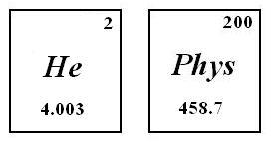
A new element is discovered and named PhysicsBowlium (atomic symbol Phys). Its entry onto the standard periodic table of elements appears as in the figure (with Helium shown as well). Given a sample of Phys which acts as a perfect monatomic ideal gas, what is the root-mean-square speed of the atoms of the gas if the sample is at $20^{\circ}C$?

(A) 1.04 $m/s$

(B) 4.00 $m/s$

(C) 33.0 $m/s$

(D) 126 $m/s$

(E) 191 $m/s$

figure
Show answer · 显示答案
Answer key
  • D

Worked solutions are in the books.

2014 · Q46Division 2Ideal Gas

A monatomic, ideal gas undergoes an isobaric process. During the process, the gas performs 80 joules of work on the surroundings. Which one of the following statements best describes the heat exchange during this process?

(A) 200 joules of energy was added to the gas.

(B) 200 joules of energy was removed from the gas.

(C) 80 joules of energy was added to the gas.

(D) 80 0joules of energy was removed from the gas.

(E) It cannot be determined without knowing the change in temperature for the gas.

Show answer · 显示答案
Answer key
  • A

Worked solutions are in the books.

2015 · Q19Division 1Division 2Ideal Gas

Ten moles of helium gas are enclosed in a container at a pressure of l.00 $aTm$ and at a temperature of 400 $K$. Which one of the following choices best represents the density of this gas sample?

(A) 0. $012\displaystyle \frac{kg}{m^{3}}$
(B) 0. $12\displaystyle \frac{kg}{m^{3}}$
(C) 1. $2\displaystyle \frac{kg}{m^{3}}$
(D) $120\displaystyle \frac{kg}{m^{3}}$
(E) $1.2\displaystyle \times 10^{4}\frac{kg}{m^{3}}$

Show answer · 显示答案
Answer key
  • B

Worked solutions are in the books.

2015 · Q25Division 1Division 2Ideal Gas

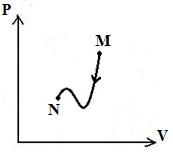
A gas undergoes the unusual process $M\rightarrow N$ in the pressure vs. volume graph shown. Which one of the following choices properly represents the signs of the internal energy change of the gas, $\Delta U$, the total energy transferred as heat to the gas, $Q$, and the total work done on the gas by the surroundings, $W$, for

{$\Delta U$}{Q}{W}
(A)PositiveNegativePositive
(B)NegativePositiveNegative
(C)NegativeNegativeNegative
(D)PositivePositiveNegative
(E)NegativeNegativePositive
figure
Show answer · 显示答案
Answer key
  • E

Worked solutions are in the books.

2015 · Q44Division 2Ideal Gas

Which one of the following choices is most associated with the following statement: "When the pressure of a gas is held constant, the volume of the gas is directly proportional to the temperature." ?

(A) Newton's Law
(B) Boyle's Law
(C) Avogadro's Law
(D) Graham's Law
(E) Charles's Law

Show answer · 显示答案
Answer key
  • E

Worked solutions are in the books.

2015 · Q47Division 2Ideal Gas

One mole of a diatomic ideal gas undergoes a reversible adiabatic process. The pressure and volume initially are given as $P=2.0atm$ and $V=30L$. If the volume is halved during the adiabatic process, how much work was done on the gas sample by the surroundings?

(A) $6790J$
(B) $5530J$
(C) $4850J$
(D) $4200J$
(E) $3040J$

Show answer · 显示答案
Answer key
  • C

Worked solutions are in the books.

2016 · Q19Division 1Division 2Ideal Gas

An ideal gas in a sealed container with $1.20\times 10^{24}$ particles has a pressure of l.0 atm at a temperature of 27.0 $^{\mathrm{o}}\mathrm{C}$. Which one of the following choices best represents the volume of the container?

(A) 450 $m^{3}$
(B) 4.5 $m^{3}$
(C) 0.49 $m^{3}$
(D) 0.049 $m^{3}$
(E) 0.00049 $m^{3}$

Show answer · 显示答案
Answer key
  • D

Worked solutions are in the books.

2016 · Q48Division 2Ideal Gas

From a given state of $P, V$, and $T$ for an ideal gas, which one of the following reversible processes has the most heat associated with it?

(A) Isothermal expansion doubling the volume

(B) Isobaric expansion doubling the volume

(C) Isovolumic pressure doubling

(D) Adiabatic expansion doubling the volume

(E) Isobaric compression halving the volume

Show answer · 显示答案
Answer key
  • B

Worked solutions are in the books.

2017 · Q19Division 1Division 2Ideal Gas

An ideal gas at a temperature of $100^{\mathrm{o}}\mathrm{C}$ has 3.0 moles of particles enclosed in a 5.0 $L$ container. Which one of the following choices best represents the pressure of the gas?

(A) $4.99\times 10^{5}Pa$
(B) $1.86\times 10^{6}Pa$
(C) $5.02\times 10^{6}Pa$
(D) $5.05\times 10^{7}Pa$
(E) $1.88\times 10^{8}Pa$

Show answer · 显示答案
Answer key
  • B

Worked solutions are in the books.

2017 · Q50Division 2Ideal Gas

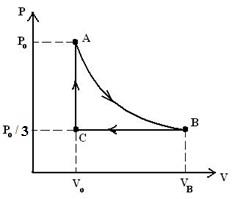
A monatomic ideal gas undergoes the reversible cyclic process (ABCA) shown in the PV diagram. Process $A\rightarrow B$ is adiabatic. What is the efficiency of this engine?

(A) 0.15
(B) 0.22
(C) 0.33
(D) 0.47
(E) 0.67

figure
Show answer · 显示答案
Answer key
  • B

Worked solutions are in the books.

2018 · Q6Division 1Ideal Gas

What temperature on the Kelvin scale is equivalent to $37^{\mathrm{o}}$ Celsius?

(A) 310 $\mathrm{K}$
(B) 283 $\mathrm{K}$
(C) 256 $\mathrm{K}$
(D) 37 $\mathrm{K}$
(E) 19 $\mathrm{K}$

Show answer · 显示答案
Answer key
  • A

Worked solutions are in the books.

2018 · Q11Division 1Division 2Ideal Gas

In a classroom demonstration, a teacher discussing the air in the room as an ideal gas slides a solid barrier of negligible thickness into place, cutting the room into two equal-sized volumes. What is the air pressure for the portion of the room in which the teacher is standing, assuming the original pressure in the whole room was $P$? Treat the room as a sealed container.

(A) $\displaystyle \frac{1}{4}P$
(B) $\frac{1}{2}P$
(C) $P$
(D) $2P$
(E) 4 $P$

Show answer · 显示答案
Answer key
  • C

Worked solutions are in the books.

2018 · Q15Division 1Division 2Ideal Gas

A sample of ideal gas is in a container at a temperature of $100^{\mathrm{o}}\mathrm{C}$ and a pressure of 2.5 atm. If the volume of the container is 0.025 $\mathrm{m}^{3}$, approximately how many molecules of gas are in the container?

(A) 4.58 $\mathrm{x}10^{24}$
(B) 1.23 $\mathrm{x}10^{24}$
(C) 6.25 $\mathrm{x}10^{23}$
(D) 4.53 $\mathrm{x}10^{22}$
(E) 1.21 $\mathrm{x}10^{22}$

Show answer · 显示答案
Answer key
  • B

Worked solutions are in the books.

2018 · Q42Division 2Ideal Gas

Two moles of an ideal gas absorbs 2100 $\mathrm{J}$ of heat during an isobaric process. If the gas changes temperature by $36^{\mathrm{o}}\mathrm{C}$ during the process, which one of the following choices could identify the gas?

(A) Carbon monoxide
(B) Water vapor
(C) Ammonia
(D) Helium
(E) Hydrogen sulfide

Show answer · 显示答案
Answer key
  • A

Worked solutions are in the books.

2018 · Q46Division 2Ideal Gas

When an ideal gas is taken through an isochoric process,

(A) $\Delta U=0$
(B) $W=0$
(C) $Q=0$
(D) $\Delta U=W$
(E) none of the above

Show answer · 显示答案
Answer key
  • B

Worked solutions are in the books.

2019 · Q35Division 1Division 2Ideal Gas

In a mixture of hydrogen, oxygen, and nitrogen gases at room temperature, the molecules having the greatest average speed are those of

(A) Hydrogen

(B) Oxygen

(C) Nitrogen

(D) All have the same speed

(E) It depends upon the composition of the mixture

Show answer · 显示答案
Answer key
  • A

Worked solutions are in the books.

2019 · Q42Division 2Ideal Gas

Three identical samples of a monatomic ideal gas are taken from a temperature $T$ to a temperature $2T.$ Sample A undergoes an adiabatic process. Sample $\mathrm{B}$ undergoes an isobaric process and Sample $\mathrm{C}$ undergoes an isochoric process. Which ofthe following correctly ranks the heats added to the samples during the three processes?

(A) $Q_{\mathrm{A}}<Q_{\mathrm{B}}<Q\mathrm{c}$

(B) $Q_{\mathrm{A}}<Q_{\mathrm{C}}<Q_{\mathrm{B}}$

(C) $Q_{\mathrm{B}}<Q_{\mathrm{A}}<Q\mathrm{c}$

(D) $Q_{\mathrm{C}}<Q_{\mathrm{A}}<Q_{\mathrm{B}}$

(E) $Q_{\mathrm{C}}<Q_{\mathrm{B}}<Q_{\mathrm{A}}$

Show answer · 显示答案
Answer key
  • B

Worked solutions are in the books.

2019 · Q50Division 2Ideal Gas

One mole of ideal gas initially at temperature $T_{0}$ and volume $Vo$ undergoes a reversible isothermal

expansion to $V_{1}$. Ifthe ratio of specific heats is $ c_{p}lc_{v}=\gamma$ and if $R$ is the gas constant, the work done by the gas is:

(A) Zero
(B) $R T_{0}\left(V_{1} / V_{0}\right)^{\gamma}$
(C) $R T_{0}\left(V_{1} / V_{0^{-}} 1\right)$
(D) $C_{v} T_{0}\left[1-\left(V_{0} / V_{1}\right)^{\gamma-1}\right]$
(E) $R T_{0} \ln \left(V_{1} / V_{0}\right)$

Show answer · 显示答案
Answer key
  • E

Worked solutions are in the books.

2021 · Q17Division 1Division 2Ideal Gas

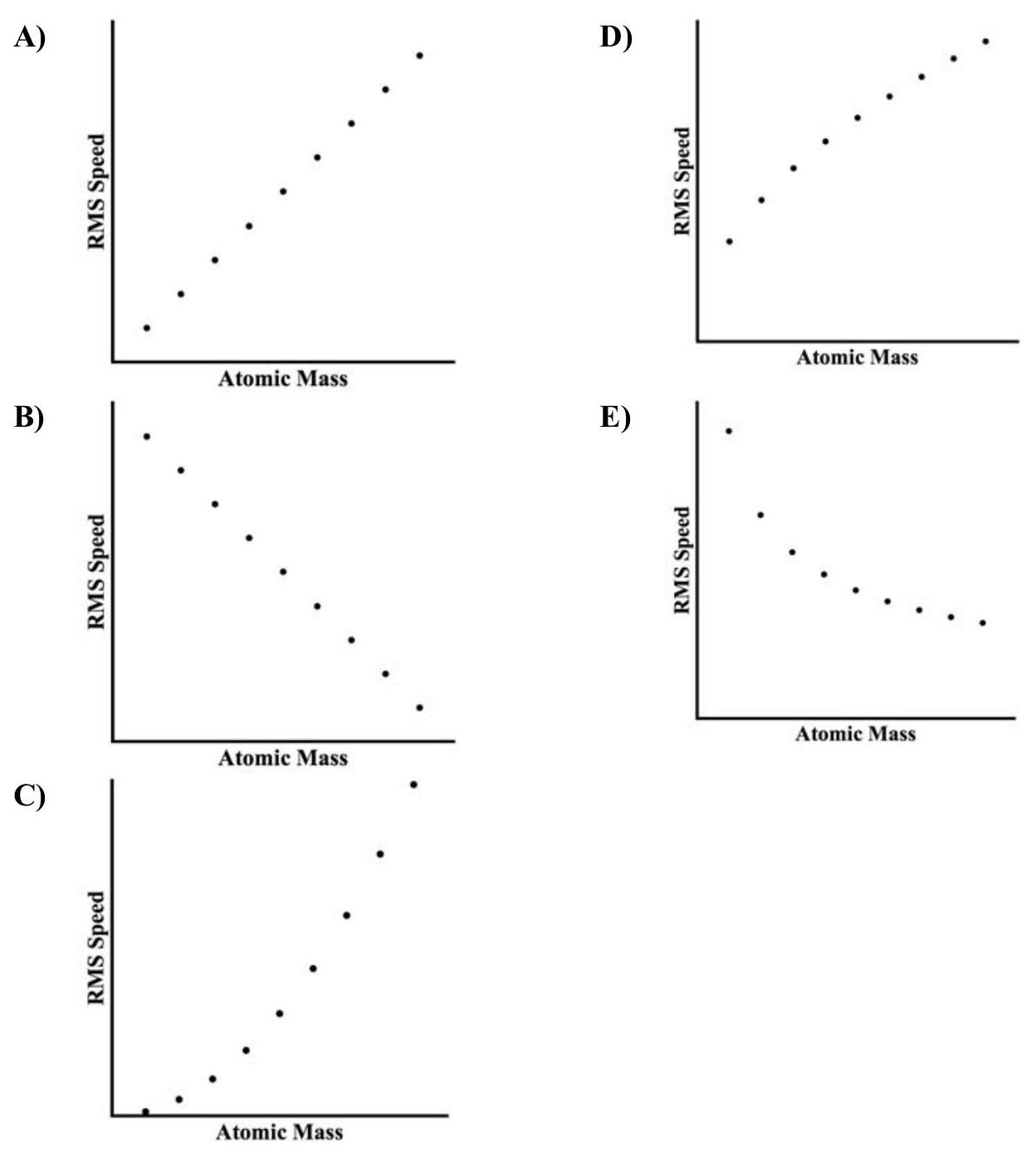
Several samples of different ideal gases all have the same temperature. Which of the following graphs could show the relationship between the atomic mass of the gas and the rms speed of the gas atoms?

figure

Show answer · 显示答案
Answer key
  • E

Worked solutions are in the books.

2021 · Q39Division 1Division 2Ideal Gas

A monatomic ideal gas undergoes an adiabatic expansion. Which of the following statements is true about the gas?
(A) The final temperature of the gas is less than the initial temperature of the gas.
(B) Heat enters the gas from the surroundings during the process.
(C) The final pressure of the gas is greater than the initial pressure of the gas.
(D) Work is done on the gas from the surroundings during the process.
(E) The internal energy of the gas remains unchanged during the process.

Show answer · 显示答案
Answer key
  • A

Worked solutions are in the books.

2022 · Q8Division 1Ideal Gas

An increase in the translational motion of the molecules of a gas confined in a steel tank will be observed in one of the following ways. It will produce an increase in:
(A) the temperature of the gas only.
(B) the pressure of the gas only.
(C) both the temperature and pressure of the gas.
(D) the temperature of the gas and a decrease in its pressure.
(E) the volume of the gas.

Show answer · 显示答案
Answer key
  • C

Worked solutions are in the books.

2022 · Q41Division 2Ideal Gas

A weather balloon is loosely filled with $2.0 \mathrm{~m}^{3}$ of helium at 1.0 atm and $27^{\circ} \mathrm{C}$. The balloon is then released. When it has reached an elevation of 7000 m , the pressure has dropped to 0.41 atm and the balloon has expanded. If the temperature at this elevation is $-31^{\circ} \mathrm{C}$, what is the new volume of the balloon?
(A) $2.7 \mathrm{~m}^{3}$
(B) $3.2 \mathrm{~m}^{3}$
(C) $3.9 \mathrm{~m}^{3}$
(D) $4.6 \mathrm{~m}^{3}$
(E) $5.1 \mathrm{~m}^{3}$

Show answer · 显示答案
Answer key
  • C

Worked solutions are in the books.

2022 · Q50Division 2Ideal Gas

An ideal gas system, with an initial volume of $1.0 \mathrm{~m}^{3}$ at standard temperature and pressure, undergoes the following three-stage cycle: Stage 1 - an isothermal expansion to twice its original volume. Stage 2 - a process by which its volume remains constant, its pressure returns to its original value and 104 J of heat is added to the system. Stage 3 - an isobaric compression to its original volume, with $3 \times 10^{4} \mathrm{~J}$ of heat being removed from the system. Calculate the work done on the system during Stage 3.
(A) $-7.005 \times 10^{4} \mathrm{~J}$
(B) $-1.013 \times 10^{4} \mathrm{~J}$
(C) $-1.013 \times 10^{5} \mathrm{~J}$
(D) $-7.050 \times 10^{5} \mathrm{~J}$
(E) $-2.030 \times 10^{5} \mathrm{~J}$

Show answer · 显示答案
Answer key
  • C

Worked solutions are in the books.

2023 · Q34Division 1Division 2Ideal Gas

A sample of an ideal gas is being held at a constant pressure. What happens to the internal energy of the gas if 10 J of heat energy are transferred to the gas?
(A) Increases by 10 J
(B) Increases by <10 J
(C) Increases by > 10 J
(D) Remains unchanged
(E) More information is needed

Show answer · 显示答案
Answer key
  • B

Worked solutions are in the books.

2023 · Q39Division 1Division 2Ideal Gas

A 20 L tank of oxygen has a pressure of 0.30 atm and a temperature of 300 K . A 30 L tank of nitrogen has a pressure of 0.60 atm and a temperature of 300 K . The oxygen is transferred to the nitrogen tank where the two mix. What is the pressure of the mixture if its temperature stays at 300 K ?
(A) 0.70 atm
(B) 0.75 atm
(C) 0.78 atm
(D) 0.80 atm
(E) 0.90 atm

Show answer · 显示答案
Answer key
  • D

Worked solutions are in the books.

2024 · Q24Division 1Division 2Ideal Gas

An ideal gas undergoes an isothermal process. Which of the following statements about the change in internal energy $(\Delta U)$ for the gas and heat $(Q)$ is true during this process?
(A) $\Delta U$ is zero, and $Q$ is zero.
(B) $\Delta U$ is zero, and $Q$ is not zero.
(C) $\Delta U$ is not zero, and $Q$ is zero.
(D) $\Delta U$ is not zero, and $Q$ is not zero, but they are not equal.
(E) $\Delta U$ is not zero, and $Q$ is not zero, and they are equal.

Show answer · 显示答案
Answer key
  • B

Worked solutions are in the books.

2024 · Q39Division 1Division 2Ideal Gas

An increase in the average speed of the molecules of a gas confined in a rigid cylinder will correspond to an...
(A) increase in the temperature of the gas only.
(B) increase in the pressure of the gas only.
(C) increase in both the temperature and the pressure of the gas.
(D) increase in the temperature of the gas and a decrease in its pressure.
(E) increase in the pressure of the gas and a decrease in its temperature.

Show answer · 显示答案
Answer key
  • C

Worked solutions are in the books.

2025 · Q25Division 1Division 2Ideal Gas

An ideal atomic gas is a hypothetical gas model where atoms are considered as noninteracting, point-like particles that move randomly and collide elastically. What is the adiabatic index of an ideal diatomic gas?
(A) $\quad 1.00$
(B) 1.29
(C) 1.33
(D) 1.40
(E) 1.67

Show answer · 显示答案
Answer key
  • D

Worked solutions are in the books.

2025 · Q33Division 1Division 2Ideal Gas

A sealed cylindrical container of height $h$ is divided into two equal volumes by a frictionless, thermally insulated piston of negligible mass. The lower half of the container contains $n$ moles of an ideal monatomic gas at an initial temperature $T_{1}$ and pressure $P_{1}$. The upper half is initially evacuated (vacuum). The piston is released, allowing the gas to expand into the entire container. Assuming the process is adiabatic, and the gas reaches a new equilibrium state, what is the final temperature $T_{f}$ of the gas?
(A) $T_{f}=T_{1}$
(B) $T_{f}=T_{1}\left(\frac{1}{2}\right)^{\frac{2}{3}}$
(C) $T_{f}=T_{1}\left(\frac{1}{2}\right)^{\frac{2}{5}}$
(D) $T_{f}=\frac{T_{1}}{2}$
(E) $T_{f}=0$

Show answer · 显示答案
Answer key
  • A

Worked solutions are in the books.

2025 · Q40Division 1Division 2Ideal Gas

A container of ideal gas undergoes a Carnot heat engine cycle in the order shown below.

Process 1 - Reversible isothermal expansion,

Process 2 - Reversible adiabatic expansion,

Process 3 - Reversible isothermal compression,

Process 4 - Reversible adiabatic compression.

The gas has returned to its original state at the end of the cycle. Let $Q_{n}$ represent the amount of heat exchanged on process $n$. Which of the following correctly calculates the efficiency of this engine?
(A) $\quad 1-Q_{1} / Q_{2}$
(B) $1-Q_{2} / Q_{3}$
(C) $1-Q_{3} / Q_{4}$
(D) $1-Q_{3} / Q_{1}$
(E) $1-Q_{4} / Q_{1}$

Show answer · 显示答案
Answer key
  • D

Worked solutions are in the books.