Physics Bowl

Gravitation and Astrophysics

22 items — reveal each answer key.

2010 · Q42Division 2Gravitation and Astrophysics

A comet moves in an elliptical orbit around the sun. As the comet moves from aphelion (the point on the orbit farthest from the sun) to perihelion (the point on the orbit closest to the sun), which of the following results is true?

Speed of the cometAngular momentum of the $\mathrm{c}\mathrm{o}\mathrm{m}\mathrm{e}\mathrm{t}/\mathrm{s}\mathrm{u}\mathrm{n}$ systemGravitational potential energy of the $\mathrm{c}\mathrm{o}\mathrm{m}\mathrm{e}\mathrm{t}/\mathrm{s}\mathrm{u}\mathrm{n}$ system
(A)IncreasesIncreasesDecreases
(B)IncreasesConstantDecreases
(C)DecreasesDecreasesIncreases
(D)IncreasesIncreasesConstant
(E)ConstantConstantConstant
Show answer · 显示答案
Answer key
  • B

Worked solutions are in the books.

2013 · Q12Division 1Division 2Gravitation and Astrophysics

It takes the Earth one day to rotate about its axis. Which one of the following choices best represents the time that it takes the Moon to make one rotation about its axis?

(A) One day
(B) One week
(C) One month
(D) One year
(E) It does not rotate at all

Show answer · 显示答案
Answer key
  • C

Worked solutions are in the books.

2013 · Q47Division 2Gravitation and Astrophysics

Which one of the following choices best represents the magnitude of the angular momentum of the Earth (expressed in base MKS units) associated with its rotation about its axis?

(A) $10^{38}$
(B) $10^{34}$
(C) $10^{30}$
(D) $10^{26}$
(E) $10^{22}$

Show answer · 显示答案
Answer key
  • B

Worked solutions are in the books.

2014 · Q27Division 1Division 2Gravitation and Astrophysics

Two spherical, non-rotating planets, X and $\mathrm{Y}$, have the same uniform density $\rho$. Planet X has twice the radius of Planet Y. Let $g_{X}$ and $g_{\mathrm{Y}}$ represent the accelerations due to gravity at the surfaces of Planet X and Planet $\mathrm{Y}$, respectively. What is the ratio of $g_{X}:g_{\mathrm{Y}}$?

(A) $2:1$
(B) $1:2$
(C) $1:1$
(D) $4:1$
(E) $1:4$

Show answer · 显示答案
Answer key
  • A

Worked solutions are in the books.

2014 · Q30Division 1Division 2Gravitation and Astrophysics

Considering only the Moon-Earth system (ignore any influence of the Sun), which one of the following best expresses the magnitude of the Moon's acceleration about the Earth?

(A) $3\times 10^{-1}\frac{m}{s^{2}}$
(B) $3\times 10^{-2}\frac{m}{s^{2}}$
(C) $3\times 10^{-3}\frac{m}{s^{2}}$
(D) $3\times 10^{-4}\frac{m}{s^{2}}$
(E) $3\times 10^{-5}\frac{m}{s^{2}}$

Show answer · 显示答案
Answer key
  • C

Worked solutions are in the books.

2015 · Q22Division 1Division 2Gravitation and Astrophysics

Satellite 1 makes a circular orbit around the Earth with a radius $r_{1}=R.$

Satellite 2 makes a circular orbit around the Earth with a radius $r_{2}=2R.$

We let $v$ represent the speed of a satellite and $a$ represent the magnitude of a satellite's acceleration. Which one of the following choices gives the correct relation between the speeds and accelerations of the satellites?

(A) $\displaystyle v_{2}=\frac{1}{\sqrt{2}}v_{1}$ ; $a_{2}=\displaystyle \frac{1}{4}a_{1}$

(B) $\displaystyle v_{2}=\frac{1}{2}v_{1}$ ; $a_{2}=\displaystyle \frac{1}{4}a_{1}$

(C) $v_{2}=\displaystyle \frac{1}{\sqrt{2}}v_{1} ;a_{2}=\displaystyle \frac{1}{2}a_{1}$

(D) $\displaystyle v_{2}=\frac{1}{2}v_{1}$ ; $a_{2}=\displaystyle \frac{1}{2}a_{1}$

(E) $v_{2}=v_{1}$ ; $a_{2}=\displaystyle \frac{1}{2}a_{1}$

Show answer · 显示答案
Answer key
  • A

Worked solutions are in the books.

2016 · Q17Division 1Division 2Gravitation and Astrophysics

"All planets in the solar system follow elliptical orbits with the Sun located at one focus of the ellipse" This statement is best summarized by which one of the following choices?

(A) Kepler's First Law

(B) Kepler's Second Law

(C) Newton's Universal Law of Gravitation

(D) Einstein's Law of Gravity

(E) Schwarzchild's Law of Orbits

Show answer · 显示答案
Answer key
  • A

Worked solutions are in the books.

2016 · Q46Division 2Gravitation and Astrophysics

Two spherical, non-rotating planets, X and Y, have the same uniform density $\rho$. Planet X has twice the radius of Planet Y. Let $v_{X}$ and $v_{\mathrm{Y}}$ represent the escape speed at the surfaces of Planet X and Planet $\mathrm{Y},$ respectively. What is the ratio of $v_{X}:v_{\mathrm{Y}}$?

(A) $2:1$
(B) $1:2$
(C) $1:1$
(D) $4:1$
(E) $1:4$

Show answer · 显示答案
Answer key
  • A

Worked solutions are in the books.

2017 · Q48Division 2Gravitation and Astrophysics

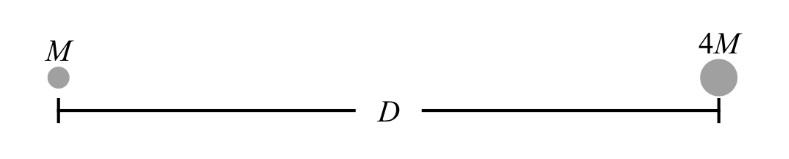
In the binary star system shown, the two stars follow circular orbits about the system's center of mass. The stars are separated by a distance D that is large compared to their size and are subject only to their mutual gravitational attraction. The orbital period of the star of mass M is T. Which one of the following choices represents the total mass of the binary star system?

(A)$\displaystyle \frac{\pi^{2}D^{3}}{5GT^{2}}$
(B) $\displaystyle \frac{4\pi^{2}D^{3}}{5GT^{2}}$
(C) $\displaystyle \frac{4\pi^{2}D^{3}}{GT^{2}}$
(D) $\displaystyle \frac{16\pi^{2}D^{3}}{5GT^{2}}$
(E) $\displaystyle \frac{25\pi^{2}D^{3}}{4GT^{2}}$

figure
Show answer · 显示答案
Answer key
  • C

Worked solutions are in the books.

2019 · Q7Division 1Gravitation and Astrophysics

A 100 kg person travels from sea level to an altitude of 5000 $\mathrm{m}$. By how many Newtons does their weight change?

(A) 0.8 $\mathrm{N}$
(B) 1.2 $\mathrm{N}$
(C) 1.6 $\mathrm{N}$
(D) 2.0 $\mathrm{N}$
(E) 2.4 $\mathrm{N}$

Show answer · 显示答案
Answer key
  • C

Worked solutions are in the books.

2021 · Q20Division 1Division 2Gravitation and Astrophysics

A simple and correct way to comprehend satellites orbiting Earth is to view them as
(A) balanced between gravitational and centripetal forces.
(B) beyond the main pull of Earth's gravity.
(C) in mechanical equilibrium with a net force of zero.
(D) having sufficient tangential velocities to fall around rather than into Earth.
(E) All of the above.

Show answer · 显示答案
Answer key
  • D

Worked solutions are in the books.

2021 · Q23Division 1Division 2Gravitation and Astrophysics

The mass of Mars is $6.40 \times 10^{23} \mathrm{~kg}$. Its radius is 3395 km . What is the mean density of Mars in $\mathrm{kg} / \mathrm{m}^{3}$ ?
(A) $9.76 \times 10^{2}$
(B) $1.95 \times 10^{3}$
(C) $3.90 \times 10^{3}$
(D) $7.81 \times 10^{3}$
(E) $7.94 \times 10^{4}$

Show answer · 显示答案
Answer key
  • C

Worked solutions are in the books.

2022 · Q49Division 2Gravitation and Astrophysics

If the Earth suddenly stopped in its orbit, and the orbit is assumed to be circular, how much time would elapse before it falls into the Sun?
(A) 147 minutes
(B) 1.22 days
(C) 64.5 days
(D) 228 days
(E) 2.34 years

Show answer · 显示答案
Answer key
  • C

Worked solutions are in the books.

2023 · Q1Division 1Gravitation and Astrophysics

Earth satellites such as the International Space Station orbit at altitudes that are mainly above Earth's atmosphere. A simple and accurate way to comprehend the orbit of these satellites is to view them as
(A) balanced between gravitational and centripetal forces.
(B) beyond the main pull of Earth's gravity.
(C) in mechanical equilibrium with a net force of zero.
(D) having sufficient tangential velocities to fall around rather than into Earth.
(E) All of the above.

Show answer · 显示答案
Answer key
  • D

Worked solutions are in the books.

2023 · Q15Division 1Division 2Gravitation and Astrophysics

If the sun collapsed suddenly to become a black hole, the Earth would
(A) continue in its present orbit.
(B) fly off tangential to the current orbital path.
(C) likely be pulled into the black hole.
(D) be pulled apart by tidal forces.
(E) Both C & D.

Show answer · 显示答案
Answer key
  • A

Worked solutions are in the books.

2023 · Q22Division 1Division 2Gravitation and Astrophysics

LaGrange Point 2 is a location in space where the gravitational attraction of the sun is equal to the gravitational attraction of the Earth. The sun is $1.5 \times 10^{8} \mathrm{~km}$ from Earth, and it has a mass that is $3.24 \times 10^{5}$ times that of Earth. How far from Earth, along a line to the sun, must an object be located to be in this location?
(A) $1.50 \times 10^{6} \mathrm{~km}$
(B) $1.83 \times 10^{6} \mathrm{~km}$
(C) $1.53 \times 10^{6} \mathrm{~km}$
(D) $3.26 \times 10^{6} \mathrm{~km}$
(E) $3.06 \times 10^{6} \mathrm{~km}$

Show answer · 显示答案
Answer key
  • A

Worked solutions are in the books.

2023 · Q30Division 1Division 2Gravitation and Astrophysics

Earth rotates once every 23 h 56 min around an axis that runs from the North to South Pole. What is the angular velocity of the Earth?
(A) $7.29 \times 10^{-5} \mathrm{rad} / \mathrm{s}$
(B) $7.59 \times 10^{-5} \mathrm{rad} / \mathrm{s}$
(C) $7.09 \times 10^{-5} \mathrm{rad} / \mathrm{s}$
(D) $4.37 \times 10^{-3} \mathrm{rad} / \mathrm{s}$
(E) $4.37 \times 10^{-5} \mathrm{rad} / \mathrm{s}$

Show answer · 显示答案
Answer key
  • A

Worked solutions are in the books.

2023 · Q37Division 1Division 2Gravitation and Astrophysics

Imagine that you're standing on the surface of a planet that shrinks to $1 / 10$ of its original diameter with no change in mass. Your weight on the shrunken planet would be
(A) $1 / 100$ as much.
(B) $1 / 10$ times as much.
(C) 10 times as much.
(D) 100 times as much.
(E) 1000 times as much.

Show answer · 显示答案
Answer key
  • D

Worked solutions are in the books.

2023 · Q42Division 2Gravitation and Astrophysics

A satellite with a mass of 2500 kg is in orbit around Earth. If a second satellite with a mass 5000 kg , is to be placed at the same orbital distance from Earth, the second satellite must have a speed which is:
(A) half the speed of the lighter satellite.
(B) twice the speed of the lighter satellite.
(C) the same speed as the lighter satellite.
(D) four times the speed of the lighter satellite.
(E) dependent upon the location from which it is launched.

Show answer · 显示答案
Answer key
  • C

Worked solutions are in the books.

2024 · Q19Division 1Division 2Gravitation and Astrophysics

Halley's Comet was last visible on Earth in 1986 and will be visible again in 2061. As it travels on its elliptical orbit around the sun, the speed of Halley's Comet...
(A) is constant.
(B) increases as it nears the Sun.
(C) decreases as it nears the Sun.
(D) is zero at two points in the orbit.
(E) can't be determined without more observations.

Show answer · 显示答案
Answer key
  • B

Worked solutions are in the books.

2024 · Q27Division 1Division 2Gravitation and Astrophysics

Mars has a mass of $6.46 \times 10^{23} \mathrm{~kg}$ and a radius of $3.39 \times 10^{6} \mathrm{~m}$. How much would a 65-kg person weigh on Mars?
(A) 122 N
(B) 198 N
(C) 244 N
(D) 416 N
(E) 650 N

Show answer · 显示答案
Answer key
  • C

Worked solutions are in the books.

2024 · Q45Division 2Gravitation and Astrophysics

The Moon orbits the Earth on a nearly circular orbit with a period, $T$, of 27.3 days. The radius of orbit is $3.84 \times 10^{5} \mathrm{~km}$. What is the acceleration of the Moon toward the Earth?
(A) $1.72 \times 10^{-3} \frac{\mathrm{~m}}{\mathrm{~s}^{2}}$
(B) $1.92 \times 10^{-3} \frac{\mathrm{~m}}{\mathrm{~s}^{2}}$
(C) $2.22 \times 10^{-3} \frac{\mathrm{~m}}{\mathrm{~s}^{2}}$
(D) $2.52 \times 10^{-3} \frac{\mathrm{~m}}{\mathrm{~s}^{2}}$
(E) $2.72 \times 10^{-3} \frac{\mathrm{~m}}{\mathrm{~s}^{2}}$

Show answer · 显示答案
Answer key
  • E

Worked solutions are in the books.