Physics Bowl

Electricity

34 items — reveal each answer key.

2010 · Q12Division 1Division 2Electricity

A scientist sets up an experiment with a proton of charge $+Q$ and mass $M$ being placed near a helium nucleus (2 protons and 2 neutrons) of charge $+2Q$ and mass $4M$. The objects are each released from rest and begin to move. From the scientist's point of view, which choice best describes the object that experiences the greatest magnitude of electric force from the other and which object experiences the greatest magnitude of acceleration? Ignore gravity.

Largest magnitude of forceLargest magnitude of acceleration
(A)The helium nucleusThe helium nucleus
(B)The helium nucleusThe proton
(C)The protonThe accelerations are equal
(D)The forces are equalThe accelerations are equal
(E)The forces are equalThe proton
Show answer · 显示答案
Answer key
  • E

Worked solutions are in the books.

2010 · Q37Division 1Division 2Electricity

A positively charged particle is moved in a straight line to the right from position $x=-4.0m$ to position $x=-2.0m$ by an external agent. The electric potential at these positions in space are $V(x=-4m)=-4.0$ volts and $V(x=-2m)=-2.0$ volts. Which statement is true about the work done by the external agent moving the charge between these positions and the electric field component parallel to the direction of motion that the moving charged particle experiences?

Assume the particle is moved at constant speed.

(A) The external agent does no work since the speed was constant.

(B) The external agent does negative work and the electric field is directed to the right.

(C) The external agent does positive work and the electric field is directed to the right.

(D) The external agent does negative work and the electric field is directed to the left.

(E) The external agent does positive work and the electric field is directed to the left.

Show answer · 显示答案
Answer key
  • E

Worked solutions are in the books.

2011 · Q5Division 1Electricity

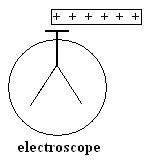
A positively charged rod is brought near a metal electroscope that is initially uncharged. As shown in the figure, the rod does not touch the electroscope. There is no charge transfer between the electroscope and rod, but the leaves of the electroscope move apart from each other when the rod is brought near the top of the electroscope. Which one of the following choices is the best explanation for this phenomenon?

figure

(A) Protons are repelled by the rod into the leaves of the electroscope.

(B) Electrons are attracted out of the leaves of the electroscope toward the rod.

(C) Protons are repelled into the leaves of the electroscope and electrons are attracted out of the leaves of the electroscope.

(D) Positively charged electrons are repelled by the rod into the leaves of the electroscope.

(E) Positively charged electrons are repelled into the leaves of the electroscope and regular electrons are attracted out of the leaves of the electroscope.

Show answer · 显示答案
Answer key
  • B

Worked solutions are in the books.

2011 · Q46Division 2Electricity

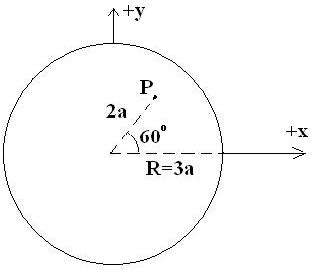
A hollow conducting sphere in static equilibrium is isolated in deep space with a net excess charge $+Q$ on it. What is the electric potential (assuming $V(r\rightarrow\infty)=0)$ at the position labeled $\mathrm{P}$ shown in the interior of the figure? The sphere has radius $R=3a$ and the point of interest is at a location $r=2a$ from the center of the sphere at an angle of $60^{\circ}$with respect to the $+x$-axis.

figure

(A) $0$
(B) $kQ/{(2a)}$
(C) $kQ/{(3a)}$
(D) $kQ/{(4a)}$
(E) $kQ/{(4a)}$

Show answer · 显示答案
Answer key
  • C

Worked solutions are in the books.

2012 · Q13Division 1Division 2Electricity

Approximately how many electrons must be removed from an electrically neutral object to give it a net charge of $Q=+1.00C$?

(A) $1.60\times 10^{-19}$ (B) 1 (C) $6.25\times 10^{18}$ (D) $6.02\times 10^{23}$ (E) $1.10\times 10^{30}$

Show answer · 显示答案
Answer key
  • C

Worked solutions are in the books.

2012 · Q31Division 1Division 2Electricity

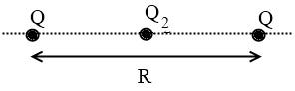
Three particles with charges $Q, Q$, and $Q_{2}$ are initially at rest very (infinitely) far apart from one another. The particles are moved to the locations shown in the figure where they are fixed in place. The particles on the left and right have charge $Q$ and are separated by a distance $R$. The particle with charge $Q_{2}$ is located at the midpoint directly between the other charged particles. The total work required to configure this three-particle arrangement is 0 Joules. Ignore any self-energies for the particles. What is the value of the charge $Q_{2}$?

(A) $-1/_{4}Q$

(B) $-\sqrt{2}/_{4}Q$

(C) $-1/_{2}Q$

(D) $-1/_{8}Q$

(E) It is not possible to accomplish what is required.

figure
Show answer · 显示答案
Answer key
  • A

Worked solutions are in the books.

2013 · Q7Division 1Electricity

Two identical particles are fixed in place a distance of 0.50 $m$ apart. The electric force that one particle exerts on the other has a magnitude of 3.00 $N$. Which one of the following choices best represents the magnitude of each particle's charge?

(A) $4.17\times 10^{-11}C$

(B) $8.33\times 10^{-11}C$

(C) $1.67\times 10^{-10}C$

(D) $9.13\times 10^{-6}C$

(E) $1.29\times 10^{-5}C$

Show answer · 显示答案
Answer key
  • D

Worked solutions are in the books.

2013 · Q29Division 1Division 2Electricity

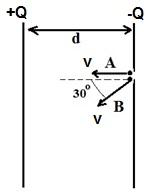
Two electrons enter a region between charged capacitor plates with equal speed $v.$ Electron A is directed horizontally to the left while electron $\mathrm{B}$ is directed at $30^{\mathrm{o}}$below the horizontal. Each electron makes it to the left-hand plate. Which one of the following choices best compares the speeds of the charges $(v_{A},\ v_{B})$ upon arrival at the left plate? Consider only the electrons A and $\mathrm{B}$'s interactions with the constant electric field between the plates, ignoring any relativistic effects.

figure

(A) $v_{A}>v_{B}$

(B) $v_{A}=v_{B}$

(C) $v_{A}<v_{B}$

(D) The answer depends on the size of the plate separation, $d.$

(E) The answer depends on the magnitude of the charge, $Q$, on each plate.

Show answer · 显示答案
Answer key
  • B

Worked solutions are in the books.

2014 · Q10Division 1Electricity

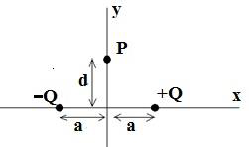
Two charges, $-Q$ and $+Q$, are fixed in place on the $\mathrm{x}$-axis, each a distance $a$ from the origin as shown. At the point labeled $\mathrm{P}$, a distance $d$ along the $\mathrm{y}$-axis from the origin, what is the direction of the electric field from the given charges?

figure

(A) Up the plane of the page
(B) Down the plane of the page
(C) To the right
(D) To the left
(E) There is no electric field.

Show answer · 显示答案
Answer key
  • D

Worked solutions are in the books.

2015 · Q8Division 1Electricity

A negatively charged balloon remains at rest when placed on a vertical wall. Which one of the following terms is most closely associated with the electrical phenomenon allowing the balloon to remain on the wall?

(A) Radiation
(B) Grounding
(C) Reduction
(D) Current
(E) Polarization

Show answer · 显示答案
Answer key
  • E

Worked solutions are in the books.

2015 · Q48Division 2Electricity

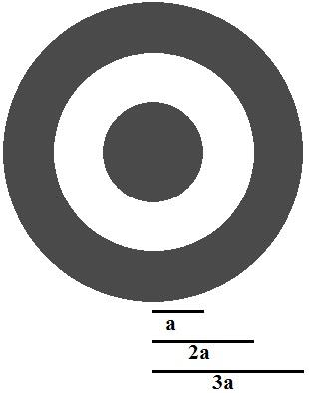
Two concentric charged conducting shells are in free space. The outer shell has inner radius $2a$ and outer radius 3. The inner shell has radius $a$. It is known that the electric potential at $r=3a$ is $V_{3a}=kQ/_{3a}$. If the electric potential $V_{a}$ at $r=a$ is $0$ volts, what is the charge on the inner spherical shell, $Q_{in}$?

figure

(A) $Q_{in}=-3/_{2}Q$

(B) $Q_{in}=-2/_{3}Q$

(c) $Q_{in}=-1/_{3}Q$

(D) $Q_{in}=-2Q$

(E) $Q_{in}=-1/_{2}Q$

Show answer · 显示答案
Answer key
  • B

Worked solutions are in the books.

2016 · Q25Division 1Division 2Electricity

The plates of a large parallel-plate capacitor are separated by a distance of 0.05 $m$. The potential difference between the plates is 24.0 $V$. A charge released from rest between the plates experiences an electric force of l.00 $N$. What is the magnitude of the charge released between the plates?

(A) 2.08 $mC$
(B) 4.17 $mC$
(C) 8.33 $mC$
(D) 16.6 $mC$
(E) 33.3 $mC$

Show answer · 显示答案
Answer key
  • A

Worked solutions are in the books.

2016 · Q33Division 1Division 2Electricity

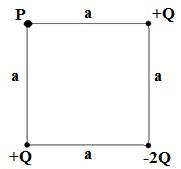
Given the configuration of three charges, $+Q, +Q$, and $-2Q$, which one of the following choices best represents the direction of the electric field at the point $P$ and the sign of the electric potential at $P$ from these charges?

figure
Field Direction at $\mathrm{P}$Sign of Electric Potential at $\mathrm{P}$
(A)$\searrow$Positive
(B)$\nwarrow$Positive
(C)$\searrow$Negative
(D)$\nwarrow$Negative
(E)ZeroZero
Show answer · 显示答案
Answer key
  • B

Worked solutions are in the books.

2017 · Q43Division 2Electricity

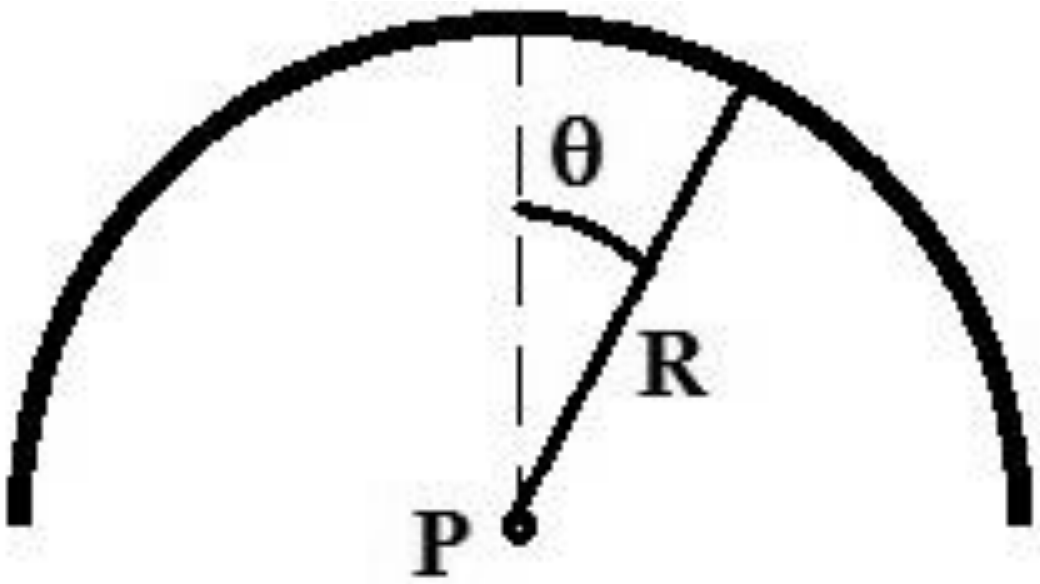
A semi-circle has radius $R$, total charge $Q$, and a charge per unit length given as $\lambda=\lambda_{0}\cos\theta$ with $\theta$ defined in the figure and $\lambda_{0}$ a positive constant. Which one of the following choices gives the electric field strength at the point labeled $P$?

figure

(A) 0
(B) $\displaystyle \frac{2k_{e}\lambda_{0}}{R^{2}}$
(C) $\frac{k_{e}Q\lambda_{0}}{R}$
(D) $\frac{2k_{e}Q\lambda_{0}}{\pi R^{2}}$
(E) $\frac{k_{e}\lambda_{0}\pi}{2R}$

Show answer · 显示答案
Answer key
  • E

Worked solutions are in the books.

2017 · Q46Division 2Electricity

Two copper spheres, $X$ and $Y$, with different radii $(R_{X}>R_{\mathrm{y}})$ and equal excess charge $+Q$, are placed apart from each other. A scientist using insulating gloves connects the spheres with a copper wire. Which one of the following choices best describes what happens after the connection is made?

(A) There is a net movement of electrons from sphere $Y$ to sphere $X$ until the electric field just outside the surface of each sphere has the same magnitude.

(B) There is a net movement of electrons from sphere $Y$ to sphere $X$ until the electric potential just outside the surface of each sphere has the same magnitude.

(C) There is a net movement of electrons from sphere $X$ to sphere $Y$ until the electric field just outside the surface of each sphere has the same magnitude.

(D) There is a net movement of electrons from sphere $X$ to sphere $Y$ until the electric potential just outside the surface of each sphere has the same magnitude.

(E) There is no net movement of electrons from one sphere to the other because the spheres already have equal charge.

Show answer · 显示答案
Answer key
  • D

Worked solutions are in the books.

2018 · Q2Division 1Electricity

A standard metal electroscope is positively charged. A person that is grounded (neutral charge) then touches the top portion of the electroscope with their finger. Which one of the following choices most correctly explains what happens when the finger touches the electroscope?

(A) The leaves of the electroscope come back together because excess protons conduct to the finger from the electroscope.

(B) The leaves of the electroscope come back together because electrons conduct to the electroscope from the finger.

(C) The leaves remain where they are as nothing occurs.

(D) The leaves of the electroscope move apart as electrons conduct from the electroscope to the finger.

(E) The leaves of the electroscope move apart as protons conduct from the finger to the electroscope.

Show answer · 显示答案
Answer key
  • B

Worked solutions are in the books.

2018 · Q32Division 1Division 2Electricity

For a negative point charge, the electric field vectors:

(A) circle the charge

(B) point radially in toward the charge

(C) point radially away from the charge

(D) pass directly through the charge

(E) cross at infinity

Show answer · 显示答案
Answer key
  • B

Worked solutions are in the books.

2019 · Q3Division 1Electricity

An isolated solid metal sphere with a radius $R$ is given a positive charge $Q$. The electric potential at the surface of the sphere is $V$. What is the electric potential at a distance of 0. $5R$ from the center of the sphere?

(A) zero
(B) 0.5 V
(C) V
(D) 2 V
(E) 4 V

Show answer · 显示答案
Answer key
  • C

Worked solutions are in the books.

2021 · Q15Division 1Division 2Electricity

In the Millikan oil-drop experiment the UPWARD force on a stationary oil drop is due to the:
(A) gravitational and electric fields
(B) gravitational field and the charge on the drop
(C) electric field only
(D) electric field and the charge on the drop
(E) charge on the drop only

Show answer · 显示答案
Answer key
  • D

Worked solutions are in the books.

2021 · Q21Division 1Division 2Electricity

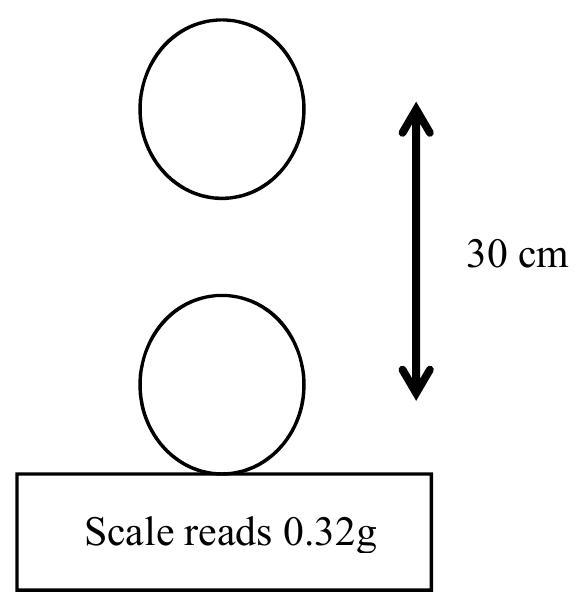
Two balloons are charged identically and uniformly by rubbing them with wool. One is placed on a scale which is then tared. No charge is transferred to the scale. The other is then placed above it separated by 30 cm . The scale reads 0.32 grams. What is the closest estimate for the charge on each balloon?

figure

(A) 200 C
(B) 200 mC
(C) 200 $\mu \mathrm{C}$
(D) 200 nC
(E) 200 pC

Show answer · 显示答案
Answer key
  • D

Worked solutions are in the books.

2021 · Q48Division 2Electricity

Two identical metal spheres are hung from a common point by $30-\mathrm{cm}$ long, nonconducting threads of negligible mass. The spheres each have a mass of 0.20 g and are given identical charges. It is found that due to the electrostatic repulsion force, the angle between the threads is $20^{\circ}$. How much charge was placed on each sphere?
(A) 11 nC
(B) 16 nC
(C) 21 nC
(D) 26 nC
(E) 31 nC

Show answer · 显示答案
Answer key
  • C

Worked solutions are in the books.

2022 · Q23Division 1Division 2Electricity

The distance between the electron and the proton in the hydrogen atom is about $0.53 \times 10^{-10} \mathrm{~m}$. By what factor is the electrical force between the electron and proton stronger than the gravitational force between them?
(A) $1.3 \times 10^{39}$
(B) $2.3 \times 10^{39}$
(C) $3.3 \times 10^{39}$
(D) $4.3 \times 10^{39}$
(E) $5.3 \times 10^{39}$

Show answer · 显示答案
Answer key
  • B

Worked solutions are in the books.

2022 · Q34Division 1Division 2Electricity

A tiny ball with a mass of 0.6 g carries a charge of magnitude $8 \mu \mathrm{C}$. It is suspended by a thread in a downward directed electric field of intensity $300 \mathrm{~N} / \mathrm{C}$. What is the tension in the thread if the charge on the ball is positive?
(A) $2.40 \times 10^{-3} \mathrm{~N}$
(B) $6.00 \times 10^{-3} \mathrm{~N}$
(C) $8.40 \times 10^{-3} \mathrm{~N}$
(D) $6.00 \times 10^{-2} \mathrm{~N}$
(E) $6.24 \times 10^{-3} \mathrm{~N}$

Show answer · 显示答案
Answer key
  • C

Worked solutions are in the books.

2022 · Q46Division 2Electricity

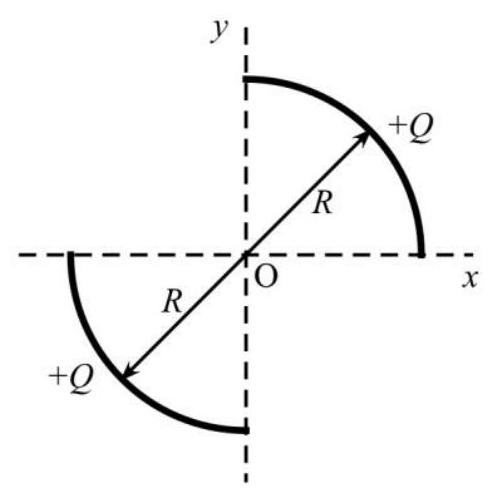
Each of the two curved rods shown in the picture form onequarter of a circle with a radius $R$. Both rods carry a uniformlydistributed electric charge $+Q$. Which of the following choices correctly expresses the net electric field and net electric potential at the origin? Assume $\mathrm{V} \rightarrow 0$ as $\mathrm{r} \rightarrow \infty$.

figure
Electric FieldElectric Potential
(A) zerozero
(B) zero$\frac{2 k Q}{R}$
(C) $\frac{2 k Q}{R^2}$zero
(D) $\frac{\sqrt{2 k Q}}{R^2}$$\frac{2 k Q}{R}$
(E) $\frac{2 k Q}{R^2}$$\frac{2 k Q}{R}$
Show answer · 显示答案
Answer key
  • B

Worked solutions are in the books.

2023 · Q25Division 1Division 2Electricity

A spark is produced between two insulated surfaces, maintained at a constant potential difference of $5.0 \mathrm{X} 10^{6} \mathrm{~V}$. The energy output is $10^{-5} \mathrm{~J}$. How many electrons have been transferred in the spark?
(A) $1.25 \times 10^{7}$
(B) $1.20 \times 10^{7}$
(C) $1.35 \times 10^{7}$
(D) $1.25 \times 10^{6}$
(E) $1.25 \times 10^{8}$

Show answer · 显示答案
Answer key
  • A

Worked solutions are in the books.

2023 · Q40Division 1Division 2Electricity

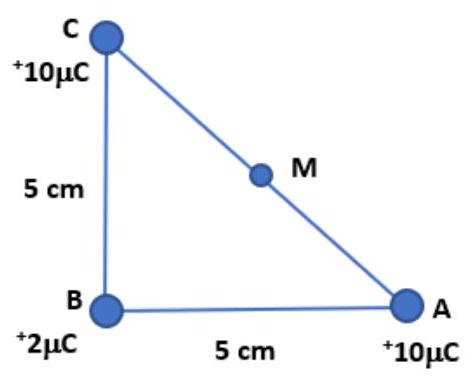
Three charges are located at the vertices of a right triangle as shown at right. What is the magnitude of the resultant electric field at the midpoint, $M$, on a line between $A$ and $C$ ?

figure

(A) $1.44 \times 10^{7} \mathrm{~N} / \mathrm{C}$
(B) $1.84 \times 10^{7} \mathrm{~N} / \mathrm{C}$
(C) $1.14 \times 10^{7} \mathrm{~N} / \mathrm{C}$
(D) $2.64 \times 10^{7} \mathrm{~N} / \mathrm{C}$
(E) $1.04 \times 10^{7} \mathrm{~N} / \mathrm{C}$

Show answer · 显示答案
Answer key
  • A

Worked solutions are in the books.

2024 · Q32Division 1Division 2Electricity

It is determined that a 500 mF capacitor loses half its remaining charge every second. If, after 5.0 s, its charge is $q$, what was its initial charge?
(A) $2 q$
(B) $4 q$
(C) $8 q$
(D) $16 q$
(E) $32 q$

Show answer · 显示答案
Answer key
  • E

Worked solutions are in the books.

2024 · Q40Division 1Division 2Electricity

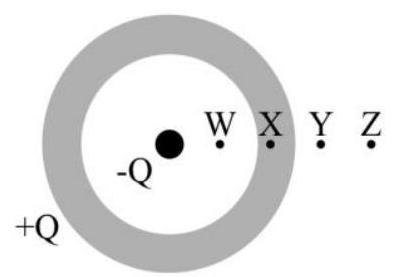
A metal spherical shell with a charge $+Q$ surrounds a point charge with a charge $-Q$. Which of the following correctly ranks the electric potentials at the lettered points (W, X, Y and Z). Assume $V \rightarrow 0$ as $r \rightarrow \infty$.

figure

(A) $V_{W}<V_{X}<V_{Y}<V_{Z}$
(B) $V_{W}=V_{X}<V_{Y}=V_{Z}$
(C) $V_{W}<V_{X}<V_{Z}<V_{Y}$
(D) $V_{Z}<V_{W}=V_{Y}<V_{X}$
(E) $V_{W}<V_{X}=V_{Y}=V_{Z}$

Show answer · 显示答案
Answer key
  • E

Worked solutions are in the books.

2024 · Q48Division 2Electricity

A drop of liquid is spherical and has a diameter of 2.0 mm. It is given a charge of $2.0 \times 10^{-15} \mathrm{C}$. This charged drop then combines with an identical uncharged drop and the two form one single drop. What is the electric potential at the surface of newly formed drop?
(A) 0.0143 V
(B) 0.0244 V
(C) 0.0286 V
(D) 0.0418
(E) 0.0506 V

Show answer · 显示答案
Answer key
  • A

Worked solutions are in the books.

2025 · Q38Division 1Division 2Electricity

Which of the following statements about the electric field inside a charged conductor at electrostatic equilibrium is true?
(A) The strength increases uniformly with the distance from the center of the conductor.
(B) The strength decreases uniformly with the distance from the center of the conductor.
(C) The strength is a uniform, non-zero value everywhere.
(D) The strength is zero everywhere.
(E) The strength varies randomly from point to point.

Show answer · 显示答案
Answer key
  • D

Worked solutions are in the books.

2025 · Q39Division 1Division 2Electricity

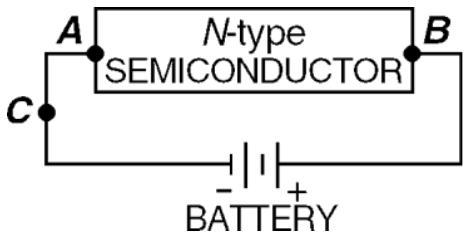
The diagram shown on the right represents an $N$-type silicon semiconductor connected to a battery. A very small amount of antimony, which has five valence electrons, had previously been added to the silicon crystal. This process produced
(A) an excess of free protons.
(B) an excess of free electrons.
(C) more resistance.
(D) less resistance.
(E) a higher emf.

figure
Show answer · 显示答案
Answer key
  • B

Worked solutions are in the books.

2025 · Q46Division 2Electricity

Two resistors are connected in parallel to an ideal voltage source using wires of negligible resistance. Resistor $B$ produces thermal energy at four times the rate of resistor $A$. Which of the following could account for this difference?
(A) Resistor $B$ has one-fourth the resistance of resistor $A$.
(B) Resistor $B$ has one-half the resistance of resistor $A$.
(C) Resistor $B$ has twice the resistance of resistor $A$.
(D) Resistor $B$ has four times the resistance of resistor $A$.
(E) Resistor $B$ has twice the potential difference of resistor $A$.

Show answer · 显示答案
Answer key
  • A

Worked solutions are in the books.

2025 · Q49Division 2Electricity

Point charges $+q$ and $-q$ are fixed in place on the $x$-axis at $x=+d$ and $x=-d$, respectively. At $x=0$, their net electric field _____ and their total electric potential _____ .

Net electric fieldTotal electric potential
a.is zerois zero
b.points in the positive $x$-directionis positive
c.points in the negative $x$-directionis negative
d.points in the positive $x$-directionis zero
e.points in the negative $x$-directionis zero
Show answer · 显示答案
Answer key
  • E

Worked solutions are in the books.