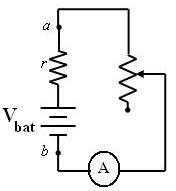
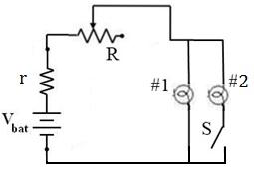
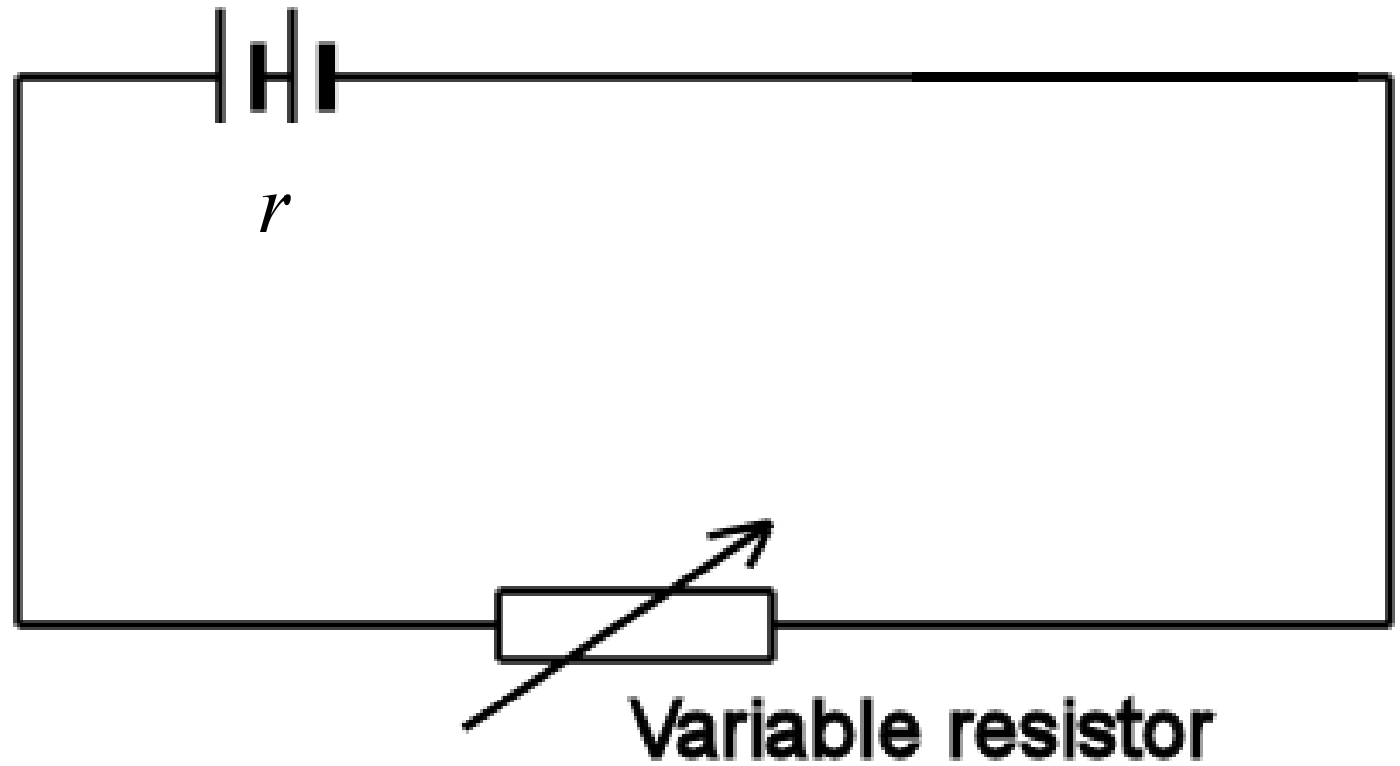
The circuit shown contains a battery (of emf $V_{bat}$) with an internal resistance $r$ connected to a rheostat (variable resistor). When the resistance of the rheostat is increased, which of the following statements is true?
(A) The terminal voltage $(V_{a}-V_{b})$ increases.
(B) The current through the ammeter in the circuit increases.
(C) The power associated with the internal resistance increases.
(D) The potential difference across the rheostat decreases.
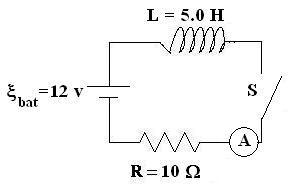
For the ideal RL circuit shown, the resistance is $ R=10.0\Omega$, the inductance is $L=5.0H$ and the battery has voltage $\xi_{bat}=12$ volts.
Some time after the switch $S$ in the circuit is closed, the ammeter in the circuit reads 0.40 $A$. At what rate is energy being stored by the inductor at this instant (in Watts)? $\mathrm{R}=10\Omega$
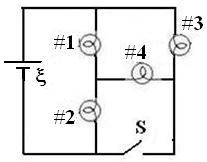
For the circuit shown, the four light bulbs have identical resistance, all wires have zero resistance, and the battery is assumed to be ideal with emf $\xi$. When the switch, $\mathrm{S}$, in the circuit is closed, a wire of zero resistance is added into the circuit. Which of the light bulbs will be dimmer after the switch is closed?
A parallel-plate capacitor of capacitance $C$ has an insulating dielectric material of constant $\kappa$ filling the entire region between its plates. This capacitor now is connected to a battery of voltage $V$ and is fully charged before the battery is disconnected. The capacitor stores energy $U.$
Using insulating gloves, a person now removes the dielectric fr om the capacitor. after equilibrium is established following the removal of the dielectric, which one of the following choices best represents the energy stored by the capacitor in terms of $U$?
A constant current of 4.00 $A$ through a light bulb results in a power of 24.0 $W$ associated with the bulb. Which one of the following choices best represents the resistance of the light bulb?
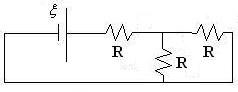
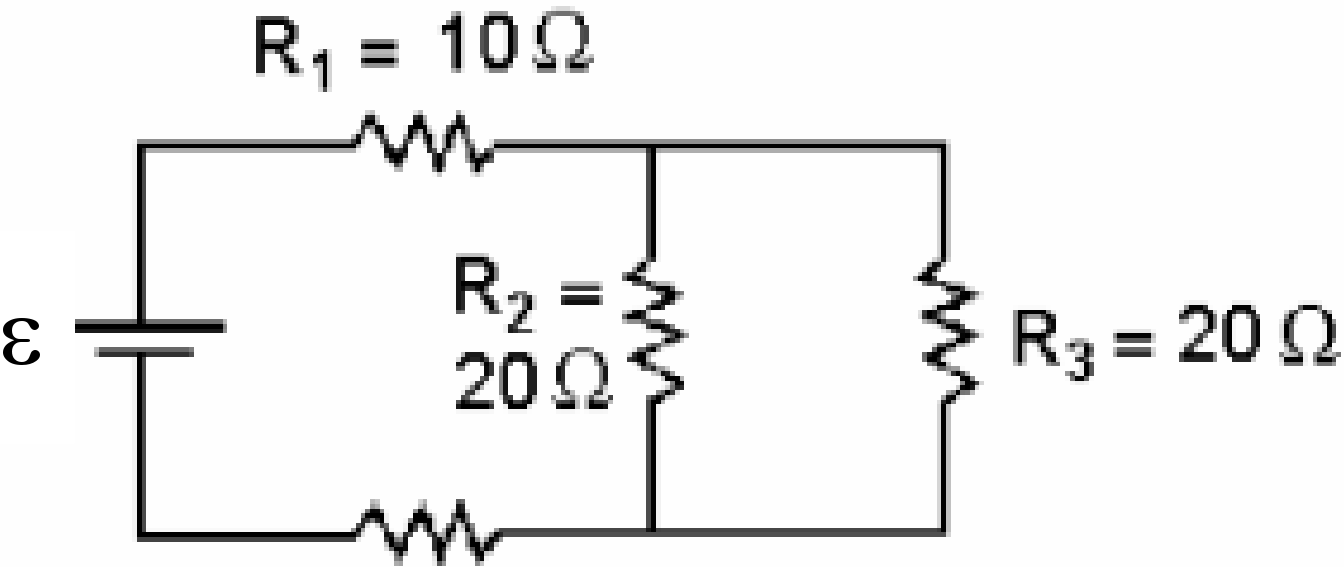
For the circuit shown to the right, what is the equivalent resistance? Assume that all wires are ideal, the battery has no internal resistance, and all three resistors have identical resistance $R.$
For the circuit shown, all wires have no resistance, the battery has a constant internal resistance of $r=8\Omega$ and the two light bulbs ($\ 1$ and $\ 2$) are identical, each with resistance $R_{bulb}$. The variable resistor is initially set to $R=26\Omega$. The switch in the circuit now is closed. To what resistance must the variable resistor be set if bulb $\ 1$ is to have the same brightness after the switch is closed as it did with the switch open?
(A) 9.0 $\Omega$
(B) 13.0 $\Omega$
(C) 16.0 $\Omega$
(D) 22.0 $\Omega$
(E) The answer can be computed only if the bulbs' resistance $R_{bulb}$ is known.
In a circuit, the flow of electrons in a horizontal wire produces a constant current of 3.20 $A$ for a time of 3.0 $hr$. Which one of the following choices best represents the number of electrons that pass through a vertical cross-section of the wire during this time?
Four resistors, each of resistance $R$, are connected to a battery in the following way: “Two resistors are connected in series. This combination of two resistors is connected in parallel to a third resistor. This set of three resistors is connected in series to a fourth resistor." What is the equivalent resistance of this arrangement of four resistors?
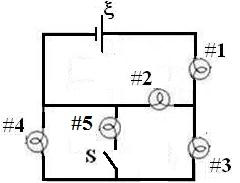
Five identical light bulbs are connected into a circuit as shown. All wires are ideal with no resistance, and the ideal battery has emf $\xi.$ When the switch $\mathrm{S}$ in the circuit is closed, aside from bulb 5, which of the other bulbs brighten?
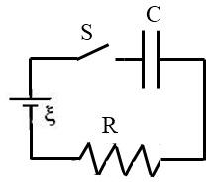
The switch $S$ in the RC circuit shown is closed at time $t=0$. All circuit elements are ideal and $R=10.0\Omega, C=2.20F$ and $\xi=12.0V.$ The capacitor is initially uncharged. How long after the switch is closed is the voltage across the capacitor three times as large as the voltage across the resistor?
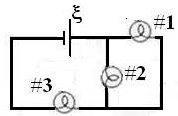
For the circuit shown, all three light bulbs have the same resistance. The battery and wires have no resistance. What is the proper ranking of the bulbs' brightness?
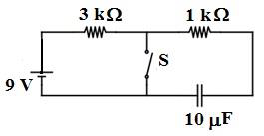
In the circuit shown, the switch $S$ has been left open for a very long time. All circuits elements are considered to be ideal. Which one of the following statements best describes the behavior of the current through the switch $S$ once it is closed?
(A) The current initially is 12 $mA$ and decreases to a steady 3 $mA.$
(B) The current initially is 3 $mA$ and increases to a steady 12 $mA.$
(C) The current initially is 9 $mA$ and decreases to a steady 3 $mA.$
(D) The current initially is 6 $mA$ and decreases to a steady 3 $mA.$
An air-filled parallel-plate capacitor of capacitance $C$ is fully charged after being connected to a battery of voltage $V$. The battery then is disconnected and an insulating dielectric slab of constant $\kappa$ is inserted between the capacitor's plates, fully filling the region. What is the voltage between the plates once equilibrium is established with the dielectric in place?
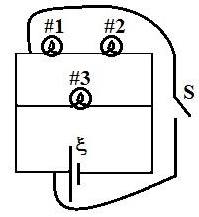
For the circuit shown, the three light bulbs have identical resistance $R$, the battery is ideal, and all wires have no resistance. Which one of the
following choices correctly identifies the light bulbs that either become dimmer or go out completely when the switch, $\mathrm{S}$, in the circuit is closed?
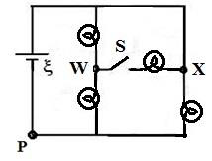
For the circuit shown, the four light bulbs have identical resistance, the battery is ideal and all wires have no resistance. After the switch, $\mathrm{S}$, in the circuit is closed, which one of the following choices correctly describes what happens to the magnitude of the current at the point labeled $\mathrm{P}$ and to the magnitude of the potential difference from $\mathrm{W}$ to $\mathrm{X}$?
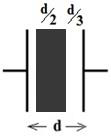
A 6.00 $\mu F$ parallel-plate capacitor is disconnected fr om a 12 volt battery after being fully charged. A person now carefully inserts a dielectric material of constant $\kappa=2$ so that it fills one-half of the space between the plates as shown. How much work was done by the person while inserting the dielectric?
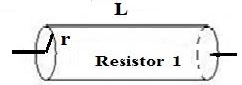
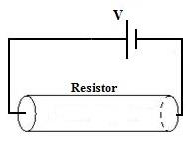
In the circuit shown, an electric current exists in the metal resistor connected to the battery. Which one of the following choices best describes the direction of electron flow through the resistor and the direction of the electric field through the interior of the resistor?
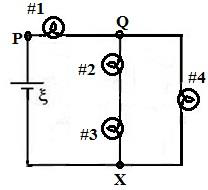
The circuit shown has 4 identical light bulbs connected to an ideal battery. If bulb 2 were removed leaving an open circuit there, what happens to the voltage across both bulb 1 and from $\mathrm{Q}$ to X?
Two lightbulbs (X and $Y$) are connected in series to a battery. Bulb $X$ is brighter than bulb $Y.$ Assume all circuit elements are ideal. If bulbs $X$ and $Y$ are connected in parallel with each other to the same battery, which one of the following choices best represents what is observed?
The circuit shown contains a battery with an internal resistance, $r$ connected to a variable resistor. When the resistance of the variable resistor is increased, which of the following statements is true?
(A) The terminal voltage increases.
(B) The current through the variable resistor in the circuit increases.
(C) The power dissipated by the internal resistance increases.
(D) The potential difference across the variable resistor decreases.
In a circuit, the flow of electrons in a horizontal wire produces a constant current of 3.20 A for a time of 3.0 hours. Which of the following choices best represents the number of electrons that pass through a vertical cross-section of wire during this time?
A series RC circuit has a resistance of 2.00 $\Omega$ and a capacitance of 0.010 $F$. A student plots the natural $\log$ of the current in the circuit as a function of time while the capacitor is charging. Which one of the following choices best represents the numerical value associated with the slope of the resulting line?
Standby power (sometimes called vampire power) is the power used by a device that is off but plugged in and in a standby mode. Regulations typically limit this power to 1 Watt. If electricity costs \$} 0.10 per kilowatt hour, then to the nearest order of magnitude, and assuming 1 Watt, how much does it cost to leave a device in standby mode for one year?
(A) {\$ 0.01
(B) \$} 0.10 \\
(C) {\$ 1.00
(D) \$} 10.00 \\
(E) {\$ 100.00
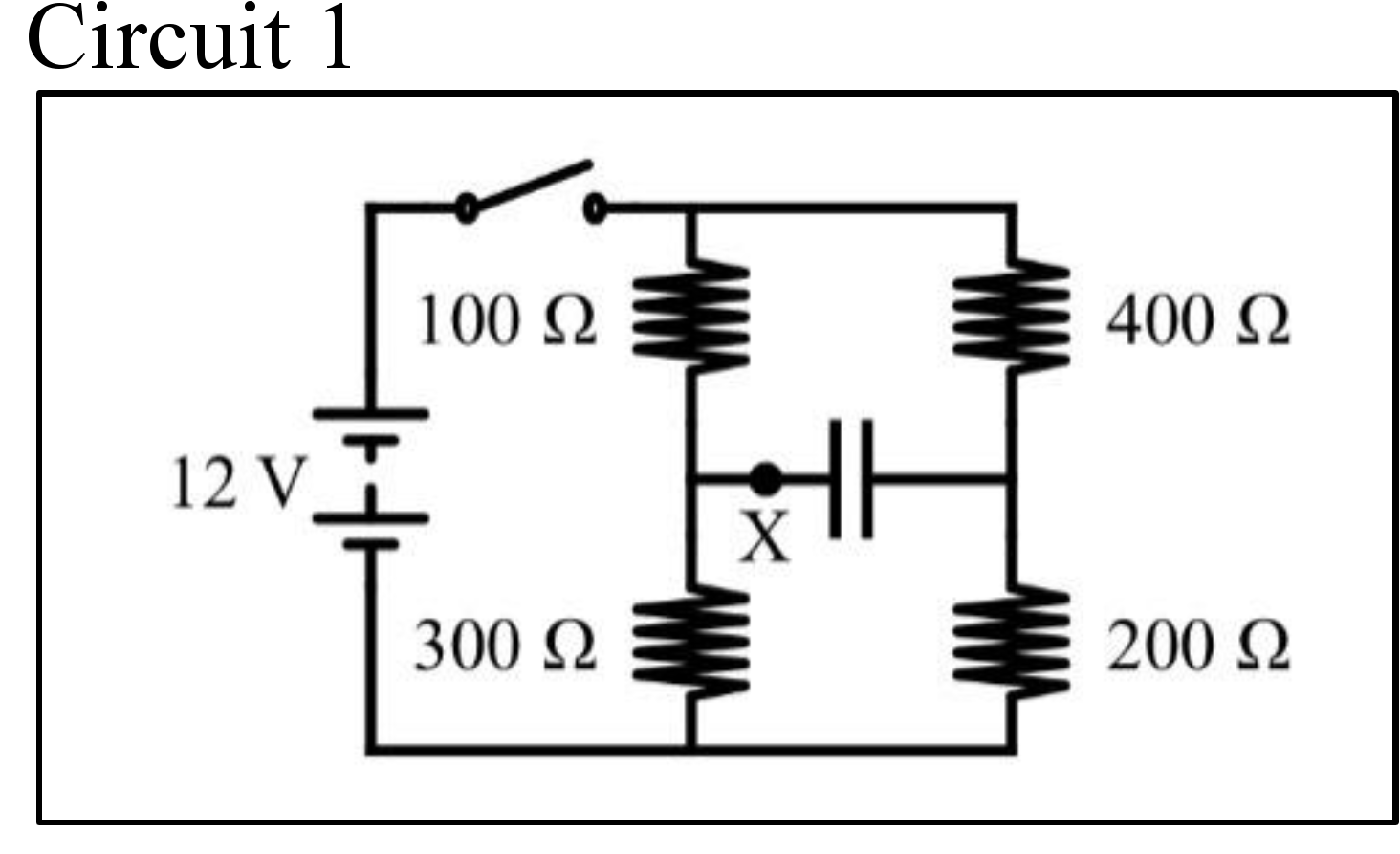
If the capacitor has a capacitance of 15 $\mu \mathrm{F}$ and is uncharged prior to closing the switch, what is the steady-state charge on the capacitor?
When two identical resistors are connected in series to an ideal voltage source, the current supplied by the source is 2.0 Amperes. When these two resistors are connected in parallel to the same ideal voltage source, what is the current supplied by the source?
You are given three 6 -ohm resistors. Neglecting the resistance of any connecting wires, which of the following resistances CANNOT be made using one or more of these resistors?
(A) 2 ohms
(B) 3 ohms
(C) 9 ohms
(D) 12 ohms
(E) 15 ohms
You are given three identical resistors, each of resistance $R$. Each resistor can sustain a maximum power of $P$. Two of the resistors are connected in series, and a third is connected in parallel with these two. What is the maximum power this network can sustain?
(A) $\frac{2 P}{3}$
(B) $\frac{3 P}{2}$
(C) $2 P$
(D) $3 P$
(E) $6 P$
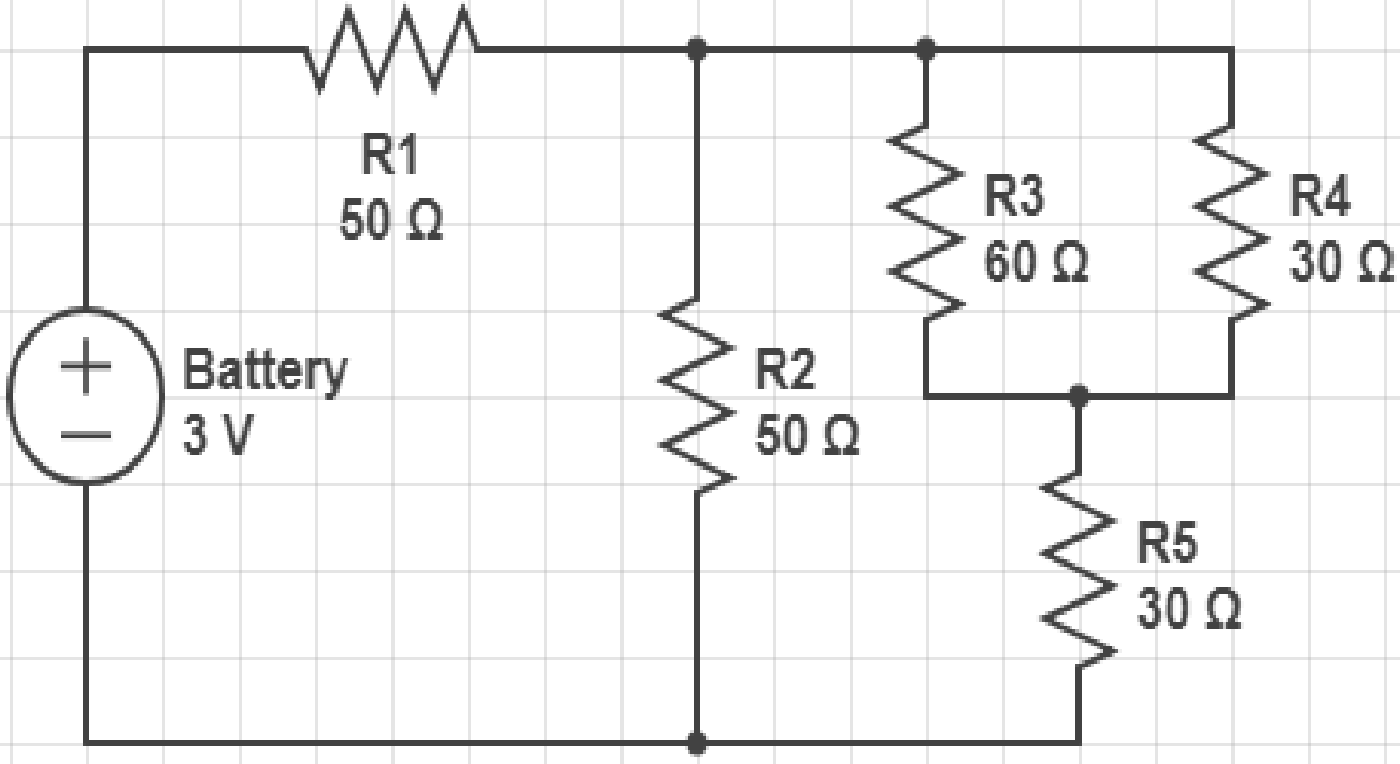
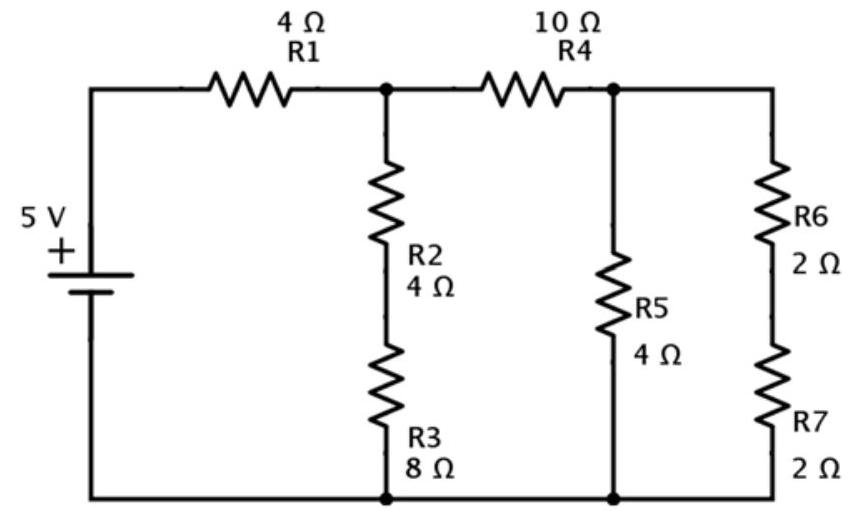
43. What is the voltage drop across $\mathrm{R}_{5}$ ?
(A) 0.250 V
(B) 0.500 V
(C) 1.00 V
(D) 2.00 V
(E) 3.00 V
44. What is the current in $\mathrm{R}_{3}$ ?
(A) 0.125 A
(B) 0.250 A
(C) 0.500 A
(D) 0.750 A
(E) 1.00 A
In an ideal LC circuit, what is the time difference between all of the energy in the circuit being stored in the inductor and all of the energy being stored in the capacitor?
(A) No time difference
(B) One-eighth of a period of oscillation
(C) One-quarter of a period of oscillation
(D) One-half of a period of oscillation
(E) After one full period of oscillation has passed
If a copper wire is stretched to make it $0.1 \%$ longer, what is the percentage change in its resistance?
(A) $0.01 \%$
(B) $0.1 \%$
(C) $0.2 \%$
(D) $0.4 \%$
(E) $0.5 \%$
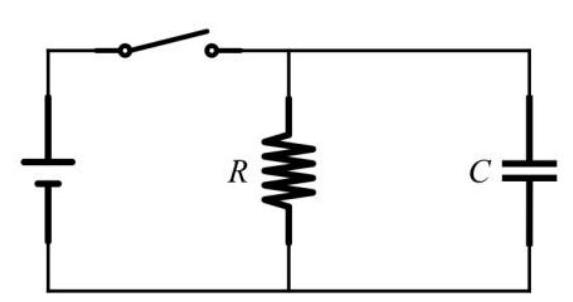
38. In the circuit shown below, the voltage source, switch, capacitor and connecting wires have no resistance. Let $\Delta \mathrm{V}_{\mathrm{R}}$ and $\Delta \mathrm{V}_{\mathrm{C}}$ represent the potential differences across the resistor and the capacitor, respectively. The capacitor is initially uncharged. Which of the following choices correctly compares these potential differences immediately after the switch is closed and after the circuit has reached steady state.
Three resistors of $4 \Omega, 6 \Omega$, and $12 \Omega$ are connected in parallel. This parallel arrangement is then connected in series with a $1-\Omega$ and a $2-\Omega$ resistor. A potential difference of 120 V is applied across the ends of the circuit. What will be the potential drop across the part of the circuit connected in parallel?
(A) 12 V
(B) 48 V
(C) 24 V
(D) 36 V
(E) 72 V
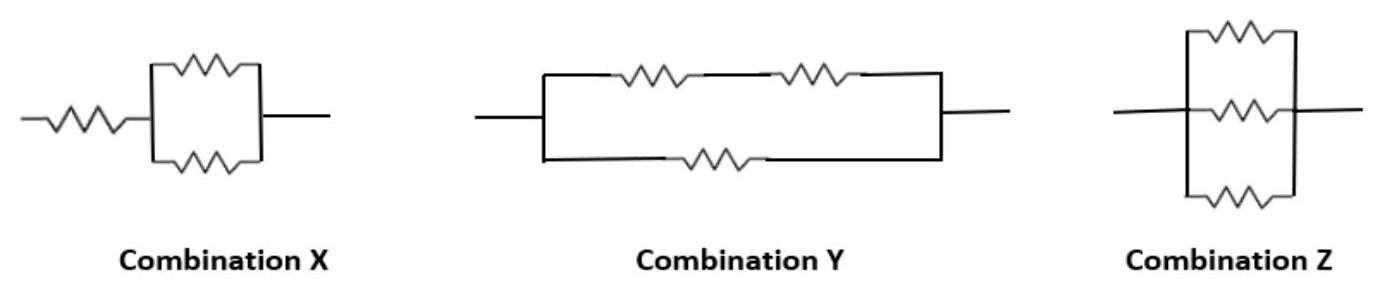
The diagram below shows combinations $\mathrm{X}$, $\mathrm{Y}$, and $\mathrm{Z}$ of three identical resistors. What is the correct order of the total resistance of the combinations going from lowest resistance to highest resistance?
(A) Y, X, Z
(B) Z, X, Y
(C) X, Y, Z
(D) Z, Y, X
(E) Y, Z, X
A high-voltage power transmission line is to supply power at 104 kW . The electricity travels through 30 km of cable that has a resistance $0.7 \frac{\Omega}{\mathrm{~km}}$. Find the rate of energy loss if the power is transmitted at 100 kV .
(A) $4.2 \%$
(B) $4.9 \%$
(C) $2.1 \%$
(D) $9.8 \%$
(E) $6.4 \%$
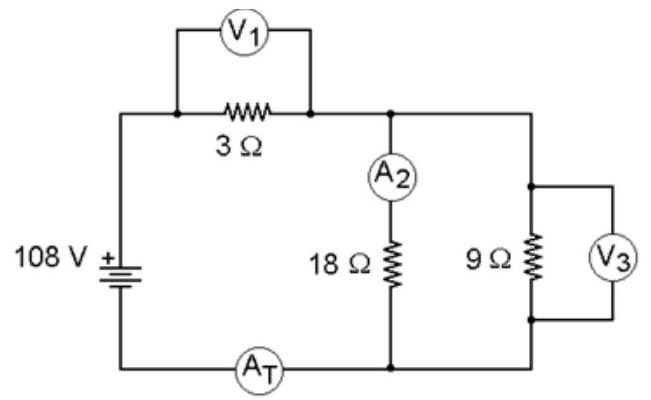
Before testing the circuit shown at right, and taking the current and voltage readings, a student is asked to predict what the meters will read at each location indicated. What will be the ammeter reading at $A_{2}$ ?
A circuit consists of a resistor, capacitor, and inductor connected in series to an AC source. As the source frequency increases, the current in the circuit decreases. Which statement about the circuit is NOT correct as the source frequency increases?
(A) The impedance of the circuit increases.
(B) The circuit is said to become more capacitive than inductive.
(C) The phase angle for the circuit becomes more positive.
(D) The inductive reactance increases.
(E) The total power from the source decreases
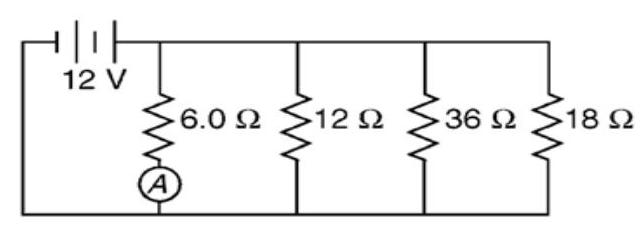
An electrical circuit is constructed with a battery and four resistors as shown in the diagram at the right. What is the current measured by the ammeter shown in the diagram?
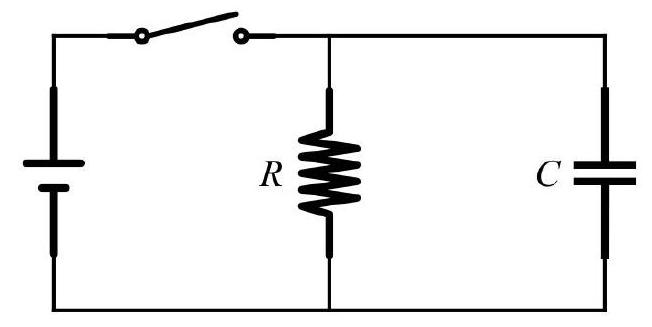
In the circuit shown, the voltage source, switch, capacitor and connecting wires have no resistance. The switch is closed until the circuit achieves steady state, at which point the switch is opened. Which of the following statements about the potential differences after the switch is opened is true.
(A) The potential differences across the resistor and capacitor instantly become zero.
(B) The potential differences across the resistor and capacitor are equal at all times.
(C) The potential difference across the resistor increases, while the potential difference across the capacitor decreases.
(D) The potential difference across the resistor instantly becomes zero, while the potential difference across the capacitor remains unchanged.
(E) The potential difference across the resistor remains unchanged, while the potential difference across the capacitor instantly becomes zero.