
ISEF 2026 Grand Award: Origami, Ladybirds, and Statistical Mechanics
2026 ISEF 终极大奖详细解析
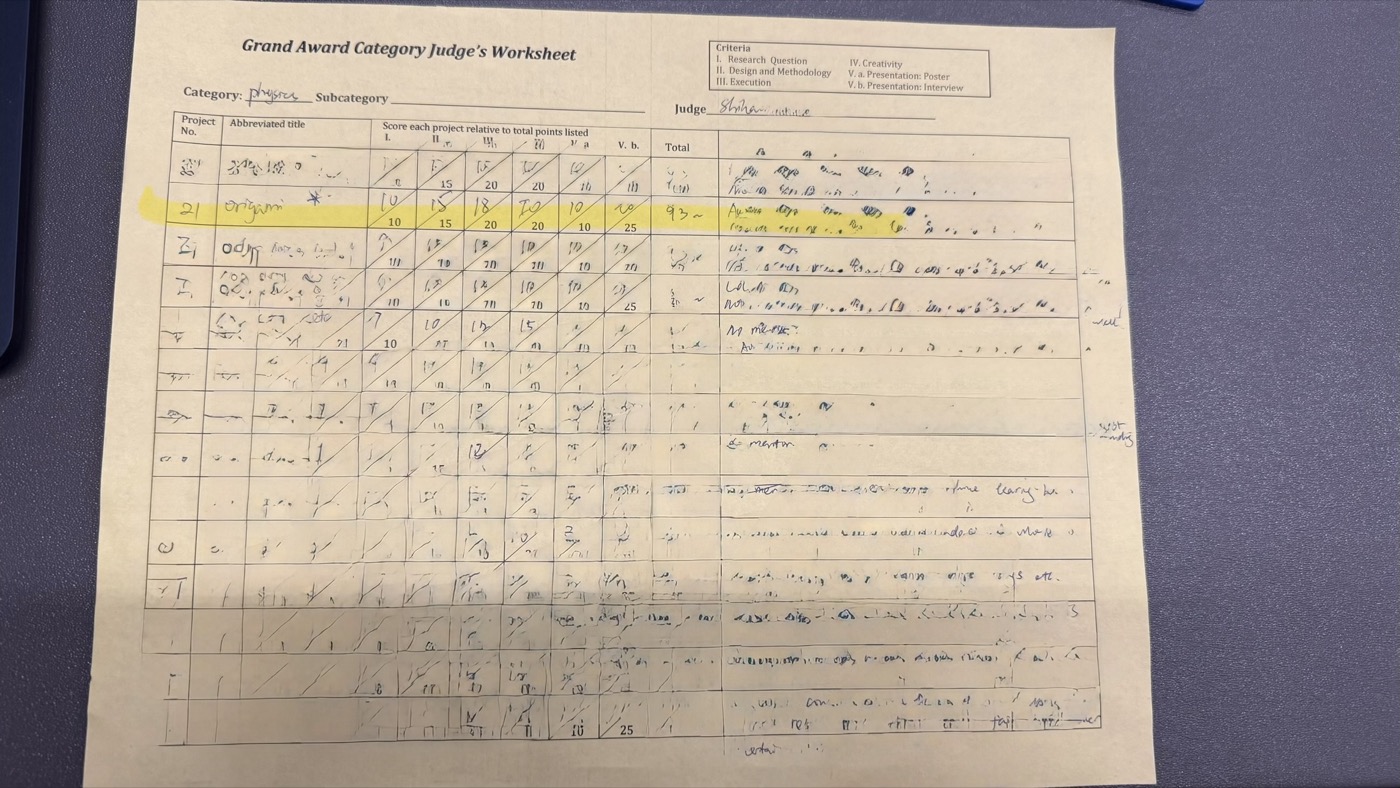
The Grand Award went to an origami-and-ladybird project. I was probably the first judge to interview it. Here is why I gave it the top score — and why the grand jury agreed.
I was likely the first judge to interview the Japanese project that eventually won the 2026 ISEF Grand Award. The session opened at 9:00 AM; by 9:15 I had found the Origami student and started talking. In my previous dispatch I compared the project to Son Heung-min at his peak. Having now seen the full results — I missed the award ceremony, went on a road trip up the California coast instead, and only learned the outcome when the physics chair sent an email saying the Grand Award had gone to our track — I think I underestimated it slightly.
I gave PHYS021 a clear tier-one score and privately named it the absolute physics first. This post exists for two audiences: students and parents aiming at ISEF, and anyone who has ever wrestled with the question of what makes a project genuinely good.
The project in one sentence
PHYS021 — “Sampling the Full Configuration Space of Origami and Linkage Mechanisms via Markov-Chain Monte Carlo”
Author: Hikaru Kuribayashi, Hokkaido Sapporo Kaisei High School, Japan
Supervisor: Prof. Synge Todo, Department of Physics, University of Tokyo
He took a question about how many ways a mechanism can move — a geometry problem — and rewrote it as a thermodynamics problem, then solved it with standard statistical-physics tools in one pass.
I. The problem: how many ways can a mechanism fold?
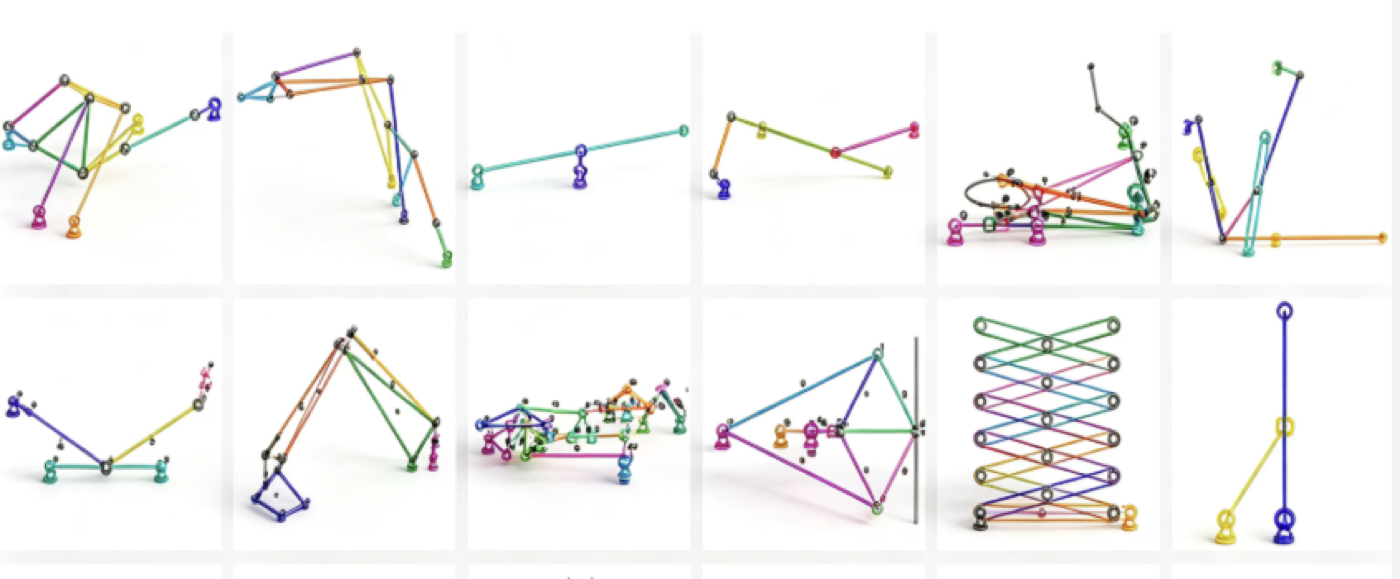
Origami and linkages look different but are the same thing underneath: rigid parts connected by hinges or fold lines, where moving one part forces the others. The question is: given a mechanism, how many distinct ways can it move?
Think of a folding umbrella — it has an "open" and a "closed" mode, with a continuous transition between them. Change the hinge angles and a third previously hidden mode might appear. For a spacecraft solar panel that needs to unfold in orbit, discovering that third mode only after launch is a serious problem.
The existing methods split into two camps. The kinematics approach translates every rigid bar and hinge into geometric constraint equations and walks the solution curve small step by step. At branch points it cannot decide which way to go. The mechanics approach defines a strain-energy function and rolls the system downhill to a minimum — but can only find the valley it started in; it cannot see over the ridge into the next basin. When different modes are separated by a gap in configuration space, continuous walking cannot cross it, and this has made complete mode enumeration effectively unsolvable for decades.
II. The key reframing — this is where the project is
Kuribayashi did not improve either existing method. He changed the language of the problem.
His observation: a mechanism at rest has all its edge lengths exactly at their design value — the rigid constraint is perfectly satisfied. During a mode transition the edges stretch very slightly. So:
Legal configurations are common; constraint violations are rare; the more severe the violation, the rarer.
This is the Boltzmann distribution. A system's probability of being in a given state is proportional to exp(−E/kT), where E is energy: low-energy states are common, high-energy states exponentially rare.
He defined a "pseudo-energy":
E(x) = Σ wij ( ‖xi − xj‖ − ℓij )2
The sum of squared deviations from each edge's design length. When the mechanism is perfectly rigid, E = 0. The more it deforms, the higher E rises. A geometry problem has become a thermodynamics problem. The configuration space is no longer a map of "valid / invalid" states but a continuous probability landscape: peaks near rigid configurations, exponential decay as you move away.
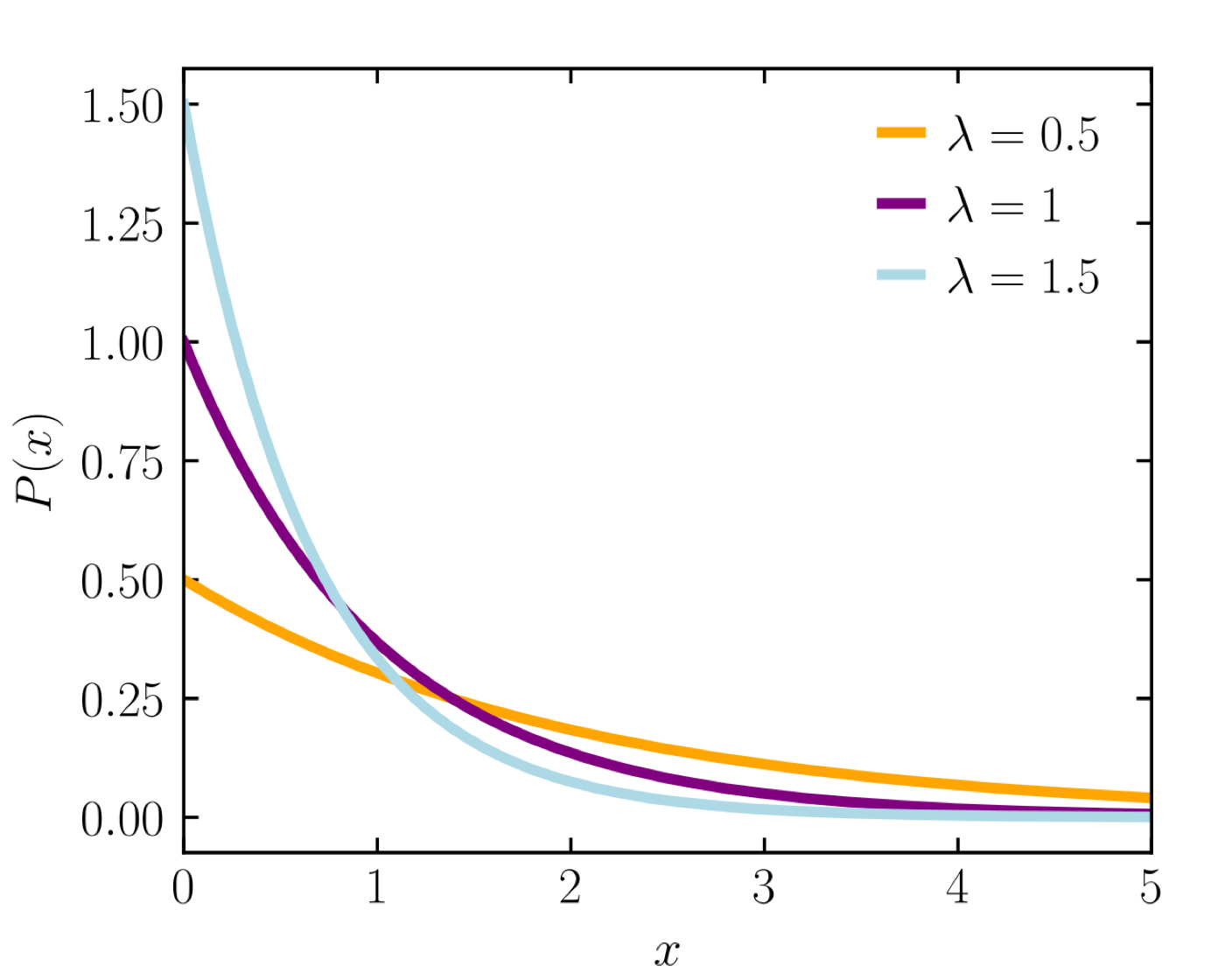
With the problem recast, the full toolkit of statistical physics becomes available. He used Markov-Chain Monte Carlo (MCMC) with parallel tempering. Think of MCMC as a probability-weighted random walk: the walker lingers in high-probability regions and moves quickly through low-probability ones. Single-temperature MCMC still cannot cross the high-energy ridge between separated modes — the ridge is too tall. Parallel tempering runs N copies of the system at different temperatures simultaneously. High-temperature copies can cross ridges freely; low-temperature copies stay close to rigid configurations and measure them precisely. The copies swap identities periodically. High-temperature copies explore new basins; they then cool down and stay there. The topology of configuration space — how many modes, how they are separated — becomes an output, not an input.
III. Results: verify first, discover second
The most trustworthy structure in a research project is: reproduce a known result exactly, then make a new claim. Kuribayashi did this twice before claiming anything original.
Test 1 — Four-bar linkage. Classical textbook problem with four known analytic modes. His sampler converged to four probability clusters that matched the four known solution curves exactly, zero tuning parameters.
Test 2 — Single-vertex origami. Five known modes; the sampler reproduced all five. This proved the same framework works for both linkages and origami — a unification that is itself significant.
Test 3 — Ladybird hindwing crease pattern. Here is where genuinely new science appears. Ladybirds use a diamond crease pattern to fold their hindwings under the elytra. A 2017 PNAS paper conjectured a bistable mechanism — two stable states with a switchable transition — but could not prove it mechanically.
Kuribayashi's sampler mapped the configuration space of the ladybird crease pattern and found three clearly separated probability clusters: flat-open, folded-closed, and an intermediate transition state. The separation itself is direct evidence of bistability. He then explained the mechanism: the diamond crease pattern creates a negative degree-of-freedom (over-constrained geometry) that suppresses all intermediate slack configurations and forces the system into exactly two clean stable states; zigzag creases geometrically forbid the trivial flat fold. A wing-folding geometry that evolution has refined for hundreds of millions of years — explained by a seventeen-year-old with statistical physics.
IV. Why it won — the rubric read in full
| Dimension | Max | My score |
|---|---|---|
| Research Question | 10 | 10 |
| Design & Methodology | 15 | 15 |
| Execution | 18 | 20 |
| Creativity | 20 | 20 |
| Poster Presentation | 10 | 10 |
| Interview | 20 | 25 |
Research Question (10/10). The problem statement is clear, focused, and falsifiable: "how do we enumerate all motion modes of a mechanism without assuming how many there are or walking continuously between them?" Not a description of what was done; not a comparison question. An open question with no accepted answer.
Methodology (15/15). The most valuable methodological move is diagnosing why existing methods fail, then designing around the failure mechanism. "Continuous walking cannot cross disconnected basins" is the diagnosis; "make the space continuous via Boltzmann weighting, then sample stochastically" is the structural fix. Each link in the reasoning chain is tight.
Execution (18/20). The implementation stack is serious: Metropolis sampling, Hamiltonian Monte Carlo, parallel tempering, replica exchange, spectral clustering. Every component has to be correctly implemented and correctly interfaced. The two-point verification strategy (known system first, unknown system second) is textbook good science. Limitations are listed honestly: self-intersections not handled, contact not modelled. Two points deducted for a simulation explanation that wasn't fully clear in the interview — possibly a language issue.
Creativity (20/20). The decisive question is whether this project is an "application" — a mature method used on new data — or a "reframing" — a new declaration of what category of problem this actually is. ISEF top awards always go to reframing. Declaring that mechanism kinematics is secretly a statistical-physics sampling problem, not a differential-geometry optimisation problem, is exactly that. Once the category changes, an entire toolbox arrives for free.
Interview (20/25). The physical origami and linkage models on the table were the decisive element — the ability to point to a hand-held object and say "this is the object my equations are describing" is visible competence. Five points deducted: he had not considered the connection between the energy landscape topology and first- versus second-order phase transitions — a question a statistical physicist would naturally ask — and his Stat Mech foundations showed a small gap where his supervisor's deep expertise was probably doing some heavy lifting.
V. Why it beat the strong competitors
Originality vs execution. Most strong projects at ISEF are "expected excellent" — a mature method beautifully applied to real data. PHYS021 was "unexpected excellent" — a connection nobody had drawn. Competitions at this level always reward the latter.
Verifiability. A judge has fifteen minutes and cannot fully audit a result. PHYS021 has an impregnable defence: it reproduces known analytic solutions exactly, zero free parameters. Several data-heavy competitors carried a residual "can I really trust this?" uncertainty that PHYS021 completely lacked.
Student ownership. The supervisor is a world-class statistical mechanician — the Boltzmann mapping is the kind of thing that would come naturally to him. But the application targets — origami, linkages, ladybird wings — are demonstrably the student's own choices. The physical models on the table are silent proof of "I built this." By contrast, data-heavy projects often carry an unspoken uncertainty about whether the student or a postdoc drove the analysis.
Cross-disciplinary legibility. The Grand Award jury is multidisciplinary by design. A biologist sees the ladybird wing. A statistician sees Boltzmann sampling in a new domain. A mechanical engineer sees linkage mechanisms. The project speaks fluently in three languages, all of them foundational.
VI. The last sentence
"A kinematics problem is secretly a thermodynamics problem."
A seventeen-year-old at a high school in Hokkaido saw a connection that generations of mechanism engineers and statistical physicists, sitting in adjacent departments, had not thought to draw. That is what ISEF is supposed to be rewarding — seeing something others did not see, and doing it right, completely, and beautifully.