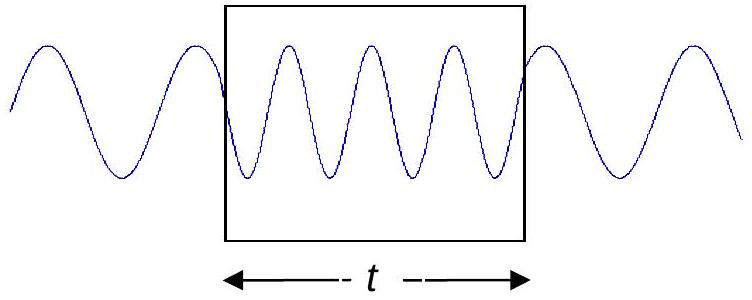
A thin rectangular block of glass, of thickness $t$, has a beam of light passing through it along a normal to a face, as shown in fig. 5. The light wave travels at a slower speed in glass than in air. The ratio of the extra number of waves introduced within the length $t$ when the glass is in place, to the number of waves within the same length $t$ in air, is given by
$$\lambda=\text { wavelength in air }$$
The refractive index, $n=\frac{\text { speed of light in air }}{\text { speed of light in glass }}$
A. $(n-1)$
B. $\frac{1}{(n+1)}$
C. $\frac{n}{(n+1)}$
D. $\frac{(n-1)}{n}$
Reveal answer
Show worked solution
We need to find the ratio of extra waves introduced in the glass to the number of waves in the same length of air.
Given:- Wavelength in air: $\lambda$
- Refractive index: $n = \frac{c_{air}}{c_{glass}}$
- Glass thickness: $t$
Step 1: Number of waves in air
In air, over length $t$, the number of wavelengths is: $$N_{air} = \frac{t}{\lambda}$$
Step 2: Wavelength in glassWhen light enters glass, its speed decreases: $c_{glass} = \frac{c_{air}}{n}$
Since frequency $f$ remains constant, the wavelength in glass is: $$\lambda_{glass} = \frac{c_{glass}}{f} = \frac{c_{air}}{nf} = \frac{\lambda}{n}$$
Step 3: Number of waves in glassIn glass, over the same length $t$, the number of wavelengths is: $$N_{glass} = \frac{t}{\lambda_{glass}} = \frac{t}{\lambda/n} = \frac{nt}{\lambda} = n \cdot N_{air}$$
Step 4: Extra waves introducedThe extra number of waves in glass compared to air is: $$\Delta N = N_{glass} - N_{air} = nN_{air} - N_{air} = (n-1)N_{air}$$
Step 5: Required ratioThe ratio of extra waves to the number of waves in air is: $$\text{Ratio} = \frac{\Delta N}{N_{air}} = \frac{(n-1)N_{air}}{N_{air}} = n-1$$
Therefore, the answer is A ($(n-1)$).