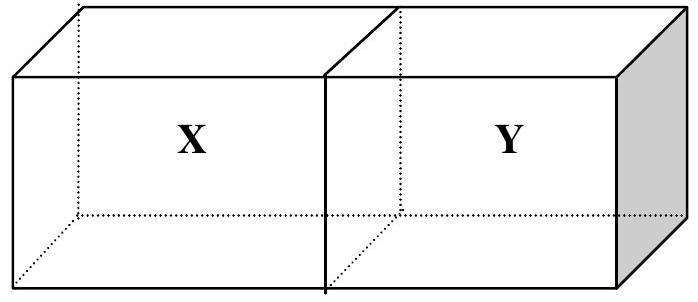
A two litre sealed container is filled with air at atmospheric pressure. It is connected to a vacuum pump which can pump air at a flow rate that is proportional to the difference in pressure within the container to the pressure outside. This tells us that the pressure drops exponentially with time. If it takes 20 seconds for the pressure in the container to halve, how long would it take to reduce the pressure in a five litre container from atmospheric pressure to $1 / 8^{\text {th }}$ of atmospheric pressure?
A. 48 s
B. 150 s
C. 200 s
D. 250 s
Reveal answer
Show worked solution
This problem involves exponential decay in a vacuum pump system.
Given: - 2L container: pressure halves in 20 seconds- 5L container: find time to reach 1/8 of atmospheric pressure
- Flow rate $\propto$ pressure difference (exponential decay)
Understanding exponential decay:
For a vacuum pump where flow rate $\propto$ pressure difference: $$\frac{dP}{dt} = -kP$$
This gives: $P(t) = P_0 e^{-t/\tau}$
Where $\tau$ is the time constant related to the pumping rate and container volume.
Relating time constant to volume:The time constant $\tau$ is proportional to volume: $$\tau \propto V$$
For 2L container:Half-life $T_{1/2} = 20$ s $$\tau_2 = \frac{T_{1/2}}{\ln 2} \approx \frac{20}{0.693} \approx 28.9 \text{ s}$$
For 5L container:$$\tau_5 = \tau_2 \times \frac{5}{2} = 28.9 \times 2.5 = 72.2 \text{ s}$$
Time to reach 1/8 pressure:$$\frac{P}{P_0} = \frac{1}{8} = \left(\frac{1}{2}\right)^3$$
This represents 3 half-lives.
$$T_{1/2}(5L) = \tau_5 \times \ln 2 = 72.2 \times 0.693 = 50 \text{ s}$$
Total time: $$t = 3 \times T_{1/2} = 3 \times 50 = 150 \text{ s}$$Answer: B (150 s)