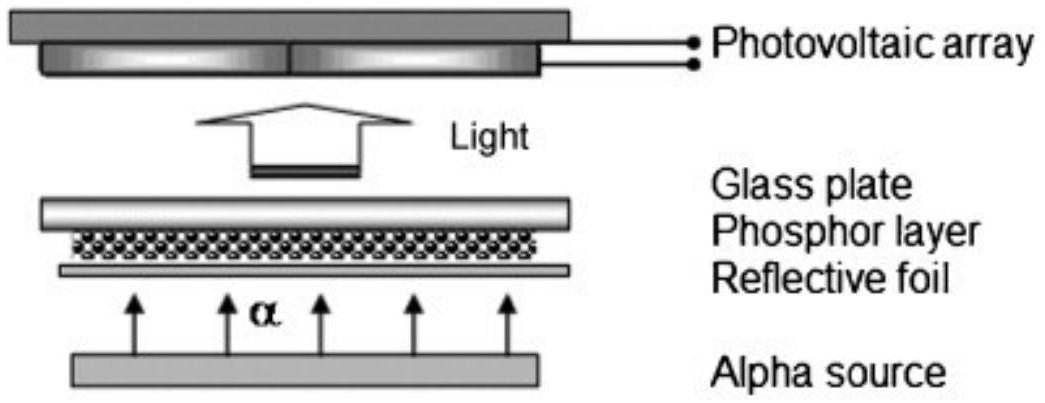
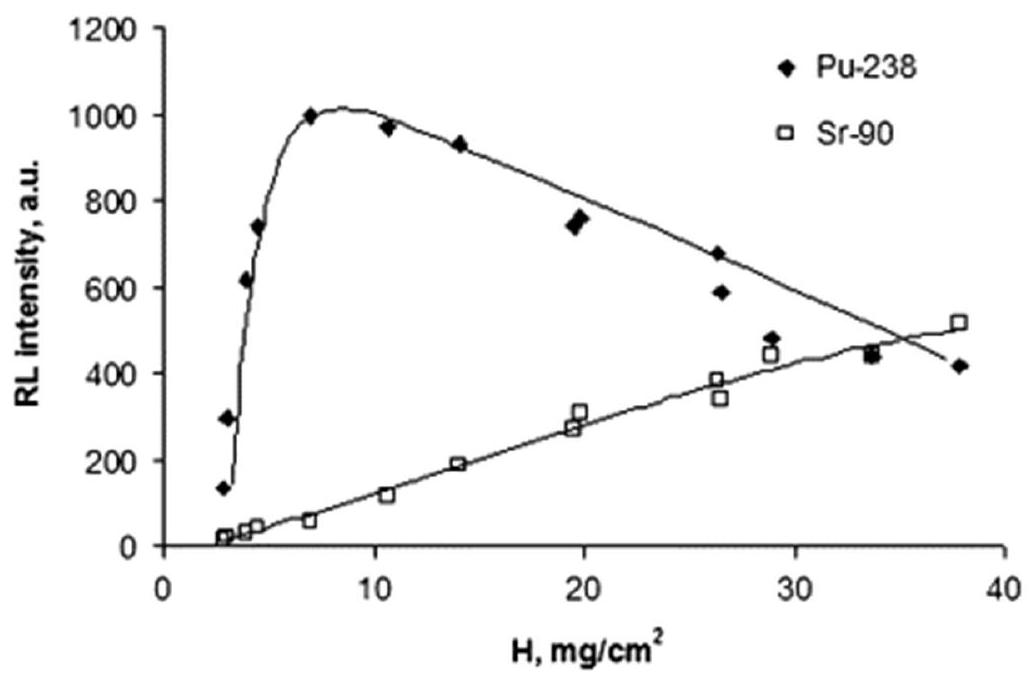
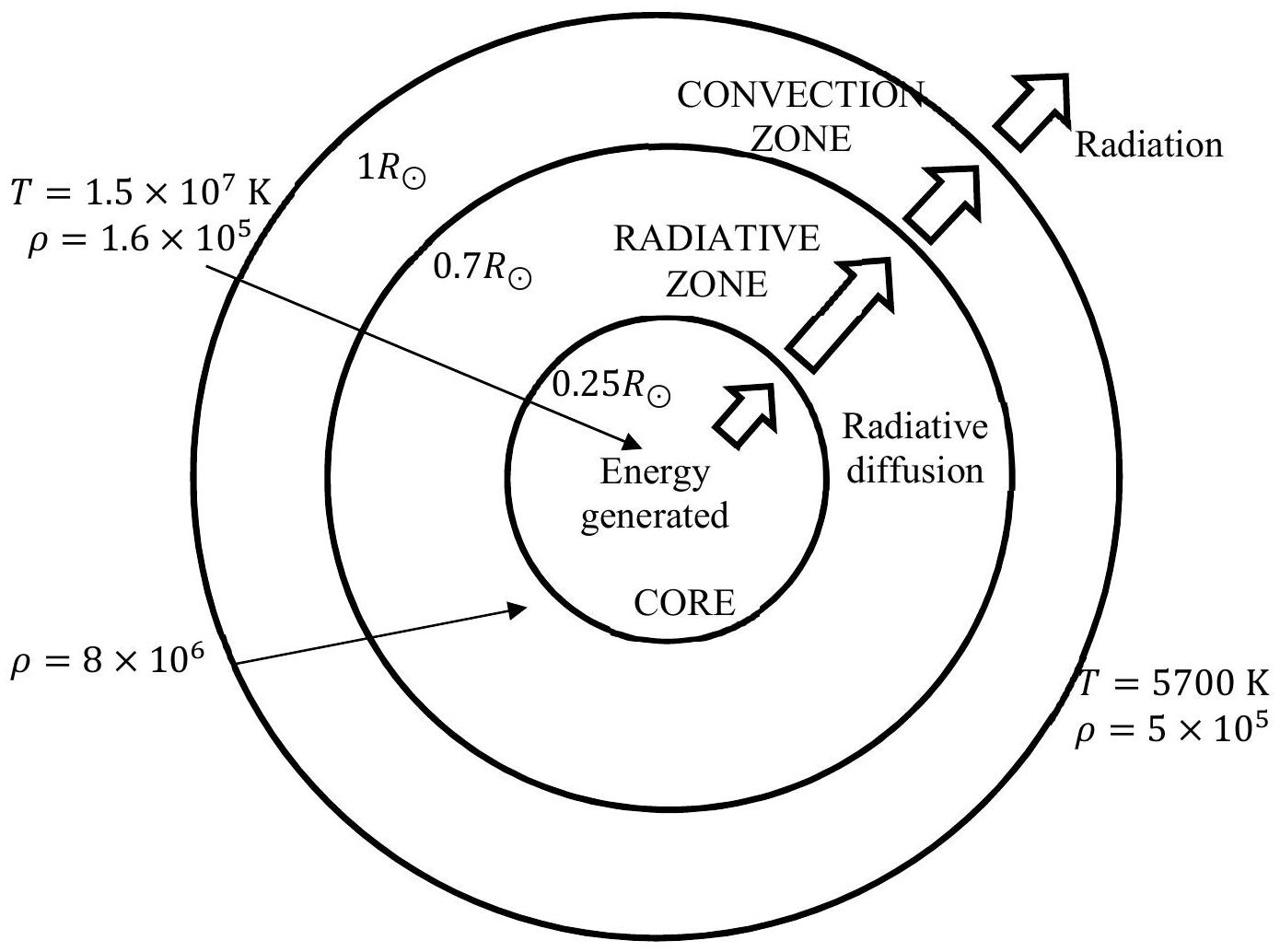
Interplanetary satellites are very complex platforms with dozens of scientific instruments, mechanical devices and radio transmitters and receivers on board. They require considerable power and operate over many years, and those travelling to the outer planets cannot use solar power. They rely instead on Radioisotope Thermal Generators (RTG), which produces heat by simple radioactive decay, and this heat is converted to electrical energy by heating one side of a semiconductor and cooling the other. There are no moving parts and the efficiency is low at typically $8 \%$, but the reliability is very high.
Rather than have one large mass of the most commonly used radioactive isotope, plutonium-238, many small pellets are used to generate the energy required to run the satellite's systems. One pellet is used to produce 5 W of electrical power.
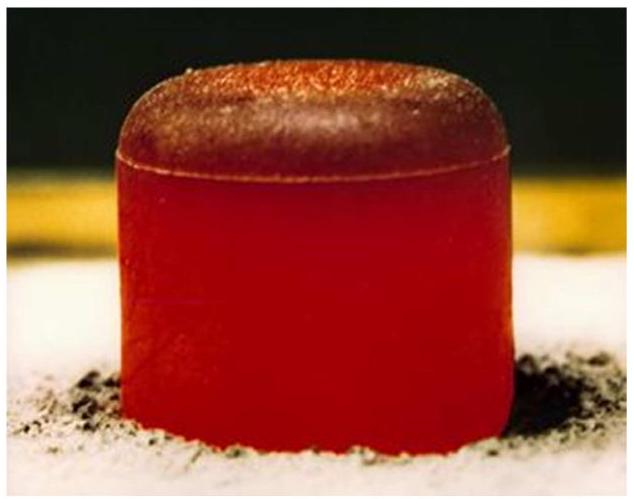
The following information has been sourced from the internet, and one can find a picture of the pellet, which is described as the size of a marshmallow. Use the following information to calculate the volume of such a pellet.
DATA: Efficiency of conversion of thermal power to electrical 8%; Energy released in a single alpha decay 5.5 MeV; $1 \mathrm{MeV}=1.6 \times 10^{-13} \mathrm{~J}$; Avogadro's number, $N_{\mathrm{A}}=6.02 \times 10^{23} \mathrm{~mol}^{-1}$; Half-life of ${ }^{238} \mathrm{Pu}$ is 87.4 years; $A_{0}=\frac{0.693 \times N_{0}}{t_{\mathrm{hl}}}$; The plutonium is supplied as a ceramic pellet of $\mathrm{PuO}_{2}$ which has a density of $10 \mathrm{~g} \mathrm{~cm}^{-3}$; The mass number of Pu-238 is 238; The mass number of oxygen (O) is 16; Only 80% of the plutonium atoms are actually radioactive Pu-238.
Calculate the volume of a pellet of Pu-238 generating $\mathbf{5 ~ W}$ of electrical power.
Show worked solution
This problem involves RTGs (Radioisotope Thermoelectric Generators) used in space missions.
Understanding RTGs:RTGs use radioactive decay to generate heat, which is converted to electricity using thermocouples. The Voyager spacecraft famously use these!
Given data:- Electrical power output: $P_{out} = 5$ W
- Efficiency: $\eta = 8\%$
- Alpha particle energy: $5.5$ MeV
- Half-life of Pu-238: $t_{\frac{1}{2}} = 87.4$ years
- Density of PuO$_2$: $\rho = 10 g/cm^3$
- Molar masses: Pu = 238, O = 16
- $80\%$ of plutonium atoms are Pu-238
a) Thermal power needed:
$$P_{thermal} = \frac{P_{electrical}}{\eta} = \frac{5}{0.08} = 62.5 \text{ W}$$
Decays per second needed:Energy per decay: $E_{decay} = 5.5 \times 1.6 \times 10^{-13} = 8.8 \times 10^{-13}$ J
$$\text{Decays/s} = \frac{62.5}{8.8 \times 10^{-13}} = 7.10 \times 10^{13}$$
b) Number of Pu atoms:Half-life in seconds: $t_{\frac{1}{2}} = 87.4 \times 365.25 \times 24 \times 3600 = 2.76 \times 10^9$ s
From $A_0 = \frac{0.693N_0}{t_{\frac{1}{2}}}$:
$$N_0 = \frac{A_0 \times t_{\frac{1}{2}}}{0.693} = \frac{7.10 \times 10^{13} \times 2.76 \times 10^9}{0.693}$$
$$N_0 = 2.83 \times 10^{23} \text{ atoms}$$
c) Volume calculation:Moles of PuO$_2$: $n = \frac{N_\frac{0}{0.8}}{N_A} = \frac{2.83 \times 10^{23}/0.8}{6.02 \times 10^{23}} = 0.587$ mol
Molar mass of PuO$_2$: $M = 238 + 2(16) = 270$ g/mol
Mass: $m = 0.587 \times 270 = 158$ g
Volume: $V = \frac{158}{10} = 15.8 \text{ cm}^3 \approx 16 \text{ cm}^3$
Answer: C ($16 \text{ cm}^3$)