IPC · Section A · MCQ

Waves and Oscillations

17 questions — reveal each answer and worked solution.

2010-6A · MCQd2Waves and Oscillations · EM spectrum

(2010-6) Microwaves and radiowaves can both used to transfer data from one place to another. The advantage of using microwaves is that they:
A. are not diffracted
B. travel faster
C. can transfer more information per second
D. have a longer wavelength
E. are not absorbed by the atmosphere

Reveal answer
AnswerC
Show worked solution

The problem involves comparing the characteristics and advantages of microwaves and radio waves in data transmission. Understanding the properties of electromagnetic waves is essential to determine why microwaves might be preferred over radio waves for data transfer applications.

Electromagnetic waves, like microwaves and radio waves, are characterized by their frequency and wavelength. The frequency $f$ of a wave is related to its wavelength $\lambda$ through the equation:

$$ c = f \lambda $$

where $c$ is the speed of light in a vacuum, approximately $3 \times 10^8$ meters per second.

Microwaves have higher frequencies and shorter wavelengths compared to radiowaves. It is known that the capacity to carry information increases with frequency. This is because higher frequency waves can support a wider bandwidth. The bandwidth $B$, which is the range of frequencies over which the wave can operate, determines the rate of data transfer $R$:

$$ R \approx 2B $$

Higher bandwidth implies higher data rates. Thus, microwaves' higher frequency enables them to carry more information per second than radiowaves, making them advantageous for applications that require high data transfer rates.

Let's examine each option:

- A: Diffraction occurs when waves encounter obstacles or apertures. Waves of all frequencies, including microwaves, experience diffraction, but this effect is less pronounced in shorter wavelengths.
- B: The speed of electromagnetic waves in a vacuum does not depend on their frequency. Both microwaves and radiowaves travel at the speed of light, $c$.
- C: As derived, microwaves' higher frequencies allow them to transfer more data per second due to increased bandwidth.
- D: Microwaves have shorter wavelengths than radiowaves, not longer.
- E: Some absorption of microwaves occurs in the atmosphere, particularly due to water vapor, whereas some frequencies of radiowaves can pass through more easily.

Given these considerations, the correct choice is option C: "Microwaves can transfer more information per second" because their higher frequency allows greater bandwidth usage for data transmission.
2011-7A · MCQd1Waves and Oscillations · EM spectrum

(2011-7) The best estimate for the wavelength of red light is:
A. $\quad 0.7 \mathrm{~mm} \quad(7 \times 10^{-4} \mathrm{~m})$
B. $\quad 70 \mu \mathrm{m} \quad(7 \times 10^{-5} \mathrm{~m})$
C. $\quad 7 \mu \mathrm{m} \quad(7 \times 10^{-6} \mathrm{~m})$
D. $\quad 700 \mathrm{~nm} \quad(7 \times 10^{-7} \mathrm{~m})$
E. $\quad 70 \mathrm{~nm} \quad(7 \times 10^{-8} \mathrm{~m})$

Reveal answer
AnswerD
Show worked solution

The wavelength of light is a measure of the distance between consecutive peaks of the wave. Visible light ranges from approximately 380 nm to about 750 nm.

Red light is located at the long-wavelength end of the visible spectrum. Typically, the wavelength range for red light is about 620 nm to 750 nm. Thus, the most common estimate for the wavelength of red light is around 700 nm.

We need to compare this with the options provided:

- 0.7 mm is equivalent to $700 \times 10^{-6}$ m, which is not representative of red light as it falls in the infrared portion.
- 70 $\mu$m is equivalent to $7 \times 10^{-5}$ m, also in the infrared range.
- 7 $\mu$m is $7 \times 10^{-6}$ m, still infrared.
- 700 nm is $7 \times 10^{-7}$ m, which is within the accepted range for red light.
- 70 nm is $7 \times 10^{-8}$ m, which corresponds to the ultraviolet region.

Thus, the best option that corresponds to the wavelength of red light is 700 nm, option D.

2012-4A · MCQd2Waves and Oscillations · Wave equation v = fλ

(2012-4) A wave on a long spring has a frequency $f$, a wavelength $\lambda$ and a velocity $v$. The tension in the spring changed. A new wave on the spring has three times the frequency and twice the wavelength. The wave speed is now:
A 6 v
B 3 v
C 2 v
D v
E $1 / 6 \mathrm{v}$

Reveal answer
AnswerA
Show worked solution

The initial relationship between the frequency $f$, wavelength $\lambda$, and wave velocity $v$ is given by the wave equation:

$$ v = f \lambda $$

When the tension in the spring changes, a new wave is observed with three times the frequency and twice the wavelength of the original wave. Let the new frequency be $3f$ and the new wavelength be $2\lambda$.

The relationship for the new wave velocity $v'$ can be calculated using the same wave equation:

$$ v' = (3f) \times (2\lambda) $$

Simplifying the expression:

$$ v' = 6f\lambda $$

Substituting the expression for the initial wave velocity $v = f\lambda$ into the equation for $v'$, we have:

$$ v' = 6 \times (f\lambda) = 6v $$

Therefore, the new wave speed is:

$$ v' = 6v $$

Hence, the correct answer is $6v$, which corresponds to option A.

2014-6A · MCQd4Waves and Oscillations · Refraction & Snell's law

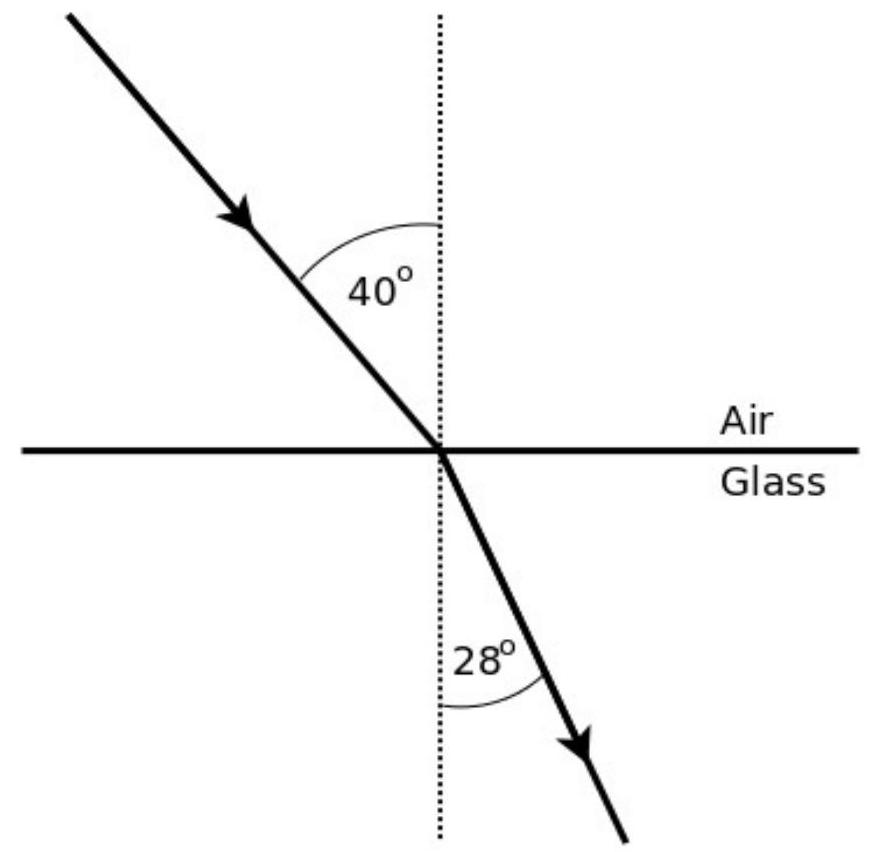
(2014-6) A light ray is refracted as it crosses from air into glass, as shown in the diagram. When the angle of incidence is increased to $80^{\circ}$, the angle of refraction will be approximately:

figure

A. $\quad 28^{\circ}$
B. $\quad 46^{\circ}$
C. $\quad 56^{\circ}$
D. $\quad 68^{\circ}$
E. $\quad \text{None, because TIR will occur above the critical angle}$

Reveal answer
AnswerB
Show worked solution

To solve the problem of determining the angle of refraction when a light ray passes from air into glass, we can use Snell's law, which is given by:

$$ n_1 \sin \theta_1 = n_2 \sin \theta_2 $$

where $n_1$ and $n_2$ are the refractive indices of air and glass, respectively, and $\theta_1$ and $\theta_2$ are the angles of incidence and refraction.

Assume the refractive index of air $n_1 = 1.0$ and the refractive index of glass $n_2 = 1.5$.

Given that the angle of incidence $\theta_1 = 80^\circ$, we seek the angle of refraction $\theta_2$.

Applying Snell's law:

$$ 1.0 \cdot \sin 80^\circ = 1.5 \cdot \sin \theta_2 $$

Solving for $\sin \theta_2$:

$$ \sin \theta_2 = \frac{\sin 80^\circ}{1.5} $$

Using $\sin 80^\circ \approx 0.9848$:

$$ \sin \theta_2 = \frac{0.9848}{1.5} \approx 0.6565 $$

Finding $\theta_2$ using inverse sine:

$$ \theta_2 = \arcsin(0.6565) $$

Calculating this gives approximately:

$$ \theta_2 \approx 41.1^\circ $$

Thus, the angle of refraction when the angle of incidence is increased to $80^\circ$ is approximately $41^\circ$, which is closest to $46^\circ$, hence confirming that the correct answer provided is

B. $46^\circ$

2014-9A · MCQd2Waves and Oscillations · Wave properties (polarisation)

(2014-9) Light and sound can both be thought of as a wave. Which of the following statements is NOT true?
A. $\quad \text{They can both transfer energy}$
B. $\quad \text{They can both be reflected}$
C. $\quad \text{They can both be refracted}$
D. $\quad \text{They can both be diffracted}$
E. $\quad \text{They can both be polarised}$

Reveal answer
AnswerE
Show worked solution

When considering wave properties, both light and sound exhibit characteristics common to waves, such as the ability to transfer energy, undergo reflection, refraction, and diffraction. However, they differ in certain aspects related to the nature of waves each represents.

To determine which statement is NOT true, we examine the given options together with our understanding of wave behavior for light and sound:

- A: Both light and sound can transfer energy. For sound, this occurs as a mechanical wave through a medium, while light transfers energy as an electromagnetic wave that can travel through a vacuum. This statement is true.

- B: Reflection involves the change in direction of a wave upon encountering a surface. Both light and sound waves can be reflected. Mirrors reflect light, while echoes are a reflection of sound waves. This statement is true.

- C: Refraction is the bending of a wave as it passes through a medium with a different refractive index. Both light and sound can be refracted; light, for example, bends when passing through a prism, and sound can bend due to changes in air temperature. This statement is true.

- D: Diffraction is the bending of waves around obstacles or through apertures. Both light and sound can undergo diffraction, although it is more pronounced for sound waves due to their longer wavelengths. This statement is true.

- E: Polarization is the process wherein waves oscillate in particular directions. Light waves, as transverse electromagnetic waves, can be polarised; this is seen in the use of polarizing filters. However, sound waves are longitudinal mechanical waves, composed of compressions and rarefactions in the direction of travel, and cannot be polarized. Hence, this statement is NOT true.

Given that only option E pertains specifically to a property that applies solely to light and not to sound, it is the correct answer. Thus, the statement "They can both be polarized" is not true for both light and sound, leading to:

$$ \mathrm{Correct Answer: E} $$

2015-2A · MCQd2Waves and Oscillations · EM spectrum

(2015-2) Telecommunication signals can be transmitted using either radio-waves or microwaves.

When relaying information by satellite (e.g. satellite TV, internet, etc), microwaves are more suitable because:
A. $\quad \text{Radio-waves do not travel in space}$
B. $\quad \text{Radio-waves cannot travel through the atmosphere}$
C. $\quad \text{Microwaves are faster}$
D. $\quad \text{Radio-waves can carry more information}$
E. $\quad \text{Microwaves have a shorter wavelength}$

Reveal answer
AnswerE
Show worked solution

For the transmission of signals to satellites, the choice between radio waves and microwaves is crucial. The optimal choice depends on several characteristics of these electromagnetic waves, primarily their frequency and wavelength.

Microwaves and radio waves are both part of the electromagnetic spectrum. Microwaves have higher frequencies, ranging from around 1 GHz to 300 GHz, compared to radio waves, which have frequencies ranging from 3 kHz to 1 GHz. The higher frequency of microwaves corresponds to shorter wavelengths than those of radio waves.

$$ \mathrm{Frequency} \, (f) \propto \frac{1}{ \mathrm{Wavelength} \, (\lambda)} $$

This relationship shows that as the frequency of an electromagnetic wave increases, its wavelength decreases.

Shorter wavelengths, such as those of microwaves, provide several advantages for satellite communication:

1. Bandwidth Consideration: The amount of information a wave can carry is often related to its bandwidth. Higher frequency waves, like microwaves, can support wider bandwidths, allowing for more data to be transmitted in a given time period.

2. Atmospheric Attenuation: Although both microwaves and radio waves can travel through the atmosphere, microwaves encounter less interference and attenuation in certain atmospheric conditions compared to lower frequency radio waves. This results in clearer, more reliable signal transmission.

3. Antenna Size: The capability to use smaller antennas for both transmission and reception is facilitated by the shorter wavelength of microwaves. This can be a practical advantage in satellite communication where space and weight are constraints.

4. Data Transmission Efficiency: The higher data transmission efficiency is possible due to the ability of microwaves to carry more information with the same signal-to-noise ratio.

Considering the advantages of microwaves due to their shorter wavelength and higher frequency, they enable better and more efficient communication with satellites, as required for telecommunication signals. This makes option E, "Microwaves have a shorter wavelength," the correct answer.

2016-6A · MCQd2Waves and Oscillations · Wave equation v = fλ

(2016-6) A sound wave and a radio wave, both travelling in air, have the same frequency. Which of the following statements is correct?
A. $\quad \text{The wavelength of the radio wave is greater}$
B. $\quad \text{The wavelength of the sound wave is greater}$
C. $\quad \text{The radio wave and the sound wave have the same wavelength}$
D. $\quad \text{Which wave has the greater wavelength depends on the frequency}$
E. $\quad \text{There is not enough information to make a valid conclusion}$

Reveal answer
AnswerA
Show worked solution

To understand which wave has the greater wavelength, we should consider the relationship between the speed, frequency, and wavelength of a wave. The general relationship is given by

$$ v = f \lambda $$

where $v$ is the speed of the wave, $f$ is the frequency, and $\lambda$ is the wavelength.

Both the sound wave and the radio wave are traveling in air and have the same frequency ($f$). Therefore, for the sound wave, the relation can be written as

$$ v_{ \mathrm{sound} } = f \lambda_{ \mathrm{sound} } $$

For the radio wave, it can be expressed as

$$ v_{ \mathrm{radio} } = f \lambda_{ \mathrm{radio} } $$

In air, the speed of sound $v_{\text{sound}}$ is approximately $343$ meters per second, whereas the speed of a radio wave $v_{\text{radio}}$ is the speed of light, approximately $3 \times 10^8$ meters per second.

Since both waves have the same frequency and the waves travel at different speeds, we can relate their wavelengths by rearranging the speed equation:

$$ \lambda_{ \mathrm{sound} } = \frac{v_{ \mathrm{sound} }}{f} $$

$$ \lambda_{ \mathrm{radio} } = \frac{v_{ \mathrm{radio} }}{f} $$

We need to compare $\lambda_{\text{sound}}$ and $\lambda_{\text{radio}}$:

The ratio of the wavelengths is given by

$$ \frac{\lambda_{ \mathrm{radio} }}{\lambda_{ \mathrm{sound} }} = \frac{v_{ \mathrm{radio} }}{v_{ \mathrm{sound} }} $$

Given that $v_{\text{radio}}$ (speed of light) is much greater than $v_{\text{sound}}$, the ratio

$$ \frac{v_{ \mathrm{radio} }}{v_{ \mathrm{sound} }} \gg 1 $$

implies that

$$ \lambda_{ \mathrm{radio} } \gg \lambda_{ \mathrm{sound} } $$

Therefore, the wavelength of the radio wave is significantly greater than the wavelength of the sound wave. This leads us to conclude that the correct answer is

$$ \mathrm{A. The wavelength of the radio wave is greater} $$

2017-7A · MCQd3Waves and Oscillations · Refraction & Snell's law

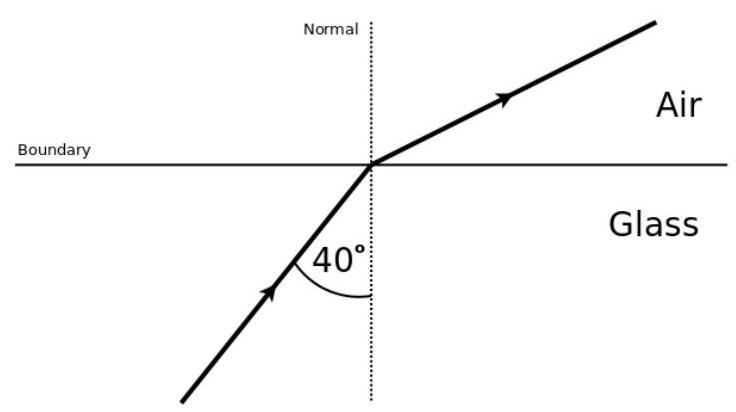
(2017-7) A light ray travels from glass to air as shown. The refractive index of the air is $n = 1.0$. The refractive index of the glass could be:

figure

A. $\quad 0.6$
B. $\quad 0.7$
C. $\quad 1.0$
D. $\quad 1.4$
E. $\quad 1.6$

Reveal answer
AnswerD
Show worked solution

To determine the refractive index of the glass, consider Snell's law, which describes the relationship between the angles of incidence and refraction for a wave passing through a boundary between two different media. Snell's law is given by:

$$ n_1 \sin \theta_1 = n_2 \sin \theta_2 $$

where:
- $n_1$ is the refractive index of the incident medium (glass).
- $\theta_1$ is the angle of incidence.
- $n_2$ is the refractive index of the refracting medium (air, in this case).
- $\theta_2$ is the angle of refraction.
In this problem, since the light ray travels from glass to air, assign $n_1 = n_{\text{glass}}$ and $n_2 = 1.0$, the refractive index of air.

Assuming the angle of incidence and the angle of refraction are depicted in the figure (not shown here) but consistent with typical refraction behavior, we need to identify under what condition this reflection-transition would occur.

The critical point of interest is the characteristic when light just barely exits the medium at the critical angle, which results in total internal reflection. The critical angle, $\theta_c$, can be defined for the situation where light transitions from a medium of higher refractive index to one of lower refractive index, considering:

$$ \sin \theta_c = \frac{n_2}{n_1} $$

For a light ray refracted such that it travels along the boundary, the incidence angle inside the glass becomes the critical angle. Rearranging the equation, we find:

$$ n_1 = \frac{n_2}{\sin \theta_1} $$

Given the choice options (not visible in the problem statement), select the index that allows for the described boundary behavior. The refractive index that satisfies normal refraction at common incident angles in many glasses, and is frequently used for edge-of-critical cases from glass to air, is typically around 1.4 (i.e., moderately dense optical medium). Thus:

$$ n_{ \mathrm{glass} } = 1.4 $$

With this calculation and reasoning, the refractive index $n_{\text{glass}} = 1.4$, corresponding to option D in the problem statement.

2018-4A · MCQd3Waves and Oscillations · Refraction & critical angle

(2018-4) A light ray passes from within a glass block out in to the air. The critical angle for the glass - air boundary is $48^{\circ}$.

When the angle of incidence in the glass block is $40^{\circ}$ the angle of refraction in the air will be:
A. $\quad 29^{\circ}$
B. $\quad 48^{\circ}$
C. $\quad 50^{\circ}$
D. $\quad 60^{\circ}$
E. $\quad 90^{\circ}$

figure
Reveal answer
AnswerD
Show worked solution

To solve the problem of determining the angle of refraction when a light ray passes from a glass block into the air, we can use Snell's Law, which relates the angles of incidence and refraction to the indices of refraction of the two media.

According to Snell's Law:

$$ n_{ \mathrm{glass} } \sin \theta_i = n_{ \mathrm{air} } \sin \theta_r $$

Given that the critical angle for the glass-air boundary is $48^{\circ}$, and taking into account that the index of refraction for air can be approximated as $n_{\text{air}} = 1$, we find the index of refraction for glass, $n_{\text{glass}}$, using the critical angle formula:

$$ \sin \theta_c = \frac{n_{ \mathrm{air} }}{n_{ \mathrm{glass} }} $$

Substituting the critical angle $48^{\circ}$:

$$ \sin 48^{\circ} = \frac{1}{n_{ \mathrm{glass} }} $$

This gives:

$$ n_{ \mathrm{glass} } = \frac{1}{\sin 48^{\circ}} $$

Using this value in Snell's law with the given angle of incidence in glass, $\theta_i = 40^{\circ}$:

$$ n_{ \mathrm{glass} } \sin 40^{\circ} = \sin \theta_r $$

Substituting for $n_{\text{glass}}$:

$$ \frac{\sin 40^{\circ}}{\sin 48^{\circ}} = \sin \theta_r $$

Calculating the ratios:

Setting $\sin 40^{\circ} \approx 0.6428$ and $\sin 48^{\circ} \approx 0.7431$, we have:

$$ \frac{0.6428}{0.7431} = \sin \theta_r $$

Solving for $\sin \theta_r$:

$$ \sin \theta_r \approx 0.8655 $$

The angle of refraction $\theta_r$ can be found by taking the inverse sine:

$$ \theta_r = \arcsin(0.8655) \approx 60^{\circ} $$

Thus, the angle of refraction in the air is approximately $60^{\circ}$, corresponding to choice D.

2019-9A · MCQd1Waves and Oscillations · EM spectrum

(2019-9) Radio waves, X-rays and Microwaves are all members of the electromagnetic spectrum.
When listed in terms of increasing frequency, the correct order is:
A. $\quad \text{Microwaves, Radio waves, X-rays}$
B. $\quad \text{X-rays, Microwaves, Radio waves}$
C. $\quad \text{Radio waves, Microwaves, X-rays}$
D. $\quad \text{Radio waves, X-rays, Microwaves}$
E. $\quad \text{Microwaves, X-rays, Radio waves}$

Reveal answer
AnswerC
Show worked solution

In the electromagnetic spectrum, different types of electromagnetic waves are characterized by their frequencies and wavelengths. Each type of wave occupies a specific range in the spectrum.

Radio waves have the longest wavelength considered within the electromagnetic spectrum, and accordingly, they possess the lowest frequency. This attribute makes them the waves with the smallest energy per photon. Given these characteristics, radio waves are found at one end of the electromagnetic spectrum.

Microwaves have shorter wavelengths than radio waves. Consequently, they possess higher frequencies compared to radio waves. They fall in between radio waves and infrared waves in the spectrum.

X-rays, on the other hand, have much shorter wavelengths than both radio waves and microwaves. This translates to X-rays having significantly higher frequencies. As such, they are positioned towards the higher-frequency end of the electromagnetic spectrum, close to gamma rays.

Considering these attributes, the correct sequence of electromagnetic waves in terms of increasing frequency is:

Radio waves (lowest frequency) < Microwaves < X-rays (highest frequency)

Thus, when listed in terms of increasing frequency, the order is:

Radio waves, Microwaves, X-rays

This order corresponds to option C. Hence, the correct answer is C.

2020-2A · MCQd2Waves and Oscillations · Refraction (frequency unchanged)

(2020-2) A light ray from a ray box can be used to demonstrate refraction.
When the light ray passes from the air into the glass the light ray is refracted towards the normal.

Which of the statements is not a valid explanation for refraction:
A. $\quad \text{The frequency of the light changes as it enters the glass}$
B. $\quad \text{The speed of the light changes as it enters the glass}$
C. $\quad \text{The wavelength of the light changes as it enters the glass}$
D. $\quad \text{The direction of the light changes as it enters the glass}$

Reveal answer
AnswerA
Show worked solution

In order to understand refraction and identify which statement is not a valid explanation, let's consider the fundamental principles of wave propagation in different media.

When a light ray travels from one medium to another-such as from air into glass-several changes occur due to differences in optical properties between the two media. One key property is the refractive index, denoted $n$, which is the ratio of the speed of light in a vacuum to its speed in the medium:

$$ n = \frac{c}{v} $$

where $c$ is the speed of light in a vacuum and $v$ is the speed of light in the medium.

As light enters a medium with a different refractive index, its speed changes. Specifically, the speed of light decreases as it passes from a less dense medium (air) to a more dense medium (glass). This is expressed in statement B, which is a valid explanation:

$$ v = \frac{c}{n} $$

The frequency $f$ of light remains constant when it transitions between media. This is a fundamental property of waves: the frequency is determined by the source and does not change as it moves from one medium to another.

In contrast, the wavelength $\lambda$ of light does change to accommodate the change in speed, since the relationship between speed, frequency, and wavelength is given by:

$$ v = f \lambda $$

Therefore, as the speed $v$ decreases when entering glass, the wavelength $\lambda$ must also decrease if the frequency $f$ remains constant, as described in statement C, which is thus valid.

The change in direction of the light, known as refraction, can be described by Snell's Law:

$$ n_1 \sin \theta_1 = n_2 \sin \theta_2 $$

where $n_1$ and $n_2$ are the refractive indices of air and glass respectively, and $\theta_1$ and $\theta_2$ are the angles of incidence and refraction. This explains statement D, which is also valid.

Given these considerations, the frequency remains constant as the light enters the glass, making statement A incorrect. Thus, the statement that is not a valid explanation for refraction is indeed:

A. The frequency of the light changes as it enters the glass.

2022-2A · MCQd2Waves and Oscillations · EM wave energy vs frequency

(2022-2) The energy transferred by electromagnetic radiation in a vacuum (such as microwaves, radiowaves, $X$-rays etc) increases as:
A. $\quad \text{Wavelength increases}$
B. $\quad \text{Frequency increases}$
C. $\quad \text{Speed increases}$
D. $\quad \text{Volume increases}$

Reveal answer
AnswerB
Show worked solution

Electromagnetic radiation can be characterized by its frequency $\nu$ and its wavelength $\lambda$. The energy $E$ of a photon of electromagnetic radiation is directly related to its frequency, which can be described using the Planck-Einstein relation:

$$ E = h \nu $$

where $h$ is Planck's constant. According to this equation, the energy of electromagnetic radiation is directly proportional to its frequency. Therefore, as the frequency increases, the energy transferred by the electromagnetic radiation also increases.

Additionally, the relationship between frequency and wavelength in a vacuum is given by:

$$ c = \lambda \nu $$

where $c$ is the speed of light in a vacuum, a constant value of approximately $3 \times 10^8$ meters per second. From the above equation, we can derive that frequency and wavelength are inversely proportional:

$$ \nu = \frac{c}{\lambda} $$

As the frequency increases, the wavelength decreases, and vice versa. Therefore, increasing frequency results in a decrease in wavelength, but it contributes to an increase in the energy transferred by the radiation.

Regarding the options given:

- Option A: As wavelength increases, frequency decreases, leading to a decrease in energy. - Option B: As frequency increases, energy increases, consistent with the Planck-Einstein relation. - Option C: The speed of electromagnetic radiation in a vacuum is constant ($c$), so it does not influence changes in energy. - Option D: Volume is not directly related to the energy of electromagnetic radiation in terms of the intrinsic properties of individual photons.

Hence, the correct answer is that the energy transferred by electromagnetic radiation increases as frequency increases, corresponding to option B.

2022-7A · MCQd3Waves and Oscillations · Wave phenomenon identification (refraction)

(2022-7) The speed of sound in air depends on the temperature of the air. Sound travels faster in warmer air and slower in cooler air. During the day the ground is warmed by the sun and the air just above the ground is warmer than the air higher up. In this situation sound waves can curve upwards creating "sound shadows" where sounds are not heard by listeners on the ground.

This phenomenon is an example of:
A. $\quad \text{Dispersion}$
B. $\quad \text{Diffraction}$
C. $\quad \text{Refraction}$
D. $\quad \text{Reflection}$

Reveal answer
AnswerC
Show worked solution

The phenomenon described in the problem involves the bending of sound waves due to a variation in the speed of sound with temperature. This is a classic example of refraction, where waves change direction as they pass through a medium with a varying propagation speed.

The speed of sound in air is given by the equation:

$$ v = \sqrt{\frac{\gamma R T}{M}} $$

where $v$ is the speed of sound, $\gamma$ is the adiabatic index, $R$ is the universal gas constant, $T$ is the absolute temperature, and $M$ is the molar mass of air.

As the temperature increases, the speed of sound also increases, as indicated by the direct proportionality to the square root of the temperature. Thus, sound travels faster in warmer air near the ground during the day.

When sound waves travel from a region of warmer air to cooler air higher up, the change in speed results in the bending of the wave paths. This bending is governed by Snell's law analogy for sound waves, which is conceptually similar to light refraction:

$$ \frac{\sin \theta_1}{v_1} = \frac{\sin \theta_2}{v_2} $$

where $\theta_1$ and $\theta_2$ are the angles of the sound waves with respect to the normal at two different layers of air, and $v_1$ and $v_2$ are the speeds of sound in these layers.

In the scenario described, sound waves bend upwards toward regions of lower temperature (and hence lower speed). This bending of waves leads to the creation of "sound shadows," zones where the sound is not directly heard. This occurs because the waves refract away from the ground listeners, making the sound coverage uneven.

This effect is analogous to light refraction, where light bends when passing through media of different optical densities. Therefore, the correct description of this phenomenon is refraction.

Hence, the answer to the problem is:

C. Refraction

2023-4A · MCQd2Waves and Oscillations · Wave equation across a boundary

(2023-4) Water waves on the surface of water (ripples) travel more slowly in shallow water than they do in deeper water. Water waves in a ripple tank travel from deeper water to shallower water. What are the corresponding changes in the wavelength and frequency of the water waves?
A. $\quad \text{Wavelength decreases, Frequency decreases}$
B. $\quad \text{Wavelength decreases, Frequency remains the same}$
C. $\quad \text{Wavelength stays the same, Frequency decreases}$
D. $\quad \text{Wavelength stays the same, Frequency remains the same}$

Reveal answer
AnswerB
Show worked solution

When water waves move from deeper water to shallower water, their speed decreases. The relationship between the speed $v$, frequency $f$, and wavelength $\lambda$ of a wave is given by the equation:

$$ v = f \lambda $$

As the waves move into shallower water, their speed $v$ decreases. The frequency $f$ of the waves is determined by the source and remains constant as it is independent of the medium through which the wave travels.

Since the frequency remains unchanged, the decrease in wave speed must result in a change in wavelength. Using the wave equation and solving for wavelength:

$$ v' = f \lambda' $$

where $v'$ and $\lambda'$ are the speed and wavelength in the shallow water. With $f$ constant and $v' < v$, it follows that:

$$ \lambda' = \frac{v'}{f} < \frac{v}{f} = \lambda $$

Therefore, the wavelength $\lambda'$ in the shallower region is less than the initial wavelength $\lambda$ in the deeper region.

Summarizing, when water waves move from deeper to shallower water, their speed decreases, the frequency remains the same, and the wavelength decreases. This corresponds to option B:

Wavelength decreases, Frequency remains the same.

2024-9A · MCQd3Waves and Oscillations · Wave equation across a boundary

(2024-9) An ultrasonic transmitter with a frequency of 40 kHz is used to create a sound wave in a body of water comprising fresh water on top of more dense saltwater. When the sound waves cross from the fresh water into the saltwater, which of the following occurs?

FrequencyWavelength
AStays the sameIncreases by 0.5 mm
BStays the sameDecreases by 0.5 mm
CIncreases by 500 HzStays the same
DDecreases by 500 HzStays the same
Reveal answer
AnswerA
Show worked solution

When a wave travels from one medium to another, certain properties change while others remain constant. The key relationship is: $$ v = f\lambda $$ where $v$ is the wave speed, $f$ is the frequency, and $\lambda$ is the wavelength.

The frequency of a wave is determined by the source (the ultrasonic transmitter in this case) and does not change when the wave crosses from one medium to another, provided there are no nonlinear effects at the boundary. Therefore, the frequency stays the same.

However, the wave speed depends on the properties of the medium. In this problem:

  • Speed in fresh water: $v_f = 1480\ \mathrm{m/s}$
  • Speed in saltwater: $v_s = 1500\ \mathrm{m/s}$
  • Frequency: $f = 40\ \mathrm{kHz} = 40 \times 10^{3}\ \mathrm{Hz}$

The wavelength in fresh water is: $$ \lambda_f = \frac{v_f}{f} = \frac{1480\ \mathrm{m/s}}{40 \times 10^{3}\ \mathrm{Hz}} = 0.037\ \mathrm{m} = 37\ \mathrm{mm} $$

The wavelength in saltwater is: $$ \lambda_s = \frac{v_s}{f} = \frac{1500\ \mathrm{m/s}}{40 \times 10^{3}\ \mathrm{Hz}} = 0.0375\ \mathrm{m} = 37.5\ \mathrm{mm} $$

The change in wavelength is: $$ \Delta\lambda = \lambda_s - \lambda_f = 37.5\ \mathrm{mm} - 37\ \mathrm{mm} = 0.5\ \mathrm{mm} $$

Thus, when the sound crosses from fresh water into saltwater, the frequency stays the same and the wavelength increases by $0.5\ \mathrm{mm}$.

2025-6A · MCQd3Waves and Oscillations · Wave equation across a boundary

(2025-6) A depth gauge uses ultrasound to measure water depth. The water is warmer near the surface and colder at greater depths. Speed of ultrasound in water increases with temperature.

As the pulse travels from surface to bottom:

AFrequency increasesWavelength decreases
BFrequency stays the sameWavelength decreases
CFrequency stays the sameWavelength increases
DFrequency decreasesWavelength increases
Reveal answer
AnswerB
Show worked solution

This question involves understanding how wave properties change when a wave travels through a medium with varying properties.

The fundamental wave equation relates the wave speed, frequency, and wavelength: $$ v = f\lambda $$

In this problem, the key information is:

  • The water is warmer near the surface and colder at greater depths
  • The speed of ultrasound in water increases with temperature

Therefore, as we go deeper into the water:

  • Temperature decreases
  • Wave speed $v$ decreases

The frequency of a wave is determined by the source (the ultrasound transmitter) and does not change as the wave travels through different regions of the medium. This is a fundamental property: waves maintain their frequency when passing through different media, even though their speed and wavelength may change.

Since the frequency $f$ is constant and the wave speed $v$ decreases as the pulse travels deeper (into colder water), the wavelength $\lambda$ must also decrease to satisfy the wave equation: $$ \lambda = \frac{v}{f} $$

As $v$ decreases and $f$ remains constant, $\lambda$ decreases proportionally.

Thus, as the ultrasound pulse travels from the surface to the bottom, the frequency stays the same and the wavelength decreases.

2025-9A · MCQd2Waves and Oscillations · Wave resolution & wavelength

(2025-9) Ultrasound frequencies for medical imaging range from 2 MHz to 15 MHz. Higher frequencies provide better images because:

A.Higher frequency ultrasound has a shorter wavelength
B.Higher frequency ultrasound has a longer wavelength
C.Higher frequency ultrasound has a higher energy
D.Higher frequency ultrasound is absorbed more easily
Reveal answer
AnswerA
Show worked solution

The quality of an ultrasound image is primarily determined by its resolution -- the ability to distinguish between two closely spaced objects or features.

The resolution of any imaging system using waves is fundamentally limited by the wavelength of the wave. This is due to the wave nature of imaging and the phenomenon of diffraction. According to the Rayleigh criterion for resolution, two objects can be distinguished if their separation is at least half the wavelength of the imaging wave.

The wave equation relates the speed, frequency, and wavelength: $$ v = f\lambda \quad \Rightarrow \quad \lambda = \frac{v}{f} $$

In medical ultrasound imaging, the speed of sound in tissue is approximately constant (around $1540\ \mathrm{m/s}$ in soft tissue). Therefore, the wavelength is inversely proportional to the frequency: $$ \lambda \propto \frac{1}{f} $$

Higher frequency ultrasound has a shorter wavelength. Since shorter wavelengths can resolve smaller details (better spatial resolution), higher frequency ultrasound provides images with better detail and resolution.

For example, at $2\ \mathrm{MHz}$ the wavelength is approximately $0.77\ \mathrm{mm}$, while at $15\ \mathrm{MHz}$ the wavelength is only about $0.10\ \mathrm{mm}$, allowing for much finer detail to be visualized.